Archive for the ‘DUGABO’ Category
ultimate blackness
It’s Al Capone, Betty White, and Andy Kaufman’s birthday.

– photo by Mitch Waxman
Over in LIC’s Blissville neighborhood, you’ll find the principal burying grounds of the Roman Catholic Church in 19th and early 20th century NYC, called First Calvary Cemetery. It’s called “First” Calvary, as there are three other properties found to the east in Woodside that the church refers to as “Second,” “Third,” and “Fourth.” First, or Old, Calvary has been in use since 1848. Calvary Cemetery is on a hill overlooking the Newtown Creek and is surrounded by the industrial zones of Long Island City and West Maspeth.
The majority of burials in First Calvary occurred between its founding and the Second World War, which means that the monuments found within its fence lines have endured the effects of the endemic atmospheric pollution typical of industrial America prior to the passing of the 1972 Federal Clean Air Act. Acid rain wasn’t a term used prior to that legislation.

– photo by Mitch Waxman
Granite seems to be the best choice for a monument able to weather the atmospherics hereabouts.
Marble rots away, obscuring the legend, iconography, and screed carven into the memorial stones. If you were to run your fingers across the surface of the stone pictured above, a sandy grit would transfer from it to your skin. To be fair, though, there used to be an acid factory right across the street from Calvary Cemetery.
That factory was opened in 1866, and was first known as “General Chemical,” then as “Nichols Chemical,” and then as “Phelps Dodge.” Phelps Dodge, of course, is one of the named “potentially responsible parties” or “PRP’s” in the ongoing Federal Superfund situation on Newtown Creek being investigated by the Environmental Protection Agency.

– photo by Mitch Waxman
Phelps Dodge vacated its property long ago. Back in 1901, when the corporate entity was still called the Nichols Chemical Company, community complaints and a law suit by the cemetery forced them to build what was – at the time – the largest chimney in the United States to release their acidic waste gases high above the ground. It was supported by wooden piles driven into the landfilled Newtown Creek marshlands their factory was built on. These piles supported a 25 foot deep concrete foundation, which in turn provided a stable enough base for a 22,000 ton, 367 feet tall chimney.
Roughly translating that to modern day “building stories,” this was a 36-37 story tall chimney.

– photo by Mitch Waxman
For comparison, the sapphire megalith of Long Island City is 53 stories in height, but three of those stories are below the ground. The Nichols/Phelps complex employed close to 1,500 people back in 1901. The acid factory was merely part of their production line, and the high grade sulfuric acid they were known for as a mere co-product for their true profit center.
The main focus of their business was the refining of copper. The company was producing some 517,000 tons of the stuff, annually, back in 1901 when that chimney went up. Most of the landfill that the company had used to build out the marshy shoreline of Newtown Creek, and upon which they built their factories, was material harvested from the refining processes – specifically slag from their redoubts and furnaces. The original shoreline of Newtown Creek was anywhere from 500-1,000 feet back from the modern shoreline, more or less where the Long Island Railroad’s Lower Montauk Branch tracks are found today.
“follow” me on Twitter- @newtownpentacle
chemical paraphernalia
Twirling, always twirling, in today’s post.

– photo by Mitch Waxman
Here amongst the blessed rolling hills of that tower of municipal Babel called Astoria, a humble narrator has been noticing a scent familiar in recent weeks. Whenever one approached the street corner along Broadway between Steinway Street and Woodside Avenue, the scent of raw sewage occurred. Now – given the amount of time I’ve spent over the years describing my adventures along the Newtown Creek (and within a few DEP facilities that govern the sewer system) I’m just going to ask you to trust me when I say that I know EXACTLY what raw sewage smells like. As is my habit, whilst hoping and praying that I’m not the only person in the neighborhood who give one single “‘eff” about the place, I waited for a couple of weeks before calling 311, hoping that someone else would do it.
Meh. If you smell something, say something.
Last week, DEP responded within an astounding 90 minutes of my 311 call to report the smell conditions. I didn’t even have to invoke the “powers that be” of Western Queens, this time, for the system to expeditiously take care of it.
As a frequent and public critic of DEP, I felt compelled to congratulate the agency’s management, which I personally offered to Deputy Commissioner Eric Landau whom I ran into during an unrelated meeting in Greenpoint on the same day that the photo above was captured. Well done, DEP.
The truck pictured has a crane like rig installed, which in turn has a claw bucket attached to the end of its line. The fellow driving the truck opened the access (or manhole) cover on the corner and removed a blockage in the pipes beneath the street. He pulled out what seemed like a significant amount of garbage from down below which was loaded into the bin on the back of the truck. Good show, DEP, and the smell of raw sewage is once gain confined to the faraway Newtown Creek, rather than Astoria’s Broadway.

– photo by Mitch Waxman
It being preferable that environmental or existential realities be “somebody else’s problem” is the New York City way, after all. All this crap that we all deal with is ultimately our own common fault, and since we got no one else to blame, that means that we don’t want to discuss it. That’s also the New York City way.
I always tell people that despite the fact that I’m involved with multiple environmentally oriented groups, I’m not an environmentalist, but that I know a few and that they are the “real thing.” They’re earth loving nature hippies, sandal wearing berry eaters, and bicycle riding dreamers who don’t understand the harsh realities of the actual tangible universe which the rest of us live in – but may the burning thermonuclear eye of God itself continue to shine beneficently of them, for despite my chides – they can actually get things done and are building a cleaner and healthier future. I’m not an environmentalist, but how can you not aspire to be one?
They are also the people you can count on to call 311 if and when the poop hits the fan, or when the corner sewer grate is exhaling rather than inhaling as it’s designed to do.

– photo by Mitch Waxman
The unwillingness most of my neighbors evince towards getting involved with, and helping to guide the policies of, our government is something I just don’t understand. Men and women of conscience are everywhere you look in NYC, yet it’s also the NYC way to walk past a burning trash fire and say “somebody else’s problem.” People often ask me “what’s the matter with you, you don’t have enough of your own problems?” in regards to my chiding and constant admonitions regarding “getting involved.” My motivation is selfish, as I may need some help from the cops or whomever, and I believe that if they know me, that help might be a bit more profound in nature. Also, I’m not a fan of sewage smells wafting up out of the century old underground pipes which carry the flow.
Maybe I’m just a cheapskate, and want to know how the third of my household income seized by the government in every paycheck is being spent. Value for money? Expensive boondoggle lining the pockets of political favorites? Don’t you want to know what your money is doing, and how our common investments and properties are being managed? Don’t you want to make sure that De Blasio doesn’t intend to put a homeless shelter on your block?
Why not?
“follow” me on Twitter- @newtownpentacle
suddenly lost
Getting high in Greenpoint, Brooklyn.

– photo by Mitch Waxman
Last week, one of the environmental projects underwritten by GCEF (the Greenpoint Community Environmental Fund) opened to the public at Brooklyn’s 520 Kingsland Avenue, alongside that loathsome exemplar of municipal neglect known as the Newtown Creek. In this case, the project is a green roof installed on top of a movie studio, specifically one of the production facilities owned and operated by the Broadway Stages company which is partially housed in a series of formerly industrial locations around Greenpoint and Long Island City. Broadway Stages has been buying up a LOT of property along the Creek in recent years.
Well, I guess the location is still industrial, it’s just a different kind of industry – entertainment rather than petrochemical. At any rate, 520 Kingsland Avenue is a few stories above the flood plain and whilst up there and on site, I got busy with the camera. You’ve seen this point of view before, incidentally – in a 2016 post where I told you about Brooklyn’s invisible flame back in June.

– photo by Mitch Waxman
Can’t really talk about it quite yet, but let’s just say I’ll be able to take you up there in a couple of weeks on a couple of free tours. I’ll supply the link as soon as it’s public. The green roof at 520 Kingsland was designed with butterflies, of all things, in mind. Saying that it’s a pretty interesting space with neat little walkways weaving through plantings, and there are incredible views of the surrounding industrial zone to check out.
That’s part of Metro Fuel’s truck fleet in the shot above, for the curious.

– photo by Mitch Waxman
The real stunners, amongst the many points of view available from 520 Kingsland Avenue, are the ones in which the shining city of Manhattan provides the backdrop. This sort of urban pornography is possible due to two reasons: one is that the Greenpoint Landing Project is just kicking into gear, so the POV isn’t blocked by forty story residential palaces yet; the other is that the surrounding area is all 19th century landfill which is both low lying and quite flat.
This POV is looking due west from the 520 Kingsland Avenue rooftop, incidentally.

– photo by Mitch Waxman
Northwest POV, gazing across the lugubrious Newtown Creek in the direction of Long Island City’s Hunters Point section.
In the distance, you’ll notice the red and white banded smokestacks of the “Big Allis” power plant at 36th avenue in the Ravenswood section. The Citi building megalith, that sapphire dagger jammed in the heart of the place at Jackson Avenue’s intersection with Thomson Avenue, used to be the only large scale building in the area.
As an aside, a few years ago some group of urban planners/art fucks from Pratt University proposed Big Allis’s red and white stripes to me as a branding element for the western Queens waterfront. I had to inform them how we residents regarded the presence of an enormous power plant operating along our waterfront that serves Manhattan’s needs, and that it wasn’t exactly a popular symbol, locally speaking.

– photo by Mitch Waxman
The singularity of the Citi megalith has, of course, changed. The pace of real estate development in the last few years has been frenetic in LIC, as evinced in the shots above and below. Sometimes, in order to really take it all in, you need to leave Queens entirely – just to gain some perspective.
Funnily enough, this is what I usually say about Manhattan – the best part of “the City” is being outside of it and witnessing the shield wall of buildings from without. An inhuman scale landscape like Manhattan’s can’t be properly observed while you’re within the oppressive shadows of its canyon walls.

– photo by Mitch Waxman
That white truss structure at center of the shot is the Long Island Expressway, which rises over Newtown Creek’s Dutch Kills tributary from its beginnings at the Queens Midtown Tunnel. Dutch Kills intersects with the main body of Newtown Creek about 3/4 of a mile back from the East River, and heads inland for the better part of a mile. The LIE traffic up on that truss bridge is flowing 106 feet over the water. The far right hand side of the shot above shows the construction going on at the intersection of Jackson Avenue and Queens Plaza, on the former West Chemicals Company site. Moving left, the rest of the construction is occurring along Jackson Avenue at Purves, Dutch Kills Street, and so on.
All of it is high end residential, incidentally, except for that squamous curvy faced one directly to the left of the orange one. That’s an office building which the NYC Dept. of Health has based itself in nearby Queens Plaza.

– photo by Mitch Waxman
One of my little adages, which I gleefully relate on my walking tours of the area, is a facet of NYS law – it dictates that if you were about to buy a home which is known to be “haunted by a ghost” by the current owner and or the surrounding community – the haunting needs to be disclosed before closing the sales contract.
If you’re buying a property that used to be a chemical factory, or a copper refinery, or some other heavy industrial pursuit that rendered the site a “brownfield” – you are under no obligation to disclose the environmental history to a buyer, however.
When you meet newer residents of LIC’s Tower Town or Brooklyn’s Greenpoint, and mention a nearby Federal Superfund site defined as “Newtown Creek” – they say “What’s that?”
Upcoming tours and events:
“First Calvary Cemetery” walking tour
with Brooklyn Brainery, Saturday, October 8th from 11:00 a.m. to 1:00 p.m.
Click here for tickets.
“follow” me on Twitter- @newtownpentacle
tangible miasma
The native art form of Queens, in today’s post.

– photo by Mitch Waxman
Long has one postulated that the native art form of Queens is illegal dumping. It is accomplished with a compositional flair and attention to detail that Brooklyn and the Bronx can only dream of. When you spend as much time as I do around the Newtown Creek and the concrete devastations surrounding it, this becomes obvious.

– photo by Mitch Waxman
I was heading over to Greenpoint recently, to accomplish some sort of folderol, when the tableau above was observed in LIC’s Blissville section. This was on Greenpoint Avenue, incidentally.

– photo by Mitch Waxman
The dumped mattresses exhibited the tell tale signs of a bedbug infestation, so I was using my telephoto zoom lens to capture shots of it – not wanting to get closer to the things than I needed to.
Bedbugs… brrr…

– photo by Mitch Waxman
I’m not sure if bedbugs can leap, or jump, or propel themselves through the atmospheric void in some unknown manner which would indicate that they can fly like Superman, but I wasn’t taking any chances.
Bedbugs, or “vantzen” as my grandmother would have called them, are grotesque human predators. Vampire insects. The stains on the mattress covers are actually produced by their fecal matter and are literally digested human blood.

– photo by Mitch Waxman
Grossed out, I propelled myself across the Greenpoint Avenue Bridge which spans the lugubrious Newtown Creek. Whatever ails you, parasite wise, will likely be cured by the therapeutic poisons of the Newtown Creek. If Newtown Creek doesn’t kill you, it will make you stronger… that’s what I tell myself all the time.
Newtown Creek, is there anything you can’t do?
Upcoming tours and events:
“The Untold History of the Newtown Creek (aka Insalubrious Valley)” walking tour
with New York Adventure Club, Saturday, October 1st from 11:00 a.m. to 1:00 p.m.
Click here for tickets.
“First Calvary Cemetery” walking tour
with Brooklyn Brainery, Saturday, October 8th from 11:00 a.m. to 1:00 p.m.
Click here for tickets.
“follow” me on Twitter- @newtownpentacle
unequal heating
Creek Week concludes, in today’s post.
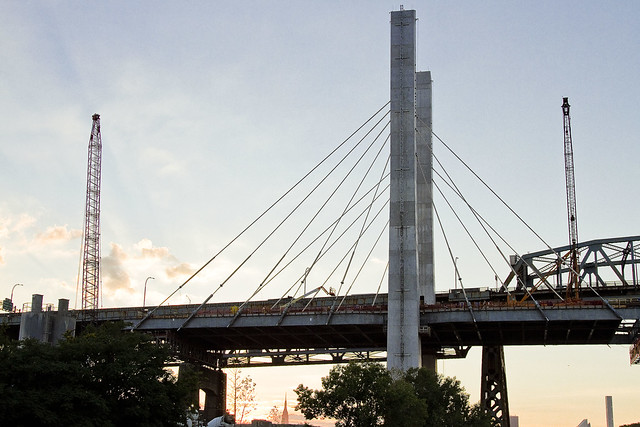
– photo by Mitch Waxman
That’s the Kosciuszcko Bridge replacement project pictured above, with the 1939 Robert Moses model bridge providing a backdrop to the under construction cable stay model. That’s the Brooklyn side, for the curious. This is a $1.2 billion replacement effort, “fast tracked” by Governor Cuomo, which is intended to replace what’s considered to be the most dangerous bridge in New York State – which happens to carry hundreds of thousands of vehicle trips a day as the Brooklyn Queens Expressway runs across its 2.1 mile long structure (along with its approaches).
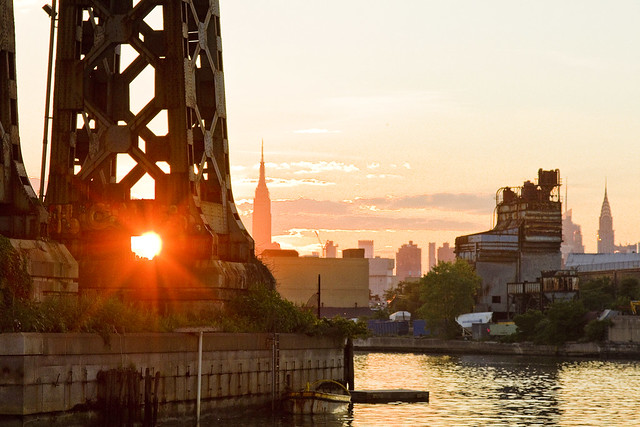
– photo by Mitch Waxman
These shots were captured while onboard a NY Water Taxi hired for the evening by the Open House NY organization, and my colleague T. Willis Elkins and I were onboard to represent Newtown Creek Alliance and narrate to two sold out crowds. The second trip was heading back out from the Newtown Creek towards the East River just as sunset was occurring, and as always – Newtown Creek was and is a visual spectacular.
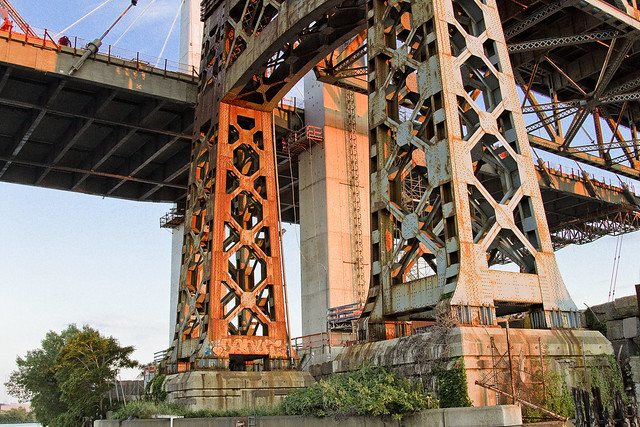
– photo by Mitch Waxman
One has been trying to capture as many angles and shots as possible of the old Kosciuszcko Bridge for a couple of years now, simply because within the next 24-36 months it will have been eradicated from common memory.
This whole “Newtown Creek Historian” business isn’t just about revealing the past, it’s about leaving behind a visual record for those who haven’t been born yet about what the place looked like during its superfund and early 21st century transformational period.
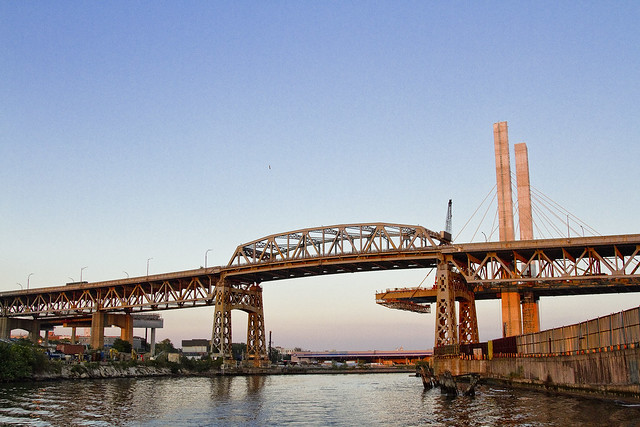
– photo by Mitch Waxman
I’ve mentioned it before, but the plan which the State DOT has put forward is that once the eastern side of the new bridge is complete, they are going to reroute the BQE onto it. Then, they’re going to demolish the 1939 model, and in its footprint, build the western section of the new cable stay bridge. The great news about that is that there is going to be a pedestrian and bicycle path on the western side of the bridge.
One looks forward to walking the camera across, and getting aerial shots from up there.
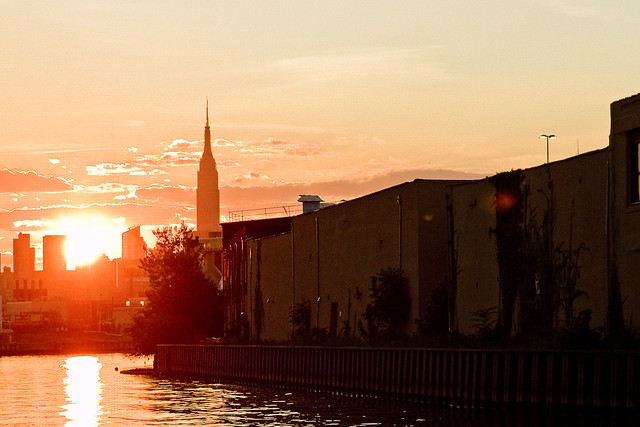
– photo by Mitch Waxman
The burning thermonuclear eye of God itself was setting in the west as our NY Water Taxi navigated back towards the East River. That’s Blissville in Queens on the right hand side of the shot above, and the former location of not just Charles Pratt’s “Queens County Oil Works” but just about the very spot where the first large scale oil refinery in the United States – Abraham Gesner’s “North American Kerosene Gas Light Company” was founded.
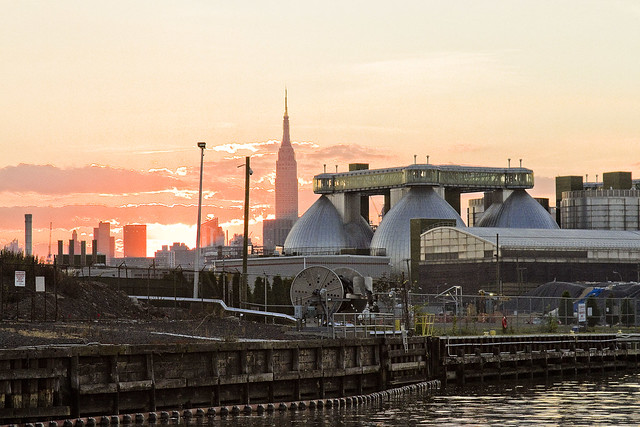
– photo by Mitch Waxman
On the Brooklyn or Greenpoint side of Newtown Creek, the former home of the Standard Oil Company of New York and birthplace of what would be one day known as Mobil Oil is closest to the camera, which are now the ExxonMobil Greenpoint Remediation Project properties at 400 Kingsland Avenue.
Sitting on part of the former oil company properties in Greenpoint is the NYC DEP’s Newtown Creek Wastewater Treatment Plant, largest and newest of NYC’s 14 sewer plants.
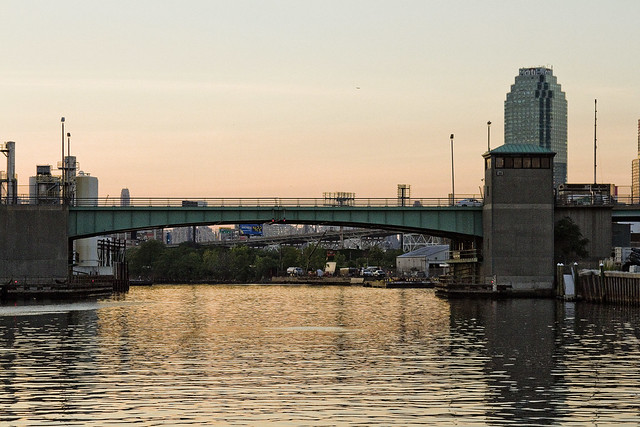
– photo by Mitch Waxman
DUGABO – or Down Under the Greenpoint Avenue Bridge Onramp – is the heart of petroleum country on Newtown Creek. Greenpoint Avenue heads west into Brooklyn, terminating at the East River at Transmitter Park, whereas it continues into Queens and once having crossed Queens Blvd. – it transmogrifies into Roosevelt Avenue and continues all the way out into Flushing.
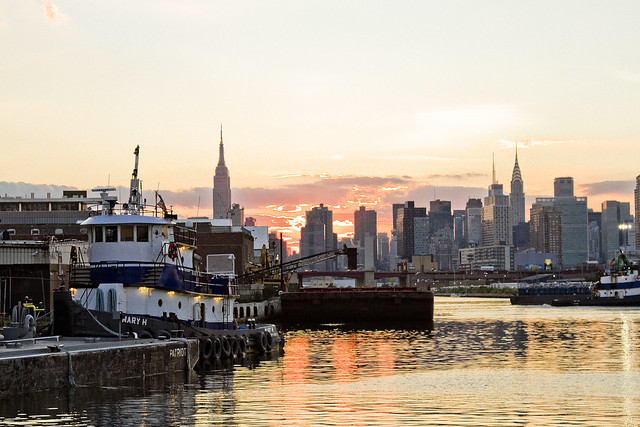
– photo by Mitch Waxman
From a maritime industrial point of view, the DUGABO area surrounding the Greenpoint Avenue Bridge is probably one of the busiest sections of Newtown Creek in the 21st century. SimsMetal and Allocco Recycling host regular tug and barge traffic, as does Metro fuel.
In the distance is the Pualski Bridge and the towers of the Shining City of Manhattan.
Upcoming Events and Tours
Saturday, August 6th, 2:00 p.m. – 4:00 p.m. –
Insalubrious Valley Walking Tour,
with NY Adventure Club. Click here for more details.
Sunday, August 14th, 11:00 p.m. – 1:00 p.m. –
Calvary Cemetery Walking Tour,
with Atlas Obscura. Click here for more details.
Sunday, August 21, 11:00 a.m. – 1:00 p.m. –
Poison Cauldron Walking Tour,
with Atlas Obscura. Click here for more details.
“follow” me on Twitter- @newtownpentacle


 The Newtown Pentacle