Archive for the ‘DUGABO’ Category
central chamber

– photo by Mitch Waxman
Recently, while out on the Newtown Creek on a Newtown Creek Alliance mission, the inestimable Executive Director of the group – Kate Zidar- gestured toward a certain structure on the Queens side and asked me what I knew about it. My mandate in the organization is to act as historian, as well as photographer, and the building in question is known to modernity as the “Lukoil Getty Terminal”. It’s waterfront is categorized by Dock Code 616, a 300 foot frontage, and it sits in plain view of the Greenpoint Avenue Bridge.
To me, it will always be referred to as Tidewater.
from wikipedia
Tidewater Oil Company (also rendered as Tide Water Oil Company) was a major petroleum refining and marketing concern in the United States for more than 80 years. Tidewater was best known for its Flying A–branded products and gas stations, and for Veedol motor oil, which was known throughout the world.
Tidewater was founded in New York City in 1887. The company entered the gasoline market just before World War I, and by 1920 was selling gasoline, oil and other products on the East Coast under its Tydol brand. In 1931, Tidewater expanded its reach into the midwestern U.S. by purchasing Northwestern Oil Company of Superior, Wisconsin.
Soon thereafter, Standard Oil Company of New Jersey (now ExxonMobil) gained control of Tidewater, and set up the subsidiary Mission Corporation to operate it. J. Paul Getty’s purchase of Mission in 1937 set the stage for the birth of Tidewater as a major national player in the oil industry.
In 1938, Getty merged Tidewater with Associated Oil Company, based in San Francisco with a market area limited to the Far West. Associated, founded in 1901, had created the prominent Flying A brand for its premium-grade gasoline in 1932.
With the merger and creation of Tidewater Associated Oil Company, Flying A became the primary brand name for the company, though the Tydol and Associated names were also retained in their respective marketing areas. Tydol During the 1950s, the Associated and Tydol brands gradually fell into disuse, and were dropped entirely in 1956. That same year, “Associated” was removed from the corporate name. The Veedol trademark was retained for motor oils and lubricants. BP acquired the Veedol brand when it bought Burmah-Castrol (who then owned the Veedol brand). In February 2011 announced that they wished to sell the Veedol Brand. Tidewater operated refineries on both the Atlantic and Pacific coasts, as well as a small fleet of West Coast-based tankers.

– photo by Mitch Waxman
In the early years of the American Oil industry, it seems, there were literally hundreds of small players who drilled or refined petroleum. A behemoth which emerged from the crowded field, that would dominate the sector in one way or another to this very day, was John D Rockefeller’s Standard Oil. Standard controlled the means of delivery, whether it be defacto control of the rail lines leading from oil rich regions (which were in Pennsylvania, back then) to refinery, or through ownership of the local pipelines which supplied their refined product to end use customers.
This allowed Standard to fix prices at a certain level, manipulate supply and demand in its own favor, or to keep competitors from getting their goods to market.
from 1919’s “Platts power, Volume 50“. courtesy google books
N.Y., Long Island City – The Tidewater Oil Co., 11 Broadway New York City, awarded the contract for the construction of a 2 story 30 x 140 ft warehouse on Greenpoint Ave and Newtown Creek, to H.D. Best, 949 Broadway, New York City. A steam heating system will be installed in same

– photo by Mitch Waxman
Unfair and underhanded, the Standard Trust went out of its way to destroy or stifle its competition and before long it controlled 90-95% of the oil business in the United States. Competitors came along as the years passed, most of which fell before the attentions of the Rockefellers. Some, like Charles Pratt, sold their operations to Standard and joined with it. Others were driven into bankruptcy. Technological advances and invention offered an opportunity to bypass the rail system dominated by the trust, and the dream of a pipeline which would feed oil to the independent refineries on the Atlantic coast of the United States became feasible.
The company that crystallized this challenge to Standard was the Tidewater Oil Company.
from 1889’s “Stoddart’s Encyclopaedia Americana: a dictionary of arts, sciences, and general literature“, courtesy google books

– photo by Mitch Waxman
For many years, Rockefeller and his Standard men (with their armies of bought and paid for politicians and local officials) ridiculed and fought against the pipeline company, but when his independent competitors banded together under the Tidewater brand in the 1870’s – he knew that Standard must innovate. In one of the first business moves of its kind, Standard began purchasing common stock in Tidewater, and by 1883 controlled a majority share in it.
Rather than using the well honed “breaking” techniques of industrial monopoly on the rival company, Rockefeller simply purchased his competition.
from “Harper’s magazine, Volume 72“, courtesy google books
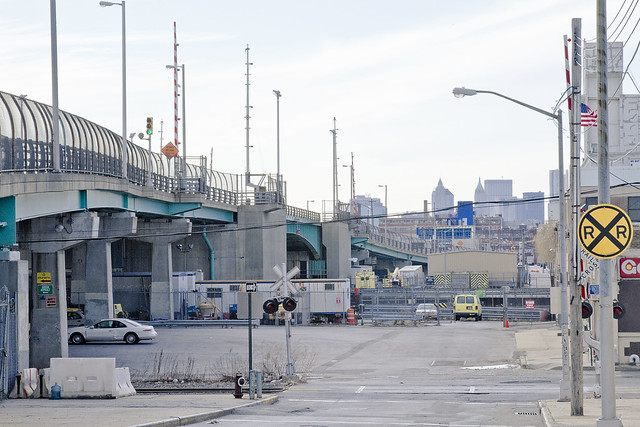
– photo by Mitch Waxman
As an aside, it should be noted that the path Greenpoint Avenue takes, in modernity, as it crosses the Newtown Creek is slightly eastward of its ancient footprint. The modern bridge, which replaced an older swing bridge that carried LIRR and light rail tracks as well as vehicles, actually pulls traffic away from the ancestral road. In the early 20th century LUNA image linked to below, which is the inverse of my recent shot above, notice that only the bridge and rail tracks are still in place.
The Tidewater building would be to the left in the historic shot below.

X

– photo by Mitch Waxman
A recommended primer for anyone interested in the story of the early American Oil industry is “The History of the Standard Oil Company, By Ida Minerva Tarbell“, an admittedly biased and muckraking account told by the daughter of an oil pioneer whose business was wiped out by the Standard Trust. Tarbell disliked the term muckraker, and considering that she was a pioneering female journalist and investigative reporter in an age not exactly known for either- let’s just respect her wishes.
from “The History of the Standard Oil Company, Volume 2 By Ida Minerva Tarbell” courtesy google books

– photo by Mitch Waxman
Like most who opposed Rockefeller, who would die as the richest man in human history (in fact, adjusting for inflation- Rockefeller died richer than Augustus of Rome, and all the Pharoahs of Egypt, and all the kings of England- put together) Tidewater ended up a footnote, and being used as an instrument by which Standard could further dominate the competition.
Standard was broken up by the actions of the federal government in the early 20th century, shattered into several smaller corporations. Standard Oil Company of NY (SOCONY) was one of these, and it would become Mobil. Standard Oil Company of NJ (SOCONJ) would become Exxon.
Rockefeller’s bank account would one day attain sentience and become Chase Manhattan bank.
from wikipedia
In 1904, Standard controlled 91% of production and 85% of final sales. Most of its output was kerosene, of which 55% was exported around the world. After 1900 it did not try to force competitors out of business by underpricing them. The federal Commissioner of Corporations studied Standard’s operations from the period of 1904 to 1906 and concluded that “beyond question… the dominant position of the Standard Oil Company in the refining industry was due to unfair practices—to abuse of the control of pipe-lines, to railroad discriminations, and to unfair methods of competition in the sale of the refined petroleum products”.
ruined palaces

– photo by Mitch Waxman
Attempts to “take it easy” for a week or two at the end of the summer, coupled with the puzzling virus which hampered all egress to joy, have left your humble narrator in a state of quivering misery. Downtrodden by vast physical inadequacies, failing organs, and a certain sense of ennui- nowhere is nepenthe to be found. Truly- I’m all ‘effed up. Crises, both existential and supranormal, abound.
from wikipedia
Within the framework of the post-Classic cycle of thirteen katuns (the so-called ‘Short Count’), some of the Yucatec Books of Chilam Balam present a deluge myth describing the collapse of the sky, the subsequent flood, and the re-establishment of the world and its five world trees upon the cycle’s conclusion and resumption. In this cosmic drama, the Lightning deity (Bolon Dzacab), the Earth Crocodile (Itzam Cab Ain), and the divine carriers of sky and earth (the Bacabs) have an important role to play. The Quichean Popol Vuh does not mention the collapse of the sky and the establishment of the five trees, but focuses instead on a succession of previous mankinds, the last of which was destroyed by a flood.

– photo by Mitch Waxman
A very bad thought, the sort of tormenting suspicion which instructs and informs madness, infects my mind. There are certain questions which should never even be asked, lest they be answered. Forbidden knowledge is prohibited for a reason, there are some things you cannot unlearn- like what the term “sediment mounds” connotes. The actions of others, with their unknowable motivations, rain random and unpredictable consequences into my days.
from wikipedia
There is a long philosophical and scientific history to the underlying thesis that reality is an illusion. This skeptical hypothesis (which can be dated in Western thought back to Parmenides, Zeno of Elea and Plato and in Eastern thought to the Advaita Vedanta concept of Maya) arguably underpins the mind-body dualism of Descartes, and is closely related to phenomenalism, a stance briefly adopted by Bertrand Russell. In a narrower sense it has become an important theme in science fiction, and recently has become a serious topic of study for futurology, in particular for transhumanism through the work of Nick Bostrom. The Simulation Hypothesis is a subject of serious academic debate within the field of transhumanism.
In its current form, the Simulation Argument began in 2003 with the publication of a paper by Nick Bostrom. Bostrom considers that the argument goes beyond skepticism, claiming that “…we have interesting empirical reasons to believe that a certain disjunctive claim about the world is true”, one of the disjunctive propositions being that we are almost certainly living in a simulation. Bostrom and other writers postulate there are empirical reasons why the ‘Simulation Hypothesis’ might be valid. Bostrom’s trilemma is formulated in temporal logic as follows:
“A technologically mature “posthuman” civilization would have enormous computing power. Based on this empirical fact, the simulation argument shows that at least one of the following propositions is true:
The fraction of human-level civilizations that reach a posthuman stage is very close to zero;
The fraction of posthuman civilizations that are interested in running ancestor-simulations is very close to zero;
The fraction of all people with our kind of experiences that are living in a simulation is very close to one.
If (1) is true, then we will almost certainly go extinct before reaching posthumanity.
If (2) is true, then there must be a strong convergence among the courses of advanced civilizations so that virtually none contains any relatively wealthy individuals who desire to run ancestor-simulations and are free to do so.
If (3) is true, then we almost certainly live in a simulation.
In the dark forest of our current ignorance, it seems sensible to apportion one’s credence roughly evenly between (1), (2), and (3).
Unless we are now living in a simulation, our descendants will almost certainly never run an ancestor-simulation.”

– photo by Mitch Waxman
Instead of allowing the intangible to complicate an already tenuous circumstance, and in the name of the annual “it’s September, so time to double down on the work” season, your humble narrator is retreating to the Creeklands. This is, after all, where one such as myself belongs- amongst the discarded and the decayed.
A long black raincoat hangs in my closet, awaiting the coming of another equinox, here in the Newtown Pentacle.
from wikipedia
In the near future, anthropogenic extinction scenarios exist: global nuclear annihilation, overpopulation or global accidental pandemic; besides natural ones: bolide impact and large scale volcanism or other catastrophic climate change. These natural causes have occurred multiple times in the geologic past although the probability of reoccurence within the human timescale of the near future is infinitesimally small. As technology develops, there is a theoretical possibility that humans may be deliberately destroyed by the actions of a nation state, corporation or individual in a form of global suicide attack. There is also a theoretical possibility that technological advancement may resolve or prevent potential extinction scenarios. The emergence of a pandemic of such virulence and infectiousness that very few humans survive the disease is a credible scenario. While not actually a human extinction event, this may leave only very small, very scattered human populations that would then evolve in isolation. It is important to differentiate between human extinction and the extinction of all life on Earth. Of possible extinction events, only a pandemic is selective enough to eliminate humanity while leaving the rest of complex life on earth relatively unscathed.
bland face

– photo by Mitch Waxman
A lot of this Newtown Creek thing involves going to meetings in Greenpoint- this monitoring committee or that alliance or just some gathering at which an unelected official or designated regulator will speak at. This consumes quite a bit of time, which is amplified in my case, as I walk to the place from Astoria. Not a long walk by any stretch, roughly 3 miles, but sometimes it feels as if I spend all my time walking to and from the Greenpoint Avenue Bridge.

– photo by Mitch Waxman
Long have I been intrigued by this little fix a flat building which sits at the cross roads of Greenpoint Avenue, Van Dam St., and Review avenue on the Queens side in Blissville. Run down, it seems to be held together with tape and tacks, but there has always been something about the structure which has caught my eye. “Something” seems significant about it, given its location. Despite efforts at finding that something, it has always remained an enigma. Until now, thanks to the NYC Municipal Archives LUNA website.

– photo by Mitch Waxman
This shot, of the Sobol Brothers SOCONY station at the intersection of Greenpoint and Van Dam, is from August 20, 1930- roughly 82 years ago. SOCONY, of course, stands for Standard Oil Company of New York. Standard used to franchise out filling stations, in the same manner as its modern day incarnation ExxonMobil does. The name SOCONY indicates that the signage went up after 1911 when the Standard Trust was broken up, incidentally.
click here for the giant sharp version of the NYCMA image.
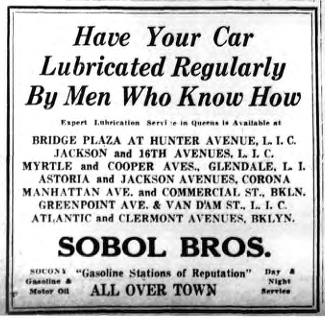
Also, at the ever reliable fultonhistory.com, I found this ad for the company, which seems to have had several locations in Queens.
vast reaches

– photo by Mitch Waxman
Pictured today are the operations of A.R.C. scrap metal division of a corporation called Alloco found at 540 Kingsland avenue in the Greenpoint section of Brooklyn, pictured from a vantage point on the loquacious Newtown Creek.
Another former Standard Oil property converted over to modern usage, A.R.C. scrap metal is involved in the recycling trade.

– photo by Mitch Waxman
I’ve had the privilege of meeting some of the folks who work here, and you couldn’t ask to encounter a nicer bunch of guys. Their yard always displays a frenzy of activity, with heavy equipment sorting through the flow of waste materials and what seems like dozens of safety vested and hard hatted workers laboring away.

– photo by Mitch Waxman
You may have seen one of these shots before, and apologies are offered for repetition. One is still sorting out problems and playing catch up after the interruption to work flow offered by the lightning strike which disabled much of my equipment.
It has been a very, very busy period of time with many unexpected and unscheduled obstacles.
_______________________________________________________________
August 5th, 2012- Newtown Creek Alliance Walking Tour- The Insalubrious Valley

– photo by Mitch Waxman
Newtown Creek Alliance historian Mitch Waxman will be leading a walk through the industrial heartlands of New York City, exploring the insalubrious valley of the Newtown Creek.
The currently undefended border of Brooklyn and Queens, and the place where the Industrial Revolution actually happened, provides a dramatic and picturesque setting for this exploration. We’ll be visiting two movable bridges, the still standing remains of an early 19th century highway, and a forgotten tributary of the larger waterway. As we walk along the Newtown Creek and explore the “wrong side of the tracks” – you’ll hear tales of the early chemical industry, “Dead Animal and Night Soil Wharfs”, colonial era heretics and witches and the coming of the railroad. The tour concludes at the famed Clinton Diner in Maspeth- where scenes from the Martin Scorcese movie “Goodfellas” were shot.
Lunch at Clinton Diner is included with the ticket.
Details/special instructions.
Meetup at the corner of Grand Street and Morgan Avenue in Brooklyn at 11 a.m. on August 5, 2012. The L train serves a station at Bushwick Avenue and Grand Street, and the Q54 and Q59 bus lines stop nearby as well. Check MTA.info as ongoing weekend construction often causes delays and interruptions. Drivers, it would be wise to leave your vehicle in the vicinity of the Clinton Diner in Maspeth, Queens or near the start of the walk at Grand St. and Morgan Avenue (you can pick up the bus to Brooklyn nearby the Clinton Diner).
Be prepared: We’ll be encountering broken pavement, sometimes heavy truck traffic as we move through a virtual urban desert. Dress and pack appropriately for hiking, closed-toe shoes are highly recommended.
Clinton Diner Menu:
- Cheese burger deluxe
- Grilled chicken over garden salad
- Turkey BLT triple decker sandwich with fries
- Spaghetti with tomato sauce or butter
- Greek salad medium
- Greek Salad wrap with French fries
- Can of soda or 16oz bottle of Poland Spring
for August 5th tickets, click here for the Newtown Creek Alliance ticketing page
final destinations
This is tomorrow, as in Sunday the 22nd. Seriously- you can count the number of seats left with one hand. If you haven’t got your tickets yet, today is probably your last chance.
 |
 |
Many people know about the environmental issues facing Newtown Creek, but did you know that the Creek was once the busiest waterway in North America, carrying more industrial tonnage than the entire Mississippi River?
You’ll learn much more when Working Harbor Committee’s maritime historians and harbor experts
put it all in context during a Hidden Harbor Tours: Newtown Creek Exploration.
The heart of industrial New York, Newtown Creek was home port to hundreds of tugboats (one of which is the historic WO Decker). It was also an international destination for oceangoing ships and a vast intermodal shipping and manufacturing hub that employed hundreds of thousands of people. Forming the border of Brooklyn and Queens for nearly three miles, five great cities grew rich along the Newtown Creek’s bulkheads — Greenpoint, Willamsburg, Bushwick, Long Island City and Manhattan itself. The waterway is still a vital part of the harbor and the Working Harbor Committee (WHC) is proud to present this tour as part of the celebration of their tenth anniversary year.
Mitch Waxman, a member of WHC’s steering committee and the group’s official photographer, also serves with the Newtown Creek Alliance as its group Historian. In addition to working on WHC’s boat tours of the Creek, Mitch offers a regular lineup of popular walking tours, and presents a series of well-attended slideshows for political, governmental, antiquarian, historical and school groups. His website – newtownpentacle.com – chronicles his adventures along the Newtown Creek and in the greater Working Harbor.
He was recently profiled in the NY Times Metro section, check out the article here.
Upcoming tour: Hidden Harbor Tours: Newtown Creek Exploration.
On July 22nd, Mitch shares his unique point of view and deep understanding of the past, present and future conditions of the Newtown Creek as the narrator and expedition leader for this years Hidden Harbor Tours: Newtown Creek exploration.
Our NY Water Taxi leaves from South Street Seaport at 11 a.m. (sharp) on a three hour tour of the Newtown Creek. From the East River we’ll move into the Newtown Creek where we’ll explore explore vast amounts of maritime infrastructure, see many movable bridges and discover the very heart of the Hidden Harbor.
Limited seating available, get your tickets today.
 |
|||||||||||||||
|
|||||||||||||||


 The Newtown Pentacle