Archive for the ‘Queens’ Category
racing ahead
Happy Birthday, Marine Parkway Bridge.

– photo by Mitch Waxman
I first mentioned the Marine Parkway Gil Hodges Bridge a few years ago, on its 75th birthday, in this post (I also lifted the shot above from that 2012 post). The post discusses the creation and opening of the vertical lift span (it was the largest specimen of this particular form of movable span in the world in 1937) and a bit of my personal history as well.
The Marine Parkway Bridge was one of Robert Moses’s early projects, and when it was built, it was constructed by the Marine Parkway Bridge Authority. An “Authority” was and is an unholy combination of private corporation and government which is allowed to issue bonds and keep its records away from private or press scrutiny (like a corporation) and also possesses the power of eminent domain and all the other stuff you’d associate with governmental agencies. The Authority was meant to be dissolved once it paid back its bonds, which were guaranteed by toll revenues, and the contractual relationship between lender and Authority was guaranteed by the State constitution as inviolable. This vouchsafed the “Authority” from circumspection by the public and press, and insulated it from the interference of Elected officialdom.

– photo by Mitch Waxman
The Marine Parkway Bridge Authority, like the Triborough Bridge Authority, was ruled over by Robert Moses. Moses ensured that whenever his various Authority bonds were about to come due a new round of financial offers would be tendered, and these bonds would be readily bought up by financial institutions which knew a “sure thing” when they saw it. Moses offered his bonds at a couple of interest points higher than Municipal bonds, and since the instruments were backed up by ever growing toll revenues and the Master Builder’s reputation, they were highly desirable. If Moses picked your bank as a lender, he also expected you to play ball with him on future projects. For more than forty years in NYC, Moses used this technique to control the building of highways, bridges, tunnels, and eventually housing in NYC. It took Nelson Rockefeller to break Moses’s grip on the system, and shatter the power of the “Authorities” by bringing them under the control of Elected officialdom.
Robert A. Caro called Moses “the Power Broker.” We all live in the aftermath of Moses.

– photo by Mitch Waxman
The Marine Parkway Bridge is owned and operated today by an Authority set up by Governor Rockefeller back in the 1960’s – called the MTA. The Metropolitan Transit Authority, like the Port Authority, has the special government/corporate status that the Triborough Bridge (later the Triborough Bridge and Tunnel Authority) and Marine Parkway Bridge Authorities enjoyed, but have little or no control over their own financing.
As Moses opined often, once the callow forces of the political parties and electoral politics got control over the Authorities, they’d reduce them down into patronage machines which would practice what was and is known as “good honest graft.” Of course, this is exactly what Moses did, and he never had to face the wrath of voters (except for a disastrous campaign for Governor, his one foray into “politics”).

– photo by Mitch Waxman
Moses had a system. When he was issuing a bond offer, or doling out insurance contracts, the sealed documents would go to favored financial institutions. These favored institutions often had silent partners who happened to be Borough Presidents, Aldermen, or later in the game – City Council members. When he received his bonds, whose terms extended the life of his Authorities decades beyond their anticipated longevity, he’d dole out contracts to “connected” companies who would then hire workers based solely on political patronage. Ever notice that highway and big infrastructure projects always seem to start during election years? That’s Moses’s legacy at work. The Marine Parkway Bridge Authority, like the TBTA, was folded into the black box that is the MTA Bridge and Tunnels division decades ago by John D. Rockefeller’s grandson Nelson, and the Authority bonds were handed off to and underwritten by his brother – who was the CEO of Chase Manhattan.
It’s not good, it’s not bad, it’s just the way that it is.
Welcome to New York City, here’s our shit sandwich, so take a bite – and happy birthday, Marine Parkway Gil Hodges Bridge.
“follow” me on Twitter- @newtownpentacle
Upcoming Tours –
July 12th, 2015
Glittering Realms Walking Tour
with Newtown Creek Alliance, click here for details and tickets.
public building
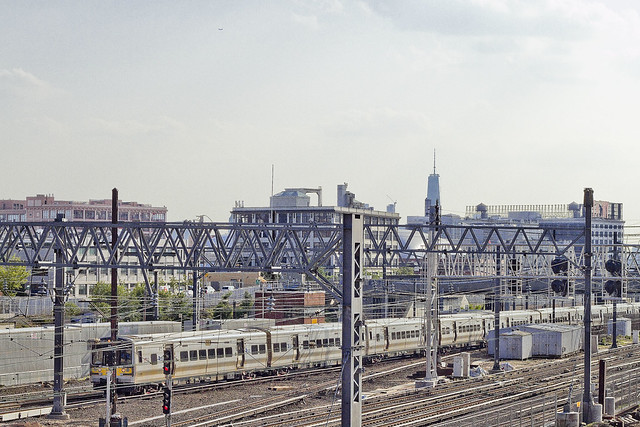
Sunnyside Yard, in today’s post.
– photo by Mitch Waxman
Everybody always asks me how I get these shots, or about certain qualities in them. Simple answer is that I’m always experimenting with the camera, and when I come up with some protocol for “how to get this or that” my next move is usually to reverse it and see what happens.
How do you get to Carnegie Hall? Practice, my friend, practice.
The setting: Recently, an evening meeting carried one up the hill from the elluvial flatlands of Southern Astoria to the heights of the ridge which Sunnyside was built into. Between these two neighborhoods, there’s a former tidal swamp into which the Sunnyside Yard was embedded back in the first decade of the 20th century. Once the largest rail coach yard on earth, the Yard still hosts the busiest rail junction found on the continent, the so called Harold Interlocking. The busy part is due to the frequent passage of Long Island Railroad commuter rail trains, which share the switches and rails with Amtrak.

– photo by Mitch Waxman
The conditions: Sunset to the west, which I was going to be shooting right into. The weather was humid, and a bit misty. The point of view is surrounded by steel plated chain link fencing whose purpose is to deny observation of vulnerable infrastructure (I’m told that this fencing was installed during the first decade of the Terror Wars). One such as myself has a vast catalog of fence holes and gaps which are dearly held, and since my meeting in Sunnyside would carry one past an entire series of these occluded viewpoints, a point was made to pocket one of my lenses small enough to fit into while leaving HQ. I also brought some chewing gum, but that’s not important.
My “good lenses,” which are used in particularly high rotation, have a circumference too large for these cracks in the walls around the Sunnyside Yard – so a “decent” lens which has a decidedly smaller diameter was employed.

– photo by Mitch Waxman
The “decent lens” mentioned is the so called “nifty fifty” offered by Canon. It’s far and away my most inexpensive tool, and allows wide open apertures which would make it handy for night time shots but for its persnickety focusing mechanics. The term for what it does, autofocus wise, is called “hunting.” What that means is that it noisily rolls through the range of focus and never quite settles itself into a lock. My usual habit with this sort of thing is to use autofocus to “get it close” and then switch the thing over to manual focus for final adjustment.
The optic formula of the lens also renders things a bit less “contrasty” than I’d like, but you can’t really complain about camera equipment which retails for around a hundred bucks – especially when it fits through fence holes.

– photo by Mitch Waxman
The methodology: For those of you not in the know, as to how cameras and lenses work – a “bright lens” will allow you to operate it at wide apertures (f1.8 in the instance of the nifty fifty). Wide apertures create a tremendous “depth of field” effect, which means that the area which is in focus will appear sharply delineated and everything else will be blurred. Higher aperture settings – the “f-stops” as it were – will create a hyperfocal range in which everything in frame will be sharply defined. The lower the “f-stop” the more light enters the camera, and the higher ones allow less light to get to the sensor. You balance the shot using shutter speed and ISO settings. Night shots and interior spaces require you to use the lens “wide open,” with slow shutter speeds, and higher ISO settings – all of which introduce certain quality issues to the captured image.
The shots in today’s post were consciously captured with the desire to have “everything” in focus, with a minimum of motion blur as well, and to record a full range of color and tone. Difficult to do with the sun behind the scene, and in a setting where everything is made of contrasting reflective surfaces.
My formula was to actually reverse my night shooting protocol on 2/3rds of the exposure triangle, using a very narrow f-stop and fairly fast shutter speed, but with a high ISO setting for tone and color sensitivity (f10, 1/1250th of a second, ISO 800). Sometimes, particularly during the summer, the problem isn’t that there enough light – there’s actually too much of it and some methodology needs to be employed to control it. Experimentation and failure often emanate from screwing around with your normal shooting habits, but sometimes it pays to mix things up a bit.
“follow” me on Twitter- @newtownpentacle
Upcoming Tours –
July 12th, 2015
Glittering Realms Walking Tour
with Newtown Creek Alliance, click here for details and tickets.
idly digging
Another odd occult altar encountered, this one in Maspeth.

– photo by Mitch Waxman
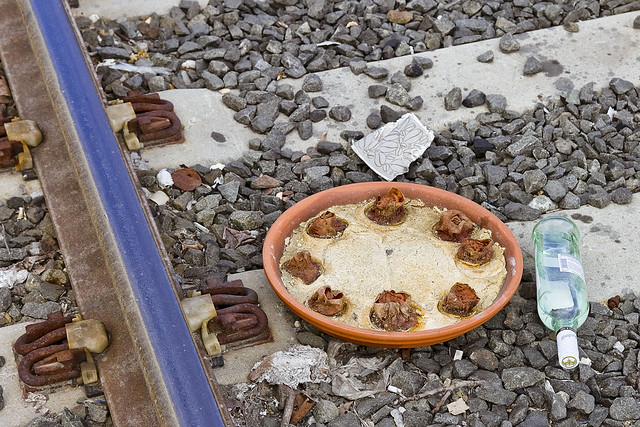
Involuntarily marching about in Queensican DUKBO (Down under the Kosciuszko Bridge Onramp) recently, on my way over to East Williamsburg to conduct an iteration of the “Insalubrious Valley of the Newtown Creek” walking tour, an occult altar was encountered not far from the bridge. It was at the grade crossing of the Haberman rail siding, nearby the intersection of 49th street and 56th road in Maspeth.

– photo by Mitch Waxman
This area has been observed, in the past, hosting some odd activity. The very same spot is where the “3 Headless Chickens” described in this 2012 post were found.
– photo by Mitch Waxman
The ceramic plate was filled with what looked like corn meal or some other roughly ground grain. The liquor bottle was white rum, and there was a considerable amount of the stuff in the bottle. The fact that it hasn’t been scooped up and consumed is noteworthy.

– photo by Mitch Waxman
The eight arranged dark shapes seemed to be yams or sweet potatoes. There was some sort of shape impressed into the “corn meal” which reminds me of some skinny or tiny person’s naked butt, or possibly those tablets which Moses brandished about.
Entirely likely that there’s a missing piece to this altar which was swept aside by rail traffic passing over it, imho.
“follow” me on Twitter- @newtownpentacle
Upcoming Tours –
July 12th, 2015
Glittering Realms Walking Tour
with Newtown Creek Alliance, click here for details and tickets.
simple swains
Most photogenic Subway line nomination, in today’s post.

– photo by Mitch Waxman
The elevated 7 line has become quite famous for its multitudinous delays, entire weekends wherein service is suspended, and the frustrations of the vast population who count on it as their daily conveyance to and from the Shining City from Queens. One would offer that despite all of this, it looks great, and since appearances are all that really matter under the current administration in City Hall and Albany…

– photo by Mitch Waxman
The underground lines just don’t have the same panache as the elevateds, and there are analogs for them in every major human infestation found upon the earth. The subterranean lines are dirty, dark, and the sweating concrete bunkers through which they run are the kingdoms of the rat. The first shot in today’s post emanates from a point in space roughly one hundred or so yards above the one above depicting the E line, incidentally.
– photo by Mitch Waxman
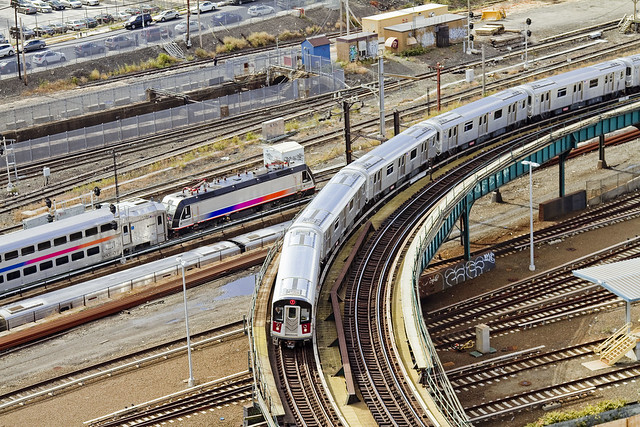
The 7 even looks good from high above, as it turns out of the Hunters Point stop into the open air over the Sunnyside Yard and heads towards Court Square. If the MTA has a “Belle of the Ball,” it’s clearly the 7 – esthetically speaking. There’s a lot to be said about the scenery at Bushwick junction as well, but the 7…

– photo by Mitch Waxman
Further east, where the so called international express heads through Sunnyside and Woodside and Jackson Heights high over Roosevelt Avenue – towards its eventual destination in Flushing – the 7 carries itself with a certain bearing and sharply appointed charm. One therefore nominates the 7 as the best looking of NYC’s subways.
Remember, it’s better to look good than to feel good, and that form always trumps function.
“follow” me on Twitter- @newtownpentacle
Upcoming Tours –
July 12th, 2015
Glittering Realms Walking Tour
with Newtown Creek Alliance, click here for details and tickets.
daytime pilgrimmage
Jackson Avenue, in today’s post.

– photo by Mitch Waxman
One has been watching the construction efforts underway at the former West Chemical site adjoining Queens Plaza for a while now. Building condominium towers in Queens Plaza is a questionable proposition, beggaring the question “who would really want to live in Queens Plaza?,” but the bigger one for me is “would you want to live on the former location of a chemical factory?.” I often remark to myself that the reason why the history of Queens is often so tough a nut to crack is the careful obfuscation of its past by the real estate industrial complex so as to preclude casual mention of the fact that so many of the new residential towers rising from Western Queens are in fact built atop such sites.
State and City officialdom call sites like these “brownfields,” which sounds a lot better than “toxic and irreversibly polluted” I guess. Just say “affordable housing” or “green infrastructure” and you’ll feel better about the whole thing.

– photo by Mitch Waxman
Brownfield remediation, or “opportunity area,” sounds a heck of a lot better at cocktail parties and let’s face it – lower Manhattan and North Brooklyn cocktail parties tend to grind into uncomfortable territory when you mention the environmental consequence of a century’s worth of industrial use. One would point out that at least the “powers that are” aren’t planning on putting a school on top of the old West Chemical site, but that brings up the uncomfortable subject of the infrastructure required to support a residential population being inserted into a former industrial zone, and the lack thereof, so that’s best avoided as well so as to not make the bond brokers skittish and derail the program.
It will not be conducive, condo sales wise, to mention all of those closed FDNY units or the frankly astounding conditions encountered at the centuried Queensboro or Ravenswood NYCHA projects, nor where the nearest hospital emergency room is located.

– photo by Mitch Waxman
The old “chickens coming home to roost” adage will likely be punching Western Queens in the nose some time in the late 2020’s – by my estimate. That’s when our trains will be running at (instead of near) capacity, our lack of school desks and hospital beds will be most apparent, and when the new populations installed in these former industrial corridors begin to organize – politically speaking. One wonders if these new populations will vote in as reliable and “party loyal” a fashion as the current residents do. Will the 20’s roar, or howl, for the Democrats?
The folks who can afford the so called “affordable housing,” rising from these “brownfields,” will they vote for a Democrat party candidate and continue the rule of the “Queens Machine” – or will they support somebody else who is a little more in tune with them socioeconomically? Only time, and a roll of the political dice, will tell.
“follow” me on Twitter- @newtownpentacle
Upcoming Tours –
July 12th, 2015
Glittering Realms Walking Tour
with Newtown Creek Alliance, click here for details and tickets.


