Archive for the ‘Tugboat’ Category
alive in
Things that pull or push other things, in today’s post.

– photo by Mitch Waxman
So, that NYC Ferry trip I mentioned in yesterday’s April Fools post? As it happened, a humble narrator hit a fortuitous moment in terms of river traffic when boarding that particular boat. Everywhere I pointed the lens, there seemed to be something going on. For the curious – this was the Soundview route, which I boarded at East 34th street over in the City, after taking the Astoria line from Hallets Cove to that location.
A few people have asked me (in real life or “meat space”) if I have some sort of relationship with the NYC Ferry people since I keep on mentioning them. The answer is “sort of,” since I do know a couple of people who work at Hornblower through the old NY Harbor crowd. A while back I did a blog post for NYC Ferry about what to do and see nearby their Astoria dock, an effort which I was recompensed for with a free 30 day pass on their boats. That’s pretty much the size of it, except for the taxes we all pay to the City which heavily underwrite the $2.75 fare. I’m just a fare paying passenger, and one who really enjoys getting out on the water – even if it was a particularly cold and blustery March afternoon.

– photo by Mitch Waxman
Spotted this rather smallish tug at Hells Gate, towing a couple of barges of what looked like either gravel or uncooked asphalt. That’s the Wards/Randalls island combine in the background, the shoreline of which hosts a staggering amount of municipal infrastructure. The NYC DEP has a combination of wastewater and sludge dewatering facilities on the shoreline mirroring Astoria Park, there’s the Hell Gate railroad Bridge and the East River span of the Triborough Bridge complex as well. Just yesterday, I was making plans with a couple of people to spend a day on the Island(s) and get to know the place a bit better.
Used to be two islands, Randalls and Wards, but… y’know… Robert Moses.

– photo by Mitch Waxman
Coming from the south/west, another tug was spotted transversing Hells Gate. That’s the Astoria Park shoreline, and you can just make out the nascent skyline of LIC’s Court Square neighborhood peeking out over the bare trees behind the bridge. I’ve been told that even with modern vessels, you have to “pick your battles” with the swift currents in this section of the river lest you end up burning up half your fuel supply fighting its ebb and flow.
One time I was sitting in Astoria Park, right alongside the Hell Gate masonry seen above, and taking pics. I started laughing while watching some rich guy in a speedboat gunning his engines against the current, but his boat was just barely holding position agains the incoming flood tide. This isn’t necessarily the case with tugs and other overpowered boats, of course, but fuel costs are what rule the roost in the shipping and towing business. How much you “spend to earn” is where an experienced versus inexperienced crew and scheduler make all the difference. Same thing is true with shipping by rail and trucks.

– photo by Mitch Waxman
Another fuel barge and tug combination was passed, while the camera’s point of view was looking north westwards over Randalls/Wards Island towards the Little Hell Gate Bridge and the roads leading to Triborough’s toll plazas. Good timing, thought I, as a CSX train set was transiting over the elevated rail tracks connecting to Hell Gate’s East River Arch Bridge (which connect to the NY Connecting Rail Road tracks in Queens) and heading for the Bronx. I think the next stop for the CSX rig will be Owls Head yard in the Bronx, but that’s just a guess.
What do I know?

– photo by Mitch Waxman
Luckily, I had outfitted the camera with zoom lens for the trip. It’s a Sigma, the 18-300 f3.5, which provides the “all in one” functionality needed for this sort of excursion. One thing about the East River and its various tributaries and estuarial bays is that you are going to want to shoot both wide and long, sometimes flipping back and forth several times in just five minutes. Given that you’re on a boat, speedily moving through the water and with all kinds of weird particulates circulating in the air column… you want to limit the number of lens flops you do.
I can recommend the Sigma, btw. I also have and love their 18-35 f1.8.

– photo by Mitch Waxman
What was that I was just saying about zooming in?
“follow” me on Twitter- @newtownpentacle
Buy a book!

“In the Shadows at Newtown Creek,” an 88 page softcover 8.5×11 magazine format photo book by Mitch Waxman, is now on sale at blurb.com for $30.
rotting ossuaries
A dollar short and a day late…

– photo by Mitch Waxman
I seem to be about twelve hours behind on my scheduling today, due to a very busy week. Thusly, a single image of a DonJon Tug moving barges about on Newtown Creek greets you in this very late post. Back tomorrow with something decidedly meatier for you to sink your teeth into, lords and ladies.
Upcoming Tours and Events
Monday, October 1st, 6:30 p.m. – Infrastructure Creek – with Atlas Obscura.
Join Newtown Creek Alliance Historian Mitch Waxman as he leads an exploration of the city’s largest sewer plant, tunnels, draw and truss bridges, rail yards, and a highway that carries 32 million vehicle-trips a year over flowing water.
Tix and more details here.
“follow” me on Twitter- @newtownpentacle
corridor outside
Remember, remember…
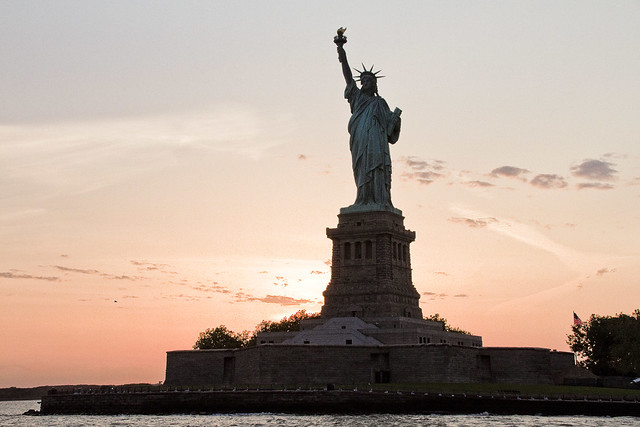
– photo by Mitch Waxman
On this day, June 15th in 1904, the General Slocum excursion boat left its dock at Peck Slip in Manhattan at ten in the morning with just over 1,000 people onboard – most of whom were women and children. It caught fire as it moved north on the East River, and reports of smoke below deck reached the wheelhouse as it was passing 97th street in Manhattan. It didn’t take long for the wood hulled boat to catch fire. It was a product of Tammany’s NYC, where safety inspectors could be convinced to overlook violations for a small sum, which is why the life vests were filled with sawdust and powdered cork and the fire hoses onboard were either non existent or rotted. Most of the crew abandoned ship, leaving the passengers to fend for themselves. By the time it grounded at North Brother Island, the official death toll was 1,021. Bodies were washing onshore at Hells Gate for days.
Today is the anniversary of the day that Lassez Faire capitalism and local control of the ferry industry ended in NYC, and why the United States Coast Guard was given broad oversight powers regarding safety onboard vessels in NY Harbor.

– photo by Mitch Waxman
After the Slocum disaster, which scored the largest death toll of any single event in NYC until the September 11th attacks in 2001, the Coast Guard instituted regulations and rules for all shipping in NY Harbor which they enforce with military discipline. It’s why you hear an announcement on every ferry trip telling you where floatation devices can be found onboard, and why private pleasure and fishing vessels in the harbor are often “pulled over” by USCG for safety inspections.
It’s also one of the arguments I make when talking politics, with my friends who identify as “Conservative,” in defense of what they describe as “job killing regulatory oversight.” There is a staggering amount of inefficiency and an abundance of stupid rules in Government, but we also haven’t had anything like a General Slocum disaster in what… 114 years?

– photo by Mitch Waxman
Given the focus point of my historical interests, which can be somewhat summed up as “maritime industrial history of NYC from the colonial to WW2 periods,” there’s a lot of horror stories which I’ve stumbled across. 95% of the environmental issues in NYC were caused by unfettered and unregulated industrial operations which, prior to 1972 and the Federal Clean Water and Clean Air acts, had zero obligation not to dump acid into rivers and streams or pulse metric shit tons of poison into the air. A disaster can occur in any era, but the needless deaths of 1,021 women and children onboard an excursion boat leaving from lower Manhattan to attend a picnic on Long Island? Unthinkable in the modern era.
All that is due to a regulatory regime for the maritime industry which was largely created and coded into law by Republican Party politicians led by Teddy Roosevelt. Dump acid into the water, or spew sulphur compounds into the sky? Also impossible thanks to a Republican named Richard Nixon. Give credit where credit is due, I say. I also question why the politics of the modern day has members of the same political party chipping away at the achievements of their historical forebears who ensured that you could just mindlessly walk onto a ferry without thinking about the General Slocum
“follow” me on Twitter- @newtownpentacle
dark figures
If only I could be laconic, if.
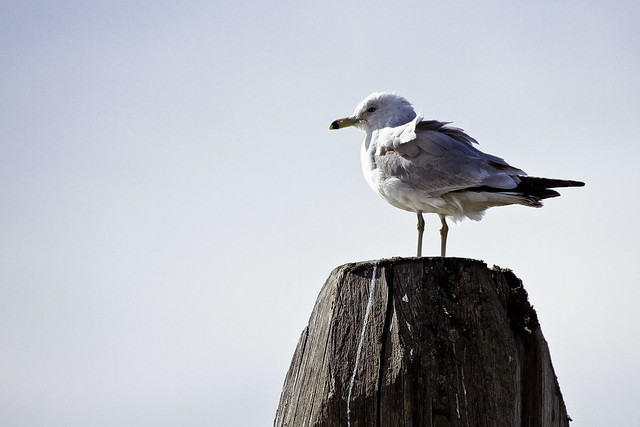
– photo by Mitch Waxman
Sunday last, I conducted a tour for the NY Transit Museum onboard an NYC Ferry. The narrative was governed by the history of ferries in NYC, with a general historical overlay of the East River corridor. There’s a lot of information to pass on, and I will admit that it’s a bit of struggle to fit it all in. The tour left from Pier 11 in Manhattan, and we debarked the boat in LIC. Given that it’s a transit museum group, the last third of the tour focuses in on the former ferry services of the Long Island Railroad offered out of Hunters Point and then I take the group a few blocks into LIC. I can usually produce a LIRR engine sitting on a sidetrack thereabouts, and there’s always the Sunnyside Yards to talk about as well.
It was really, really cold for April last Sunday, in the 30’s when I left HQ.
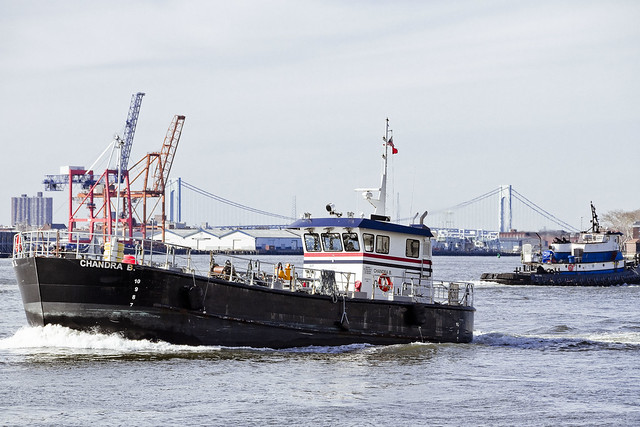
– photo by Mitch Waxman
This is the second time I’ve narrated this particular tour, and hopefully will be presenting it again in the near future. Saying that, now that it’s been spoken aloud a few times, I’ve got some rewriting to do in the name of brevity and clarity. It’s so easy to bog down in historical minutia when discussing the East River, you have to be careful when narrating lest you lose the audience’s attention in a swirl of details. I never structure what I’m going to say as a dry recitation of facts and dates, which is the worst possible way to relate historical data, in my view. It’s a story, so tell it like a story, with a beginning/middle/end.
The cool thing about the Transit Museum is that they outfit me with a little closed circuit radio microphone and all the tour participants get these little radio headsets, so I don’t need to yell the whole time. That took a bit of adjustment time for me, as I’m used to using a booming voice and certain style of pronunciation on tours. Speaking into a mike is more a “radio situation” where you want to get all mellifluous in terms of vocalizations.
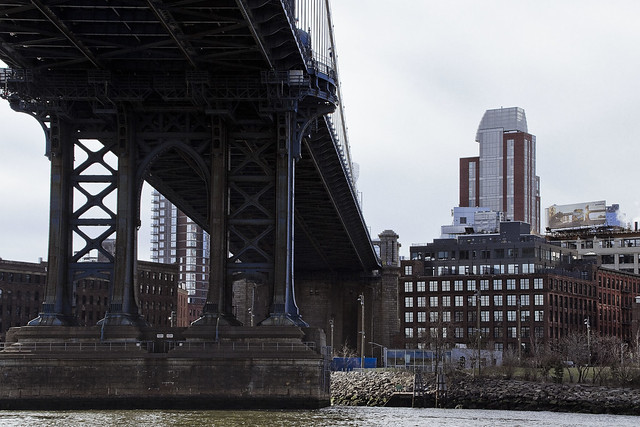
– photo by Mitch Waxman
Suffice to say that shortly after the Civil War there were as many as 21 seperate “official” ferry lines crossing back and forth between Brooklyn and Queens and Manhattan. Like a lot of 19th century industries, a politically connected monopoly emerged out of a company founded by Livingstone and Fulton which made regulation and inspection by Government officialdom go away, creating a lassez faire system whose excesses eventually led to the General Slocum disaster in 1915 1904 which made the idea of getting on a ferry rather unpalatable to early 20th century New Yorkers in the same way that entering a giant office building in the years following 9/11 was an unsettling experience. The Coast Guard was put in charge of safety matters, and they began to enforce strict safety regulations and practices on the ferry industry.
Then came Robert Moses…
Upcoming Tours and Events
April 14 – Exploring Long Island City – with NY Adventure Club.
Long Island City is a tale of two cities; one filled with glittering water-front skyscrapers and manicured parks, and the other, a highly active ground transportation & distribution zone vital to the New York economy — which will prevail?
Tickets and more details here.
April 15- Newtown Creekathon – with Newtown Creek Alliance.
That grueling 13 and change mile death march through the bowels of New York City known as the “Newtown Creekathon” will be held on that day, and I’ll be leading the charge as we hit every little corner and section of the waterway. This will be quite an undertaking, last year half the crowd tagged out before we hit the half way point. Have you got what it takes the walk the enitre Newtown Creek?
Click here to reserve a spot on the Creekathon.
“follow” me on Twitter- @newtownpentacle
formula filled
My creek also puts on a show when I’ve been away from her too long.
– photo by Mitch Waxman
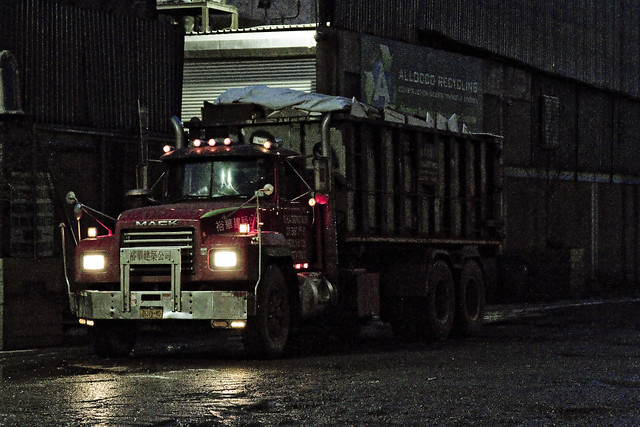
One of my practices, developed over the last decade or so, is to take a Newtown Creek break periodically and “allow my liver to return to a normal size.” I’m joking about the liver, but one does enjoy a bit of detox occasionally, and allowing the poisons I’ve accrued a chance to leach out. This is a luxury one enjoys, as he doesn’t live along Newtown Creek, others aren’t so lucky. Pictured above is roll on/ roll off garbage truck carrying a bin, spotted at a waste transfer station owned by a friend of mine which fairly straddles the border of Brooklyn and Queens.
– photo by Mitch Waxman
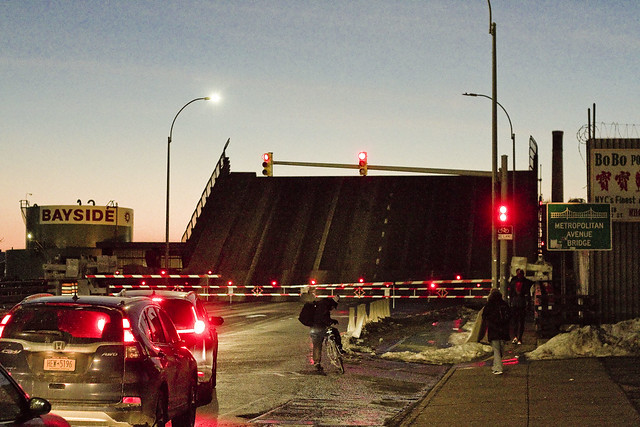
Marching along Metropolitan Avenue, one squealed with delight as the Metropolitan Avenue Bridge began to open. This used to be quite a frequent occurrence “back in the day.” These days there’s only one regular maritime customer back here on the English Kills tributary, which is Bayside Fuel.

– photo by Mitch Waxman
The timing of the bridge opening was bizarre, occurring at precisely the time of one of the heaviest traffic intervals in this section of North Brooklyn, about 6:30 p.m.

– photo by Mitch Waxman
That odd timing, however, allowed one to stand in the middle of Metropolitan Avenue without getting squished.

– photo by Mitch Waxman
I believe that the tug pictured above is the Mary H., which normally handles the Bayside duty, but it’s hard to say as I didn’t get any of its markings. I did manage to focus in on the captain in his wheelhouse, however, so “win.”
As a note, the Metropolitan Avenue Bridge spans the English Kills tributary of the larger Newtown Creek at a navigational mark 3.4 miles eastwards of the East River. Metropolitan Avenue was originally created as a private toll road about 1814, and was called the Williamsburgh and Jamaica Turnpike. The owners of the toll road, and the original bridge, were two brothers whose family name was Masters. That’s why you’ll occasionally see references to the road as the “Masters Turnpike” and the “Masters Bridge” in the historical record, if like me, you stay up until 4 in the morning reading old municipal journals and reports from the Chambers of Commerce of Brooklyn or Queens.

– photo by Mitch Waxman
My conceit is to call this area of Newtown Creek surrounding the Metropolitan Avenue Bridge “DUMABO.” That’s short for “Down Under the Metropolitan Avenue Bridge,” as I believe we need to be ahead of the real estate people on these sorts of things.
“follow” me on Twitter- @newtownpentacle


 The Newtown Pentacle