Posts Tagged ‘Brooklyn’
some passages
Kosciuszko Bridge project, Brooklyn side, Q2 2016, in today’s post.
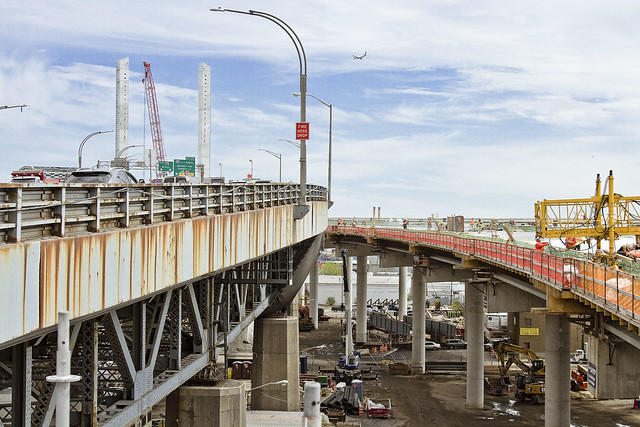
– photo by Mitch Waxman
The invitation went out to all the concerned parties – inclusively referred to as the Stakeholders Advisory Group – from the NYS DOT that an opportunity to observe the progress of the Kosciuszko Bridge replacement project was once again at hand.
Accordingly, a humble narrator collected together the camera and lenses, and set off for Greenpoint’s DUKBO – Down Under the Kosciuszko Bridge Onramp.
Several progress reports have been offered on the NYS DOT’s Kosciuszko Bridge replacement project. I seem to be the only person In New York paying any attention to the project, and there’s been a series of prior posts on the bridge presented at this – your Newtown Pentacle – chronicling the project.
To start – this 2012 post tells you everything you could want to know about Robert Moses, Fiorella LaGuardia, and the origins of the 1939 model Kosciuszko Bridge. Just before construction started, I swept through both the Brooklyn and Queens sides of Newtown Creek in the area I call “DUKBO” – Down Under the Kosciuszko Bridge Onramp. Here’s a 2014 post, and another, showing what things used to look like on the Brooklyn side, and one dating back to 2010, and from 2012 discussing the Queens side – this. Construction started, and this 2014 post offers a look at things. There’s shots from the water of Newtown Creek, in this June 2015 post, and in this September 2015 post, which shows the bridge support towers rising. Additionally, this post from March of 2016 detailed the action on the Queens side.
– photo by Mitch Waxman
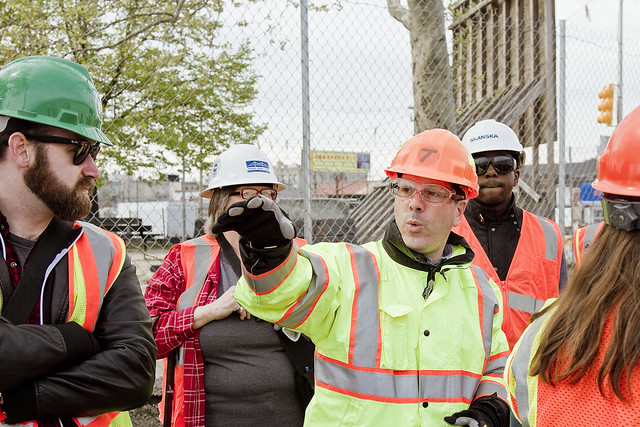
Leading the tour was NYS DOT’s project leader, engineer Robert Adams, who is the fellow pictured above in the stylish (and highly visible) yellow jacket.
Mr. Adams allows me to call him Bob, for which I’m grateful. One such as myself dislikes the usage of extraneous syllables in the spoken form. For the purposes of today’s post, however, I’ll refer to him as Mr. Adams – as the job his team is overseeing has done such an impressive job of staying on or ahead of schedule, he deserves the honorific.
– photo by Mitch Waxman
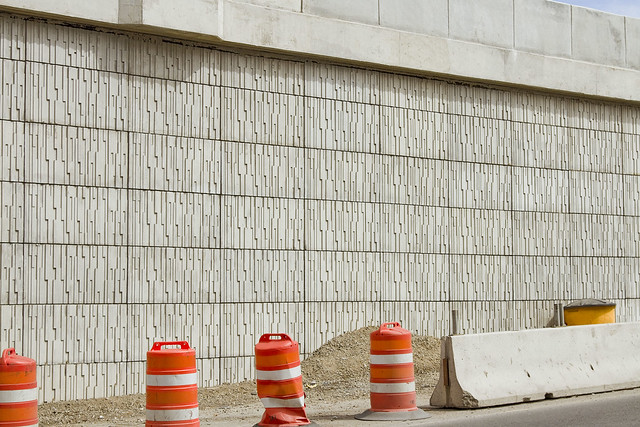
Part of the job, as it were, includes the rerouting of the Brooklyn Queens Expressway section which travels north/south along Meeker Avenue. The new roadway is supported by masonry and steel, and its outer facing is covered in sculptural tiles (which I think are concrete). I asked Mr. Adams if the sculptural motif on the tiles had a particular purpose – diffusing sound, or guiding rain runoff, for instance – but he said that it was purely esthetic, and part of the architectural design.
– photo by Mitch Waxman
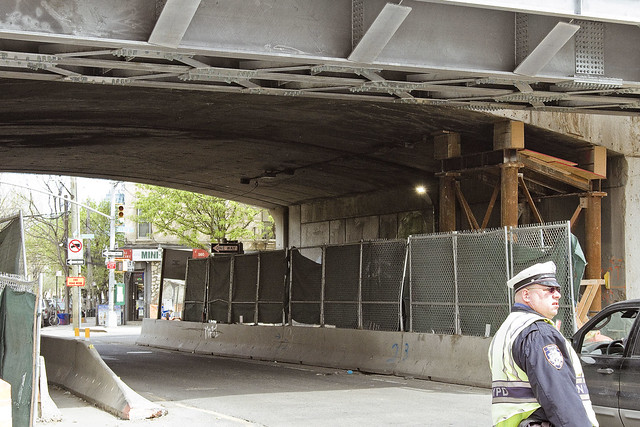
The old overpass abutments on Meeker Avenue are in the process of being dismantled. It’s a fairly chaotic scene down around here – this is the intersection of Vandervoort and Meeker if you’re curious.
Mr. Adams told us that one of the ways in which his team alleviated the impact of construction on traffic flow to the highway above was to build the new abutments “behind” the old ones. When the project is done, this will allow the DOT to add wider pedestrian sidewalks, and to also create an increased amount of space for the required turning radius of trucks as they move under the overpass.

– photo by Mitch Waxman
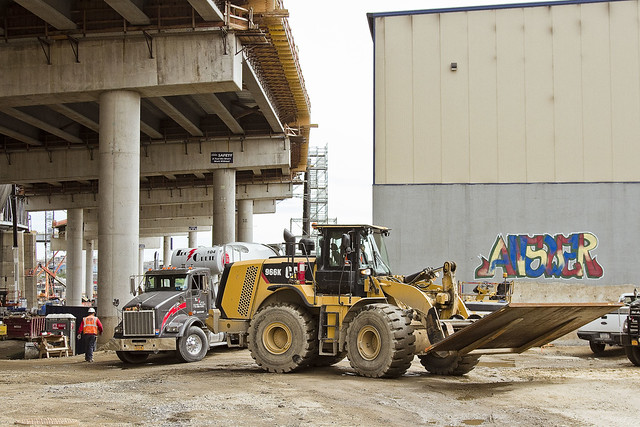
On the actual job site, in a spot which I refer to as “used to be Cherry Street,” is pictured above. Old school Cherry street is found beneath the masonry structure occupying the left side of the shot above, I would mention, and the unpaved access road at bottom right represents the right of way for “New Cherry Street.”
– photo by Mitch Waxman
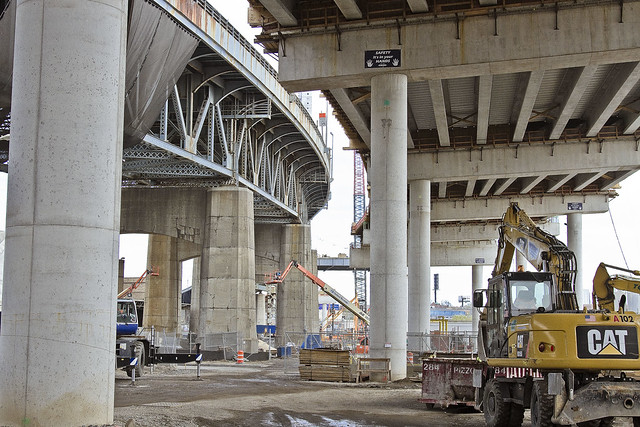
Getting down to the action, and there’s a lot of it going on down here in DUKBO. This spot is one of the areas where some of that worksite safety training I’ve mentioned before comes into play. The contractors on the job – Skanska, Kiewit, and ECO3 – all subscribe to “safety culture” which is designed to keep laborers from suffering needless injuries. We – as in the civilian visitors Mr. Adams was escorting around the site – were all dressed up in orange vests, safety glasses, hard hats, and work gloves.
– photo by Mitch Waxman
The roadway leading to the new bridge is on the right, with the 1939 vintage Kosciuszko Bridge on the left. We were told that the area down here will actually be available for use as a public space in the post construction era. At a luncheon meeting after the tour, Mr. Adams was petitioning the group for ideas as to what the community might want to happen down here. There will be space available on the Queens side as well.
Speaking of Queens, we were also told that in the early summer, a similar walk-through of the Queens side will be happening. Can’t wait for that one, mainly so I don’t have to walk all the way to Greenpoint from Astoria.
– photo by Mitch Waxman
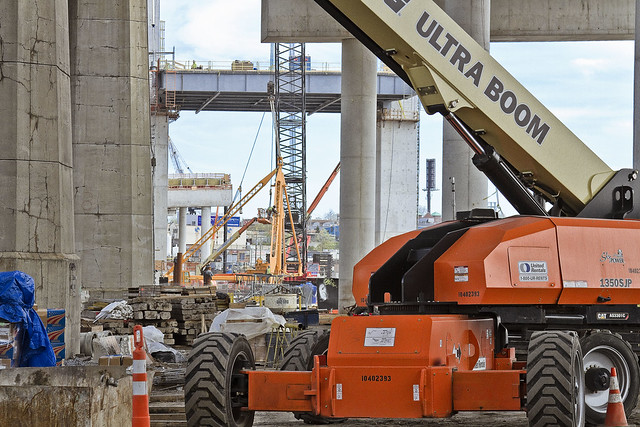
Having crossed Gardiner Avenue, heading south towards the languid waters of Newtown Creek, it was pretty exciting to notice that steel has begun to be affixed to the concrete tower columns of the new bridge – a major milestone. The new Kosciuszko Bridge is going to be of the cable stay variety, and the first of its type in NYC.
– photo by Mitch Waxman
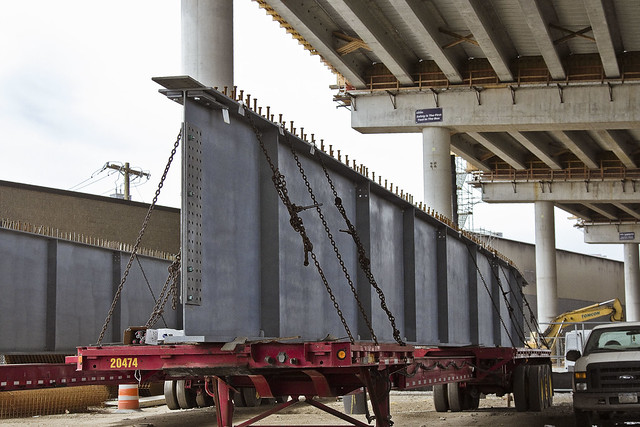
Speaking of steel, there were gigantic chunks of the stuff ready for deployment. These pieces are actually the outward facing sides of the highway. Mr. Adams made it a point of informing us that this was an entirely American produced bridge, with steel coming in from Pennsylvania and concrete sourced from a Queens company that’s called Tek Crete.
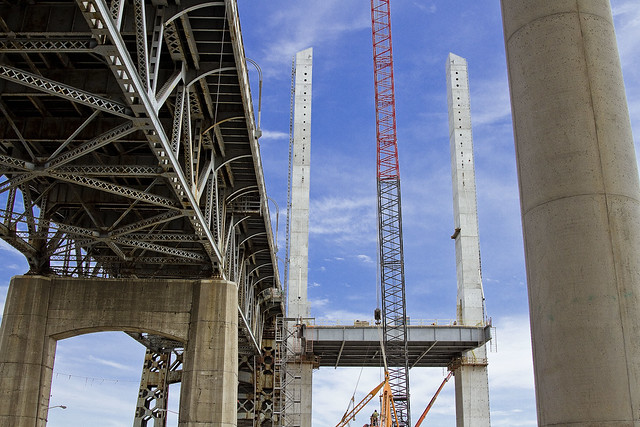
– photo by Mitch Waxman
A bit closer to the columns, and rapidly emerging roadway, which will become the easterly half of the new bridge.
The plan from the beginning has been to produce the new span in three distinct stages. First – build the lanes of the eastern side. Second – demolish the 1939 bridge. Third – build the westerly side which will sit in the footprint of the 1939 model. Chatter on the tour indicated that the demolition part of the project will begin in 2017, and that the engineers are still debating as to how best remove the concrete piers which support the steel truss.
The truss itself is actually the easiest part of the job to figure, and the center section is going to be removed in one piece. It will be lowered, by cranes, onto barges which will be towed by tugboats out of Newtown Creek.
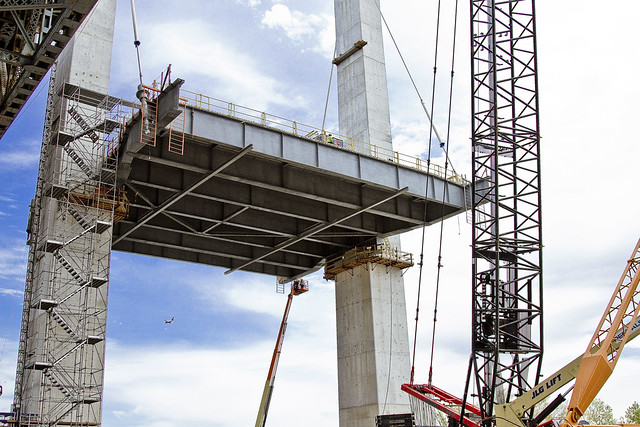
– photo by Mitch Waxman
As you can see in the shot above, the first set of cable stays has already been affixed to the new road section. For a sense of scale on how absolutely colossal this project is, take notice the itty bitty construction workers who are on the lift between the two towers.
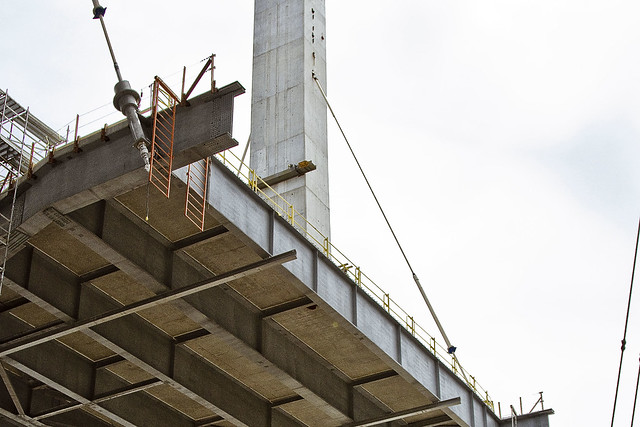
– photo by Mitch Waxman
A bit of a better angle showing the cable stays and their anchors on the roadway section. This will be be built out both south – towards Greenpoint and Meeker Avenue – and north, over the water and into Queens.
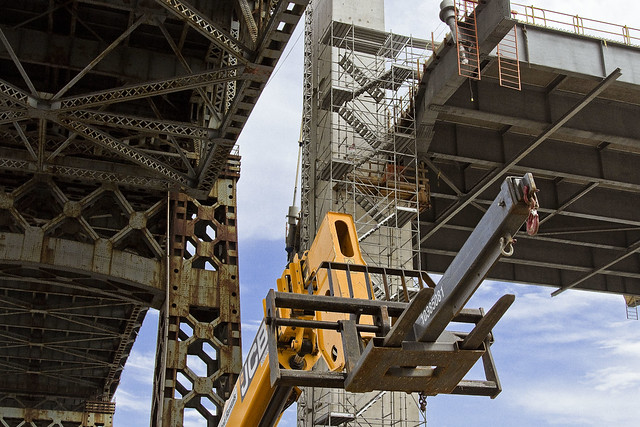
– photo by Mitch Waxman
Mr. Adams and his team indicated that we were going to be heading back towards Greenpoint, and climbing a temporary stairway up to the still under construction roadway which will be the north bound lanes of the Brooklyn Queens Expressway. Couldn’t resist one last shot from ground level showing the two structures.
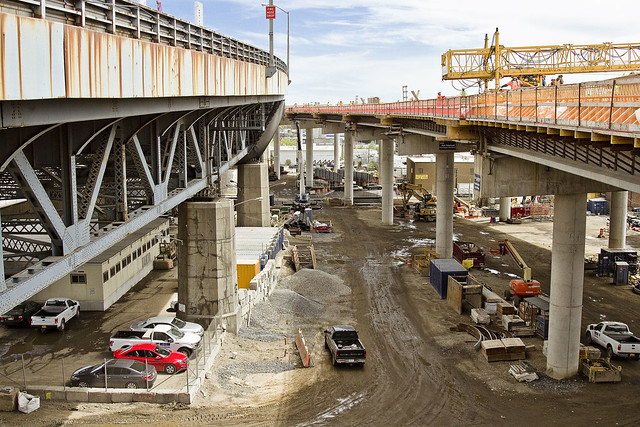
– photo by Mitch Waxman
From the temporary stairway, which was around 4-5 stories worth of climbing, and looking north towards Queens.
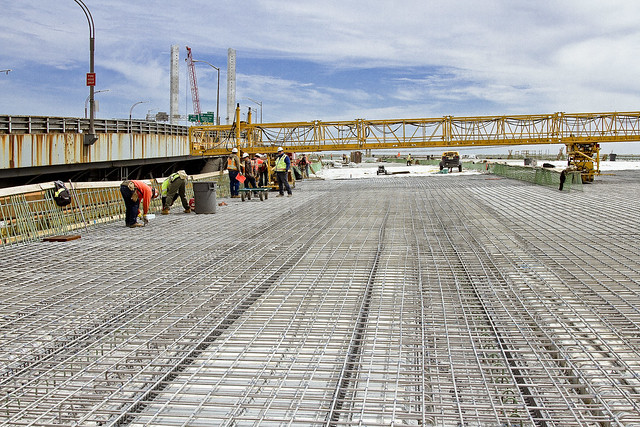
– photo by Mitch Waxman
The roadway itself is still under construction. The views from up here were fairly epic, but I’ll share those in a future post. Suffice to say that were I to attempt the same shots post construction, I’d be thoroughly squished by traffic moving at highway speeds.
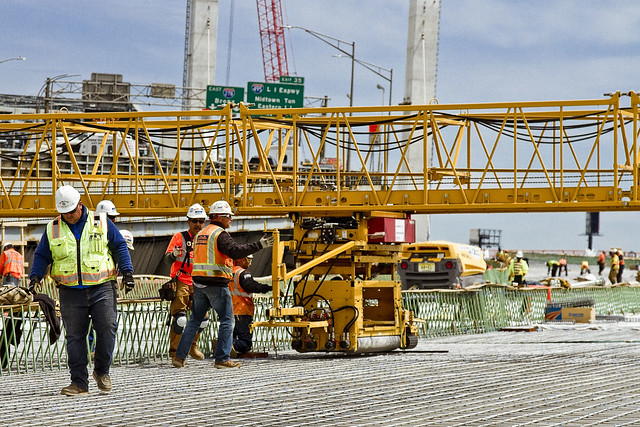
– photo by Mitch Waxman
Not sure which Union these fellows were members of, but they were too busy for me to ask. The Union guys were tying off the structural rebar, in preperation of pouring the concrete which would become the underpinning of the BQE’s roadway.
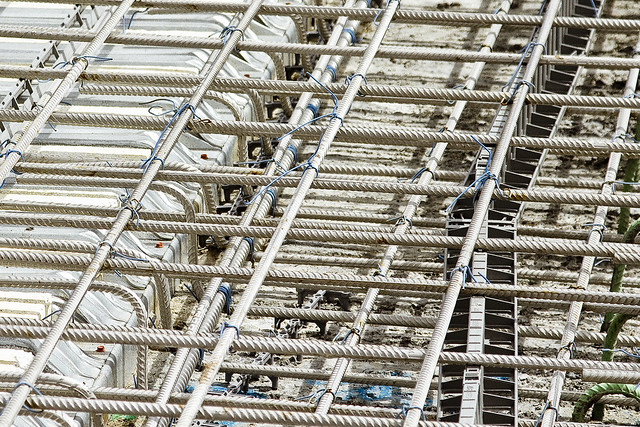
– photo by Mitch Waxman
The rebar that these Union guys are installing is actually stainless steel rather than galvanized iron. The extra expense for the stainless is justified in the name of avoiding corrosion, due to the massive amount of salt which is typically applied to the BQE during the winter months.
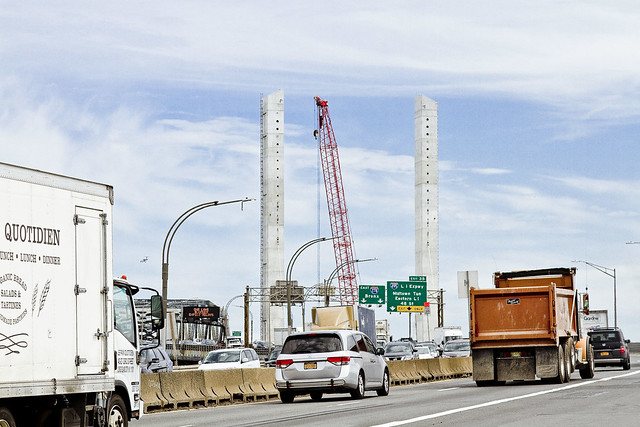
– photo by Mitch Waxman
One last shot looking north along the 1939 version of the Kosciuszko Bridge. What’s truly interesting to me about this project which Robert Adams is supervising is the fact that at no point can traffic along this Robert Moses built highway be impeded or stopped. It’s analogized best as doing a full rebuild of your car’s transmission, while driving at 90 mph in heavy traffic.
Progress on the Kosciuszko Bridge replacement will continue to be documented, at this, your Newtown Pentacle.
Upcoming Events and Tours
Sunday, May 8th at 11 a.m. – North Henry Street Project,
with Municipal Arts Society Janeswalk and Newtown Creek Alliance,
in Greenpoint, Brooklyn. Click here for more details.
“follow” me on Twitter- @newtownpentacle
unlimited demand
Me? I like a good arch.

– photo by Mitch Waxman
In glorious Astoria, Queens, you’ll notice that the neighborhood hosts a rail viaduct which carries the New York Connecting Railroad tracks to the Hell Gate Bridge, and that the cyclopean concrete structure uses a series of arches to carry the load. Whenever I’m out shooting, a point is made to photograph arches whenever they’re encountered, strictly in the name of “framing” for the composition. These tracks have been here since 1917, and opened in March, or possibly July of that year.
The arch is actually a relatively modern “thing” as far as human history goes, and began turning up in the built environment roughly 4,000 years ago in Mesopotamia.

– photo by Mitch Waxman
The Romans are famous for their usage of the arch and created several twists on the structural element. They would line up a series of arches to create an arcade, or twist them around a focal point to build domes. They also came up with the idea for triumphal arches, like the one you’ll find on the Canal Street side of the Manhattan Bridge, which also has a colonnade.
In case you were wondering – the Manhattan Bridge arch and colonnade were opened for inspection some five years after the bridge itself premiered. It was in 1910, a year after the bridge opened, that the architectural firm Carrère and Hastings drew the plans for the arch, and it was sculpted by Carl A. Heber. There’s also a sculptural frieze called “Buffalo Hunt” by a fellow named Charles Rumsey.

– photo by Mitch Waxman
Speaking of arches and the New York Connecting Railroad, as well as Astoria, you’d be remiss not mention the treasure of treasures which is Hell Gate. Lindenthal and Horbostel designed the great rail bridge, which is actually a series of bridges when you get down to it. The main attraction is an inverted bow spring arch.
Technically speaking, it’s called the East River Arch Bridge.
The New York Connecting Railroad Bridge, aka the East River Arch Bridge- or commonly the Hell Gate Bridge- is estimated to be the most permanent of all the structures garlanding NY Harbor. According to Discover Magazine’s Feburary 2005 issue – it would take a millennium of environmental decay for Hell Gate’s steel to fail and collapse as compared to a mere 300 years for the other East River crossings. A target of no small strategic importance, Hell Gate was a mission objective for the Nazi saboteurs who were landed in Amagansett, Long Island by a Submarine (U-Boat 202– the Innsbruck) during the second World War’s Operation Pastorius. The legal consequences of Pastorius, by the way, are the precedent setting United States Supreme Court decision of Ex Parte Quinn.
Ex Parte Quinn is the legal pretext that underpins the detention of and trial, by military tribunals, of “foreign combatants” in the United States – a central tenet of our modern Terror War.

– photo by Mitch Waxman
My favorite arches can be found at my favorite place, of course. The Greenpoint Avenue Bridge over Newtown Creek is featured above. There have been multiple bridges erected at this location over the years, but the first one was known as the “Blissville Bridge” and it was erected in 1850.
from the DOT website:
The Greenpoint Avenue Bridge is a double-leaf trunnion bascule, with 21.3m wide leaves. This bridge is a steel girder structure with a filled grid deck. The bridge provides a channel with a horizontal clearance of 45.4m and in the closed position a vertical clearance of 7.9m at MHW and 9.4m at MLW. The bridge structure carries a four-lane two-way vehicular roadway with a 1.2m striped median and sidewalks on either side. The roadway width is 8.6m and the sidewalks are 4.0m and 3.7m for the north and south sidewalk respectively. The approach roadways are narrower than the bridge roadway. The west approach and east approach roadways are 17.1m (including 1.4m center median) and 11.9m respectively.
Greenpoint Avenue Bridge is also known as the J.J. Byrne memorial bridge. Who was Byrne? Long story, click here to learn more.

– photo by Mitch Waxman
Over in Staten Island, the Bayonne Bridge opened for use to the general public was 28,856 days ago, on November 15th, 1931 at 5 A.M. Bayonne is the fourth longest steel arch bridge upon the entire planet, and was designed by Othmar Amman. Click here for more on the Bayonne Bridge, and the construction project underway which is raising its roadway to accommodate a new class of cargo vessel.
“follow” me on Twitter- @newtownpentacle
obstinate retort
random things I’ve seen.

– photo by Mitch Waxman
My pals at the North Brooklyn Boat Club collect bricks and other things they find along the shorelines of the lugubrious Newtown Creek. Historic bricks are a whole topic in themselves, but the ones you find along the creek can be somewhat revelatory, as many of them were used in the furnaces of the industrial revolution. The company which manufactured these so called “refractory” ceramics was founded in 1854, and located on Richards street, between Van Dyke and Beard streets, in Red Hook.
Odds are that it was used for the retort of a manufactured gas plant, based on the sort of discoloring and wear pattern it exhibits. It’s also likely infiltrated with all sorts of heavy metals and arsenic compounds.

– photo by Mitch Waxman
Over in Blissville, along Greenpoint Avenue at the corner of Starr, this (reportedly) 1930 model building hosts a deli at the street level and two apartments above. There’s a basement as well, and I’ve found conflicting accounts regarding the date of construction, with NYC’s Buildings Department displaying a “CofO” listing the place as having been first occupied in 1917. The records regarding Queens at DOB are pretty spotty, if you ask me, and I chalk up their inaccuracies to the chaos of LIC & New York City Consolidation.
According to the DOB, the building Newtown Pentacle HQ occupies in Astoria is actually the parking lot of an Italian restaurant in Rego Park, as an example.

– photo by Mitch Waxman
This one is shot from the last car of an N train leaving Queens Plaza, through that trippy lenticular plastic that MTA believes will defeat the armies of chaos. I dream of getting on an N, or Q, with clean windows. It’s part of the reason why I like taking the C, as those older model cars still allow an unimpeded view of the tunnels.
Regardless of optical distortion, I like the shot above for some reason.

– photo by Mitch Waxman
Simply put, the shot above describes the proper Brooklyn pronunciation of the word “fifth.”

– photo by Mitch Waxman
Back in Queens, which is the only place in NYC where a private property owner can get away with hanging his own sign on the pedestrian sidewalk admonishing passerby to make way for his workers and their heavy equipment. Look out for forklifts indeed.
“follow” me on Twitter- @newtownpentacle
occasional indifference
It’s all so depressing.

– photo by Mitch Waxman
Not too much to report to you today, Lords and Ladies. The hermitage season has certainly seen me shooting a whole lot of macro shots of foodstuffs, but otherwise a humble narrator has been stuck in the house nursing a wounded shoulder and disabled right arm. Wish I could describe some outré tale about the infirmity, but just chalk it up to age, and the “pain squirrel.” One has hit that section of life wherein something hurts every day, and whichever branch of the bodily tree that the pain squirrel has decided to inhabit that morning is where you’ll find the offending sensation.
Aches and pains are just a part of life, like taxes and a lonely death, after all.

– photo by Mitch Waxman
The shoulder thing has been a “mofo” however. I’m right hand dominant, and unfortunately the limb that hand dangles off of is the affected one. My left arm is used as little more than a paper weight, and the right one has been nigh useless for about a week. If this sort of thing was occurring in my left arm, of course, I’d be in a hospital and under the care of a cardiologist. Saying that, this has little to do with the heart and circulatory system, instead it’s a pinched nerve which is slowly unpinching. Opiate pain medications were required just to accomplish a few hours of sleep when the condition first manifested, and one was forced to fashion himself a sling. Shoulder and tricep were dancing around unbidden within the skinvelope, my bicep muscle felt as if it was being eaten by a horde of beetles, and my elbow was reporting back to the brain that it had become hollow. Additionally, my wrist was of the belief that it had become packed in ice.
The dog was quite concerned, but she made a play to assume the alpha/dominar position in our household pack. What can I say, she’s a dog, that’s what they do when they sense weakness. In the case of my dog, of course, rebellion took the form of her staring at me while she “woofed.” Her play ended when Our Lady of the Pentacle got home, since we all know who’s really in charge around here.

– photo by Mitch Waxman
Accordingly, I’ve got zilch as far as new stuff to show you this week. Today, and for the next couple of days, it’s going to be shots from the archives – such as the twilight shot of the Sunnyside Yards above. Pain Squirrel and canid rebellion notwithstanding, the show must go on.
“follow” me on Twitter- @newtownpentacle
only the
Big doings on my beloved Newtown Creek, in today’s post.

– photo by Mitch Waxman
Word reached me that a barge had sunk on Newtown Creek last week, at the Allocco Recycling plant in Greenpoint, and despite suffering from a debilitating shoulder injury (Don’t worry, I seem to be on the mend) a humble narrator painfully packed up his kit and headed over to the tripartite intersection of North Henry Street and Kingsland Avenue at Newtown Creek.

– photo by Mitch Waxman
Allocco Recycling are in the metals and aggregates (or Fill Materials) industries. Metals are the usual thing – copper, aluminum, iron recycling and collection. Aggregates involves the seining and separation of rock, stone, sand, and gravel from construction and excavation materials. Allocco are good guys, in my book, as they ship their processed materials out of Greenpoint using barges rather than trucks. A single barge is the equivalent of 38 heavy trucks.

– photo by Mitch Waxman
Allocco has a large property that borders on one of Newtown Creek’s minor tributaries – the so called “Unnamed Canal.” Across the street is the Newtown Creek Wastewater Treatment Plant’s employee entrance, and down the block is a biofuel company called Metro Fuel. I’m prejudiced towards both entities, it should be pointed out. The DEP lies to me on a regular basis, so I don’t like them. Metro – whom I do like – on the other hand, was founded by my pal Paul Pullo. Paul is a friend and supporter of Newtown Creek Alliance whom I work with on a number of the NC committees like NCMC and the Newtown Creek CAG. NCA is also working with Allocco on our Living Dock project which is playing out on Unnamed Canal, as well as the “North Henry Street Project” which will be discussed in some detail at an NCA meeting next week.
All of my conflicts of interest are laid out in the paragraph above, except for one, which I’ll mention later.

– photo by Mitch Waxman
Showrunner Mike Allocco, it’s a family owned business after all, told me what happened (and allowed me on the property). It seemed that they were filling a barge with stone on a Friday night and closed shop. The half filled barge was about one third of the way submerged when they returned to work the next morning. His crew did everything they could to hoist and pump out the barge, but it continued to sink and by Saturday afternoon the barge was in the state you see in the shot above.
Allocco then contacted DonJon towing to salvage the thing, and DonJon brought in its heavy equipment. The large maritime crane – which is actually the second largest unit of its type in NY Harbor – is the Chesapeake 1000, and the smaller unit with the crawler crane attached is the Delaware Bay. There were a couple of tugs keeping them in position, but I was unable to identify which boats they were.

– photo by Mitch Waxman
The plan, which has already played out and been accomplished, closed Newtown Creek to maritime traffic for an interval. The DonJon crews fed a pair of cables under the sunken barge, lifted it out of the water, pumped out the water, and then moved it into a shallower section of the Allocco bulkhead for repairs. When these shots were gathered, the presumption was that the barge had a damaged hull.
That other conflict of interest mentioned above? As I was shooting these photos, I got a call from a reporter friend who was working for DNAinfo that wanted to buy a shot from me. That shot, and my buddy’s reportage, can be observed in this post at DNAinfo. As the article discusses, the barge had settled down over the Buckeye Pipeline, and luckily for all of us – the fuel delivery infrastructure wasn’t damaged. This was due to the barge settling down onto the so called “Black Mayonnaise” sediments which sit 15-20 thick on Newtown Creek. The quote from DEC’s Randy Austin presented in the DNA piece is ““That’s probably the first time in the history of the Newtown Creek when that sludge bank served as an environmental benefit.”

– photo by Mitch Waxman
For a maritime industrial geek like your humble narrator, seeing the Chesapeake 1000 was a real treat. DonJon Towing hosts a page listing all of the technical specifications that this 1972 vintage 2,484 Gross Tonnage crane entails. The “1000” part of its name comes from its lifting capacity, but it used to be known as the Sun 800 before DonJon got it. The Sun 800 was damaged in a storm, and during the repair process it was upgraded and outfitted with the 1,000 ton boom it currently sports. The hard hat guys I chatted with on the shoreline at Allocco related the cranes history to me as we watched the operation.
Now, this is where the interesting bit comes in.

– photo by Mitch Waxman
It seems that the Sun 800/Chesapeake 1000 was originally built by the Howard Hughes corporation to facilitate the Glomar Explorer project. Glomar Explorer was a giant ship built in the early 70’s which the Hughes people told the world was going to be used for the harvesting of ocean floor minerals and specifically manganese nodules.
That was a cover story, however, for the true mission of the thing, which was to recover a Soviet submarine which had sunk some three miles down on the floor of the Pacific Ocean for the CIA. The project was called “Project Azorian.” The Chesapeake 1000 is officially an artifact of the height of the Cold War, like the Saturn V rocket.
It continually amazes me, the sort of things that Newtown Creek leads to.

– photo by Mitch Waxman
The other DonJon rig on the job was Delaware Bay, which is a clam shell dredge vessel. It’s got 1,250 square feet of deck space and was built in 2006. It’s 225 feet long and 54 feet wide, and 1,205 gross tonnage.

– photo by Mitch Waxman
The barge itself is unremarkable, other than the fact that it’s submerged. It’s a dry bulk type, and is essentially a giant floating bucket.

– photo by Mitch Waxman
As mentioned above, the crews from DonJon were executing a plan in which a couple of heavy cables would be run under the sunken barge, at which point the Chesapeake 1000 would lift the thing up and out of the Creek and then pump out the water. To this end, there was a dive team operating.

– photo by Mitch Waxman
One cannot imagine the horrors of diving into the turbid waters of Newtown Creek, nor the safety precautions that a professional diver would need to undertake in pursuance of the act. I’ve had the pleasure of chatting with members of this profession who operate in NY Harbor, and they tell me that it’s actually a blind business.

– photo by Mitch Waxman
Visibility in the waters of NYC is a couple of feet under best case circumstance, but in the East River and its tributaries, you often can’t see your hand six inches from your face mask. They do a lot of their job by feeling around, and relying on their training.
One fellow kept on bobbing up around the cables which were being fed under the sunken barge.

– photo by Mitch Waxman
So, that’s the story about the time in February of 2016 that a barge sunk at a recycling company called Allocco in Greenpoint, along the lugubrious Newtown Creek.
“follow” me on Twitter- @newtownpentacle


 The Newtown Pentacle