Posts Tagged ‘Brooklyn’
final destinations
This is tomorrow, as in Sunday the 22nd. Seriously- you can count the number of seats left with one hand. If you haven’t got your tickets yet, today is probably your last chance.
 |
 |
Many people know about the environmental issues facing Newtown Creek, but did you know that the Creek was once the busiest waterway in North America, carrying more industrial tonnage than the entire Mississippi River?
You’ll learn much more when Working Harbor Committee’s maritime historians and harbor experts
put it all in context during a Hidden Harbor Tours: Newtown Creek Exploration.
The heart of industrial New York, Newtown Creek was home port to hundreds of tugboats (one of which is the historic WO Decker). It was also an international destination for oceangoing ships and a vast intermodal shipping and manufacturing hub that employed hundreds of thousands of people. Forming the border of Brooklyn and Queens for nearly three miles, five great cities grew rich along the Newtown Creek’s bulkheads — Greenpoint, Willamsburg, Bushwick, Long Island City and Manhattan itself. The waterway is still a vital part of the harbor and the Working Harbor Committee (WHC) is proud to present this tour as part of the celebration of their tenth anniversary year.
Mitch Waxman, a member of WHC’s steering committee and the group’s official photographer, also serves with the Newtown Creek Alliance as its group Historian. In addition to working on WHC’s boat tours of the Creek, Mitch offers a regular lineup of popular walking tours, and presents a series of well-attended slideshows for political, governmental, antiquarian, historical and school groups. His website – newtownpentacle.com – chronicles his adventures along the Newtown Creek and in the greater Working Harbor.
He was recently profiled in the NY Times Metro section, check out the article here.
Upcoming tour: Hidden Harbor Tours: Newtown Creek Exploration.
On July 22nd, Mitch shares his unique point of view and deep understanding of the past, present and future conditions of the Newtown Creek as the narrator and expedition leader for this years Hidden Harbor Tours: Newtown Creek exploration.
Our NY Water Taxi leaves from South Street Seaport at 11 a.m. (sharp) on a three hour tour of the Newtown Creek. From the East River we’ll move into the Newtown Creek where we’ll explore explore vast amounts of maritime infrastructure, see many movable bridges and discover the very heart of the Hidden Harbor.
Limited seating available, get your tickets today.
 |
|||||||||||||||
|
|||||||||||||||


unreasonable impulse

– photo by Mitch Waxman
Occasion called for your humble narrator to find himself one thousand and fifty feet above Manhattan recently, staring down at the much maligned Newtown Creek. Kryptonian perspective notwithstanding, it was strange to see how small all of it seemed, stretching back a mere four miles from the East River. Always lost in the hidden minutia of the place, it was very odd to see all of it laid out so neatly for inspection.

– photo by Mitch Waxman
The big construction job at Hunters Point South, just getting underway, looks like a child’s sandbox from this height- with an adorable little rail yard next to it. Across the water in Greenpoint, an itsy bitsy sewer plant with its gleaming digester eggs shining in the light of the burning thermonuclear eye of god itself. Others may see only what’s there now, but I see Jack Frost Sugar and Chelsea rope and Newtown Creek Towing Company.
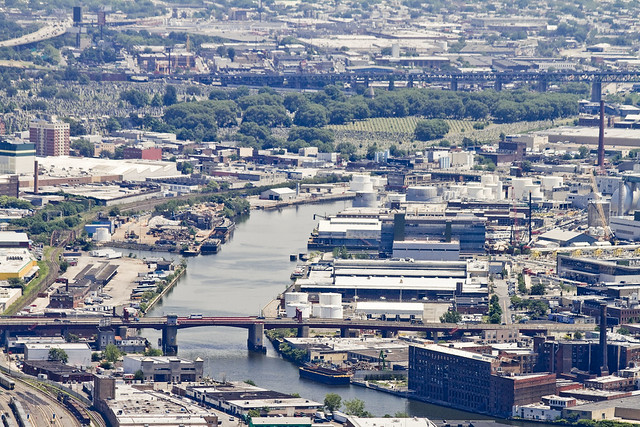
– photo by Mitch Waxman
That green patch is Calvary, with the thrice damned Kosciuszko framing it. Dutch Kills and the SimsMetal Newtown Creek Dock would be at the “9” position were the above shot a clock face, with Pulaski Bridge at the bottom. The Petroleum District in Greenpoint is about where the three would be, and you can just make out the Greenpoint Avenue Bridge. About where the “5” would be- notice the barge at TNT scrap metal on Manhattan Avenue?

– photo by Mitch Waxman
Dizzying, the extreme altitude began to work on my delicate constitution and the shooting session had to be cut short. Additionally, all I was able to think about was the Newsboy Governor and the Knickerbocracy’s Four Hundred for some reason.

– photo by Mitch Waxman
This is the sort of view of the Newtown Creek which I prefer, up close and personal, rather than from atop the world’s fourth largest building. The biggest problem with the Empire State Building’s observation deck, after all, is that you can’t see the Empire State Building.
____________________________________________________________________________
Click for details on Mitch Waxman’s
Upcoming boat tours of Newtown Creek
July 22nd, 2012 NEXT SUNDAY- There are Just a few tickets left, don’t miss out
Working Harbor Committee Newtown Creek Boat Tour
clearing sky

– photo by Mitch Waxman
While scuttling across the Greenpoint Avenue Bridge recently, enroute to a Newtown Creek Alliance meeting featuring a presentation by the DEC’s head oil spill man -Randall Austin, this fellow was observed hard at work by one unused to such exertion. As a zoom lens was already affixed to my camera, I decided to see what might be captured, and realized that I knew almost nothing about the process of welding.
Of course, what I do know about is Newtown Creek.
from wikipedia
Welding is a fabrication or sculptural process that joins materials, usually metals or thermoplastics, by causing coalescence. This is often done by melting the workpieces and adding a filler material to form a pool of molten material (the weld pool) that cools to become a strong joint, with pressure sometimes used in conjunction with heat, or by itself, to produce the weld. This is in contrast with soldering and brazing, which involve melting a lower-melting-point material between the workpieces to form a bond between them, without melting the workpieces.

– photo by Mitch Waxman
On a basic level, I understand the process, but having never undertaken the task- am largely ignorant of its mores. Something I do know of welding, however, it that a welded tank is preferred to a riveted one for bulk storage of petroleum- which was once the industry “standard”.
Incontrovertibly, if one is at Newtown Creek, and the word “Standard” comes up- only one meaning can be gleaned.
from wikipedia
A rivet is a permanent mechanical fastener. Before being installed a rivet consists of a smooth cylindrical shaft with a head on one end. The end opposite the head is called the buck-tail. On installation the rivet is placed in a punched or drilled hole, and the tail is upset, or bucked (i.e., deformed), so that it expands to about 1.5 times the original shaft diameter, holding the rivet in place. To distinguish between the two ends of the rivet, the original head is called the factory head and the deformed end is called the shop head or buck-tail.

– photo by Mitch Waxman
The facility that this torch bearing fellow was at work in is either the Lukoil or Metro depots, but I’m never certain about the property lines in the petroleum district- and given the generally paranoid atmosphere loosed roughly upon society and caused by the ongoing Terror Wars- it’s probably best not to speculate too long about the subject of whose fence begins or ends and where the property lines are.
What’s more interesting about this spot along Newtown Creek, to me at least, is that this laborer was at work in a very special spot- historically speaking.
from wikipedia
Oil depots are usually situated close to oil refineries or in locations where marine tankers containing products can discharge their cargo. Some depots are attached to pipelines from which they draw their supplies and depots can also be fed by rail, by barge and by road tanker (sometimes known as “bridging”).
Most oil depots have road tankers operating from their grounds and these vehicles transport products to petrol stations or other users.
An oil depot is a comparatively unsophisticated facility in that (in most cases) there is no processing or other transformation on site. The products which reach the depot (from a refinery) are in their final form suitable for delivery to customers. In some cases additives may be injected into products in tanks, but there is usually no manufacturing plant on site. Modern depots comprise the same types of tankage, pipelines and gantries as those in the past and although there is a greater degree of automation on site, there have been few significant changes in depot operational activities over time.

– photo by Mitch Waxman
This was right across the street from an early (1840) Kerosene refinery- Sone and Fleming, which was later acquired by John D Rockefeller’s Standard Oil Trust and transformed into an oil refinery. This facility has been mentioned before, in connection with an armageddon like blaze which Greenpoint suffered through in 1919. Such disasters were fairly common occurrences in the early days of oil refining and storage depots, and often were caused or made worse by weaknesses in petroleum tanks that were defectively riveted.
Today, there are no refineries along the Creek, it’s all about distribution and temporary storage.
from nytimes.com
TWENTY ACRES OF OIL TANKS ABLAZE; BIG FACTORIES BURN; Flames Cross Newtown Creek from Standard Yards Storing 110,000,000 Gallons of Oil. LOSS RUNS TO MILLIONS Each Fresh Explosion Fills the Sky, as from a Volcano, with Flame and Smoke. 1,200 FIREMEN AT THE SCENE Blaze Spreads for Blocks–Two City Fireboats Catch Fire and Two of Crew Reported Missing. TWENTY ACRES OF OIL TANKS ABLAZE Burned in 1883. Crowd All But Engulfed.
also- check this photo at cah.utexas.edu out, it’s from 1919, showing the fire’s aftermath.

– photo by Mitch Waxman
Welded joins are an order of magnitude better than riveted ones in such structures. Owing to my ignorance of this industrial art, a quick check was made with a neighbor who was formerly a member of a steam fitting trade union. He instructs that a perfect weld should look like a series of quarters overlapping each other seamlessly, and that an x-ray spectrum radiological photograph can be inspected to confirm a firm and lasting fit- something which cannot be obtained with rivets.
See, you learn something new every day- here in heart of the Newtown Pentacle- along the loquacious and utterly provocative Newtown Creek..
from 1921’s Welding engineer, Volume 6, courtesy google books
____________________________________________________________________________
Click for details on Mitch Waxman’s
Upcoming boat tours of Newtown Creek
July 22nd, 2012 NEXT SUNDAY- There are Just a few tickets left, don’t miss out
Working Harbor Committee Newtown Creek Boat Tour
established categories

– photo by Mitch Waxman
This maritime Sunday, it’s a return to the Newtown Creek, where a tug was witnessed heading out to the East River with two barges of what seems to be metal. Unusual best describes the manner in which the barges are tied to the tug, at least in my limited experience. Most of the tandem tows I’ve witnessed over the last several years orient multiple barges in a line, after the manner of train cars in relationship to locomotive engine.

– photo by Mitch Waxman
Although I can report this only from having seen photos, on the Mississippi or other inland waterways, several barges will be lined up in long rows before tugs. Unfortunately, I came upon the Mscene too late to capture any identifying information about this tug, even the identity of its company. Hopefully, our friends at tugster might be generous enough to identify at least the name of the towing corporation based on the “colorway” of the boat for you, gentle readers, in the comments section.
trembling anxiety

– photo by Mitch Waxman
Recent adventure carried your humble narrator from the noble hills of raven tressed Astoria unto the engineered environment surrounding that squamous exemplar of municipal neglect known as the Newtown Creek. Hardly an extraordinary destination, for one such as myself, and noteworthy only because of the early hour at which the visit occurred. Sleep is an enemy to me, surrendered to only when absolutely necessary, and accordingly both my waking and work habits are those of the late rising nocturne.
I’m all ‘effed up.
from wikipedia
Hypnophobia or somniphobia is an abnormal fear of sleep. It may result from a feeling of control loss, or from repeating nightmares. The prefix Hypno- originates from the Greek word hypnos, which means sleep.

– photo by Mitch Waxman
Seldom have I gazed upon the Newtown Creek in such ante meridiem illumination. Tidal influence on the Creek, this far back, is a vertical affair. The horizontal movement of water is slight, but rises and falls a few feet following the patterns set by the East River, which the Newtown Creek is technically a tributary of. The mucoid slick observed in the shots above, I would offer, are fats which were carried out of the sewer outfalls which form a garland about the waterway.
Likely, these are cooking oils and congealed grease.
from wikipedia
Mysophobia (from Greek μύσος – musos, “uncleanness” and φόβος – phobos, “fear”) is a term used to describe a pathological fear of contamination and germs. Someone who has such a fear is referred to as a mysophobe. The term was introduced by Dr. William Alexander Hammond in 1879 when describing a case of obsessive-compulsive disorder (OCD) exhibited in repeatedly washing one’s hands. This phobia is sometimes referred to as germophobia or germaphobia, a combination of germ and phobia to mean fear of germs, as well as bacillophobia, bacteriophobia, and spermophobia.

– photo by Mitch Waxman
There had been rain the night before, one of the powerful bursts which have- so far- made the summer of 2012 remarkable not just for their intensity but for providing punctuation around periods of intense heat. One quarter of an inch of rain resolves, city wide, into a billion gallons of storm water pulsing into a byzantine and often century old network of weirs, tunnels, and pipes. No engineered working of men can endure such sudden volume, and during sustained events especially, should be expected to.
Friends and associates, versed in the esoteric facets of storm water infrastructure management, instruct one not to flush a toilet during a rainstorm unless absolutely necessary- in order to alleviate some of the burden on the system.
from wikipedia
Phobophobia (from Greek: φόβος, phobos, “fear”) is a phobia defined as the fear of phobias, or the fear of fear, including intense anxiety and unrealistic and persistent fear of the somatic sensations and the feared phobia ensuing. Phobophobia can also be defined as the fear of phobias or fear of developing a phobia. Phobophobia is related to anxiety disorders and panic attacks directly linked to other types of phobias, such as agoraphobia. When a patient has developed phobophobia, their condition must be diagnosed and treated as part of anxiety disorders.
____________________________________________________________________________
Click for details on Mitch Waxman’s
Upcoming boat tours of Newtown Creek
July 22nd, 2012- Working Harbor Committee Newtown Creek Boat Tour


 The Newtown Pentacle