Posts Tagged ‘Brooklyn’
strange corridors

– photo by Mitch Waxman
Staying current on the story of Newtown Creek involves attending a lot of meetings. Some are private, most public. Often, they came rapid fire and it feels as if every other evening is consumed. One of the many community groups which hold such gatherings is the Newtown Creek Monitoring Committee. I’m a guest at this particular gathering, and as such an attempt is made to remain silent and observe the proceedings.
The group engages in a dialogue with representatives of the NYC DEP, who are offered input from community representatives regarding issues that might arise from the presence of the Newtown Creek Waste Water Treatment Plant.
One of these issues, as you would imagine, is the spread of odors emanating from the vast facility.

– photo by Mitch Waxman
The DEP contract with a company, called “Odor Science and Engineering”, who specialize in the detection and discovery as well as elimination of point sources for malodorous gases. Luckily, an inspection of the plant by the company was scheduled for the following week and Christine Holowacz (DEP community liaison) arranged for a few of us to accompany the effort.
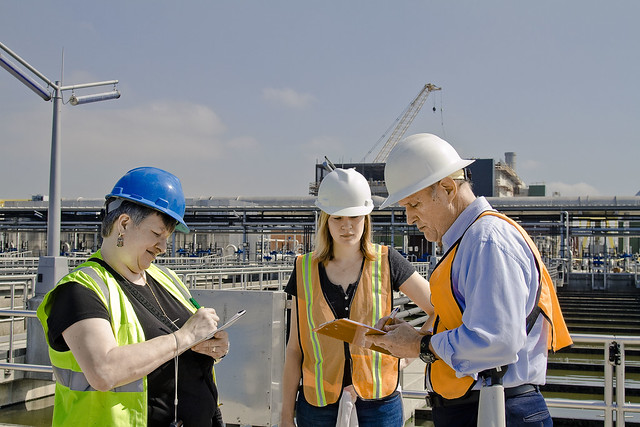
Pictured above is Kate Zidar (Newtown Creek Alliance Executive Director) and Laura Hoffman (Newtown Creek Monitoring Committee), who with myself, showed up bright and early to be fitted with hard hats and vests.

– photo by Mitch Waxman
We were introduced to Dr. Ned Ostojic Ph.D and P.E., Odor Science & Engineering’s Vice President & Director of Engineering.
A tall and dignified fellow, Dr. Ostojic spoke with a barely detectable yet pleasant European accent and was extremely hospitable to us as he described his function at the plant. An engineer, he was tasked with not only finding the sources of odor but describing practical solutions to eliminate them.

– photo by Mitch Waxman
Dr. Ostojic produced a device whose purpose was to combat a human perception bias called environmental adaptation. To describe it simply, the human mind filters out environmental stimuli to create a sense of “normalcy”. If you live on a noisy street, your brain filters out most of that noise and you become inured to the environmental background level. The brain functions in the same way with smell, something I know to be accurate. When I encounter the smell of the Newtown Creek, or of any sewer plant, no reaction is displayed while others openly gag.
My brain has become adapted to Newtown Creek.

– photo by Mitch Waxman
He asked us not to make fun of the devices name, which was a “Nasal Ranger”.
It allows calibrated measurement of smell based on a concentrating chamber which lies behind an aperture dial. The dial allows ever smaller samples to be inhaled into the device, which can then be graded on a subjective and numerical scale. Good science, don’t forget, is all about measurement and objective recording. The Nasal Ranger removes personal interpretation from data records, as its operators are trained according to an empirical standard.

– photo by Mitch Waxman
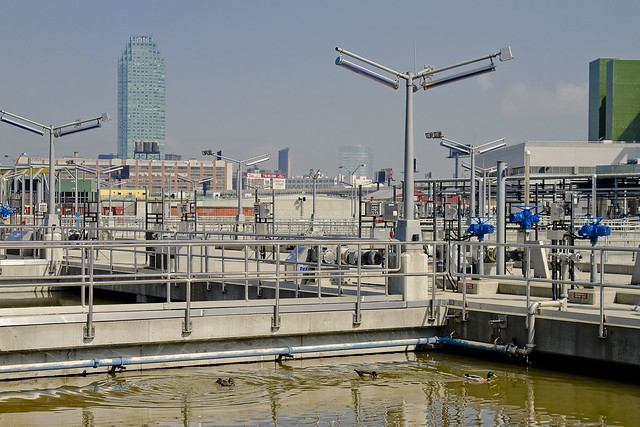
We three accompanied Dr. Ostojic on his walk through of the plant, and his duty this day was the inspection of the settling tanks which allow sewer borne debris to drop out, or be be skimmed from, the wastewater flow before it enters those famous digester eggs which distinguish this plant and betray its location on the skyline of New York City.

– photo by Mitch Waxman
Several times has your humble narrator been allowed to enter and record the grounds of this facility, found along the Newtown Creek, but this side of things has always been off limits because of extreme danger.
One of the curious facts related to me that day was that , were one of us to slip and fall into the highly aerated water and sewage in the tanks surrounding us, the liquid would not display much buoyancy. Because of all the dissolved gas in the liquid, neither would it slow your fall much and you would plummet- as if through air- some two stories to a hard cement floor.
In no uncertain terms, I was told, you would die. This was confirmed by one of my union buddies, who works at another plant in the DEP system.

– photo by Mitch Waxman
This is somewhere around midway through the sewage treatment process, after the larger bits of solute and debris carried in the flow have been removed. When the raw flow hits the plant, it carries wood and boxes and all sorts of garbage and debris with it. This gross matter is removed mechanically at another part of the plant. Next up is grit, which can be sand, soil, or just plain old coffee grounds. The rate of speed at which the wastewater races through the system makes even such innocuous contaminants hazardous to the works, and is removed by more specialized machines housed in separate “grit buildings”.

– photo by Mitch Waxman
Of course, nothing is perfect, and the job of these settling tanks is to skim off any floatable material which has evaded prior filtration. Fats, oils, and a surprising number of cigarette butts, tampon applicators, condoms, and other floatable material is seen at the collection side of the tanks. As they are open to the air, this is one of the spots which Dr. Ostojic regularly inspects and pays a great deal of attention to. He was constantly checking his readings and observations against the prevailing winds.

– photo by Mitch Waxman
Dr. Ostojic wasn’t alone for the inspection and was working with the fellow pictured above, who introduced himself as Gary Grumley. Mr. Grumley was working with a different detection device than Dr. Ostojic, a hydrogen sulfide detector.
Hydrogen sulfide, of course, is a colorless gas which is infamous for the fecund smell of decay commonly referred to as “rotten eggs”. Such emissions are responsible for a lot of community complaints, and are unfortunately part of the complex chemistry which accompanies the disposition of sewage.

– photo by Mitch Waxman
The device itself seemed sturdy, and Mr. Grumley arranged it neatly for photographing. He had begun work several hours prior to our arrival and began transmitting his findings and observations to Dr. Ostojic.

– photo by Mitch Waxman
A graphic map of the plant with its multitude of buildings, service areas, and zones was on Dr. Ostojic’s clipboard.
A running tally of various areas where an unexpected or intense odor was encountered had been kept, and each occurrence was registered with a numerical value or rating. We didn’t encounter anything truly horrible btw.
– photo by Mitch Waxman
An example was offered later in the day by the DEP’s Superintendent of the Plant, Jim Pynn, of Dr. Ostojic’s contributions.
It seems that a problem had developed around the hatches leading to an underground tank, cylindrical in shape, which had been located in a rectangular shaped shaft. An onerous odor was regularly emerging from the shaft, and Dr. Ostojic was called in. He determined that as wind passed over it, a venturi was forming in the space between the cylinder and the right angled walls which suctioned the tainted air from it’s enclosure and into the open air.
Dr. Ostojic’s simple solution, adding chevrons to the sides of the tank which would abort the formation of a vortex, saved the plant a costly redesign of the affected area. The smell stayed where it was meant to, as well.
– photo by Mitch Waxman
Dr. Ostojic was gracious and quite patient with us. A loving nickname for him, which is offered with wide smiles and a wink by those who work at the plant, is “Ned the Nose”.
Usually, when one is invited to attend a meeting at an industrial site in Greenpoint, Brooklyn- with someone named Ned the Nose- the encounter seldom turns out to be as pleasant as this was.

– photo by Mitch Waxman
Newtown Pentacle, we go these places so you don’t have to.
ALSO:

Your humble narrator will be narrating humbly at this year’s Obscura Day event on April 28th, leading a walking tour of Dutch Kills. The tour is already a third booked up, and as I’m just announcing it, grab your tickets while you can.
“Found less than one mile from the East River, Dutch Kills is home to four movable (and one fixed span) bridges, including one of only two retractible bridges remaining in New York City. Dutch Kills is considered to be the central artery of industrial Long Island City and is ringed with enormous factory buildings, titan rail yards — it’s where the industrial revolution actually happened. Bring your camera, as the tour will be revealing an incredible landscape along this section of the troubled Newtown Creek Watershed.”
For tickets and full details, click here :
obscuraday.com/events/thirteen-steps-dutch-kills-newtown-creek-exploration
Veneralia

– photo by Mitch Waxman
Technically speaking, this post is day late and a dollar short, as the holiday of Veneralia was traditionally observed by the Romans on April 1. Given the prankster traditions of our modern culture that revolve around the date, however, it was decided to run an acknowledgement of the holiday today- if the story of Troy has taught us anything, it’s “Don’t mess around with the Goddess of Love”.
from wikipedia
Venus was offered official (state-sponsored) cult in certain festivals of the Roman calendar. Her sacred month was April (Latin Mensis Aprilis) which Roman etymologists understood to derive from aperire, “to open,” with reference to the springtime opening of trees and flowers.
Veneralia (April 1) was held in honour of Venus Verticordia (“Venus the Changer of Hearts”), and Fortuna Virilis (Virile or strong Good Fortune), whose cult was probably by far the older of the two. Venus Verticordia was invented in 220 BC, during the last tears of Rome’s Punic Wars, in response to advice from a Sibylline oracle, when a series of prodigies was taken to signify divine displeasure at sexual offenses among Romans of every category and class, including several men and three Vestal Virgins.

– photo by Mitch Waxman
Veneration… the very root of the word comes from her name, this Roman deity named Venus. She wore many hats, and was worshipped in several aspects. The one which we at Newtown Pentacle HQ revere is the personification of Venus Cloacina, goddess of the main drain. Myrtle adorns the entranceway to that ceremonial room with ceramic tiles which we maintain, and rhyming prayers will be offered before a porcelain altar.
from wikipedia
In Roman mythology, Cloacina (Latin, cloaca: “sewer” or “drain”) was the goddess who presided over the Cloaca Maxima (“Great Drain”), the main trunk of the system of sewers in Rome. She was originally derived from Etruscan mythology. The Cloaca Maxima said to be begun by one of Rome’s Etruscan kings, Tarquinius Priscus, and finished by another, Tarquinius Superbus.
Titus Tatius, who reigned with Romulus, erected a statue to Cloacina as the spirit of the “Great Drain”. As well as controlling sewers, she was also a protector of sexual intercourse in marriage. Despite her Etruscan origins, she later became identified with Venus.

– photo by Mitch Waxman
Towering above the lowest point of New York City in Greenpoint, at the bottom of a geologic soup bowl (as it were), is the greatest temple of this goddess. If fancy strikes, as you drive along the BQE or traverse the streets of our ancient neighborhoods, remember to offer the ancient prayer:
“O Cloacina, Goddess of this place,
Look on thy suppliants with a smiling face.
Soft, yet cohesive let their offerings flow,
Not rashly swift nor insolently slow.
– courtesy sewerhistory.org
ALSO:
Your humble narrator will be narrating humbly at this year’s Obscura Day event on April 28th, leading a walking tour of Dutch Kills. The tour is already a third booked up, and as I’m just announcing it, grab your tickets while you can.
“Found less than one mile from the East River, Dutch Kills is home to four movable (and one fixed span) bridges, including one of only two retractible bridges remaining in New York City. Dutch Kills is considered to be the central artery of industrial Long Island City and is ringed with enormous factory buildings, titan rail yards — it’s where the industrial revolution actually happened. Bring your camera, as the tour will be revealing an incredible landscape along this section of the troubled Newtown Creek Watershed.”
For tickets and full details, click here :
obscuraday.com/events/thirteen-steps-dutch-kills-newtown-creek-exploration
skillfully wafted
– photo by Mitch Waxman
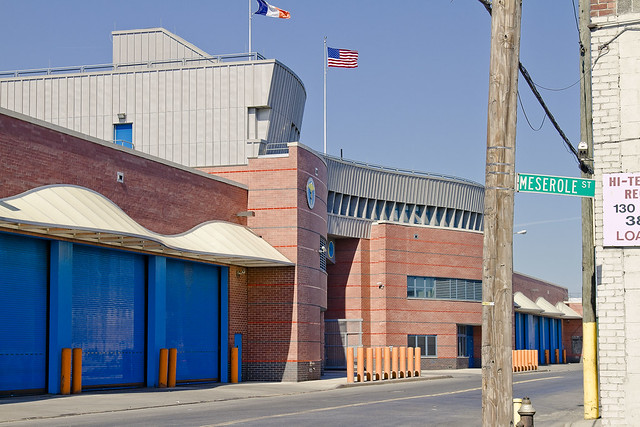
As mentioned in the Newtown Pentacle posting “Approaching Locomotive“, a recent opportunity to visit the gargantuan Waste Management facility on Varick Street in Brooklyn (whose back yard abuts the English Kills tributary of the fabled Newtown Creek) materialized. your humble narrator has long desired to witness the place, so I jumped at the chance.
As a note- I’m a member of Newtown Creek Alliance, and so is one of the subjects of this posting. Said admission is offered in the name of avoiding charges of bias, nepotism, or cronyism.
from wikipedia
Waste Management, Inc. (NYSE: WM) is a waste management, comprehensive waste, and environmental services company in North America. Founded in 1894, the company is headquartered the First City Tower in Houston, Texas.
The company’s network includes 367 collection operations, 355 transfer stations, 273 active landfill disposal sites, 16 waste-to-energy plants, 134 recycling plants, 111 beneficial-use landfill gas projects and six independent power production plants. Waste Management offers environmental services to nearly 20 million residential, industrial, municipal and commercial customers in the United States, Canada, and Puerto Rico. With 21,000 collection and transfer vehicles, the company has the largest trucking fleet in the waste industry. Together with its competitor Republic Services, Inc, the two handle more than half of all garbage collection in the United States.

– photo by Mitch Waxman
Accompanying a class of high school students from “The Green School” on Graham Avenue in Williamsburg, we arrived at the Titan depot early in the afternoon. Early for the diurnal, of course, but late in the day for the Waste Management folks who get more accomplished before sunrise than most do by sunset.
The Green School is a 9th-12th grade learning community that develops science, math, literacy, and social studies skills in the context of New York City’s many environments. Through rigorous interdisciplinary curricula and hands-on experiential projects, students will engage with their environment, participate meaningfully in community life, and prepare for their futures.
While focusing on “green” careers, the school’s primary theme is sustainability, a concept and a practice that incorporates and recognizes the interconnectedness of the environment, the economy, society, and culture and promotes practices with the future in mind. The curricula focus on giving students scientific, historical, and contextual knowledge to make meaningful connections between their lives and the broader world, and the math and literacy skills they need to participate in that world. Students are able to demonstrate mastery of academic work in portfolios, examinations, and reflections by applying it to the world around them, explaining the geometry in the arc of an elevated train, deducing air quality using the scientific method, or designing and carrying out learning experiences for local elementary students. Students participate in community service projects, internships and apprenticeships, and do independent projects based on their interests each year.
The mission of The Green School lends itself to create a school environment open to the diverse needs of ELL, special education, gifted and struggling students. The Green School is committed to provide all students an education and the required skills that are transferable from the classroom to their collegiate and/or professional pursuits.

– photo by Mitch Waxman
The two fellows at either end of the shot above are Newtown Creek Alliance’s Michael Heimbinder and Marc Ottaviani, 11th grade English Language Arts teacher. Michael, in addition to his NCA work, is involved in several other projects- one of which is habitatmap.org.
from habitatmap.org
Michael Heimbinder, Founder & Executive Director
Michael Heimbinder is a writer, researcher, community organizer and information designer. Over the years he has collaborated with a wide range of environmental and human rights organizations including the Newtown Creek Alliance, the United Nations Equator Initiative, the Ghana Wildlife Society and Food First. He is also a Fellow at the Oakland Institute and a technical advisor to the Organization of Waterfront Neighborhoods where he consults on solid waste management issues in New York City. Michael is a graduate of Colorado College and received his M.A. in International Affairs from the New School for Social Research.

– photo by Mitch Waxman
The program which the kids are taking part in, funded by the NYCEF fund of the Hudson River Conservancy, is built around the habitatmap concept, and is described thusly:
“School to develop and teach a ten week course that instructs 11th grade students on maps-based research methods focusing on two facilities adjacent to Newtown Creek: the Newtown Creek Wastewater Treatment Plant and Waste Management’s Varick Avenue Transfer Station. The selected facilities are the starting point from which the students are examining water and waste systems by geographically tracing the material flows and institutional networks that connect these facilities to the larger world. The students’ findings will be documented using HabitatMap’s community mapping platform and integrated into a maps-based research methods toolkit. The toolkit will be used by high schools, both in New York and nationally, to conduct investigations of water and waste systems in their own communities using examples from Newtown Creek.
By developing coursework that combines technology, classroom learning, and field research the curriculum is specifically designed to meet the Green School’s mission, which aims to prepare students for their future studies and employment “through rigorous interdisciplinary curricula and hands-on experiential projects that encourage students to engage with their environment and participate meaningfully in community life.”
also from habitatmap.org
Mission
HabitatMap is a non-profit environmental health justice organization whose goal is to raise awareness about the impact the environment has on human health. Our online mapping and social networking platform is designed to maximize the impact of community voices on city planning and strengthen ties between organizations and activists working to build greener, greater cities. Utilizing our shared advocacy platform participants can:
- Alert the public to environmental health hazards
- Hold polluters accountable for their environmental impacts
- Highlight urban infrastructures that promote healthy living
- Identify future opportunities for sustainable urban development
- Promote policies that enhance equitable access to urban resources

– photo by Mitch Waxman
As such class trips have begun since the dawn of time, we were brought to a room where one of the Waste Management superintendents and staff described the process, and procedural habits, of the transfer station. A transfer station, for those of you unused to such terminology, is a concentrating point for the garbage collected by the DSNY and others for sorting and containerizing. The white collection trucks carry their cargo here, where it is loaded onto train cars for eventual disposition into (usually out of state) landfills.
from wikipedia
A transfer station is a building or processing site for the temporary deposition of waste. Transfer stations are often used as places where local waste collection vehicles will deposit their waste cargo prior to loading into larger vehicles. These larger vehicles will transport the waste to the end point of disposal in an incinerator, landfill, or hazardous waste facility, or for recycling
In the future, transfer stations could be equipped with material recovery facilities and with localized mechanical biological treatment systems to remove recyclable items from the waste stream.

– photo by Mitch Waxman
When the DSNY trucks arrive at the facility, they are weighed on enormous vehicle scales like the ones in the shot above. When exiting the facility, they are weighed a second time, and the differential is recorded as the tonnage of waste which was delivered. My understanding is that in the contract Waste Management enjoys with the City of New York, the fees paid for the handling of this putrescent lahar are assessed on a “per ton” basis.
from gothamgazette.com
Other parts of the city’s solid waste plan have moved forward. Twenty-year contracts have been either negotiated or are in effect with Waste Management of New York to export trash from Brooklyn, the Bronx and Queens. The sanitation department is currently negotiating with the Port Authority of New York and New Jersey for a long-term contract to take the vast majority of Manhattan’s refuse to a waste-to-energy plant in New Jersey.
At the time of the solid waste management plan’s approval, the administration argued long-term contracts would save the city money, and it would get the city’s trash off of dirty diesel trucks. Almost 90 percent of city trash, the mayor promised, would be sent by rail or barge instead.
According to the Department of Sanitation, the cost of exporting the city’s trash has increased per ton from $61.30 in 2000 to $92.80 in 2010 — a 20 percent increase over the rate of inflation. As of April, 33 percent of the city’s trash has been unloaded from trucks and put on rail cars — an increase from 14 percent in 2006, according to the solid waste plan.
None of the city’s waste is currently exported by barge, according to the Department of Sanitation, because those transfer stations have not been completed.

– photo by Mitch Waxman
We were informed that our arrival in the afternoon was fortuitous as Waste Management’s schedule is precisely administered to conclude sorting and containerization by a certain time of day which allows them purchase to clean and disinfect their mill. The representatives explained that they are regularly visited by inspection officers and are contractually obligated to several “best practice” regulations.
from habitatmap.org
In 2006 Waste Management NY 215 Varick handled 652,706 tons of material; this sum represents 5.3% of all waste exported through transfer stations in New York City.

– photo by Mitch Waxman
Late in the night and early morning, fleets of collection trucks arrive here, are weighed, and “tip” or discharge their cargo. Enormous machinery, clawed derricks and jotun sized earth moving equipment, flies into action. This can be an enormously dangerous place to work, were routine safety procedures not strictly observed. Even so, extreme caution was urged as we moved into the relatively empty transfer station.
from nyc.gov
Each week, in Fiscal Year 2010, the Department assigned approximately 4,941 trucks to collect 49,922 tons of curbside residential refuse and scheduled 460 E- Z Pack and Roll-on/Roll-off containerized trucks to collect an additional 8,000 tons. The amount of refuse generated by the 8.2 million residents of New York City is subject to seasonal variations. Each month, the Department allocates weekly truck and tonnage targets to each of its 59 districts to better manage our productivity. These targets are closely monitored to ensure that productivity improvement goals are met. District Superintendents constantly evaluate routes and tonnage in their districts to achieve these targets.

– photo by Mitch Waxman
The extant mound of trash in these shots was huge, but as mentioned by the Waste Management people, represented only a small fraction of what they handle daily. In fact, they were quite nearly finished processing the daily waste of most of Brooklyn when we arrived. They also explained that the relative lack of odor was due to state of the art equipment maintained at the site which accomplished odor control and elimination via technological means.

– photo by Mitch Waxman
For scale, this stitched panorama image is included. That’s Mr. Heimbinder in the foreground, and he’s around six feet tall. The trash pile was roughly thirty to forty feet high, and covered a fairly large parcel of floorspace. Any estimate I could offer would be wrong, as your humble narrator is notorious for overestimation of such matters. Somewhere between a regulation basketball court and a regulation football field would be my best guess.

– photo by Mitch Waxman
The Waste Management crew were waiting for us to exit the facility before they got back to work, and as schedules must be maintained- we were escorted along. Like a lot of the people you meet in the garbage industry, they were really nice and seemingly “regular joes” who took their jobs seriously. A few of the Waste Management and DSNY personnel who were on site also talked to the kids, assuring them that these were “good jobs” with great pay and a full package of benefits.

– photo by Mitch Waxman
Your humble narrator knows quite a few people employed in this industry, at both public agencies and private carting firms. None of them regret their choices, career wise, but for the early start time which is common at such jobs. Most of the folks I know who are engaged in this trade leave home before the sun comes up, arriving at work by 5 A.M. or thereabouts. Often, a change of clothes is kept in the trunk, as their work clothes can become quite soiled as the day goes on. After a shower, you’d never know what they do for a living.
warm and fragrant

– photo by Mitch Waxman
An appointment in Greenpoint carried me across the Greenpoint Avenue Bridge last Tuesday, and as my habit is to be early to meetings, some time was available for photography. It was an unusual and foggy day, and the mists were creating an enormous depth of field atmospherically. Always a visual pleasure, the GPA bridge offers views of the former Tidewater pumping station on the Queens bank as well as the tank farms of Lukoil and Metro fuel on the Brooklyn bank- which are pictured above.
That’s when I noticed something disturbing.

– photo by Mitch Waxman
We are lucky that we live in the age we do, when an oil slick moving down the languorous Newtown Creek is a remarkable sight. Once upon a time, such visualizations were commonly extant and regularly observed. Luckily, due to regulation and improved industrial practices, such events happen far less frequently than they once did.

– photo by Mitch Waxman
The standard protocol to follow when you observe an oil slick on the Newtown Creek, or anywhere in New York Harbor, is to first document it by taking a picture using your cell phone or digital camera. Make a note of your location and the time. Next, call 311 to alert city authorities, followed by a call to the State DEC spill hotline- 1 (800) 457-7362.
They take these matters quite seriously.

– photo by Mitch Waxman
Take note of whether the tide is coming in or going out, as this will help authorities to pinpoint the source of the contaminants. On this day, the tide was ebbing and the oil slick was flowing toward the East River along the tepid current. It should be mentioned that the obvious petroleum industry presence found alongside the Greenpoint Avenue Bridge is maintained by fairly responsible parties in modernity, and the shot above is not meant to indite or should be viewed as indicative of being responsible for the event depicted in this post.
The slick was coming from the other direction, flowing east to west and traveling beneath the bridge toward them.

– photo by Mitch Waxman
Later that afternoon, after having accomplished my intended goals in Greenpoint, and returning home via the Pulaski Bridge to Queens- a new feature on the lower Creek was noticed. A temporary or floating dock installed nearby the Vernon Avenue Street End, and one of two “work boats” was traveling eastward from it and moving under the Pulaski.
It moved too fast for me to ready the camera, but it bore the screed “spill response boat” upon it.

– photo by Mitch Waxman
Everybody’s friends at Riverkeeper, whom I informed of my observations upon returning home, made inquiries with DEC officials about the nature and extent of this possible spill event. DEC sent back word that the slick was no spill, rather it was likely a result of sediment sampling efforts being carried out by the Federal EPA as part of the ongoing discovery phase of the Superfund process. It seems that while dredging up small quantities of the so called “Black Mayonnaise” which lines the bed of the creek for study, some effluent might have been released into the waterway.
vast enclosure

– photo by Mitch Waxman
When you cut things down to the bone, and ask yourself the question “Who was the New Yorker that most profoundly changed the City?” it always comes back to one fellow. Ray Kelly or Mike Bloomberg would vie for the crown in modernity, in the long view of history Alexander Hamilton, DeWitt Clinton, Boss Tweed, or the Roebling clan have major claims on the title. Robert Moses would tell you that it was himself, and arguably, so would Osama Bin Laden.
In the opinion of a humble narrator, the crown belongs to one man- a Swedish immigrant named Othmar Ammann, and today is his birthday.
from wikipedia
Othmar Hermann Ammann (March 26, 1879 – September 22, 1965) was a American structural engineer whose designs include the George Washington Bridge, Verrazano-Narrows Bridge, and Bayonne Bridge.

– photo by Mitch Waxman
Brooklyn Bridge has the fame, Williamsburg Bridge the infamy, Manhattan Bridge is overlooked. The bridges of Othmar Ammann, however, are the ones which shaped the modern megalopolis and allowed the expansion and diaspora of New York’s laborers from the tenement neighborhoods of the five boroughs to the suburban satellites of modernity. The vast populations of Long Island and New Jersey and Westchester who commute into the city on a daily basis would have never achieved their current size, were Ammann removed from the story.
As a side note, and just to toot my own horn for a moment, the shot above was published last year in the New York Times- check it out here
Also from wikipedia
Othmar Ammann designed more than half of the eleven bridges that connect New York City to the rest of the United States. His talent and ingenuity helped him create the two longest suspension bridges of his time. Ammann was known for being able to create bridges that were light and inexpensive, yet they were still simple and beautiful. He was able to do this by using the deflection theory. He believed that the weight per foot of the span and the cables would provide enough stiffness so that the bridge would not need any stiffening trusses. This made him popular during the depression era when being able to reduce the cost was crucial. Famous bridges by Ammann include:
- George Washington Bridge (opened October 24, 1931)
- Bayonne Bridge (opened November 15, 1931)
- Triborough Bridge (opened July 11, 1936)
- Bronx-Whitestone Bridge (opened April 29, 1939)
- Walt Whitman Bridge (opened May 16, 1957)
- Throgs Neck Bridge (opened January 11, 1961)
- Verrazano Narrows Bridge (opened November 21, 1964)

– photo by Mitch Waxman
Othmar Ammann was a bit of an artist, his bridges achieving a rare thing for engineering projects, which is the elevation of a functional structure to the sublime. A prevailing theory in fine art and graphic design which emerged in the 20th century is “less is more”, and Ammann’s spans are manifestations of this concept in steel and cement.
from smithsonian.com
By the early 1960s, when the George Washington’s lower deck was added (as specified in the original plans), Ammann had all but eclipsed his mentor. Ammann’s other 1931 creation, the Bayonne Bridge connecting Staten Island and New Jersey, was until 1977 the world’s largest steel arch bridge — more than 600 feet longer than the previous record holder, Lindenthal’s Hell Gate Bridge.
Months before his death in 1965, Ammann gazed through a telescope from his 32nd-floor Manhattan apartment. In his viewfinder was a brand-new sight some 12 miles away: his Verrazano-Narrows suspension bridge. As if in tribute to the engineering prowess that made Ammann’s George Washington Bridge great, this equally slender, graceful span would not be surpassed in length for another 17 years.

– photo by Mitch Waxman
Eclipsed by the vain and power seeking during his sunset years, Ammann is one of the forgotten few who crafted the connections between the individual components of the archipelago islands of New York Harbor. Mighty Triborough or the graceful arch of the Bayonne Bridge speak to his sense of esthetic, and indicate that he was in touch with some higher imperative than merely moving automobiles from one place to another.
from nytimes.com
His works soar above the water, spanning the city’s rivers and connecting New York to the rest of the country. But who has heard of Othmar H. Ammann?
Donald Trump hadn’t, at least not back in 1964 when he was a high school student and his father took him to the dedication ceremony for the Verrazano-Narrows Bridge. ”It was a sad experience,” Mr. Trump recalled. ”For years, various politicians had fought the bridge. Now that it was built, I watched as these same people all got up and took credit for it, congratulating themselves and introducing one another. The only one not introduced was the man who made the bridge, Othmar Ammann.


 The Newtown Pentacle