Posts Tagged ‘Brooklyn’
roughly hemispherical

– photo by Mitch Waxman
Good news permeates the City of Greater New York, as a remedy to the various financial crises has emerged. To begin with, the Mayor and City Council have voted to eliminate the wasteful practice of running mostly empty buses during non peak hours, and replacing them with smaller and more efficient vehicles like the one pictured above. Ergonomic and comfortable, the fare has been waved for these new conveyances, in order to encourage ridership and acceptance of the new scheme. Your humble narrator looks forward to “scooping” around the borough, although calling the driver “a backhoe” will be considered a hate crime and socioeconomic slur leveled against a City employee and will be punishable by 15 years forced labor at the Ratner trash mines in Pennsylvania.
Savings- $385 million!!!

– photo by Mitch Waxman
Over in Brooklyn, the “Williamsburg Financial Corridor” has proven to be such a success that the entire Third Ward has been designated an outlying district of Manhattan. Brooklyn will miss it’s emo child, but Manhattan welcomes the “Lower, extremely East Side” (LEES) to it’s family. Win Win for the City, although Brooklyn will still have to fund the schools, hospitals, and other facets of Williamsburg’s municipal infrastructure. The good news is that Billyburgers can now report that they have a Manhattan address to their families back in the Mid-West.
Benefit to Manhattan- 3 billion in property taxes!!!

– photo by Mitch Waxman
Never let it be said, though, that Manhattan doesn’t share the load. In another daring and data driven decision, the Mayor and City Council have agreed to sell the Empire State Building to Dubai. The Sheikhs of that far off desert land have announced their plans to lift the iconic structure from its foundations via the use of a fleet of Skyhook helicoptors and dirigibles. The scheme involves transporting the luckily aerodynamic skyscraper to the shores of Arabia via the heavy lift capability of its Al-Zeppelins, all the way to their exotic Emirate just south of the Persian Gulf.
The City is the big winner in this story however, as both Mayor’s office and City Council members and staff will receive free vacations at the desert resort, during which time they can forget all about April 1st, and the fools they govern over back in New York.
glassy flatness

– photo by Mitch Waxman
Odd and solitary even as a child, amongst my few friends in public school was a fellow named Brian. Despite the occasional beatings he would administer to me, which long experience has taught me to expect when interacting with others, he was an amiable kid. Brian was wont to propagate an urban legend which once permeated Brooklyn, a story which goes like this (phonetically spelled, as Brooklyn patois is critical to the telling):
“So, yooz knows about de Verryzanno Bridgde, rights? When deys wuz bilding its, and pourinz de cement- workers who fell intadee cements would just sinks rights down, and dheres nuttin that could get dones to saves ’em, so’s da bahdeez are still in da bridge. My grandfather’s brudda died dat way, my Uncle Mike…”
translation:
So, you know about the Verrazano Bridge, right? When they were building it, and pouring the cement- workers who fell into the cement would just sink in, and there was nothing that could be done to save them, so the bodies are still in the Bridge… As far as the Grandfather’s brother, versions of the story told by others involved every possible male acquaintance or familial description possible.
from nycroads.com
The foundations, which support the 264,000-ton weight of both the towers and the suspended deck, as well as a design live load of 16,000 tons on the deck, were dug 105 feet below the water on the Staten Island side, and 170 feet below the water on the Brooklyn side. Conventional foundation design called for sand islands that kept water, as well as provided working and storage space. However, because the currents were swift and the ground was unstable in the area, sand islands were not constructed. Instead, “cofferdams,” or vertically interlocking steel sheet pilings, were driven below the surface to protect the caissons. Above each 13-foot-high caisson base, muck and sand were dredged out of 66 vertical concrete shafts. When the caissons reached their predetermined depth, the shafts were filled with water, and caisson tops and bottoms were sealed with concrete. The two tower piers, which contain a combined 196,500 cubic yards of concrete, were completed in less than two years at a cost of $16.5 million.
Two anchorages were then constructed at either end of the Narrows. Each anchorage stands 130 feet high, 160 feet wide and 300 feet long. However, because of the differences below ground, the Brooklyn anchorage contains 207,000 cubic yards of concrete, while the Staten Island anchorage contains only 171,000 cubic yards of concrete. On their inshore ends, they support the two decks of bridge approaches. On their outshore ends, they carry four massive, roller-mounted saddles that support, and move with, the four cables as they change length, either because of temperature changes or because of load changes. The hand-polished concrete exteriors have diagonal patterns that continue the path of the suspension cables. Inside the anchorages, forces from the suspension are transferred at two points: the front of the anchorage (where the compacted cables bend around saddles that rest on inclined steel posts), and near the heel of the anchorage (where eyebars transfer force to inclined girders buried within the concrete). The anchorages cost $18 million to construct.

– photo by Mitch Waxman
This urban legend- and yes, it is– was once omnipresent in the land of Egg Creams and really good Pizza.
So much so that it actually made it to the movies, as you’ll observe in the clip from “Saturday Night Fever” presented below, courtesy of youtube. For a great first person description of the building of the bridge, and the remembered effects of building the Brooklyn pierage in Bay Ridge- check out the inestimable Forgotten-NY’s “Bridge in the Back Yard” posting from 2003 here.
I can tell you that the old guys in Canarsie and Flatbush who worked on the thing always “beamed” a little bit when driving down the Belt Parkway toward the City and seeing it rear up.
from youtube

– photo by Mitch Waxman
Officially, there were three deaths associated with the building of the Verrazano, and the bodies were all recovered. Brooklyn legends notwithstanding, that is actually an incredible number given the size and scope of the project.
But what else would you expect from the maestro, Othmar Amman, on his final project?
from wikipedia
The bridge is owned by New York City and operated by the Triborough Bridge and Tunnel Authority, an affiliate agency of the Metropolitan Transportation Authority. Interstate 278 passes over the bridge, connecting the Staten Island Expressway with the Gowanus Expressway and the Belt Parkway. The Verrazano, along with the other three major Staten Island bridges, created a new way for commuters and travelers to reach Brooklyn, Long Island, and Manhattan by car from New Jersey.
The bridge was the last great public works project in New York City overseen by Robert Moses, the New York State Parks Commissioner and head of the Triborough Bridge and Tunnel Authority, who had long desired the bridge as a means of completing the expressway system which was itself largely the result of his efforts. The bridge was also the last project designed by Chief Engineer Othmar Ammann, who had also designed most of the other major crossings of New York City, including the George Washington Bridge, the Bayonne Bridge, the Bronx Whitestone Bridge, the Robert F. Kennedy Bridge, and the Throgs Neck Bridge. The plans to build the bridge caused considerable controversy in the neighborhood of Bay Ridge, because many families had settled in homes in the area where the bridge now stands and were forced to relocate.
Newtown Creek Waste Water Plant Time Capsule
I received this email a couple of weeks ago- how could I resist going?
New York City Environmental Protection Commissioner Cas Holloway Invites you to join him for the Newtown Creek Time Capsule Ceremony.
Friday, February 11, 2011
The Visitor Center at Newtown Creek, 329 Greenpoint Avenue, Brooklyn
As is usually the case with such events, local political figures and high officials of the municipality can be expected to turn up. DEP Commissioner Cas Holloway, Assemblyman Joe Lentol, and City Council Member Stephen Levin were in attendance, as were several prominent citizens and business leaders of the Greenpoint community were there as well.
The kids in the shots were Class 5-313 of the Samuel P. Dumont P.S. 31 Magnet School for the Arts and Humanities, who placed drawings in a time capsule not to be opened some in 50 years. Other items placed in the capsule included the latest infrastructure and strategic plans of the DEP, periodicals, and other City documents concerning the water system of New York City.
a ghastly plot
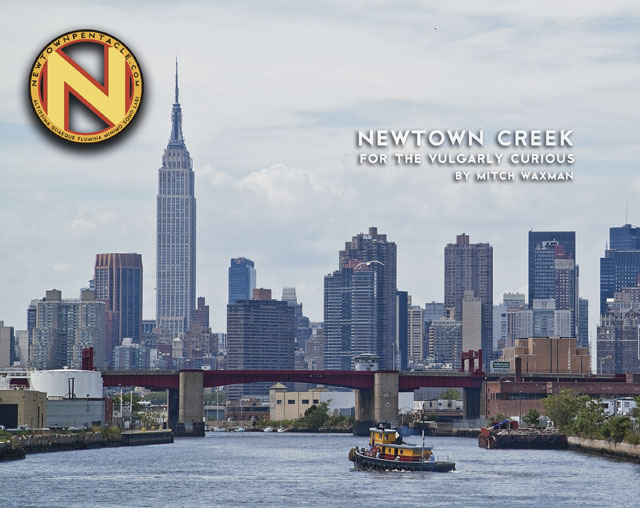
“Newtown Creek for the Vulgarly Curious” is a fully annotated 68 page, full-color journey from the mouth of Newtown Creek at the East River all the way back to the heart of darkness at English Kills, with photos and text by Mitch Waxman.
Check out the preview of the book at lulu.com, which is handling printing and order fulfillment, by clicking here.
Every book sold contributes directly to the material support and continuance of this, your Newtown Pentacle.
Project Firebox 21

– photo by Mitch Waxman
The stout forearms and colorful urban patois which once identified and distinguished those who emanate from storied Greenpoint no longer betray the origins of all its residents, due to the caste of bohemians and esthetes who have lately made the ancient village their home. Observe the ironic wit, sardonic smile, and postmodern vacuity of this long suffering alarm box at the terminus of Greenpoint Avenue where it collides with the East River.


 The Newtown Pentacle