Posts Tagged ‘Maritime Sunday’
scratching restlessly

– photo by Mitch Waxman
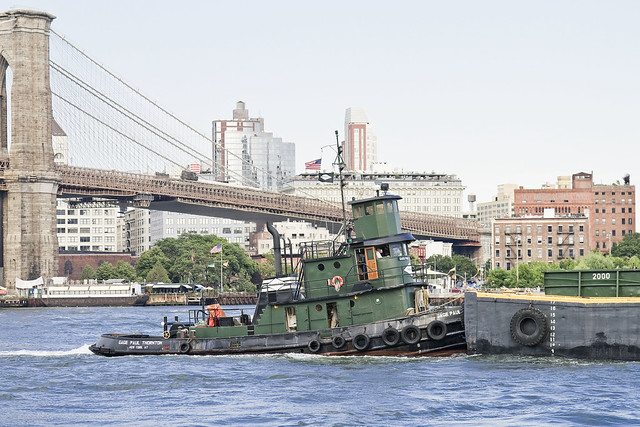
Recently observed, the Gage Paul Thornton moving a fuel barge past Pier 16 in Manhattan, providing some focal point for this week’s “Maritime Sunday”. Picturesque, the spot that the boat is moving through is just loaded with NY iconography, recognizable instantly and impossible to confuse with anywhere else.
from marinesteel.com
Thornton Towing & Transportation is owned by Gerard and Richard Thornton, and Ed Carr; all of whom have spent their entire professional careers working on and around the waters of New York Harbor.
– photo by Mitch Waxman
It’s an odd thing, that when pointing a lens at Manhattan these days, it’s hard to find a place to “pin” the location as identifiably “New York City”. Without the Brooklyn Bridge or Empire State Building in the shot, it’s hard to recognize the formerly iconic skyline anymore. Brooklyn, Queens, and the Bronx still look like NY, but Manhattan has had so much reconstructive and cosmetic surgery that it’s hard to recognize.
another Thornton tug was featured not that long ago at this, your Newtown Pentacle- The Thornton Brothers was seen in the posting “middle stature“

– photo by Mitch Waxman
Similar rhinoplasty and silicon injections are in the works for the other boroughs of course, Williamsburg has had a boob job in recent years, and Long Island City has had a facelift and tummy tuck. One hopes that the process will fizzle out before it goes too far and the Bronx starts to look like Bruce Jenner.
Anyway, a hearty Maritime Sunday shout out is sent to the Gage Paul Thornton and her crew.
from dailymail.co.uk
He was a star athlete and American hero when he brought home the gold medal after the 1976 Olympic Games.
But Bruce Jenner today appears to have chiselled away at the masculine features that graced Wheaties boxes decades ago.
The reality star, better known now as Kim Kardashian’s step-father, was barely recognisable from the retro image as he stepped out for a promotional event this weekend, his face looking distinctly tighter than usual.
glassy or metallic

– photo by Mitch Waxman
Coming home from the Working Harbor Committee Walking tour of the Kill Van Kull yesterday, while onboard the Staten Island Ferry, one of the tour goers pointed out a gargantuan ship passing by and asked me about it. While neither of the ships pictured above and below are that exact vessel, they are of the same class and function. Automobile carriers, they are known to the maritime trade as “Ro-Ro” or “Roll on Roll off” cargo ships, which we’ll be taking a look at this “Maritime Sunday”.
from wikipedia
Since 1970 the market for exporting and importing cars has increased dramatically and the number and type of RO/ROs has increased also. In 1973, Japan’s K Line built European Highway, the first pure car carrier (PCC), which carried 4,200 automobiles. Today’s pure car carriers and their close cousins, the pure car/truck carrier (PCTC) are distinctive ships with a box-like superstructure running the entire length and breadth of the hull, fully enclosing the cargo. They typically have a stern ramp and a side ramp for dual loading of thousands of vehicles (as cars trucks, heavy machineries, tracked units, Mafi trailers, loose statics), and extensive automatic fire control systems.
The PCTC has liftable decks to increase vertical clearance as well as heavier decks for “high and heavy” cargo. A 6500 unit car ship with 12 decks can have three decks which can take cargo up to 150 short tons (136 t; 134 long tons) with liftable panels to increase clearance from 1.7 to 6.7 m (5 ft 7 in to 21 ft 10 in) on some decks. Lifting decks to accommodate higher cargo reduces the total capacity.

– photo by Mitch Waxman
One often spots these gargantua moving slowly about the harbor, most often escorted by at least two tugs. Despite their ungainly appearance, the ships are a great deal more stable than they would appear, or so I am told. Researching this post, tales of Ro Ro ships listing as much as 80 degrees in heavy seas without capsizing have emerged. The economic advantages offered by these vessels, however, far outweigh their risks.
from eukor.com
EUKOR operates a large and modern fleet of specialized Pure Car and Truck Carriers (PCTC), embracing some of the largest vessels in the world – annually transporting around 3 million cars worldwide, utilizing a global network of offices and agents.
Through continuous expansion of our route network, minimization of transit times, utmost attention to cargo-handling quality and a strong dedication to cost savings for our customers, we strive towards delivering total customer satisfaction. Ultimately, we aim to achieve our vision of becoming the best shipping company for the global automotive industry.
We combine the best of what Korea and Europe have to offer. Having Hyundai Motor and Kia Motors as shareholders (20%) gives us a unique growth platform within the industry. Add to that the shareholdings of Norwegian shipping company Wilh.Wilhelmsen (40%) with shipping experience dating back to 1861 and leading Swedish shipping group Wallenius Lines (40%)- founded in 1934 and pioneers in car carrier operations since the 1950′s -and we have created a company of world class competencies.

– photo by Mitch Waxman
The Ro Ro’s, it seems, allow vehicles to be driven onto the ship and then back off at their port of destination. This creates a series of efficiencies when delivering automobiles. Time spent at dock is anathema to shipping companies, and the name of the game is to discharge and acquire new cargo in as efficient and expedient fashion as possible. Expediting such matters, and finding solutions to the never ending flow of goods through the port, is what has made New York the 2nd largest port in the United States (although the secondary ranking is something which officials at the Port Authority will argue against, claiming factual rather than statistical primacy over the currently ranked #1 in California).
This is less of a link than a crib from emails which have been passed around recently by members of the Working Harbor Committee. The source of the information is undoubtedly “official” but I can’t tell you it’s origin.
What actually transpires at The Port of New York/New Jersey:
- Total estimated value of cargo-$176 Billion (2011)
- 6.752 deep draft commercial ship arrivals (over 18/day)
- 1st in nation for petroleum product movement
- 1st in nation for domestic/foreign imports combined
- 3rd largest U.S. port for containerized cargo
- 3rd largest Passenger Ferry service in the world
- 3rd largest Cruise Ship port in the U.S.
In 2011, transported:
- 85 million tons of general and bulk cargo
- 5.5 million twenty-foot equivalent units of containerized cargo (15,058 containers per day)
- 561,965 vehicles
- Distributed to 89-90 million consumers in a 10- contiguous state area (35% of U.S. population
perils faced

– photo by Mitch Waxman
Simple of mind, your humble narrator is always overjoyed when a previously unrecorded Tug passes in front of me. This time around, it’s the Mary Alice operated by Donjon Towing. Extensive operations performed by the corporations boats upon my beloved Newtown Creek have been discussed frequently at this, your Newtown Pentacle, and usage of the search box at the upper right hand corner of this page will reveal many of them to those who typed “Donjon” into it’s text field.

– photo by Mitch Waxman
If horses could swim well, it would take 3,000 of them to equal the output of this Tug’s engines, which drive the hundred foot long and 40 foot high boat through the Kill Van Kull along with its barge. A home town girl, Mary Alice was built in 1974.

– photo by Mitch Waxman
As she passed me by, the comical windmill generator in Jersey- rising over the oil tanks- came into view. For a while, I’ve been wondering if it was put there to provide comic relief to, or just taunt, the petrochemical companies located on the Kill Van Kull. That’s this week’s Maritime Sunday, Lords and Ladies.
established categories

– photo by Mitch Waxman
This maritime Sunday, it’s a return to the Newtown Creek, where a tug was witnessed heading out to the East River with two barges of what seems to be metal. Unusual best describes the manner in which the barges are tied to the tug, at least in my limited experience. Most of the tandem tows I’ve witnessed over the last several years orient multiple barges in a line, after the manner of train cars in relationship to locomotive engine.

– photo by Mitch Waxman
Although I can report this only from having seen photos, on the Mississippi or other inland waterways, several barges will be lined up in long rows before tugs. Unfortunately, I came upon the Mscene too late to capture any identifying information about this tug, even the identity of its company. Hopefully, our friends at tugster might be generous enough to identify at least the name of the towing corporation based on the “colorway” of the boat for you, gentle readers, in the comments section.
tangible things

– photo by Mitch Waxman
Hanging around the East River side of Lower Manhattan recently, your humble narrator was elated to see the Bouchard Tug “Ellen S. Bouchard” transiting past Governors Island. Such prurient thrills are all that I’m still capable of getting excited about these days, so I whipped out the camera and started shooting.
Built in 1982, by Halter Marine of New Orleans, Louisiana (hull #1036) as the Ellen S. Bouchard for Bouchard Transportation of Melville, New York.

– photo by Mitch Waxman
That’s a fuel barge that the tug is managing, and odds would be good that it’s journey began on either the Kill Van Kull or the Port of Newark. It would be foolish to guess where it was headed, except to say that it will drop its cargo off at a distribution center for eventual disposition to end customers via tanker trucks.
From his first voyage at eleven years of age as a cabin boy on a sailing ship bound for China, Captain Bouchard knew that shipping would be his life. By 1915, he was the youngest tugboat captain in the Port of New York.

– photo by Mitch Waxman
The barge would be carrying something close to the equivalent capacity of fifty standard sized oil trucks, and was accordingly making its way through the narrow East River in a slow and deliberate fashion. Such caution is necessary, as an accidental allision or collision would spell disaster for both natural and unnatural features alike.
from wikipedia
Bouchard Transportation Co., Inc, based in Melville, New York, and founded in 1918, is primarily a family and employee-owned company that provides transportation and logistics services in U.S..

– photo by Mitch Waxman
There’s something about the sight of Tug passing under the Brooklyn Bridge that causes one to want to buy a slice of pizza or order a bagel with cream cheese and lox and complain about the Mayor or the Yankees. It’s just so “New York”.
from wikipedia
The tugboat is one symbol of New York. Along with its more famous icons of Lady Liberty, the Empire State Building, and the Brooklyn Bridge, the sturdy little tugs, once all steam powered, working quietly in the harbor became a sight in the city.
The first hull was the paddler tug Rufus W. King of 1828.


 The Newtown Pentacle