Posts Tagged ‘New York City’
virgin aether

– photo by Mitch Waxman
“It’s a meat grinder over there” is a phrase and analogous statement often used by modern pundits to describe a past or present war, firefight, or even a less than welcoming part of the Bronx.
Conjuring imagery of familiar butcher tools spewing out hamburger meat, the term means something else entirely to those versed in the lore of that infamous cataract known as the Newtown Creek.
To those who have stared too long at the blasted heaths of Blissville, “It’s a meat grinder over there” refers to a certain spot in DUGABO (Down Under the Greenpoint Avenue Bridge Onramp), the mention of which engenders the sudden display of wan and pale complexions upon the faces of long time area residents merely at the mention of its cursed and shunned name.
Van Iderstine.
from 1875’s “Report of the Department of Health of the City of Brooklyn, N.Y.“, courtesy google books
FAT RENDERING.
In this process animal fat, obtained from the slaughter-houses and butcher-shops, is exposed to sufficient heat to liquefy it The resulting tallow is removed to settling-vats, and finally [tacked in suitable casks to harden. Up to within the past lew years the methods in use were of the most primitive description, the fatty materia) being placed in open kettles and heat applied at the bottom. As during the heating of the mass very offensive odors are given off, consisting of sulphureted and phosphureted hydrogen and ammoniacal gases, repeated complaints were caused, and it became necessary to adopt some method of correcting the evil.
The most improved methods dispose of the noxious goses by combustion or condensation. The latter is the one adopted by the factories in this district, and consists of the following process. The fatty material is placed in a steam-tight tank (Lockwood & Everett’s), capable of holding about ten thousand pounds; the tank is double, being, in fact, a smaller tank within a larger. The fat is contained in the inner compartment, while the outer is used for holding the steam. On applying the steam heat, pressure is originated in the mass, and the offensive gases thereby forced through a condensing-pipe into Newtown creek below low-water mark. The tallow at a certain stage is passed by its proper pipe to a large open vat, from which it is dipped into casks. The residue, known as “scrap,” is subsequently removed through a trap in the bottom of the tank, and being pressed is sold for fertilizing purposes.
By this method all offense appears to be prevented, and the manufacture might be carried on without prejudice in a built-up portion of the city.
In this district there are three rendering factories of any importance, all situated on Newtown Creek, near Greenpoint avenue. The owners are F. A. Van Iderstine, S. Rosenbaeh and John Van Iderstine.

– photo by Mitch Waxman
Chicago’s Phillip Armour, whose industrial methodology was contemporaneously described as “using every part of the pig except the squeal”, set a standard for the industrial exploitation of animals. Inedible parts of farm or food livestock, spoiled meat or rancid chicken eggs, dead animals such as equines, canines, feral cats- even the collected blood from slaughterhouse killing floors was (and is) a valuable commodity.
Rendering companies receive this organic “raw material” from butcher shops, slaughterhouses, dog pounds, and veterinarians.
In the days of horse and Ox drawn carriages, thousands of dead pack animals found their way to the Van Iderstine mills, which seemed to specialize in larger mammals.
I haven’t been able to locate a primary source for this not locked up behind a paywall, yet, but they apparently handled Elephants.
from fire-police-ems.com
In the early days any animal which died on the streets of New York, such as horses that pulled wagons, circus animals, some as huge as elephants, that died when the circus came to town, were taken to the Van Iderstine Factory. There, they were put into a giant funnel set-up that had huge meat grinders at the bottom which ground up their bodies. These smaller more manageable pieces were brought to other buildings on the large factory premises where the fat was rendered to make soap and glue.
Van Iderstine trucks would also go to butchers all over the city to buy their waste fat and bones.

– photo by Mitch Waxman
Some detail will be presented and discussed in later postings of the subject, as the early Van Iderstine story is obscured behind distaste for their long presence in the community, and reviled on both sides of the Creek. An odd thing, considering they were a major employer and- in one corporate guise or another- the operation was in this spot for a little over a century. There’s a Green Asphalt company in the shot above, which is found in modernity at the extreme eastern side of the Van Iderstine property.
A fire in 1964, coupled with a rising tide of community activism, is said to have led to the company’s abandonment of the site and eventual move to Newark, New Jersey.
from wikipedia
The rendering industry is one of the oldest recycling industries, and made possible the development of a large food industry. The industry takes what would otherwise be waste materials and makes useful products such as fuels, soaps, rubber, plastics, etc. At the same time, rendering solves what would otherwise be a major disposal problem. As an example, the USA recycles more than 21 million metric tons annually of highly perishable and noxious organic matter. In 2004, the U.S. industry produced over 8 million metric tons of products, of which 1.6 million metric tons were exported.
Usually, materials used as raw materials in the rendering process are susceptible to spoilage. However, after rendering, the materials are much more resistant to spoiling. This is due to the application of heat either through cooking in the wet rendering process or the extraction of fluid in the dry rendering process. The fat obtained can be used as low-cost raw material in making grease, animal feed, soap, candles, biodiesel, and as a feed-stock for the chemical industry. Tallow, derived from beef waste, is an important raw material in the steel rolling industry providing the required lubrication when compressing steel sheets. The meat and the bones (which are in a dry, ground state) are converted to what is known as meat and bone meal. For many years meat and bone meal were fed to cattle. This practice is now prohibited in developed countries because it is believed to be the main route for the spread of bovine spongiform encephalopathy (mad-cow disease, BSE), which is also fatal to human beings. Meat and bone meal from cattle is, however, fed to non-ruminant animals and meat and bone meal from non-ruminant animals is fed to cattle in the United States. This may not prove to be a solution to the problem due to the resistant nature of the infectious agent of BSE, a misfolded protein (prion). Therefore, even if cattle is fed to non-ruminant animals and vice-versa, it will not prevent BSE from occurring. The underlying cause is that the prion survives within the system of the animal that has been fed with meat and bone meal from different animals including cattle. These animals are then eventually rendered and fed to cattle, which also results in the development of the disease.

– photo by Mitch Waxman
Effluents, miasma, all sorts of ugly “humours”, hung in the air around the Van Iderstine Mill. A complex of buildings, there would have been dozens of dark blue trucks waiting to tip their loads into the yard. Workers would have sorted fester from boil, fat from bone, and would have had to be quick with both saw and hook- along with possessing a startling ability to ignore a blasting and pestilential stink.
The LIRR tracks, of course, run right alongside the property and provided the factory with freight service. These tracks were also used by passenger trains heading east from Hunters Point.
One colorful description of experiencing Van Iderstine in a passenger train advanced that the writer’s first impression of the distant scene was that a series of smoky campfires had been lit at Van Iderstine, with long plumes of black smoke trailing into an evening sky.
When the train came nearer, he realized that the smoke was actually formed by billions of flies descending on the yard from the swampy wetlands found east of the spot, past Haberman and around Maspeth Creek.
from epa.gov
Volatile organic compounds (VOCs) are the primary air pollutants emitted from rendering operations. The major constituents that have been qualitatively identified as potential emissions include organic sulfides, disulfides, C-4 to C-7 aldehydes, trimethylamine, C-4 amines, quinoline, dimethyl pyrazine, other pyrazines, and C-3 to C-6 organic acids. In addition, lesser amounts of C-4 to C-7 alcohols, ketones, aliphatic hydrocarbons, and aromatic compounds are potentially emitted. No quantitative emission data were presented. Historically, the VOCs are considered an odor nuisance in residential areas in close proximity to rendering plants, and emission controls are directed toward odor elimination. The odor detection threshold for many of these compounds is low; some as low as 1 part per billion (ppb). Of the specific constituents listed, only quinoline is classified as a hazardous air pollutant (HAP). In addition to emissions from rendering operations, VOCs may be emitted from the boilers used to generate steam for the operation.

– photo by Mitch Waxman
Sensational hyperbole is what it seems to be.
Nearly every reference to Van Iderstine and the other renderers- or distilleries like Fleischman Yeast- involves a court case or ordinance condemning them. Rest assured that the horror stories, in particular the ones offered by the NY State Board of Health, are likely true. Reports from community members old enough to remember the operation are less than glowing. It’s just odd.
The Board of Health reports, then and now, are considered sworn testimony- but…
This was the golden age of Tammany Hall.
Entirely speculative, this, but: In the 1890’s, the Tammany boys were cooking up the consolidation of the City of Greater New York, and they very well might have needed a villain or two for their political narratives. I’m just getting started on this one, I’ll let you know what can be squirreled out on the subject.
After all- who can guess, all there is, that might be buried down there?
from 1894’s “Public Papers of Roswell P. Flower, Governor” courtesy google books
A continuous nuisance of a serious character is caused, (a) by Hildebrandt’s Works, located on Furman’s Island, just north of Wissel’s offal dock. This is a small wooden structure where blood and animal refuse matter are treated in an open kettle; (b) by the following rendering establishments: Preston’s Fertilizer and Rendering Works; Peter Van Iderstine, Jr.’s Fat Rendering Works; F. A. Van Iderstine’s Rendering Works; Fred. Heffners Fat Rendering Works.
These rendering establishments depend upon the water of the creek for water supply to furnish their condensers. The latter are used to condense the gases and vapors given off during the process of rendering. These gases and vapors, condensed and held in solution and in suspension in the water, are discharged into the creek with the discharge from said condensers. The creek water is utterly unfit for this purpose, and the creek itself is unfit to receive such discharge, which, under the conditions now existing thereat, is a source of nuisance that can only be abated by closing the rendering works named in this section, or by a radical change in the present method of disposing of the gases in question. The latter, under the circumstances, is not practicable.
____________________________________________________________________________
Click for details on Mitch Waxman’s
Upcoming walking and boat tours of Newtown Creek
July 8th, 2012- Atlas Obscura Walking Tour- The Insalubrious Valley
for July 8th tickets, click here for the Atlas Obscura ticketing page
July 22nd, 2012- Working Harbor Committee Newtown Creek Boat Tour

curious customs
– photo by Mitch Waxman
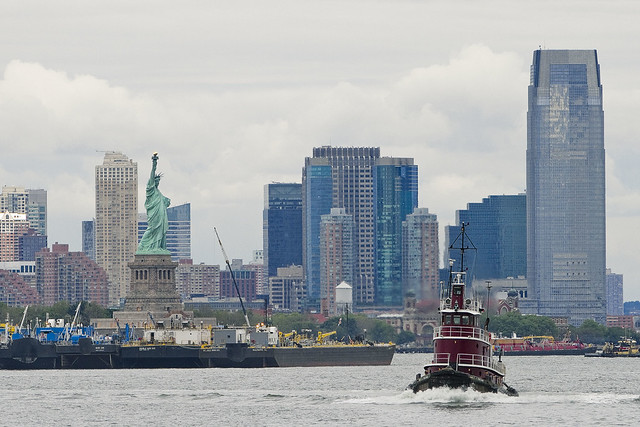
The Marie J. Turecamo tug presented itself to a humble narrator recently, framing iconic views of the harbor for your perusal on this week’s “Maritime Sunday”. Periodically, when some magazine art buyer or advertising stalwart is looking for a harbor shot, my phone will ring and someone will ask for “a tugboat moving past the Statue of Liberty” or something similar. Invariably, the caller is seeking out free usage of the shot.

– photo by Mitch Waxman
Other photographers get angry with me when I allow free usage of this shot or that to various personages or groups, accusing me of devaluing the craft. “Information wants to be free” is my normal reply, and “an image too dearly held has no intrinsic valuation” is the follow up. This is when I’m called a schmuck, and informed that I’m being “taken advantage of”. Allow me to set the record straight on this subject, lords and ladies.

– photo by Mitch Waxman
A regular beneficiary of my largesse, whether it be the estimable Working Harbor Committee or the Newtown Creek Alliance or any of the other “worthy” harbor groups whom I regularly supply images to, receives a limited license to the photo. They cannot, for instance, use my shots in a manner which I haven’t specified or agreed to- web usage versus printed material. A byline is required, and if at any time I decide to ask them to pull the shot, this is my right as I’m retaining the image copyright and full usage rights. In advertising lingo, the shots are offered and licensed as “stock”, and the compensation asked for use of them is somewhat asymmetrical and seldom monetary.

– photo by Mitch Waxman
What I’m ultimately after is photographic access to people, places, and situations which are normally unattainable. I’ve been inside the Manhattan Bridge, walked on a Queensboro bridge completely devoid of traffic, been privy to dozens of situations that “press” photographers would have killed to get near. I’ve been to off limits spots all around the harbor, delved into the deepest recesses of the City, ascended to unattainable and high vantages, and seen things that most living New Yorkers barely suspect. If a group is doing something worth doing, as in the case of WHC with its education programs and senior citizen programming, or NCA’s quest to save the Newtown Creek from sophistry- I’m happy to donate the usage of a few images. On the other hand, if you see something you’d like a print of, or would like to license an image or two for commercial usage- contact me here.
unvocal waves

– photo by Mitch Waxman
Recent business carried me into Manhattan, to a meeting where the alcohol flowed freely and afterwards your humble narrator found himself more than a little tipsy. In prior times of plenty, a taxi might have been hired to carry my besotted husk back to Astoria, but as dire financial circumstances demand- it would be the subway that would ferry me home.
The assignation that night was right in the middle of rich people country, Lexington Avenue in the high 30’s, so the drinks were far better than the usual swill I quaff.

– photo by Mitch Waxman
Making my way through Times Square, by this point more than just a little tipsy and edging on drunk, the notion of attempting a few night shots entered my fevered mind. As mentioned in several prior posts, this is something “I’m working on”. A difficult endeavor under normal circumstance, low light photography is especially interesting after several cocktails have been imbibed over a short interval.

– photo by Mitch Waxman
Luckily, I’ve never felt inhibited taking “street shots” of strangers, and have often been chided for walking right up to people and just starting to click away. Of course, embarrassment ruled over me the next morning, as I found a series of cliche “Times Square Street Photography” shots had been captured in my stupor.
Back to the sobering realities of the Newtown Creek for me.
____________________________________________________________________________
Click for details on Mitch Waxman’s
Upcoming walking and boat tours of Newtown Creek, and Staten Island’s Kill Van Kull
June 30th, 2012- Working Harbor Committee Kill Van Kull walk
for June 30th tickets, click here for the Working Harbor Committee ticketing page
July 8th, 2012- Atlas Obscura Walking Tour- The Insalubrious Valley
for July 8th tickets, click here for the Atlas Obscura ticketing page
July 22nd, 2012- Working Harbor Committee Newtown Creek Boat Tour
vain presence

– photo by Mitch Waxman
One feels as if enough attention hasn’t been paid to Queens of late, and special efforts to program my walks have been accordingly undertaken. Ambitions and obligations have drawn me, more often than not, to Brooklyn in the last few months and it seems as if I spend my days walking back and forth to the Greenpoint Avenue Bridge more than anywhere else.
I haven’t been east of Forest Hills so far this year, nor south of Ridgewood- for instance.

– photo by Mitch Waxman
Special attentions must, as always, be paid to the area around Court Square, Queens Plaza, and Hunters Point- all of which are undergoing thunderous transformations and metamorphoses. Blink just once, it seems, and an entire neighborhood might be transformed into something new and unrecognizably shiny. That thing which cannot possibly exist in the cupola of the Sapphire Megalith doesn’t ever blink, as its singular eye is lidless and likely triple lobed, but it isn’t talking.

– photo by Mitch Waxman
Unadulterated and unbound, Western Queens never fails to disappoint the itinerant photographer plying its lanes. Rhapsodic, the lessons and parables freely observable and extant both inform and instruct. It is said, by physics scholars and quantum mechanists, that reality is altered merely by the act of observation itself.
A humble narrator, therefore, hopes to profoundly alter reality in the coming weeks.
____________________________________________________________________________
Click for details on Mitch Waxman’s
Upcoming walking and boat tours of Newtown Creek, and Staten Island’s Kill Van Kull
June 30th, 2012- Working Harbor Committee Kill Van Kull walk
for June 30th tickets, click here for the Working Harbor Committee ticketing page
July 8th, 2012- Atlas Obscura Walking Tour- The Insalubrious Valley
for July 8th tickets, click here for the Atlas Obscura ticketing page
July 22nd, 2012- Working Harbor Committee Newtown Creek Boat Tour
dizzying fear

– photo by Mitch Waxman
Just a short one today.
Several of the neighbors here in Astoria, all of whom were born and raised on the southern end of the European subcontinent, have purchased models and iterations of these so called “Smart Cars”. A lot of good natured ribbing is offered by area wags and devotees of the SUV class of motor vehicles to the owners of these tiny cars, over beers or around the BBQ, focusing in on the diminutive size of the vehicle and what it says about the owner’s various physical attributes or virility. The laughing stops, however, when the Smart Car guy manages to find street parking in quick order, and the mockers are stuck driving around for the better part of an hour looking for an appropriate spot which would be large enough for an elephant to enjoy.
Who’s laughing now?
____________________________________________________________________________
Click for details on Mitch Waxman’s
Upcoming walking and boat tours of Newtown Creek, and Staten Island’s Kill Van Kull
June 30th, 2012- Working Harbor Committee Kill Van Kull walk
for June 30th tickets, click here for the Working Harbor Committee ticketing page
July 8th, 2012- Atlas Obscura Walking Tour- The Insalubrious Valley
for July 8th tickets, click here for the Atlas Obscura ticketing page
July 22nd, 2012- Working Harbor Committee Newtown Creek Boat Tour


