Posts Tagged ‘newtown creek’
mold stained facades
“follow” me on Twitter at @newtownpentacle

– photo by Mitch Waxman
Only 14 days left until the 13th b’ak’tun ends, initiating the Mayan Apocalypse on December 21st. Seeking to visit those places special to me- one last time- before the sun blinks, the heavens crash, and the earth splits- your humble narrator journeyed to the Empty Corridor in Long Island City. Empty Corridor, incidentally, is a term of my own invention- the rest of you know it as 50th avenue.

– photo by Mitch Waxman
The feature rich terrain which surrounds the Newtown Creek and its industrial districts is often difficult to categorize without some sort of assigned nomenclature. The Creek itself…long time readers of this, your Newtown Pentacle, have grown accustomed to the appellations DUKBO (Down Under the Kosciuszko Bridge Onramp), DUPBO (Pulaski), DUGABO (Greenpoint Avenue), even DUMABO (Metropolitan Avenue) to describe various sections using bridge crossings for reference. I’ve called a certain route through Greenpoint “The Poison Cauldron” and another that leads from Bushwick to Maspeth “The Insalubrious Valley”. There is a reason for this, beyond my personal amusement.

– photo by Mitch Waxman
Simply put, the historic place names for these spots have fallen out of common memory. If I said, meet me in Arnheim or at Whites Dock near the Plank Road, how many would be able to reach these spots? In my educated estimation, knowing the various players and personalities of the local historical enthusiasts and area wags, approximately eleven people would have any idea what I was taking about. For a time, the nickname of DULIE (Down Under the Long Island Expressway) was considered for this spot, but that fits the eastward section of Borden Avenue a bit better, so “Empty Corridor” was assigned to it.

– photo by Mitch Waxman
There used to be lots of interesting things here, before Robert Moses rammed the steel viaduct and the midtown tunnel which feeds it through in 1939. There were warehouses that were fed by the freight lines of the Long Island Railroad, as well as a thriving manufacturing community. Nowadays, there are nothing but truck based businesses- UPS is the biggest of them. And cats. Lots of cats.

– photo by Mitch Waxman
One thing you will notice as universal in these industrial backwaters is that ferals are everywhere. Cats, that is. These days, you don’t see packs of dogs roaming about. When your humble narrator was a boy, living in the hinterlands of flatlands and canarsie, it was not uncommon to see 10-20 dogs of dissimilar breeds roaming around. Some were escaped or abandoned pets, but most were the product of miscegenation and rough in appearance and demeanor. These days, Cats seem to be the dominant feral animal.

– photo by Mitch Waxman
Another thing you’ll notice is that laborers in the neighborhood look after these creatures, creating shelters out of plastic crates and depositing large quantities of food. This, of course, provides fuel to the fire, and an unsustainable birth rate. There are only so many birds and rats that can be caught under normal circumstances, and without their tenders, life can get pretty grim for these kitties here in the Empty Corridor.
Tales of Calvary 13- The Callahan monument
“follow” me on Twitter at @newtownpentacle

– photo by Mitch Waxman
It’s the fifth of December, a date which the pagans once called Faunalia. In 1945, Flight 19 disappeared in the Bermuda Triangle, and we only have to wait 16 more days for the Mayan Apocalypse to occur.
Why not spend the day in Section 6?
Cornelius Callahan and his family are represented by an enigmatic monument at Calvary Cemetery, here in western Queens, which is remarkable not just for sheer size but for workmanship and design as well. Callahan was chairman of the building committee for the Catholic Archdiocese, and was credited with being instrumental to the building of the orphan asylums in Kingsbridge by Archbishop Farley himself. He died on June 8, 1911.
You can read his obituary at the nytimes, click through and scroll down to the bottom left of the page.

– photo by Mitch Waxman
It should be mentioned that this monument is the sculptural capstone of a family crypt. In addition to Cornelius, his wife(s), sister, daughter and apparently a pet named Emma are buried beneath this block of carved stone. Daughter Katie M. Callahan was meant to inherit the paternal fortune, provided she bear offspring, but unfortunately she left this mortal coil before her father. The story of the execution of the will has survived the passage of 101 years.

– photo by Mitch Waxman
The will Cornelius left behind stipulated that his properties be sold off and the proceeds divided amongst several individuals but the primary beneficiary was the Archdiocese itself. Records of a lawsuit persist in the historic record which state that the Church and other heirs would have preferred the deed to the midtown Manhattan properties rather than the cash, but a judge ruled in favor of Cornelius’s estate and Mr. Callahan’s stated wishes. Even 101 years ago, retaining Manhattan Real Estate was seen as a better investment than selling it, I guess.

– photo by Mitch Waxman
A good amount of looking around revealed little else about the Callahans, although they were obviously people of high station and attainment. Cornelius, as stated above, was the chair of the Building Committee for the Archdiocese of New York during a historical period when it was at its nadir- politically and financially speaking. This was an era of church building, parochial campus expansion, and an age when the Irish (in particular) ruled over the City. Mr. Callahan would have overseen a small army of construction workers, suppliers, and itinerant laborers in his professional capacity.

– photo by Mitch Waxman
You never know who you might run across at Calvary Cemetery. The Original Gangster, a King of Ireland, the Abbot, or even the Newsboy Governor. This is where Tammany Hall lies, dreaming but not dead, alongside those huddled masses who legendarily yearned to breathe free. Wandering its emerald devastations, one can barely hope to comprehend the transmogrification accomplished by those interred here. They found a city of two and three story wooden buildings, and within a generation or two, altered it into the heroic shape of modern day New York City.
Have a happy Faunalia, lords and ladies, and embrace your loved ones, for the Mayan Apocalypse draws nigh.
glassy eyes
“follow” me on Twitter at @newtownpentacle

– photo by Mitch Waxman
17 days to the Mayan Apocalypse, and for a preview of things to come- turn to the loathsome shoreline of the Newtown Creek at Hunters Point in Long Island City. These shots are from a few days after Hurricane Sandy. There isn’t normally garbage hanging from the trees here- one of the fellows I was with commented “check out the Sandy Christmas Tree”. Normally, there may be some wind blown detritus about, but this is incredible.

– photo by Mitch Waxman
This piece of construction equipment, I was told, was wrecked by the flood water. It did seem pretty rusty, but heavily used machines often are. What distinguished it was the fact that it was just hanging open, and normally a mechanism like this is locked up tightly to guard against vandalism and theft. As a resident of Queens, you will often see heavy equipment just driving down the street- backhoes, earth movers, cranes. There is no absolute law in Queens, instead permutation and interpretation rule, and anything is probable at any given moment. It would not surprise me to see a space shuttle towed by a van going down a one way street, on its way to a scrap yard.

– photo by Mitch Waxman
One of the working guys from a nearby property told me that the water was about four feet high around this spot. The real flood was down near the LIC Crab House which apparently suffered major damage from the surge tide.
indefinable odors
“follow” me on Twitter at @newtownpentacle
This is a reblog of the post “indefinable odors“, which focused in on the little commented Hunters Point Avenue Bridge. Sorry for the repeat, fresh and new stuff is in the pipes.

– photo by Mitch Waxman
Down by Dutch Kills, one must persevere to maintain some inkling of hope for the future of mankind.
Saying that, however, in its own way Dutch Kills is actually quite a lovely place- as storied industrial centers which have seen better days typically are. A canalized waterway, Dutch Kills is a tributary of that languid cautionary tale known as the Newtown Creek, and has been isolated for several seasons from its principate source by emergency bridge construction and a changing industrial landscape. I’m down here a lot of course, most recently in the “from some point in space” posting of November 3rd, which includes an intriguing set of high elevation shots of the area which I recently managed to capture.
from nyc.gov
Hunters Point Avenue is a two-lane local City street in Queens. Hunters Point Avenue is oriented east-west and extends from 21st Street to the Long Island Expressway/Brooklyn Queens Expressway interchange in Queens. The avenue is parallel to and approximately one block south of the Long Island Expressway. The Hunters Point Bridge over Dutch Kills is situated between 27th Street and 30th Street in the Long Island City section of Queens, and is four blocks upstream of the Borden Avenue Bridge. It is a bascule bridge with a span of 21.8m. The general appearance of the bridge has been significantly changed since it was first opened in 1910. The bridge provides a channel with a horizontal clearance of 18.3m and a vertical clearance, in the closed position, of 2.4m at MHW and 4.0m at MLW. The bridge structure carries a two-lane, two-way vehicular roadway with sidewalks on either side. The roadway width is 11.0m, while the sidewalks are 1.8m wide. The width of the approach roadways vary from the width of the bridge roadway. The west approach and east approach roadways are 13.4m and 9.1m, respectively.
The first bridge at this site, a wooden structure, was replaced by an iron bridge in 1874. That bridge was permanently closed in 1907 due to movement of the west abutment, which prevented the draw from closing. It was replaced in 1910 by a double-leaf bascule bridge, designed by the Scherzer Rolling Lift Bridge Company. The bridge was rebuilt in the early 1980′s as a single-leaf bascule, incorporating the foundations of the previous bridge.

– photo by Mitch Waxman
Seldom commented, the Hunters Point Avenue Bridge segments Dutch Kills neatly, and has done so for nigh on a century now. The marshes and streams which once typified the area before the advance of railroad and vast agglutination of industrial installation are long gone, relegated to subterranean sewers and masonry clad spillways, but a century ago- the Hunters Point Avenue Bridge (and its predecessors) allowed egress between the terrestrial isolation of the Long Island City center and the rest of western Queens.
The NY Times, in 1908, commented that Long Island City might someday be known as “A city of bridges” due to the many crossings over the tributaries of the Newtown Creek and the presence of mighty Queensboro at its center.
from federalregister.gov
The Hunters Point Avenue Bridge, at mile 1.4, over the Dutch Kills has vertical clearances of 8 feet at mean high water and 13 feet at mean low water. The existing regulations for the Hunters Point Avenue Bridge in 33 CFR 117.801(d) require the draw to open on signal if at least a one-hour advance notice is given to the drawtender at the Grand Street/Avenue Bridge, the NYCDOT Radio Hotline, or NYCDOT Bridge Operations Office. In the event the drawtender is at the Roosevelt Island Bridge or the Borden Avenue Bridge, up to an additional half-hour delay may occur.
The bridge owner, the New York City Department of Transportation (NYCDOT), submitted bridge opening log data to the Coast Guard for review. The bridge owner plans to operate these bridges with multiple crews of drawtenders. The two-hour advance notice should allow sufficient time for the crews to operate these bridges due to the close proximity of the bridges to each other. Recent yearly openings have been relatively low which will allow the bridge owner to utilize the roving crew concept and still meet the needs of navigation.

– photo by Mitch Waxman
The Hunters Point Avenue Bridge (the 1910 version) was configured differently than the modern structure when first built, although the original was constructed for some $95,214 from plans by the Scherzer Rolling Lift Bridge Company with the dirty work performed by the Duseath Engineering Company of 114 Liberty St. NY. As you’d imagine, there is a certain logic behind the esoterica presented about this obscure little bridge found in a literal “industrial backwater” in Queens.
But… I can’t tell you what is is yet… (it was a Bridge centennial parade)
from nysdot.gov
About 1900, most of the Newtown Creek was bulkheaded and occupied by about fifty industrial properties. Undeveloped or less developed sections without bulkheads included Dutch Kills, about 2,000 feet of shoreline in Queens just above Dutch Kills with two LIRR lighterage piers, about 1,000 feet of shoreline in Queens near the Penny Bridge, and about 3,500 feet of shoreline downstream of Maspeth Avenue in Brooklyn.15 Dutch Kills, and the Queens side of Newtown Creek, just upstream of Dutch Kills, were developed circa 1905-1912, largely through the efforts of the Degnon Terminal & Realty Company. The Degnon firm created an industrial park with rail and marine access around Dutch Kills between about Hunters Point and 47th Avenue, Dutch Kills subsequently was included within USACE dredging projects. Without federal assistance, Degnon created a 150-foot-wide channel with 2,400 feet of bulkhead, including a turning basin. To create rail links to the development, Degnon helped the LIRR build a new 1,000-acre freight terminal circa 1907 along Newtown Creek east of Dutch Kills on property bought from Calvary Cemetery, including several short piers intended to handle heavy freight such as brick, coal, lumber, and ice. From this terminal, a private Degnon Terminal Railroad was created, largely through local streets. On newly filled marshy margins of Dutch Kills, Degnon Terminal & Realty promoted industrial development both on and away from the water. One iron works and several large building materials firms occupied the Degnon waterfront by the early 1920s. Reconstruction of the two movable bridges over Dutch Kills circa 1908-10 contributed to these developments. On other Degnon lots, large firms included the American Eveready Company and the American Chiclet Company, respective makers of batteries and candy.16 Facilitating this growth was the construction of the Queensboro Bridge (1909) and the start of the operation of the IRT subway line in 1917.

– photo by Mitch Waxman
Unfortunately, I can’t announce the news yet… Let’s just say that it would be a good idea to leave the 11th of December open, and that Long Island City is terrible in its grandeur during the winter months.
More on this will be forthcoming by the end of the week.
from wikipedia
Edward Byrne began his civil engineering career in 1886 with the New York City Aqueduct Commission on the construction of the Croton Water Supply System. It is of interest that on this project he met Robert Ridgway, who also was destined to become a distinguished engineer and an outstanding civil servant.
From 1889 to the close of 1897, Byrne worked on highways and bridges for the old Department of Public Works of New York City.
On January 1, 1898, he joined the Department of Bridges and began a striking and noteworthy service which ended in November, 1933, with his resignation from the position of Chief Engineer of the Department of Plant and Structures (the successor of the Bridge Department), in order to assume the duties of Chief Engineer of the Triborough Bridge. His thirty-six years of service in the Department of Bridges, and its successor, the Department of Plant and Structures, may be divided into two periods.
Borden Avenue Bridge
During this period, he was in charge of bridge construction and maintenance, supervising the construction of the Willis Avenue Bridge over the Harlem River, the Vernon Avenue Bridge, the Borden Avenue and Hunters Point Bridges over Dutch Kills, and the old bridge over Flushing River.

– photo by Mitch Waxman
Also, as a note:
I get asked all the time what these signs mean, what they indicate, and how seriously they should be regarded. The powers that be don’t make it easy to find out, for despite the “for more information” attribution, the City doesn’t go into much detail at nyc.gov/dep about them. Partly, this is due to the vogue followed by municipal authorities in recent years which allows private contractors to perform public work. The contractor is under no obligation to release their work into the public domain, as government workers are, and many important details about our metropolis ends up hidden behind corporate firewalls.
Here’s a little of the Batman type detection required to penetrate a purposely obtuse subject, which is a skill I’ve been developing over the lifetime of this, your Newtown Pentacle.
Quoting from hydroqual.com
The Bowery Bay WPCP is permitted by the NYSDEC under SPDES permit number NY-0026158. The facility is located at 43-01 Berrian Blvd., Astoria, NY, 11105 in the Astoria section of Queens, on a 34.6 acre site adjacent to the Rikers Island Channel, leading into the Upper East River, bounded by Berrian Blvd. and Steinway Street. The Bowery Bay WPCP serves an area of approximately 16,105 acres in the Northwest section of Queens, including the communities of KewGarden Hills, Rego Park, Forest Hills, Forest Hills Gardens, North Corona, South Corona, Lefrak City, Elmhurst, East Elmhurst, Jackson Heights, Maspeth, Woodside, Sunnyside Gardens, Sunnyside, Hunters Point, Long Island City, Astoria, Astoria Heights, Steinway, Ravenswood, and Roosevelt Island.
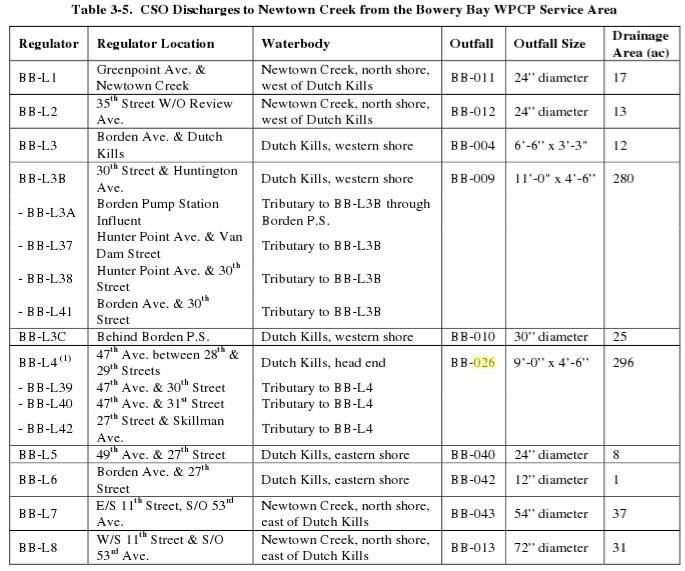
and from the same document this text and chart
The Low Level service area contains 46 regulators, of which 19 interconnected regulators discharge to the Newtown Creek during wet weather through the 13 CSOs. Of these 13 CSOs, 6 discharge to the tributary Dutch Kills (BB-004, 009, 010, 026, 040, and 042), and 6 discharge to Newtown Creek(BB-011, 012, 013, 014, 015, and 043). An additional 2-feet, 8-inches x 4-foot outfall, BB-049, is listed in the Bowery Bay WPCP SPDES permit as discharging to Dutch Kills near 21st Street, but no further information is available such as which regulator it is connected to.
fevered state
“follow” me on Twitter at @newtownpentacle

– photo by Mitch Waxman
Gaze in wonder upon the fabled Newtown Creek of the 21st century, whereupon a tug of the Poling and Cutler towing organization wrestles a fuel barge in a westerly course toward the East River. A famously repeated phrase offered by your humble narrator boldly states that “in the late 19th and early 20th century, Newtown Creek carried more commercial traffic than the entire Mississippi River”, a statement which often causes listeners to roll their eyes. It is inconceivable, given the modern appearance of the Creek and its banks, to believe this statement. Some ask me whether or not tugs and barges even operate along the Newtown Creek in this dystopian future we have all found ourselves living in.

– photo by nycma.lunaimaging.com, September 11, 1903
Gaze, thereby, upon the Newtown Creek of 1903. This is roughly the same spot, with the Chelsea fiber mill (modern day Manhattan Avenue and GMDC) on the southern (left) or Greenpoint bank and the Newtown Creek towing company docks on the right or LIC bank (modern day Vernon Blvd. street end). Another shot emanating from the NYC Municipal Archives, this is one of the few extant photographic records of the Newtown Creek’s zenith as the “workshop of America” at the height of the second industrial revolution.


