Posts Tagged ‘newtown creek’
hidden laboratory
It’s International Cheese Day, for the industrialized and lactose tolerant nations of this planet.

– photo by Mitch Waxman
3.4 miles from the East River is a spot which one refers to as DUMABO – or Down Under the Metropolitan Avenue Bridge Onramp. The first bridge over the flowing waters of English Kills was erected here (slightly to the west, actually) in 1814 and was privately owned by the Masters brothers, so it was accordingly referred to as the “Masters Bridge.” Historic sources indicate this spot as being, during the colonial to civil war period, the demarcation point between salt and fresh water on the English Kills tributary of the fabulous Newtown Creek. Shellfish were described as being found in “great abundance.” It was once known as White’s Dock, for the vulgarly curious. The precursor of the modern day Metropolitan Avenue Bridge was built in the 1870’s, and the modern bridge (much altered) was erected in 1931.
The fresh water was being fed into English Kills by upland springs and streams in nearby Bushwick that flowed downhill into it, and by ground water entering it from the bottom. Back in 1814, Metropolitan Avenue was just a wooden plank toll road rising up from the swamps, and it was called the “Williamsburgh and Jamaica Turnpike road.” The springs and streams of Bushwick are what attracted beer breweries like the Ulmer people to a then German speaking rural neighborhood to ply their trade, but I digress. The fat renderers and acid factories began to show up in the 1830’s and 40’s around these parts, and notably – Peter Cooper’s “pestilential” glue factory, where Jello was invented, was just a few blocks away.

– photo by Mitch Waxman
NYC DOT has been doing a bunch of work at this spot recently, some sort of construction that they attached to the bridge itself. Unfortunately, they didn’t do anything about the loose soil on the shoreline, nor the decaying wooden bulkheads holding that shoreline in place. Of course, not many people come back here, but it would have been fairly easy to fall into English Kills given the rotting shoreline when the shot above was captured.

– photo by Mitch Waxman
That’s the Mary H. tug, tied up to the Bayside Fuel Depot bulkheads, just east of the Metropolitan Avenue Bridge. This is pretty much the extent of serious maritime access to English Kills given the black mayonnaise/sediment mound situation that gobbles up operational draught and depth. The green wall with all the kit on top is Waste Management’s Varick Street Waste Transfer Station. The Waste Management facility handles predominantly “putrescent” or black bag garbage for the NYC Department of Sanitation, which is processed on site and then loaded onto the so called “garbage train” which travels on the tracks of LIRR’s Bushwick Branch to Fresh Pond and then over the Hell Gate Bridge to points unknown.
Seriously, unknown. I’ve asked and was told “homeland security” precluded the dissemination of where NYC’s garbage is dumped.

– photo by Mitch Waxman
One headed up Varick Street towards industrial Bushwick from Metropolitan Avenue, where this spectacular salt dome structure was encountered. Seriously, no sarcasm is offered, this was a visually interesting and somewhat elegant solution to the problem. The rest of the neighborhood is dull, weathered, depressing. It’s nice to see a bit of color and style on display for something so pedestrian. It’s right next door to the Waste Management facility on Varick Avenue.

– photo by Mitch Waxman
The streets in this section, just south and east of Newtown Creek, are industrial in the extreme. Heavy trucking, the garbage industrial complex… suffice to say that the roadways aren’t exactly bike or pedestrian friendly, and that they are in a sorry state of repair. Watch your step hereabouts, and never cross in front of a driveway without first taking a look. This part of the Newtown Creek watershed is what the band Metallica was likely describing with their “death magnetic” album. There’s “ghost bikes” everywhere you look, the air is a poisonous fume…
Yep, it’s pretty much Tolkien’s Mordor back here.

– photo by Mitch Waxman
Turning off of Varick, I found myself wandering down Stewart Avenue and onto Randolph Street towards the undefended border of Brooklyn and Queens and that hazy industrial borderland which can either be called Ridgewood, East Williamsburg, or Bushwick – depending on whom you ask. Saying that, move quickly through this area, don’t talk to anyone, and certainly do not ask them questions if they speak to you. I would expand on why, but I’d again be told that I’ve seen too many movies, by some rich guy that moved to Hipster Bushwick from Connecticut less than six months ago who is trying to connect with a local art or club scene that they heard about on Instagram.
Of course, I couldn’t have more inconspicuous – the only person for about a square mile not wearing a safety vest and hard hat, and instead clad in a filthy black raincoat flapping about in the poison wind while waving a camera about.

– photo by Mitch Waxman
Speaking of the Bushwick Branch of the LIRR, which carries the garbage train from Bushwick into Queens and its mysterious destination on the continent, it’s just beyond that fence in the shot above. It’s been a while since I wandered through here, and those corrugated fences you see are fairly new, as evinced by a near total lack of graffiti. Back to the implied presence of criminally inclined individuals who are organized into a structure which one might define as a “crew” or a “family,” I’d point out the total lack of graffiti on a visible fence line in North Brooklyn – the high end graffiti capital of these United States.
Go ask someone who grew up in Brooklyn or Queens what that means.
Nevertheless, as is always the case when wandering through the industrial zones surrounding the fabled Newtown Creek, that horrible inhuman thing with the three loved burning eye that cannot possibly exist in the sapphire megalith of Long Island City was watching. It sees all, owns all, knows all.
More to come, next week, at this – your Newtown Pentacle.
“follow” me on Twitter- @newtownpentacle
future freedom
It’s Revolution and Youth Day, in the nation of Tunisia.

– photo by Mitch Waxman
Another day in Calvary, another dead New York City Irishman who changed the world.
During the period between the Civil and First World Wars, the well fed Upper Classes began to comment on the physical degeneracy of the Working Class. Back then, it was expected for an employee to labor 16 hours a day for six days a week. Sunday morning was for Church, but Sunday afternoons saw huge numbers filing into saloons and bars and getting hammered on Liquor. Government wise, it’s the reason why the so called “blue laws” were passed – banning the sale of alcohol on Sundays, but there’s always a way to find a drink (or Heroin, in the modern sense). The working class exhibited horrible levels of physical fitness back then – I guess something about having been a starving peasant who survived a transatlantic journey in steerage and now working sixteen hour shifts in some hellish fertilizer mill or sugar plant, being exposed to every conceivable industrial poison and darting amongst dangerous machines with zero safeguard… it wears you down. The tenement life, with its disease, crowding, poor quality food and water probably didn’t help either.
Across the industrial world, team sports and “physical culture” were created and encouraged, and modern day sports like Baseball and “track and field” promulgated to the unwashed. All roads lead to Calvary, of course, but the general idea was that by getting a bit of exercise – the road to the grave could be lengthened. The creation of the modern Olympic Games were a part of this physical culture movement. You couldn’t work in a factory if you could barely stand up, after all, so the famously sober Captains of Industry supported this burgeoning movement. After all – a well muscled employee can probably do the work of two and spare you a payroll expense.

– photo by Mitch Waxman
Amateur Athletic Associations were formed, with the goal of toughening up the working class and getting them to lower the shot glass in the name of hurling a javelin, or sprinting a hundred yards, or tossing a ball around. Knowing that the fathers of America’s working class were already ruined, the organizers of this new physical culture movement decided to focus in on the sons. The fathers mainly became interested in “athletics” when they realized a new excuse to bet and gamble had appeared that wasn’t as “fixable” or rigged by the Upper Classes (like betting on the horses), but there you go.
In New York City, the Public Schools Athletic Committee was formed, and was headed by a fellow named James E. Sullivan.
Native to New York City, James E. Sullivan lived his entire life in what would be considered southern Harlem today, and his last address was found on 114th street. He was the assistant director of the American team sent to the 1900 Olympic Games in Paris, and Secretary for the American team at the 1904-1912 games in St. Louis, London, and Stockholm. Sullivan was everywhere in the 19th century United States that an athletics competition was underway, and served NYC’s “Metropolitan Association of the Amateur Athletic Union” in various functions on its board of directors for thirty four years. Sullivan’s professional life was in the publishing field, and he was the founder and publisher of “The Athletic News.”
James E. Sullivan wasn’t just successful in life, he was adored by all the right people. He was honored by and appointed to various National roles by Presidents McKinley, Teddy Roosevelt, and Taft. The Kings of Greece and Sweden both decorated him, and honored him with feudal associations in Europe (specifically the Golden Cross of the Knights of the Saviour).
That’s his grave in LIC’s Calvary Cemetery above, and when his funeral cortège was moving from there (Roman Catholic Church of St. Aloyslus, at 132d Street and Seventh Avenue) to here at Calvary, the road was lined with 60,000 schoolboys mourning his passing – according to the NY Times.

– photo by Mitch Waxman
James E. Sullivan died on a surgeons table in Manhattan’s Mt. Sinai Hospital at 11 a.m., on the 16th of September in 1914. He was being treated for an intestinal condition. Sullivan had been ill since surviving a train wreck in 1911, over in Fort Wayne, Indiana.
Inscribed with a white bronze plaque, the monument is dedicated to “James Edward Sullivan, born Nov. 18, 1862 and passed on Sept. 16, 1914. A second carving lists Margaret Eugenia Sullivan, born July 26, 1856 and died July 16, 1923.”
The plaque’s inscription reads “A tribute from the Metropolitan Association of the Amateur Athletic Union.”

– photo by Mitch Waxman

– photo via Wikipedia, click it for their page on James E. Sullivan.
You never know who, or what you’re going to find at Calvary Cemetery in LIC’s Blissville neighborhood. It’s a history book written in marble and bronze, found along the banks of the lamentable Newtown Creek in the borough of Queens.
Tomorrow, something completely different – at this, your Newtown Pentacle.
“follow” me on Twitter- @newtownpentacle
ultimate blackness
It’s Al Capone, Betty White, and Andy Kaufman’s birthday.

– photo by Mitch Waxman
Over in LIC’s Blissville neighborhood, you’ll find the principal burying grounds of the Roman Catholic Church in 19th and early 20th century NYC, called First Calvary Cemetery. It’s called “First” Calvary, as there are three other properties found to the east in Woodside that the church refers to as “Second,” “Third,” and “Fourth.” First, or Old, Calvary has been in use since 1848. Calvary Cemetery is on a hill overlooking the Newtown Creek and is surrounded by the industrial zones of Long Island City and West Maspeth.
The majority of burials in First Calvary occurred between its founding and the Second World War, which means that the monuments found within its fence lines have endured the effects of the endemic atmospheric pollution typical of industrial America prior to the passing of the 1972 Federal Clean Air Act. Acid rain wasn’t a term used prior to that legislation.

– photo by Mitch Waxman
Granite seems to be the best choice for a monument able to weather the atmospherics hereabouts.
Marble rots away, obscuring the legend, iconography, and screed carven into the memorial stones. If you were to run your fingers across the surface of the stone pictured above, a sandy grit would transfer from it to your skin. To be fair, though, there used to be an acid factory right across the street from Calvary Cemetery.
That factory was opened in 1866, and was first known as “General Chemical,” then as “Nichols Chemical,” and then as “Phelps Dodge.” Phelps Dodge, of course, is one of the named “potentially responsible parties” or “PRP’s” in the ongoing Federal Superfund situation on Newtown Creek being investigated by the Environmental Protection Agency.

– photo by Mitch Waxman
Phelps Dodge vacated its property long ago. Back in 1901, when the corporate entity was still called the Nichols Chemical Company, community complaints and a law suit by the cemetery forced them to build what was – at the time – the largest chimney in the United States to release their acidic waste gases high above the ground. It was supported by wooden piles driven into the landfilled Newtown Creek marshlands their factory was built on. These piles supported a 25 foot deep concrete foundation, which in turn provided a stable enough base for a 22,000 ton, 367 feet tall chimney.
Roughly translating that to modern day “building stories,” this was a 36-37 story tall chimney.

– photo by Mitch Waxman
For comparison, the sapphire megalith of Long Island City is 53 stories in height, but three of those stories are below the ground. The Nichols/Phelps complex employed close to 1,500 people back in 1901. The acid factory was merely part of their production line, and the high grade sulfuric acid they were known for as a mere co-product for their true profit center.
The main focus of their business was the refining of copper. The company was producing some 517,000 tons of the stuff, annually, back in 1901 when that chimney went up. Most of the landfill that the company had used to build out the marshy shoreline of Newtown Creek, and upon which they built their factories, was material harvested from the refining processes – specifically slag from their redoubts and furnaces. The original shoreline of Newtown Creek was anywhere from 500-1,000 feet back from the modern shoreline, more or less where the Long Island Railroad’s Lower Montauk Branch tracks are found today.
“follow” me on Twitter- @newtownpentacle
sheerly perpindicular
It’s Friday the 13th…

– photo by Mitch Waxman
Tapophile? Ghoul? Trespasser? I’ve been called all of these things because of my devotion to studying the history of First Calvary Cemetery in the Blissville neighborhood of Long Island City. Calvary Cemetery, for the uninitiates amongst you, was founded by the Roman Catholic Church in 1848 to comply with New York City’s “Rural Cemetery Act” which proscribed the continuing interment of cadavers in Manhattan due to fears of contagious disease. Prior to this, it was common for churches to have graveyards, and far more common was the usage of the dirt floor basements of tenements as ad hoc burial spots for the poor. The law commanded all the major religious denominations to acquire and maintain cemeteries in “rural areas” to house their congregants – which at the time – was a description that included the south eastern corner of Blissville near its border with the Berlin section of Maspeth. The cemetery was consecrated by Archbishop “Dagger” John Hughes in 1848, and there are literally millions buried in this – the original property – and in the nearby Second, Third, and Fourth Calvary Cemeteries. The law also requires the disinterment of buried bodies, which was a ghastly process that occurred in the dead of night, and vast numbers of human remains were removed from their Manhattan graves and barged across the river for reinterment in the new rural cemeteries. There are so many cemeteries in the surrounding neighborhoods of Brooklyn and Queens that the term “cemetery belt” is commonly used to describe the vast acreages of graves. All of these are not Roman Catholic ones, of course. There’s a cemetery for everyone.
For Catholics, however, all roads lead to Calvary.
Calvary Cemetery was founded, and continues to be maintained, by the Roman Catholic Church – specifically by the Trustees of Old St. Patrick’s Cathedral in Manhattan, and it is a very special place. The Trustees consider the cemetery to be an extension of the altar at the Cathedral. To one such as myself, Calvary is a history book, left sitting wide open and found along the Queens shoreline of the noisome Newtown Creek.

– photo by Mitch Waxman
Your best bet is to wander in here, roam around a bit and see what you can see. If you come here looking for something specific, it’s going to be quite frustrating. Let the place talk to you, and it’ll show you exactly what you need to see – just like Queens itself. Don’t force it. Look up, down, all around. Notice things. If you take a hard look at these things, you might be offered a lost or occluded slice of the history of New York City.
That’s the grave of the Malone family – Father Sylvester Malone, his brother Edward and his sister in law Annie. Slice.

– photo by Mitch Waxman
Father Malone… wow… it’s actually amazing to me that he’s not still spoken of in North Brooklyn. Beloved in life, Sylvester Malone was born in Ireland’s County Meath. Malone was recruited to the priesthood by Reverend Andrew Byrne in 1838, and came to America with him. In NYC, Malone fell into the circle of priests surrounding Archbishop John Hughes, and was ordained at Old St. Patrick’s Cathedral in 1844. Malone was shortly assigned to Old St. Mary’s church in Williamsburg. Malone worked a Parish circuit that included the East River side of Newtown (including Astoria’s Hallets Cove) and the former Boswijck – or Bushwick – Colony, including Greenpoint, Williamsburg, and Bushwick. Malone formed a friendship with architect Patrick Keely (who also designed St. Anthony’s in Greenpoint and more than 200 other new gothic churches in the northeastern United States) and the two oversaw the construction of Sts. Peter and Paul church in Williamsburg, which Malone was permanently assigned to in 1852.
The inscription on his memorial reads:
Sylvester Malone. Pastor of St. Peter and Paul’s Church for fifty five years. Regent of the University of the State of New York. Live in Charity with all of your fellow citizens. A curse on prejudice and ignorance. Bane of the human family. As long as you have existence, there can be but little peace and charity.

– photo by Mitch Waxman
Malone was known for his open acceptance of people of other faiths, regularly attending the Jewish community’s Purim Ball, visiting the Masonic Hall, was an outspoken abolitionist, and encouraged his flock to perceive other faiths and cultures as neighbors rather than adversaries. Famously, he was one of the first Catholic priests to embrace the African Americans in his community, presenting honors to the Civil War’s Black Veterans Association. He happily interacted with Protestant denominations as well. While researching this post, some of the earliest usages of the term “tolerance” jumped out at me. You don’t hear much about the modern political concept of “tolerance” in the 19th century, and almost never from the pen of an Irish born Catholic priest based in industrial Brooklyn.
Malone was also a regent of the State University of New York, and remained at Sts. Peter and Paul Church until his death in 1899. Unfortunately, the original building housing his church was demolished in 1957, so I can’t show you that. A modern church building sits on the old site, but the influential gothic design of the original is lost to modernity except for a few blurry old photos.

– photo by Mitch Waxman
There were three Malone Brothers, with Sylvester being the senior. Brother Patrick was the middle son and a Civil Engineer by trade, and Edward was the youngest. Edward fought in the Civil War, was a physician and surgeon of some renown, and died at the age of 52. Patrick and Edward actually died within a few months of each other in 1890. There was a sister too, but I can’t tell you anything about her, and I’m not sure if she ever left Europe or not.
Dr. Edward Malone was born Aug. 5, 1832, and died June 16, 1890. His wife, Annie Loyola Malone, died July 13, 1916.

– photo by Mitch Waxman
You never know what, or who, you’re going to find in LIC’s Calvary Cemetery.

“follow” me on Twitter- @newtownpentacle
guttural accent
Old acquaintance be forgot, all that jazz, in today’s post.

– photo by Mitch Waxman
Last post of 2016 right here, lords and ladies, coming to you from the Empty Corridor of LIC. As y’all know, my favorite part of the concrete devastations for many years has been the splendid isolation it offered, which is getting all screwed up by real estate development. There’s so many more people around these parts than there were ten years ago… where’s a humble narrator got to go to find some solitude and listen to his HP Lovecraft audiobooks? I suppose there’s always Calvary Cemetery, but…
The Empty Corridor, I would mention, is a term of my own invention. It’s the zone of LIC found down under the Long Island Expresway – or DULIE. You’ve got to stay ahead of the real estate people, I always say.

– photo by Mitch Waxman
There’s an MTA owned railroad access road which isn’t exactly a NYC DOT street, despite it having a “29th street” sign hanging on it. It adjoins the Dutch Kills tributary of Newtown Creek, connecting Hunters Point Avenue and 47th avenue. If you send mail to one of the businesses found on this street, you can write the address as “One Dutch Kills” rather than “29th street” and it will be delivered. That’s something I learned in 2016.
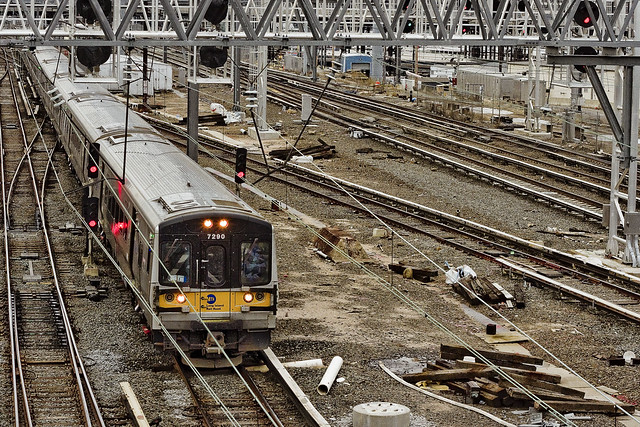
– photo by Mitch Waxman
On the subject of looking forward to 2017, the battle of Queens looms large. The Mayor of NYC announced, a while ago now, that he intends to deck over the titan Sunnyside Yards and build what promises to be a disastrous number of housing units there without a concurrent buildout of infrastructure. Bill de Blasio; the big little mayor, the dope from park slope, the vainglorious ideologue – he’s got another thing coming if he thinks he’s going to wreck Western Queens.
A sleeping activist giant has awoken in this borough, thanks to his homeless hotels, disingenuous neoliberalism masquerading as progressive policy, and his crass Tammany style corruption.
“follow” me on Twitter- @newtownpentacle


 The Newtown Pentacle