Posts Tagged ‘ny harbor’
protecting shade

– photo by Mitch Waxman
Much to the chagrin of Our Lady of the Pentacle, an awful lot of time is devoted to “mah research”, and the recent largesse displayed by the NYC Municipal Records folks in allowing online access to their startling photographic collections has consumed an awful lot of my time.
Of particular interest to me, of course, are the historic shots of Newtown Creek and the surrounding communities at various moments in time. Today’s offering is a comparison of modern conditions with historic ones, which in the shots above and below- portray the venerable Grand Street Bridge in both eras from dissimilar but roughly analogous points of view.
My shot is closer to Queens, with the 1903 one below hugging the Bosserts lumber yard on the Brooklyn side.
Here’s the Grand Street bridge in 1903, when it was brand new courtesy NYC Dept. Of Records

Cool, huh?

– photo by Mitch Waxman
Metropolitan Avenue Bridge, formerly known as Masters Bridge, from English Kills looking west in modernity, and the precursor of the modern span being constructed in 1904 below (also looking west).
DUMABO in 1904, courtesy NYC Dept. Of Records

Also cool, no?

– photo by Mitch Waxman
Meeker Avenue Bridge is what it was called when it opened in 1939, and it was renamed as the Kosciuszko Bridge in 1940. My shot is from the middle of the Newtown Creek, while the historic view below is right next to the Phelps Dodge bulkheads on the Queens side.
Here’s the thing in 1939, courtesy NYC Dept. Of Records

– photo by Arthur J. Foley
____________________________________________________________________________
Click for details on Mitch Waxman’s
Upcoming walking and boat tours of Newtown Creek
July 8th, 2012- Atlas Obscura Walking Tour- The Insalubrious Valley
(note: there are just a few tickets left for this one)
for July 8th tickets, click here for the Atlas Obscura ticketing page
July 22nd, 2012- Working Harbor Committee Newtown Creek Boat Tour

book filled attic

– photo by Mitch Waxman
History has never seen anything even remotely similar to the United States of America.
Other cultures which were “game changers” can be pointed at and commented upon- the Zulu, Egyptians, Hellenes, Romans, Ottomans, and Mongols come to mind. The so called “Great Powers” of Europe and Asia would also demand and merit some mention- especially Spain, China, and France. England has always been special as well, but is noteworthy for doing so much with so little (from a men and material point of view).
The United States, however, is in a league of its own historically.
from wikipedia
Historians have long disputed whether Congress actually signed the Declaration of Independence on July 4, even though Thomas Jefferson, John Adams, and Benjamin Franklin all later wrote that they had signed it on that day. Most historians have concluded that the Declaration was signed nearly a month after its adoption, on August 2, 1776, and not on July 4 as is commonly believed.
In a remarkable coincidence, both John Adams and Thomas Jefferson, the only signers of the Declaration of Independence later to serve as Presidents of the United States, died on the same day: July 4, 1826, which was the 50th anniversary of the Declaration. Although not a signer of the Declaration of Independence, but another Founding Father who became a President, James Monroe, died on July 4, 1831, thus becoming the third president in a row who died on this memorable day. Calvin Coolidge, the 30th President, was born on July 4, 1872, and, so far, is the only President to have been born on Independence Day.

– photo by Mitch Waxman
Problems abound, of course.
Foreign entanglements and unending warfare, a historic record marred by genocide and enslavement, and a disturbing plutocratic tendency which raises oligarchs and their interests to godlike pinnacles. Odd religious movements and a puritanical adherence to an unspoken orthodoxy have been part of this culture since the beginning and are nothing new. Political and spiritual corruption have been part of the national DNA since day one, but it is important to embrace the myth of America.
Was its coming not foretold in the stars?
from wikipedia
SN 1054 is a supernova that was first observed as a new “star” in the sky on 4 July 1054 AD, hence its name, and that lasted for a period of around two years. The event was recorded in multiple Chinese and Japanese documents and in one document from the Arab world. While it has been hypothesized that SN 1054 was also observed by American-Indian tribes and Europeans, it has not been conclusively proven.
The remnant of SN 1054, which consists of debris ejected during the explosion, is known as the Crab Nebula. It is located in the sky near the star Zeta Tauri (ζ Tauri). Some of the remnant of the explosion formed a pulsar, called the Crab Pulsar (or PSR B0531+21). The nebula and the pulsar it contains are the most studied astronomical objects outside the Solar System. It is one of the few Galactic supernovae where the date of the explosion is well known. The two objects are the most luminous in their respective categories. For these reasons, and because of the important role it has repeatedly played in the modern era, SN 1054 is the best known supernova in the history of astronomy.

– photo by Mitch Waxman
Vain, easily offended, and quickly angered- sophmoric and uncultured- dross.
Globally, the reputation of the Nation is not what we think or have been told it is. Our steady diet of jingoistic nationalism and readiness to embrace political mythologies scares the hell out of Europeans in particular, and the simplistic interpretations of centuries old global conflicts favored by the proletarian masses of North America reduce Near Eastern and Asian intellectuals to tears. Remember that the question asked by many Americans in the days and weeks following the September 11th attacks was “Why do they hate us?”.
Certain schools of thought will opine that the modern Constitutional Republics are the end product of a historical cycle that began during the Protestant Reformation, continuing though the European Renaissance and subsequent industrial revolution with the United States merely a notable example. Others will describe a largely agrarian and mineral rich country, one which was presented with a historic opportunity during and after the second Thirty Years War (ww1 and ww2)– a moment which is now withering away as other players approach their paramount. Such navel gazing, however, misses the point.
The real question, unasked, was “Why don’t they love us?”.
from wikipedia
American exceptionalism is the theory that the United States is different from other countries in that it has a specific world mission to spread liberty and democracy. In this view, America’s exceptionalism stems from its emergence from a revolution, becoming “the first new nation,” and developing a uniquely American ideology, based on liberty, egalitarianism, individualism, populism and laissez-faire. This observation can be traced to Alexis de Tocqueville, the first writer to describe the United States as “exceptional” in 1831 and 1840. Historian Gordon Wood has argued, “Our beliefs in liberty, equality, constitutionalism, and the well-being of ordinary people came out of the Revolutionary era. So too did our idea that we Americans are a special people with a special destiny to lead the world toward liberty and democracy.”
The specific term “American exceptionalism” was first used in 1929 by Soviet dictator Joseph Stalin chastising members of the Lovestone-led faction of the American Communist Party for the heretical belief that America was independent of the Marxist laws of history “thanks to its natural resources, industrial capacity, and absence of rigid class distinctions.”
Although the term does not necessarily imply superiority, many neoconservative and American conservative writers have promoted its use in that sense. To them, the United States is like the biblical “shining city on a hill,” and exempt from historical forces that have affected other countries.

– photo by Mitch Waxman
Today is the Fourth of July, and the 236th time that this date has had a contextual meaning that makes it remarkable. It’s the anniversary of when the game changed, and the end of an age of Kings and Emperors. Today is when a continent’s worth of people crack open a beer, char meat over a fire, and detonate small explosives to celebrate this distant event. It’s also a day when we should consider what has gone before, and remind ourselves that tomorrow will always be better than today.
That’s the American Way, and such optimism is the reason why history has never seen anything like the United States.
from Thomas Paine’s “Common Sense“, courtesy wikisource
We ought to reflect, that there are three different ways, by which an independancy may hereafter be effected; and that one of those three, will one day or other, be the fate of America, viz. By the legal voice of the people in Congress; by a military power; or by a mob: It may not always happen that our soldiers are citizens, and the multitude a body of reasonable men; virtue, as I have already remarked, is not hereditary, neither is it perpetual. Should an independancy be brought about by the first of those means, we have every opportunity and every encouragement before us, to form the noblest purest constitution on the face of the earth. We have it in our power to begin the world over again. A situation, similar to the present, hath not happened since the days of Noah until now. The birthday of a new world is at hand, and a race of men, perhaps as numerous as all Europe contains, are to receive their portion of freedom from the event of a few months. The Reflexion is awful and in this point of view, How trifling, how ridiculous, do the little, paltry cavellings, of a few weak or interested men appear, when weighed against the business of a world.
greater remoteness

– photo by Mitch Waxman
As mentioned in the past at this, your Newtown Pentacle, your humble narrator came of age in the sun drenched neighborhoods of south eastern Brooklyn. Our nearest neighbors in Queens were in Howard Beach, Jamaica, and of course the Rockaway Peninsula villages of Rockaway and Breezy Point. A significant portion of my wastrel youth was spent riding an apollo 3 speed bicycle along the coastlines of Jamaica Bay and it’s various inlets, as I’ve always been drawn to the water by some primeval urge.
Much of this coastline is administered as “Gateway National Park”, which sounds a lot better than “Horsehead Bay” I guess.
from wikipedia
Gateway National Recreation Area is a 26,607-acre (10,767 ha) National Recreation Area in the Port of New York and New Jersey. Scattered over Brooklyn, Queens, and Staten Island, New York and Monmouth County, New Jersey, it provides recreational opportunities that are rare for a dense urban environment, including ocean swimming, bird watching, boating, hiking and camping. Ten million people visit Gateway annually.
Gateway was created by the US Congress in 1972 to preserve and protect scarce and/or unique natural, cultural, and recreational resources with relatively convenient access by a high percentage of the nation’s population. It is owned by the United States government and managed by the National Park Service.

– photo by Mitch Waxman
If you mention a bridge and Flatbush Avenue together in the same sentence, odds are you mean the East River or Brooklyn Bridge. In the context of those of us who hail from Marine Park, Mill Basin, Bergen Beach, Canarsie, Flatlands, Sheepshead Bay, or Gerritsen Beach- the bridge on Flatbush Avenue we think of first is the “Marine Parkway- Gil Hodges Bridge”, which we always referred to as the Marine Park Bridge.
Seventy five years ago today- on July 3, 1937- this toll bridge was officially opened for traffic.
from wikipedia
The Marine Parkway-Gil Hodges Memorial Bridge in New York City (originally Marine Parkway Bridge) is a vertical lift bridge that crosses Rockaway Inlet and connects the Rockaway Peninsula in Queens, with Marine Parkway to Floyd Bennett Field, Flatbush Avenue, and the Marine Park neighborhood in Brooklyn. Opened on July 3, 1937, it carries four motor traffic lanes, and a footpath on the western edge. Cyclepaths along both sides of the Parkway connect to the Shore Parkway Greenway and to Flatbush Avenue. The operation of this bridge includes the maintenance of the Marine Parkway from the toll plaza to Jacob Riis Park. Though a city-owned and operated bridge, it connects two parts of Gateway National Recreation Area, a unit of the National Park System: Floyd Bennett Field and Jacob Riis Park. The bridge is designated as New York State Route 901B, an unsigned reference route.

– photo by Mitch Waxman
There’s a great fishing spot under the bridge, due to a deep water channel dug out during the second world war designed to allow wounded shipping to limp into Mill Basin or Sheepshead Bay after crossing the war torn Atlantic. The cold water flow, and perhaps the light filtering down from the bridge, encourages bluefish and snappers to congregate beneath the structure.
Deep familiarity with the area is part of my DNA, and although I seldom get out there these days- seeing this bridge always makes me think of “home”.
from mta.info
The Marine Parkway Gil Hodges Memorial Bridge was opened by the Marine Parkway Authority in 1937 to provide access to the Rockaway Peninsula, which previously could be reached only by ferry or by a circuitous route around the eastern end of Jamaica Bay. When it was built, the bridge’s vertical lift span was the longest in the world. The tapering, curled tops of its towers added a whimsical aspect to the bridge’s design.
The Marine Parkway Authority also built the Jacob Riis Parking Field and cooperated with the city’s Department of Parks in the reconstruction and expansion of Jacob Riis Park. After a series of mergers, the Marine Parkway Authority became part of the Triborough Bridge Authority in 1940.
Today, the land at both ends of the bridge is part of the Gateway National Recreation Area. On the Brooklyn side is Floyd Bennett Field and a direct connection to the Shore Parkway and Flatbush Avenue. The Queens side in the Rockaways has seen considerable residential and recreational development since the bridge’s construction.

– photo by Mitch Waxman
According to official sources “Aymar Embury II, who was also the architect for MTA’s Triborough and Bronx Whitestone Bridges, was the architect. The Chief Engineers were Madigan-Hyland and Emil H. Praeger, and Robinson & Steinman and Waddell & Hardesty were Consulting Engineers“.
Who knew?
Happy 75th birthday, old friend, and enjoy the Fourth of July fireworks on the western horizon tomorrow night.
from nytimes.com
The morning of July 3, 1937, marked the grand opening of the new Marine Parkway Memorial Bridge. With the sun shining and the N.Y.P.D. Police Band ready to play, Mayor Fiorello H. La Guardia, Robert Moses, head of the Marine Parkway Authority and city Parks Commissioner and other officials, were getting ready to embark in a 500-car motorcade to christen the bridge.
There was excitement in the air as the band tuned up from its designated place on the bridge’s elevated lift span and invited guests got into cars on the Brooklyn side of the bridge along Flatbush Avenue for the inaugural ride across the span.
But the first vehicle to cross the bridge did not belong to the mayor or master builder Robert Moses, who helped make the bridge a reality. About 15 minutes before the ceremonies were scheduled to start, the first vehicles to cross the span were three engine companies from Brooklyn; summoned to help put out a five-alarm fire that destroyed two blocks of wooden concession stands along the Rockaway Beach Boardwalk.
curious customs
– photo by Mitch Waxman
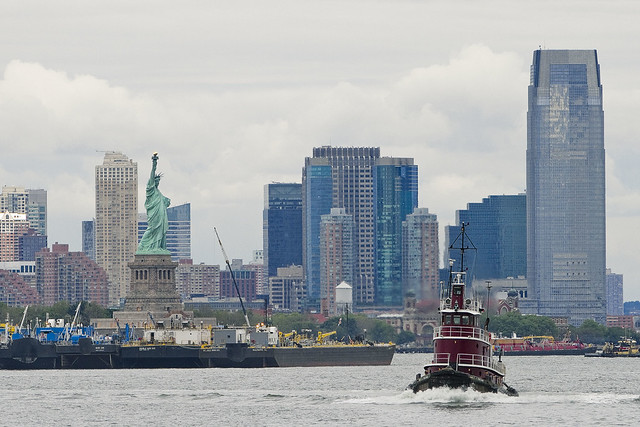
The Marie J. Turecamo tug presented itself to a humble narrator recently, framing iconic views of the harbor for your perusal on this week’s “Maritime Sunday”. Periodically, when some magazine art buyer or advertising stalwart is looking for a harbor shot, my phone will ring and someone will ask for “a tugboat moving past the Statue of Liberty” or something similar. Invariably, the caller is seeking out free usage of the shot.

– photo by Mitch Waxman
Other photographers get angry with me when I allow free usage of this shot or that to various personages or groups, accusing me of devaluing the craft. “Information wants to be free” is my normal reply, and “an image too dearly held has no intrinsic valuation” is the follow up. This is when I’m called a schmuck, and informed that I’m being “taken advantage of”. Allow me to set the record straight on this subject, lords and ladies.

– photo by Mitch Waxman
A regular beneficiary of my largesse, whether it be the estimable Working Harbor Committee or the Newtown Creek Alliance or any of the other “worthy” harbor groups whom I regularly supply images to, receives a limited license to the photo. They cannot, for instance, use my shots in a manner which I haven’t specified or agreed to- web usage versus printed material. A byline is required, and if at any time I decide to ask them to pull the shot, this is my right as I’m retaining the image copyright and full usage rights. In advertising lingo, the shots are offered and licensed as “stock”, and the compensation asked for use of them is somewhat asymmetrical and seldom monetary.

– photo by Mitch Waxman
What I’m ultimately after is photographic access to people, places, and situations which are normally unattainable. I’ve been inside the Manhattan Bridge, walked on a Queensboro bridge completely devoid of traffic, been privy to dozens of situations that “press” photographers would have killed to get near. I’ve been to off limits spots all around the harbor, delved into the deepest recesses of the City, ascended to unattainable and high vantages, and seen things that most living New Yorkers barely suspect. If a group is doing something worth doing, as in the case of WHC with its education programs and senior citizen programming, or NCA’s quest to save the Newtown Creek from sophistry- I’m happy to donate the usage of a few images. On the other hand, if you see something you’d like a print of, or would like to license an image or two for commercial usage- contact me here.
roving commission

– photo by Mitch Waxman
Lo, sigh heavily and behold- for once again it is Maritime Sunday at this, your Newtown Pentacle. This week, we’re focusing in on the DonJon Marine’s Sarah Anne moving (presumably) from Newtown Creek to the Port of Newark with a load of scrap metals. This is an oft repeated journey for the Tugs of New York Harbor, and offers quite an occupation.
from donjon.com
Since its incorporation in 1966, Donjon Marine has established and continues to seek long-term client relationships in a world where limited business resources demand a constant balancing of expenditures. Beginning with its foundation in the New York area as a pioneer in marine salvage services, Donjon has grown to become a leader in both conventional and environmental dredging. Its areas of expertise also include recycling, land and marine demolition, pollution control and remediation, heavy lift transport, marine transportation and landfill remediation/site management.

– photo by Mitch Waxman
The metals trade often comes up in these postings, partially due to my proximity to its center at Newtown Creek, and partially due to the wonder of it all. The claims which are made by those versed in macroeconomic and engineering circles is that the recycling process saves a lot of energy (and atmospheric emissions of concurrent gaseous pollution) from being used in the pursuit of new materials obtained via traditional mining and refining processes.
Click here for the Sarah Ann page at donjon.com, and get all her vital statistics

– photo by Mitch Waxman
Personal observation of the metal recycling process has shown, instead, the heaviest of machinery being operated at full throttle and spewing exhaust into the open air. The whole process is fed by trucks, barges, and vast ocean going ships whose journeys span continents.
Tremendous amounts of fuel, industrial machinery, and human labor are required.
from sname.marinelink.com
Donjon Marine, Co., Inc., a global marine services provider based in N.J., announced that Donjon has added the 2,700 hp twin screw tug Sarah Ann (ex-June K) to its expanding tug fleet. The 78 by 26 by 10.5-ft tug, with twin CAT 3512B diesels and a nine-ft draft, was built in 2003 by A&B Shipyard, Amelia, La. Designed principally for ship handling and assist work, barge towing and dredge assist, the tug’s draft is shallow enough to navigate the many creeks and estuaries throughout the Port of New York region.

– photo by Mitch Waxman
Often have I wondered how much is actually saved, environmentally, by the process. This is, of course, heresy to the environmental crowd. Any intellectual deviation from a political normative- such as “recycling is incontrovertibly good and has no cost”- even the act of questioning such logic, is met with disbelief and scorn.
Hey, I’m just asking.
Doesn’t sound good at cocktail parties in Manhattan, I guess.
from wikipedia
The scrap industry contributed $65 billion in 2006 and is one of the few contributing positively to the U.S. balance of trade, exporting $15.7 billion in scrap commodities in 2006. This imbalance of trade has resulted in rising scrap prices during 2007 and 2008 within the United States. Scrap recycling also helps reduce greenhouse gas emissions and conserves energy and natural resources. For example, scrap recycling diverts 145,000,000 short tons (129,464,286 long tons; 131,541,787 t) of materials away from landfills. Recycled scrap is a raw material feedstock for 2 out of 3 pounds of steel made in the U.S., for 60% of the metals and alloys produced in the U.S., for more than 50% of the U.S. paper industry’s needs, and for 33% of U.S. aluminum. Recycled scrap helps keep air and water cleaner by removing potentially hazardous materials and keeping them out of landfills.
June 30th, 2012- Working Harbor Committee Kill Van Kull walk

– photo by Mitch Waxman
My various interests out on the sixth borough, NY Harbor, have brought me into association with the Working Harbor Committee. A member of the group’s Steering Committee- I also serve as the “official” group photographer, am chairman and principal narrator of their annual Newtown Creek Boat Tour, and occasionally speak on the microphone during other tours (mainly the Brooklyn one). This year, the group has branched out into terrestrial explorations to compliment the intense and extant schedule of boat tours, and I’m going to be leading a Kill Van Kull walking tour that should be a lot of fun.
The Kill Van Kull, or tugboat alley as its known to we harbor rats, is a tidal strait that defines the border of Staten Island and New Jersey. A busy and highly industrialized waterfront, Working Harbor’s popular “Hidden Harbor – Newark Bay” boat tours provide water access to the Kill, but what is it like on the landward side?
Starting at the St. George Staten Island Ferry terminal, join WHC Steering Committee member Mitch Waxman for a walk up the Kill Van Kull via Staten Islands Richmond Terrace. You’ll encounter unrivaled views of the maritime traffic on the Kill itself, as well as the hidden past of the maritime communities which line it’s shores. Surprising and historic neighborhoods, an abandoned railway, and tales of prohibition era bootleggers await.
The tour will start at 11, sharp, and you must be on (at least) the 10:30 AM Staten Island Ferry to meet the group at St. George. Again, plan for transportation changes and unexpected weirdness to be revealed to you at MTA.info.
for June 30th tickets, click here for the Working Harbor Committee ticketing page
July 8th, 2012- Atlas Obscura Walking Tour- The Insalubrious Valley

– photo by Mitch Waxman
Newtown Creek Alliance historian Mitch Waxman will be leading a walk through the industrial heartlands of New York City, exploring the insalubrious valley of the Newtown Creek.
The currently undefended border of Brooklyn and Queens, and the place where the Industrial Revolution actually happened, provides a dramatic and picturesque setting for this exploration. We’ll be visiting two movable bridges, the still standing remains of an early 19th century highway, and a forgotten tributary of the larger waterway. As we walk along the Newtown Creek and explore the “wrong side of the tracks” – you’ll hear tales of the early chemical industry, “Dead Animal and Night Soil Wharfs”, colonial era heretics and witches and the coming of the railroad. The tour concludes at the famed Clinton Diner in Maspeth- where scenes from the Martin Scorcese movie “Goodfellas” were shot. Lunch at Clinton Diner is included with the ticket.
Details/special instructions.
Meetup at the corner of Grand Street and Morgan Avenue in Brooklyn at 11 a.m. on July 8, 2012. The L train serves a station at Bushwick Avenue and Grand Street, and the Q54 and Q59 bus lines stop nearby as well. Check MTA.info as ongoing weekend construction often causes delays and interruptions. Drivers, it would be wise to leave your vehicle in the vicinity of the Clinton Diner in Maspeth, Queens or near the start of the walk at Grand St. and Morgan Avenue (you can pick up the bus to Brooklyn nearby the Clinton Diner).
Be prepared: We’ll be encountering broken pavement, sometimes heavy truck traffic as we move through a virtual urban desert. Dress and pack appropriately for hiking, closed-toe shoes are highly recommended.
Clinton Diner Menu:
- Cheese burger deluxe
- Grilled chicken over garden salad
- Turkey BLT triple decker sandwich with fries
- Spaghetti with tomato sauce or butter
- Greek salad medium
- Greek Salad wrap with French fries
- Can of soda or 16oz bottle of Poland Spring
for July 8th tickets, click here for the Atlas Obscura ticketing page
July 22nd, 2012- Working Harbor Committee Newtown Creek Boat Tour
 |
|
Many people know about the environmental issues facing Newtown Creek, but did you know that the Creek was once the busiest waterway in North America, carrying more industrial tonnage than the entire Mississippi River?
You’ll learn much more when Working Harbor Committee’s maritime historians and harbor experts
put it all in context during a Hidden Harbor Tours: Newtown Creek Exploration.
The heart of industrial New York, Newtown Creek was home port to hundreds of tugboats (one of which is the historic WO Decker). It was also an international destination for oceangoing ships and a vast intermodal shipping and manufacturing hub that employed hundreds of thousands of people. Forming the border of Brooklyn and Queens for nearly three miles, five great cities grew rich along the Newtown Creek’s bulkheads — Greenpoint, Willamsburg, Bushwick, Long Island City and Manhattan itself. The waterway is still a vital part of the harbor and the Working Harbor Committee (WHC) is proud to present this tour as part of the celebration of their tenth anniversary year.
Mitch Waxman, a member of WHC’s steering committee and the group’s official photographer, also serves with the Newtown Creek Alliance as its group Historian. In addition to working on WHC’s boat tours of the Creek, Mitch offers a regular lineup of popular walking tours, and presents a series of well-attended slideshows for political, governmental, antiquarian, historical and school groups. His website — newtownpentacle.com — chronicles his adventures along the Newtown Creek and in the greater Working Harbor.
He was recently profiled in the NY Times Metro section, check out the article here.
Upcoming tour: Hidden Harbor Tours: Newtown Creek Exploration.
On July 22nd, Mitch shares his unique point of view and deep understanding of the past, present and future conditions of the Newtown Creek as the narrator and expedition leader for this years Hidden Harbor Tours: Newtown Creek exploration.
Our NY Water Taxi leaves from South Street Seaport at 11 a.m. (sharp) on a three hour tour of the Newtown Creek. From the East River we’ll move into the Newtown Creek where we’ll explore explore vast amounts of maritime infrastructure, see many movable bridges and discover the very heart of the Hidden Harbor.
Limited seating available, get your tickets today.
 |
|||||||||||||||
|
|||||||||||||||


 The Newtown Pentacle