Posts Tagged ‘photowalk’
blessed are the sleepy…

– photo by Mitch Waxman
As opined in the past, illegal dumping is a bit of an art form here in Queens, and it is not uncommon to find largish domestic items binned out at the entrance to this industrial site or that rail yard. In this case, it’s a rather plush sofa which was left nearby one of the entrances to the Sunnyside Yard, which offered this fellow an opportunity to drop off for a quick nap.

– photo by Mitch Waxman
The ability to sleep in public has always been denied to me, even as a child (much to the chagrin of Mr. and Mrs. Narrator). I marvel at the Asian folks who can catch a quick kip standing up on the R train every day, am jealous of the minute naps which others can surrender to, and can’t imagine leaving myself this vulnerable on the street for even a minute.
Back in the 80’s, if you fell asleep on the subway, someone would steal your shoes.
sinister exultation

– photo by Mitch Waxman
It was a mid summer day in the city, July 24th to be exact, and the kind of weather which feels like one has been wrapped in hot barber shop towels was upon us. Occluded by a humid and occasionally precipitating mist, the burning thermonuclear eye of god itself was absent from the scene, but its influence was seen and felt by everyone here in this old section of Long Island City once known as the Degnon Terminal.
While marching down Skillman Avenue, your humble narrator could not help but notice a not so minor conflagration at the nearby Hunters Point rail station.

– photo by Mitch Waxman
It seems that an Amtrak engine, part of a problematic series of units employed by the rail conglomerate which are known as being given to sudden and unexpected events of immolation (or so my rail fan contacts tell me) had caught fire.
It was no surprise that the only camera on the scene was my own, as there are few in the Greater City who care for Queens and it’s burdens. FDNY (which does care about Queens) was on scene in great numbers, including members of several units which the Manhattan Political Elites had recently attempted to close due to budget issues.

– photo by Mitch Waxman
The engine seemed to be suffering from an electrical issue, which was anecdotally confirmed by one of the fire department commanders who was gracious enough to discuss the issue with me. Frustration was evinced by this veteran of New York’s never ending war on combustion that the spot which the engine had halted at was beyond the reach of his hose lines, and that they could only put band aids on the fire using hand held extinguishers.
There were literally dozens of fire team specialists in full tactical gear and several mobile command posts arrayed at strategic spots around the rail yard, but their ambitions were stymied by security fence and distance from hydrants.

– photo by Mitch Waxman
The commander, a lanky Irishman of solid build whose height easily passed the six foot mark, next informed me that their plan was to bring a second engine in from the nearby Sunnyside Yard complex and hitch it to the back of the train.
This second unit would then tow the burning engine and it’s passenger cars back to the titan Sunnyside Yard where both equipment and resources to combat the blaze would be available and abundant.

– photo by Mitch Waxman
Over the last few years, of course, your humble narrator has discovered or happened across every possible vantage point large enough to stick a camera lens through around the fenced off and often carefully obscured rail infrastructure which weaves through Western Queens and knowing FDNY’s plan, moved into a more propitious spot to record the event.
One must be careful when photographing trains and trackways, lest one accidentally step onto federal or state property and violate not just homeland security regulations but archaic laws which have persisted since the early days of the iron road, many of which carry mandatory sentences.

– photo by Mitch Waxman
The irony of these so called regulations, of course, is that whether it is because of expedience or carelessness, many of the employee entrances to the rail yard are often left ajar and unguarded. Was this to occur in Manhattan, there would undoubtedly be a series of broadcast and print media articles and investigations, followed by political posturing and a spate of sham regulations.
Since this is Queens, where the Borough motto should be “welcome to Queens, now go fuck yourself”, nothing will happen and the issue will never be discussed.

– photo by Mitch Waxman
The smell of burning insulation and plastics mixed freely with the humid air, and a monstrous storm was building in the milky sky. Far off thunder to the south indicated that a storm was coming. Your humble narrator, not too far from home however, persevered and dared the weather to do it’s worst.
Besides, the reason I was on Skillman Avenue in the first place was that I had to meet some guy to talk about a thing down here, and I caught this whole event simply because Queens wanted me to witness her burdens again.

– photo by Mitch Waxman
Perhaps it’s the impending anniversary of the September 11 attacks, or merely the normal late summer ennui which always darkens my mood, but the notion that the FDNY hasn’t got fire hose lines long enough to put out a train fire here- at so critical a spot in the infrastructure of the Megalopolis, and that an ordinary civilian like myself can so easily gain visual and physical access to all this- worries me.
In my travels across the concrete desolations of the river communities of North Brooklyn and Western Queens, there are so many of these unguarded and strategic points which have presented themselves that frankly- I don’t like taking the Train or Ferry anymore. When I point these vulnerabilities out to associates who are employed by government agencies or elected officials, they roll their eyes and tell me not to worry.
Same thing they used to do when I wondered out loud back in the 90’s about whether or not the United States had a system of air defenses protecting the defacto capitol city of North America.
irrepassable gate
– photo by Mitch Waxman
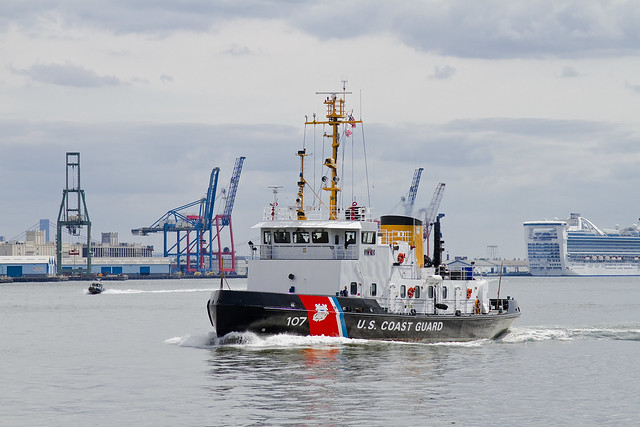
Awhile back, I posted this series of shots to Flickr, and an enigmatic shipping enthusiast from the vast interweb hive mind immediately commented “140′ Bay Class Icebreaking Tug USCGC PENOBSCOT BAY WTGB-107 homeport Bayonne, NJ.”.
From wikipedia
The USCG Bay-class icebreaking tug is a class of 140-foot (43 m) icebreaking tugs of the United States Coast Guard, with hull numbers WTGB 101 through to WTGB 109.
They can proceed through fresh water ice up to 20 inches (51 cm) thick, and break ice up to 3 feet (0.91 m) thick, through ramming. These vessels are equipped with a system to lubricate their progress through the ice, by bubbling air through the hull.

– photo by Mitch Waxman
When focusing in on this ship, I just thought it looked cool. Turns out that this class of vessels has a long and storied past.
Here’s a Coast guard shot of Penobscot Bay in action during the winter…
Here’s the official story, courtesy United States Coast Guard:
from uscg.mil
The 140-foot Bay-class Cutters are state of the art icebreakers used primarily for domestic ice breaking duties. They are named after American Bays and are stationed mainly in Northeast U.S. and Great Lakes.
WTGBs use a low-pressure-air hull lubrication or bubbler system that forces air and water between the hull and ice. This system improves icebreaking capabilities by reducing resistance against the hull, reducing horsepower requirements

– photo by Mitch Waxman
Note: I should mention that members of the USCG have offered me very good, yet unofficial, advice on appropriate maritime footwear in the past- which may render some personal bias on my part for the organization.
The USCG also maintains a short history page on this ship, which can be accessed here.
the dark moor

– photo by Mitch Waxman
Lucid and unwholesome, witness this sky flung perspective of the backbone of New York City- vantaged from several hundred feet above the Newtown Creek and it’s little known tributary- Whale Creek, and high atop the digester eggs of the Newtown Creek Wastewater Treatment Plant.
Gaze in wonder at the majesty of western Queens.
Additionally, click here to see this view reversed, and witness the parallel horizon of infinite Brooklyn.

– photo by Mitch Waxman
That’s the Thomas D. Witte tugboat maneuvering a barge into position at the SimsMetal dock, and the rusty crossing in the background is the non functioning swing bridge which spans the larger Queens side tributary of Newtown Creek called Dutch Kills.

– photo by Mitch Waxman
That’s the LIRR moving along the ancient rail tracks which have blessed the industries and cursed the residents of this area since the early 19th century. The general area that the locomotive track is passing through, employed to this very day by petrochemical interests, is the former Queens location of Standard Oil at Newtown Creek.

– photo by Mitch Waxman
In the distance, from left is Lindenthal’s magnificent Queensboro, the Big Allis power plant, the omnipresent Sapphire megalith, the high flying Long Island Expressway, and a substantial portion of the vast industrial quarters of Long Island City which I call “The Empty Corridor“.
distant ravine

– photo by Mitch Waxman
The final product of my “Grand Walk” which was found on my camera card, which was populated by these puzzling images of centuried statuary lost amongst First Calvary’s emerald devastations.
The figure is life sized, according and conforming to the proportions and stature of the malnourished 19th century. In our modern era of gigantic milk, beef, and grain fed humans, when 6 feet of height is not an uncommon attainment for Italians, Irish, and Chinese alike (all 3 notoriously short statured groups according to historical anecdote), she seems to be a young girl- but this delicate figure conforms to statistical adult height records of 19th century immigrant New York.
We often forget, when discussing fashionable dining trends (locavore or vegan, organic or farm raised- bleh) that the primary goal of our forebears wasn’t ultimately financial acquisition, but was instead a guarantee of basic nutrition.

– photo by Mitch Waxman
Pithy commentary about the fallacies of a modern world, corporatized and commercialized, notwithstanding- attention is called to the plastic baubles which the monument has been adorned with. Such commemorate decoration is commonly observed at area cemeteries, although the rules and bylaws of these institutions publish severe limitations on acceptable grave ornamentation. Unless taste and or propriety are offended, the management seems to allow these minor decorative touches to subsist for a time, after which the activities of groundskeeping and upkeep sweep the place clean.
Behind a fence or near a seldom used entranceway at any of these urban polyandrions, once can easily locate a dumpster containing a polyglot of rotting flowers in cheap vases, joss paper idols, and a cacophony of sentimental or religious trinkets which lie glittering amidst the debris.

– photo by Mitch Waxman
The trinket itself is pedestrian, a childish and injection molded representation of grapes on the vine. What sets me to wonder, and more than wonder, is that undeniable resemblance to the color of the purple bloom worn by the apostate Hibernian and his bizarre companions whose threatening aspect hurled me into a panicked state and meandering escape route through the ancient sections of New York City.
I’ve been queried via private email about this person by several people. Unfortunately, as mentioned in the last posting, I can only remember bits and pieces- but the flower in his lapel matched the color of these plastic beads exactly- of that I can be sure.
What does it mean? I cannot tell you, as it would be madness to attempt the connection of dots between a seemingly random series of events.

– photo by Mitch Waxman
Did your humble narrator, stricken by terror induced delirium, randomly stumble along deeply buried trolley tracks past storefront mystics on Delancey Street and over the Williamsburg Bridge into the heart of 19th century Williamsburg?
It was in the piecing together of these seemingly random shots, in their proper order, that the various historical tidbits began to present themselves, and the journey across the Newtown Creek and through Maspeth led into places which I had never suspected- such as the story of Case’s Crew (the apostate Friends shunned by most, but welcomed here).
Local historical authorities reacted in a bizarre and hostile manner when queried about this group of apostate Friends, I would add. The impression of this exchange puzzled me, but for some, knowledge is meant to be suppressed and zealously hidden away in a vault rather than disseminated freely.

– photo by Mitch Waxman
Often, as I pack up my ridiculous “field kit” and leave the house for one of my “walks” about the vast human hive, I will joke that “I feel like Queens wants me to see something today, probably “that way”- as I gesture in some random direction to Our Lady of the Pentacle or my little dog Zuzu.
Our lady smiles and says “bless”, while Zuzu usually turns around to see what I’m pointing at.
I’ve learned it’s just best to listen to Queens, as it suffers beneath the load it bears for the rest of the City, and simply attempt to understand its terrible story. If some decide to stand in my way, or otherwise obstruct me, they will know what it means to burn away into ignominy and learn the meaning of the words inexorable, irresistible, and merciless.
The story, it’s parable, and the answers to the future offered by this ancient place are too important.

– photo by Mitch Waxman
This “Grand Walk” ended at Greenpoint Avenue, apparently, or at least that’s when the pictures stopped.
The final shot was of the Long Island Expressway from First Calvary, an elevated roadway which hurtles as high as 106 feet above Borden Avenue and that liquid malignity which fills the banks of Dutch Kills. Borden Avenue, of course, is a counterpart to Grand Street in Brooklyn- another ferry to trolley road corridor which has been forgotten and obliterated by modernity.
Ultimately, all roads do indeed seem to lead to Calvary, here in the Newtown Pentacle.
from Documents of the Senate of the State of New York, Volume 5, 18dd, courtesy google books
The road is a double track line laid in the center of Borden avenue, from Vernon to Bradley avenues, and thence a single track along Bradley avenue to Green Point avenue and entrance to Calvary cemetery.
At Vernon avenue a junction is made, and tracks used of the Steinway and Hunter’s Point railroad, along Borden avenue to the Thirty-fourth street ferry slips fronting on East river. A piece of track is laid from Borden avenue along Front street to Third street, a portion of which is used for storing cars, and there is a short side track at the cemetery terminal.
The total length of road now owned and operated from Vernon to Green Point avenues is about one and two-fifths miles, and the portion of the Steinway railroad operated jointly is about one-fifth of a mile, making a total length of road owned, leased and operated by the Long Island City and Calvary Cemetery Railroad Company one and three fifths miles.
Borden avenue is paved with block stone as far south as the drawbridge over the Dutch Kills canal; the remainder of the track is laid upon and along the center of an ordinary earth roadway.
The superstructure is laid with fiat iron street rails where the street is paved, and also along Bradley avenue a distance of onefifth mile.
The general construction of the superstructure is not as permanent in character and condition of maintenance as generally found on surface roads. Ties are widely spaced, and flat rail not thoroughly secured to longitudinal timbers, and the line and surface imperfect. South of the draw-bridge, upon the earth road-bed, the track is laid with light T rails, secured at ends with fish plate, many of which are omitted, causing the ends to form an uneven vertical joint.
From the crossing of the Long Island railroad to Bradley avenue, Borden avenue is a roadway raised up about eight feet above the low flat lands bordering the Dutch Kill and Newton creek, and the portion of the avenue south of the canal is being raised each year, requiring a corresponding raise of superstructure, which may account in part for the imperfect condition of that portion of the tracks; no serious inconvenience can bo experienced, however, as the cars have good, easy springs, and they ride the rail fairly well; yet a thoroughly Constructed, lined and surfaced superstructure would add to the comfort of passengers, and insure greater speed at less outlay of power.
At Calvary cemetery no separate waiting-room is provided, those in hotels being used. At the northerly terminal the covered way and waiting-rooms of the ferry are conveniently near, and afford protection in inclement weather.


