Archive for 2012
Magic Lantern Show in Ridgewood

Your humble narrator will be narrating humbly on Friday, February 24th at 7:30 P.M. for the “Ridgewood Democratic Club, 60-70 Putnam Avenue, Ridgewood, NY 11385” as the “Newtown Creek Magic Lantern Show” is presented to their esteemed group. The club hosts a public meeting, with guests and neighbors welcome, and say that refreshments will be served.
The “Magic Lantern Show” is actually a slideshow, packed with informative text and graphics, wherein we approach and explore the entire Newtown Creek. Every tributary, bridge, and significant spot are examined and illustrated with photography. This virtual tour will be augmented by personal observation and recollection by yours truly, with a question and answer period following.
For those of you who might have seen it last year, the presentation has been streamlined, augmented with new views, and updated with some of the emerging stories about Newtown Creek which have been exclusively reported on at this- your Newtown Pentacle.
For more information, please contact me here.
dreamless sleep

– photo by Mitch Waxman
Another of the so called “Black Arts” of the 19th century, sugar refining was one of the great industries which distinguished New York City and its neighboring municipalities.
The sole survivor of this once omnipresent occupation is found in Yonkers. Raw sugar is barged to this facility for processing, which makes it a neat item to highlight for “Maritime Sunday” here at this, your Newtown Pentacle.
from wikipedia
Yonkers is the fourth most populous city in the state of New York (behind New York City, Buffalo and Rochester), and the most populous city in Westchester County, with a population of 195,976 (according to the 2010 Census). Yonkers borders the New York City borough of The Bronx and is 2 miles (3 km) north of Manhattan at the cities’ closest points.
– photo by Mitch Waxman
These shots were captured in the November, while onboard a Riverkeeper vessel which was performing a regular survey of the downstate waterways, and the good folks at that estimable organization were gracious enough to let a humble narrator ride along.
The Sugar Refinery in Yonkers is relict, a late 19th century mill which is still engaged in its trade.
from wikipedia
The raw sugar is stored in large warehouses and then transported into the sugar refinery by means of transport belts. In the traditional refining process, the raw sugar is first mixed with heavy syrup and centrifuged to wash away the outer coating of the raw sugar crystals, which is less pure than the crystal interior. Many sugar refineries today buy high pol sugar and can do without the affination process.

– photo by Mitch Waxman
American Sugar Refining operates this factory, engaging in what seems to be a quite hazardous industrial process.
It seems that sugar dust can be highly explosive, requiring equipment that is “spark proof” to safeguard against detonation.
Who knew?
from wikipedia
American Sugar Refining Company (ASR). The ASR was incorporated in the state of New Jersey on January 10, 1891, with $50 million in capital. By 1907, it owned or controlled 98% of the sugar processing capacity in the United States and was known as the Sugar Trust. The United States Supreme Court declared in United States v. E. C. Knight Company that its purchase of the stock of competitors was not a combination in restraint of trade. By 1901, the company had $90 million in capital. The company became known as Domino Sugar in 1900.

– photo by Mitch Waxman
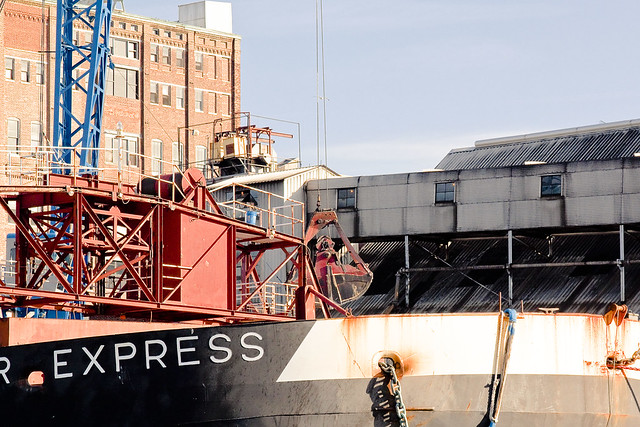
The tug Heron was present, tending to a barge labeled “Sugar Express”. Heron is middle aged, like myself, and has gone by several different aliases during its long career- unlike myself.
A surprising observation for me was that the raw product was being unloaded from the barge in the same manner that one would unload rock or gravel.
Built in 1968, by McDermott Shipyard of Morgan City, Louisiana (hull #151) as the tug Progreso .
In 1972, the tug was acquired by Dixie Carriers where she was renamed as the Dixie Progress .
In 2002, she was acquired by Allied Transportation of Norfolk, Virginia where she was renamed as the Heron.

– photo by Mitch Waxman
The industrial process of sugar refining uses powerful acids to purify and process the sweet stuff, and in 2005 the plant came under the scrutiny of regulators when it was revealed that they had released a large quantity of powerful acid into the water.
As with everything else in our world, it seems that nature must pay a price for our desires, even when it’s just a teaspoon of sugar to help the medicine go down.
from sawmillrivercoalition.org
In January 2005, American Sugar Refining Inc., a company that produces sugar for Domino Sugar and located on the Saw Mill River, pled guilty to a criminal pollution charge for spilling hydrochloric acid into the Hudson River in Yonkers in 2003.
Project Firebox 30

– photo by Mitch Waxman
It lives on the corner of Van Dam and Review, and clearly remembers when the self storage place across the street was a pickle factory. Like all long time residents of Queens, it can barely recognize the place these days, but carries on and sallies forth on the daily round. It’s not old enough to remember the Greenpoint Avenue Bridge burning down, twice. Neither does it remember Gleason’s trolleys nor the vast funeral cortèges that emptied the Five Points as they proceeded to Calvary. Memory is not a strong point for its kind, for as a watchman, the sole function it must serve is to raise the alarum.
interest and speculation

– photo by Mitch Waxman
A humble narrator can never be 100% sure about anything, as I live in a hallucinatory dreamscape of thwarted ambition where angles that appear obtuse are often in fact acute, but this would seem to be the head of a tunnel boring machine at the Sunnyside Yards. The device is of Byzantine complexity and cyclopean size, but sits suspended.

– photo by Mitch Waxman
These shots are from the middle of January, the 18th to be exact (which is also Robert Anton Wilson’s birthday), and were captured at a fortuitous moment when the burning thermonuclear eye of god itself was hanging low in the sky.
A video of the second avenue subway project’s tunnel crew bursting through the the skin of the earth is extant upon the interwebs, and I believe this to be the front of that mechanism which has been grinding out its subterranean course for the last several years.

– photo by Mitch Waxman
It is a rare thing to see equipment like this out in the open, let alone suspended above the ground by steel spars erected by the estimable engineers of Bay Crane. A mere week later, the device was entirely disassembled into constituent parts, no doubt to allow it to be easily shipped off to the location of its next task.
candlemas

– photo by Mitch Waxman
Today is Candlemas, a station of fire on the wheel of the year which marks the equidistant point between winter and spring solstices. Our pagan antecedents would have gathered today, and exchanged candles of beeswax to mark the occasion. The entire month of February is named for a Roman feast held on or near the 15th, called Februa, a purification ritual.
The pre Christian Irish called this time of the year “faoilleach”, the wolf month.
In modern times, it’s mainly known as “groundhog day“.
from wikipedia
The Presentation of Jesus at the Temple, which falls on 2 February, celebrates an early episode in the life of Jesus. In the Eastern Orthodox Church and some Eastern Catholic Churches, it is one of the twelve Great Feasts, and is sometimes called Hypapante (lit., ‘Meeting’ in Greek). Other traditional names include Candlemas, the Feast of the Purification of the Virgin, and the Meeting of the Lord.

– photo by Mitch Waxman
At least three thousand years of tradition say that today is a good day to cleanse the body and home, and tradition states that your Christmas decorations must be torn away by tonight or death will come to your house. Additionally, one is expected to eat pancakes.
Farmers begin turning the soil today, and their wives are expected to put baked goods on the windowsill as an offering to the fertility goddess Brigid (later latinized as St. Brigid).
Our Lady of the Pentacle and your humble narrator look forward to evening pancakes. It has been too long.
from wikipedia
Imbolc (also Imbolg), or St Brigid’s Day (Scots Gaelic Là Fhèill Brìghde, Irish Lá Fhéile Bríde, the feast day of St. Brigid), is a Celtic festival marking the beginning of spring. Most commonly it is celebrated on 1 or 2 February (or 12 February, according to the Old Calendar) in the northern hemisphere and 1 August in the southern hemisphere. These dates fall approximately halfway between the Winter Solstice and the Spring Equinox.
The festival was observed in Gaelic Ireland during the Middle Ages. Reference to Imbolc is made in Irish mythology, in the Tochmarc Emire of the Ulster Cycle. Imbolc was one of the four cross-quarter days referred to in Irish mythology, the others being Beltane, Lughnasadh and Samhain. It has been suggested that it was originally a pagan festival associated with the goddess Brigid, who should not be confused with St Brigit of Kildare.

– photo by Mitch Waxman
In the fictional clade of H.P. Lovecraft’s mythos, Candlemas is a day oft mentioned, and is most prominently the birthday of both Wilbur Whately and his twin brother. The brother had no name, but was said to resemble their father more strongly than Wilbur.
from hplovecraft.com
It was in the township of Dunwich, in a large and partly inhabited farmhouse set against a hillside four miles from the village and a mile and a half from any other dwelling, that Wilbur Whateley was born at 5 A.M. on Sunday, the second of February, 1913. This date was recalled because it was Candlemas, which people in Dunwich curiously observe under another name; and because the noises in the hills had sounded, and all the dogs of the countryside had barked persistently, throughout the night before.


 The Newtown Pentacle