Author Archive
swept aside
Conspiracy in North Brooklyn?

– photo by Mitch Waxman
Pictured above is the FDNY’s Firefighter 2 Fireboat dousing the remains of a document storage warehouse at North 11th street right at the border of Greenpoint and Williamsburg. The building is likely a total loss and will be probably be demolished, as this was a seven alarm “all hands fire” which required the attentions of more than 200 Firefighters to control. It’s eerily similar to the Greenpoint Terminal Market fire, which “Grenperntners” will eagerly describe as an arson job designed to clear the way for real estate development. FDNY investigators described the Greenpoint Terminal Market event as an accident brought on by a homeless man’s campfire.
There’s a few conspiracy theories already forming around CitiStorage, which I’ll pass on with the caveat that these are “conspiracy theories” and nothing resembling the final analysis of what happened will be available for months until after the FDNY investigators pronounce judgement.

– photo by Mitch Waxman
The first conspiracy theory is alluded to above, and declares that the Real Estate Industrial Complex was hungry for this valuable piece of land on Brooklyn’s Gold Coast. Arsonists were sent in to get rid of the structure, which is why the fire had two distinct ignition events. To me, this one doesn’t hold water, as it’s far simpler for the REIC to legally gain possession of anything they want simply by pushing the right political buttons. Look at Willets Point, or Atlantic Yards, or Hudson Yards for examples of the vulgar display of their power. This “burn out” concept used to be a thing, during the 1970’s, 80’s, and 90’s, incidentally.

– photo by Mitch Waxman
The second theory requires a bit of context to fully appreciate. The documents storage facility which went up in flames housed, amongst other things, court and hospital records for the City. The Albany scandal revolving around Assembly Speaker Shelly Silver accuses him of various improprieties regarding referrals to a personal injury law firms, from which he personally profited. The conspiracy theory is that somebody torched this place to protect the former “most powerful man in New York” from some revelation or “smoking gun” which Federal investigators might have found there. Again, a conspiracy theory, not a conclusion.
from nytimes.com
Those that said they had records stored in the warehouse, which occupies nearly half a square block, included the state court system, the city Administration for Children’s Services, the city Health and Hospitals Corporation, and members of the Greater New York Hospital Association.
– photo by Mitch Waxman
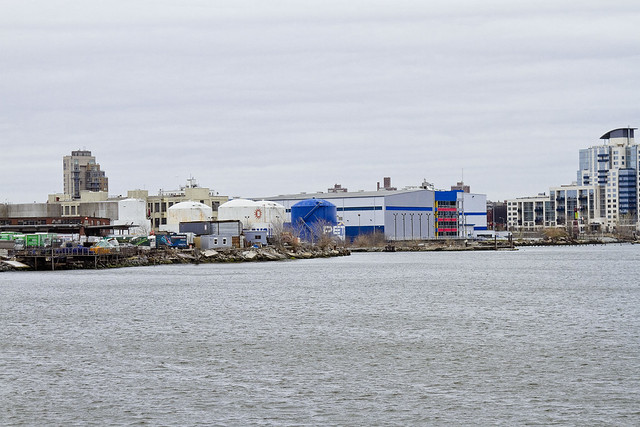
Whatever happened, the toxic plume of smoke from the fire has been painting the neighborhoods surrounding this spot at Bushwick Inlet for a couple of days. I was able to smell it in Astoria just last night, and as one approached the spot in Greenpoint where the shots above were captured, it was inescapable and somewhat nauseating. Pictured above is what the scene looked like in 2013, incidentally, sans conflagration.
“follow” me on Twitter- @newtownpentacle
recalls nothing
There’s something wrong…

– photo by Mitch Waxman
When the prophesied storm of fimbulvinter rolled through our town the other night, Our Lady of the Pentacle and myself (along with our little dog Zuzu) were warm and snug down in the bunker we had readied for the Mayan Apocalypse. My understanding is that when the glacial ice sheet moved south across Astoria, according to some of the hardier Croatians who disregarded the warnings of City and State, a wooly mammoth was spotted on 31st avenue as it fled from a group of fur clad Neanderthals. Word has it that folks in the East Elmhurst area spotted a Sabre Toothed Tiger roaming about. The ice age escalated quickly, and this is how we live now. Please, please, generate some global warming and fast – do something to increase your carbon footprint right now – it’s freezing outside.

– photo by Mitch Waxman
One realizes that the singular tonality of the age we live in is one of looming apocalypse. I get it. Jaded, the human infestation won’t respond to warnings about this and that unless you attach an existential danger to the message. Having grown up in a home where my mother would pop a blood vessel if the kitchen sink displayed moisture or a crumb was found nearby the toaster, I really do understand overreaction. However, the lesson of “Chicken Little” seems to be something that our risk averse culture has forgotten these days.
The sky was literally falling last week, but it was snow. This is normal, and expected, because it’s January in New York. If the government really wants to get ahead of this sort of thing, they should start considering turning NYC into one of those science fiction style domed cities.

– photo by Mitch Waxman
Those things one such as myself worries about are a bit mundane, I fear. Having somebody who is texting while walking on a subway platform jostle and knock me onto the tracks, getting crushed by a falling air conditioner, or being splattered by the manic actions of some truck driver. Being struck by a bicyclist or electric delivery bike as they speed down the sidewalk – all of my little scenarios are far more likely than being flash frozen in a “Day after Tomorrow” style atmospheric inversion.
While sitting in the bunker, drinking hot chocolate with Our Lady, one did begin to ponder what has become of all that post Hurricane Sandy money which was spent studying ways to protect the City against extreme weather events.
Perhaps we should initiate a blue ribbon commission to study the studies which studied the problem?
“follow” me on Twitter- @newtownpentacle
these assertions
Boats, and a ship, in today’s post.

– photo by Mitch Waxman
A recent trip to the Kill Van Kull, the busy waterway that defines the border betwixt New Jersey and… Staten Island… happened to coincide with a small burst of shipping activity. DonJon’s Emily Ann is pictured above.

– photo by Mitch Waxman
A cargo ship was emerging form the Port Elizabeth Newark complex after having crossed under the Bayonne Bridge. She was riding pretty high in the water, destination unknown. The rail tracks are all that’s left of this branch of the Staten Island Railroad.

– photo by Mitch Waxman
Moran tugs are iconic, especially when posing against the newest NYC icon, the so called Freedom Tower. Sorry for the “softball” post today, it’s been a heck of a week. More on that in a future posting.
“follow” me on Twitter- @newtownpentacle
plateau betwixt
Back to the cemetery, in today’s post.

– photo by Mitch Waxman
Over at the venerable Cemetery of the Evergreens in Bushwick, the W. H. Guild mausoleum is found. It’s a cast iron and cylindrical structure which is a fairly unique and unusual thing. The W.H. Guild in question is one William H. Guild of Brooklyn, who died in 1878. A rumor I’ve heard from several people is is that this is some sort of naval gun turret or something.
It’s not, it’s a boiler tank. Here’s the scoop –
Guild was a Williamsburg based manufacturer of steam pumps, boiler tanks, and all the bits that you’d fit on to them. His goods found their most useful employment in the sugar industry, but you’d also find the products offered by Messrs. Guild and Garrison of Brooklyn handy to have if you ran a steam ferry or a civil war era factory. It seems that the old man wanted to be buried in something he made, which was (and is) a boiler tank.

– photo by Mitch Waxman
You have to learn to trust Kevin Walsh at Forgotten-NY on the subject of what things used to be called, and the hidden hierophant of history proclaims that Kent Avenue in Williamsburg was once called “First Street.” (Incidentally, before it was First Street it was Charles Street, so take that Kevin!)
According to Armbruster’s “Eastern District of Brooklyn, K Streets“ you’d have found the factory of Guild and Garrison on First Street between South 8th and South 9th streets. Armbruster actually uses the factory as a “modern” landmark to place where Kings Distillery’s “Williamsburgh Garden” beer garden was located. A somewhat more modern reference for the location of Guild and Garrison would be that it was a few blocks south of the former Domino Sugar plant. The company also maintained an office at 74 Beekman Street, in Manhattan.
from bklyn-genealogy-info.stevemorse.org
The office of Kings Distillery was in HANSFIELD Tavern. Later he opened a 3rd place along
the shore, between South 8th & South 9th Streets, calling it, Williamsburgh Garden and
many balls and festivities were held there.
GUILD & GARRISON’S Machine shop was later established there.

– photo by Mitch Waxman
It seems that Mr. Guild was involved in a bit of drama during his sunset years, having eloped at the age of 70 with an 18 year old named Rosella Stillman in 1864. The details of the affair were preserved by the Brooklyn Daily Eagle in its Wednesday, April 6, 1864 edition, the text of which is found below.
from newspapers.com
EASTERN DISTRICT
ELOPEMENT OF A MAN OF SEVENTY AND A GIRL OF EIGHTEEN
A Prominent Business Man and the Daughter of a New York Editor Disappear–What was Revealed by Inquiries–A Marriage Notice which Settled all Doubt–Off for Europe
Social circles in the Nineteenth Ward are in a state of ferment over the elopement of an eighteen-year old daughter of a well known citizen of that locality, who is one of the editors of a New York daily papers, and one of the most prominent business men in the Eastern District, who is said to be over seventy years of age.
On Monday last Mr. Amos B. STILLMAN, who resides at No. 75 Ross street, went to Coney Island, taking with him his daughter, Rosella, aged eighteen. Upon returning, Mr. STILLMAN proposed to go at once to his business in New York, and his daughter, as was her usual practice, accompanies him on his way to the ferry. At South Eighth and Second streets they parted, Mr. STILLMAN continuing on his journey to the ferry and his daughter, as he supposed, to return home. When Mr. STILLMAN reached his home after having performed his duties in New York, he was greatly surprised at being told by his wife that their daughter had not been home at all that night. The father at once proceeded to make inquiries, but all he succeeded in ascertaining was that his daughter had visited Theodore DOW’S shoe store, No. 85 Fourth street, soon after he had left her and purchased a pair of gaiters, leaving the ones which she had been wearing, and stating that she would call for them.
Mr. STILLMAN then remembered that on parting with his daughter he had inquired of her if she had need of any money, and received a negative reply. While pondering as to where his daughter had received the money, it suddenly occurred to him that Mr. William H. GUILD, of the firm of GUILD & GARRISON, well-known manufacturers doing business in First street, who at late was a frequent visitor at his home, had on several occasions made his daughter presents, some of which consisted of money. Mrs. STILLMAN then (yesterday) repaired to the residence of Mr. GUILD, and was told that that gentleman was not at home, and that he had not been on the previous night. Mr. STILLMAN then made up his mind that the couple had eloped. Though filled with grief at what he considered the unwise action of his daughter, the father then let the matter rest. The following notice, which appeared in a New York paper this morning, settles the question beyond all doubt:
GUILD-STILLMAN–In St. Barnaby’s Church, Williamsburgh, on Monday, July 28,
Wm. H. GUILD, of Williamsburgh, to Rosella M., eldest daughter of Amos B. STILLMAN, also of Williamsburgh. After the marriage, Mr. and Ms. GUILD sailed for Europe.
It is said that directly after being made the purchase of shoes, Miss STILLMAN entered a coach which was in waiting on Broadway, and with Mr. GUILD was driven to the church at which the wedding ceremony was performed. They were then driven to New York where they put up at a hotel. The bridegroom is a widower whose wife has been dead about a year and is a man of wealth. He has a family of grown up children.
“follow” me on Twitter- @newtownpentacle
smartly curled
A visit to Manhattan, in today’s post.

– photo by Mitch Waxman
For reasons that I’d rather not go into, one had several hours to kill recently while immersed in an elevated and overtly emotional state of mind. Wandering around First Avenue and its side streets, between 14th and 23rd street, happenstance carried me to 415 14th street where one may notice that the Church of the Immaculate Conception stands. The address once belonged to a Presbyrterian outfit that called itself “Grace Chapel” but after the construction of Stuyvesant Town and Peter Cooper Village annihilated the Roman Catholic original “Immaculate Conception” across the street, the Catholics purchased the building and moved in. They’ve been here since 1946, I’m told.
from immaculateconception-nyc.org
In 1914, the Metropolitan Life Insurance Company embarked on one of the most successful urban renewal projects in the history of New York City. It created Peter Cooper Village and Stuyvesant Town to address a projected housing shortage among returning World War II veterans. The Met, as it was known in those days, bought up block after block of the area between 14th and 23rd Streets, from First Avenue to Avenue C. Included in the purchases were Immaculate Conception Church, its rectory, convent and school buildings.
The Archdiocese of New York then purchased an Episcopal mission settlement, Grace Chapel, on the south side of 14th Street, East of First Avenue. It was renamed “Immaculate Conception.”

– photo by Mitch Waxman
The Lower East Side, along with Harlem, barely resembles the neighborhood I remember from the 1980’s. This particular corner used to be a good place to die, or at least catch a scorching case of death, and there was a bit of a fortress mentality to the area back “in the day.” Junkies, addicts, and the whole crew of loathsome indigents who called the L line Subway station on 14th “HQ” used to pollute the sidewalks hereabouts. It was odd to see the gates to the church open, and a sign promised that there was a cloister back here, so I scuttled onto the property to take a look.
from wikipedia
A cloister (from Latin claustrum, “enclosure”) is an open space surrounded by covered walks or open galleries, with open arcades on the inner side, running along the walls of buildings and forming a quadrangle or garth. The attachment of a cloister to a cathedral or church, commonly against a warm southern flank, usually indicates that it is (or once was) part of a monastic foundation, “forming a continuous and solid architectural barrier… that effectively separates the world of the monks from that of the serfs and workmen, whose lives and works went on outside and around the cloister.”

– photo by Mitch Waxman
Unfortunately, the so called cloister seems to have converted over to a parking lot, so there wasn’t too much to see. There’s also a parochial school back here, and for some reason – unaccompanied middle aged men with cameras seem to set off alarm bells when the subject of school children comes up so I headed back out to 14th street. I did stop into the chapel, but there were bunches of adherents praying in there and I didn’t want to disturb their reverie or violate their privacy by taking photos.
It’s quite lovely in there, however.
from wikipedia
Stranger danger is the danger to children presented by strangers. The phrase stranger danger is intended to sum up the danger associated with adults whom children do not know. The phrase has found widespread usage and many children will hear it (or similar advice) during their childhood lives. Many books, films and public service announcements have been devoted to helping children remember this advice. The concept has been criticized for ignoring the fact that most child abductions and harm result not from strangers, but rather from someone the child knows.

– photo by Mitch Waxman
On the front of the church, there’s a public fountain. There aren’t many of these 19th century artifacts left in Manhattan – I can think of one in the west village and a couple down near the City Hall/Canal Street area that was once known as the Five Points, but it’s a rare thing to spot them anymore. I’m far more surprised that it survived the urban renewal period of the 40’s and 50’s than our current era of gentrification, actually. It’s more than likely that there used to be a common cup chained to the fountain, not unlike the one displayed in a period photo at ephemeralnewyork in the link below.
from ephemeralnewyork
This 1913 photo shows a boy at a public water fountain in Madison Square Park; he’s drinking from a common cup attached to a chain. Of course, no one today would ever drink from the same cup thousands of strangers also put their lips on. But back then, in pre-germ-awareness times, not everyone realized how unsanitary it was.

– photo by Mitch Waxman
I’m no metallurgist, but to me the fountain seems to be bronze. There’s a basin and two ornamental fishes, the latter were where the water was dispensed into the former. If you think its difficult finding a place to sit down or use a toilet in 21st century Manhattan, you couldn’t imagine how rough it would have been back in the late 19th century.
Back then, this part of the Shining City was a thriving immigrant neighborhood of tenements and small factories that extended to the East River. The other side of the street, where Stuyvesant Town currently squats, was once a slum called “The Gaslight district.” Amenities like this drinking fountain were acts of charity offered to the affected masses by the well off. On the masonry above it is the legend “Ho, everyone that thirsteth.”
from wikipedia
In 1842, one gas storage tank at East 23rd Street and the river was erected, quickly followed by the construction of other gas tanks, and by the late 19th century, the site of the complex had become known as the Gashouse District because of the many tanks that dominated the streetscapes. The tanks, which sometimes leaked, made the area undesirable, as did the Gas House Gang and other predators who operated in the area. With the construction of the FDR Drive, the area began to improve. By the 1930s, all but four tanks were gone and, while shabby, the area was no more blighted than many parts of the city after the years of the Great Depression; crime in the district had been endemic, however. When Alexander S. Williams was promoted to police captain and assigned to the area, he met the gangs’ violence with equal force of his own, putting together a brute squad that beat up gangsters with clubs. He commented: “There is more law at the end of a policeman’s nightstick than in a decision of the Supreme Court.

– photo by Mitch Waxman
At the base of the bronze fountain is a legend offering the birth and death dates for a person named “Fanny Garretson Russell.” I looked around the web for information on this inscription, which you’d think would be well documented due to its presence in Manhattan, but found nothing.
“OK” thought I, and utilizing some of my “find the hidden history of Queens” skills, I got to work-
Fanny was the grand daughter of Charles Handy Russell, of Providence Rhode Island. Russell’s father was a Major in the continental army during the American Revolution, and the family history goes all the way back to the Mayflower on one side and the founding of Woburn, Massachusetts in 1640 on the other.
Charles Handy Russell came to New York in the 1820’s, rising to a position of financial and political prominence. Russell was a railroad man, the President of the Bank of Commerce, dabbled in maritime insurance, was part of the original board of directors in charge of Central Park, and a husband to Caroline Howland. The couple had children: Charles Howland Russell – who was the Private Secretary of the United States Secretary of State during the administration of President Hayes, and Samuel Howland Russell were amongst them.
Samuel, a mining engineer who graduated from Columbia University, married Elizabeth Watts Garretson in June of 1884. Their first daughter was named Fanny, who died on the 23rd of August in 1894. This fountain’s dedication is to her.
“follow” me on Twitter- @newtownpentacle


