Archive for the ‘Blissville’ Category
final destinations
This is tomorrow, as in Sunday the 22nd. Seriously- you can count the number of seats left with one hand. If you haven’t got your tickets yet, today is probably your last chance.
 |
 |
Many people know about the environmental issues facing Newtown Creek, but did you know that the Creek was once the busiest waterway in North America, carrying more industrial tonnage than the entire Mississippi River?
You’ll learn much more when Working Harbor Committee’s maritime historians and harbor experts
put it all in context during a Hidden Harbor Tours: Newtown Creek Exploration.
The heart of industrial New York, Newtown Creek was home port to hundreds of tugboats (one of which is the historic WO Decker). It was also an international destination for oceangoing ships and a vast intermodal shipping and manufacturing hub that employed hundreds of thousands of people. Forming the border of Brooklyn and Queens for nearly three miles, five great cities grew rich along the Newtown Creek’s bulkheads — Greenpoint, Willamsburg, Bushwick, Long Island City and Manhattan itself. The waterway is still a vital part of the harbor and the Working Harbor Committee (WHC) is proud to present this tour as part of the celebration of their tenth anniversary year.
Mitch Waxman, a member of WHC’s steering committee and the group’s official photographer, also serves with the Newtown Creek Alliance as its group Historian. In addition to working on WHC’s boat tours of the Creek, Mitch offers a regular lineup of popular walking tours, and presents a series of well-attended slideshows for political, governmental, antiquarian, historical and school groups. His website – newtownpentacle.com – chronicles his adventures along the Newtown Creek and in the greater Working Harbor.
He was recently profiled in the NY Times Metro section, check out the article here.
Upcoming tour: Hidden Harbor Tours: Newtown Creek Exploration.
On July 22nd, Mitch shares his unique point of view and deep understanding of the past, present and future conditions of the Newtown Creek as the narrator and expedition leader for this years Hidden Harbor Tours: Newtown Creek exploration.
Our NY Water Taxi leaves from South Street Seaport at 11 a.m. (sharp) on a three hour tour of the Newtown Creek. From the East River we’ll move into the Newtown Creek where we’ll explore explore vast amounts of maritime infrastructure, see many movable bridges and discover the very heart of the Hidden Harbor.
Limited seating available, get your tickets today.
 |
|||||||||||||||
|
|||||||||||||||


Newtown Creek Boat Tour

– photo by Mitch Waxman
This coming Sunday -the 22nd of July, the Working Harbor Committee is producing and offering a boat tour of the Newtown Creek to any interested parties. A special emphasis on the waterway’s storied history and maritime legacy will be made.
I’m going to be doing the history part, speaking in my capacity as the Newtown Creek Alliance Historian, and am tasked with highlighting the various points of interest encountered along the route. Anticipated to be some three hours in length, this boat tour will be delving some three miles inland, proceeding to the Metropolitan Avenue Bridge crossing English Kills in East Williamsburg, Brooklyn.

– photo by Mitch Waxman
The Maritime History of Newtown Creek is one largely forgotten in these decadent times, but even now an odd tugboat and barge might be spied making their way down the waterway on any given day. Property owners were considered to have been blessed by some of the finest industrial bulkheads in the world a mere century ago, yet many of the businesses based along the Creek today ignore this invaluable resource, allowing their waterfront property to decay and decline.
Nevertheless, a staggering amount of maritime traffic is still observed here, and towing companies such as Reinauer, K-Sea, DonJon, and Poling and Cutler are regular visitors.

– photo by Mitch Waxman
Vast operations will be witnessed by those onboard, many of which are involved in the scrap metal and recyclables trade. Responsible for an enormous amount of cross harbor shipping, companies such as SimsMetal are heavily reliant on the maritime trades for their economic success.
Not all that long ago, Newtown Creek carried a greater tonnage of cargo than the entire Mississippi River.

– photo by Mitch Waxman
An active and thriving industrial zone in the center of New York City, from the water one can truly grasp the sheer scale of Newtown Creek’s busy waterfront. Normally hidden by high fences and obscured by street facing structures, the intensity of the Newtown Creek is laid bare before the admiring gaze of first time visitor and veteran urban explorer alike.

– photo by Mitch Waxman
A tributary of the estuarine East River, Newtown Creek extends some 3.8 miles from its junction with the more familiar waterway, and provides demarcation for the currently undefended border of much of Brooklyn and Queens. Named to the Federal Superfund list, the Creek suffers from a history of environmental degradation and municipal neglect.
An era of great change is upon the Newtown Creek, and this trip will be one of your last chances to see it in its current form.

– photo by Mitch Waxman
We will see four moveable bridges, and this year will be your last chance to see the static Kosciuszko Bridge as the NYS DOT has indicated that construction on its replacement will begin as early as the Spring of 2013.

– photo by Mitch Waxman
Along it’s banks, great fortunes have risen.
Amongst others- Peter Cooper (BO Railroad, Canton Iron, and Cooper Union), Charles Pratt (Astral Oil, and Pratt University), and ultimately John D. Rockefeller (Standard Oil)– all grew richer than the dreams of avarice in this place. Alongside them, the darkest mills of the industrial revolution- rendering plants, yeast distilleries, bone blackers, and acid factories provided tens of thousands of jobs to the immigrant populations of Brooklyn and Queens. Today- National Grid, BP, Amoco, ExxonMobil, and a host of other multinational companies still maintain an enormous investment in this valuable industrial canal.
There are still a few, and I mean “few” tickets left for this trip- get yours while you can.
Upcoming tour: Hidden Harbor Tours: Newtown Creek Exploration.
On July 22nd, Mitch shares his unique point of view and deep understanding of the past, present and future conditions of the Newtown Creek as the narrator and expedition leader for this years Hidden Harbor Tours: Newtown Creek exploration.
Our NY Water Taxi leaves from South Street Seaport at 11 a.m. (sharp) on a three hour tour of the Newtown Creek. From the East River we’ll move into the Newtown Creek where we’ll explore explore vast amounts of maritime infrastructure, see many movable bridges and discover the very heart of the Hidden Harbor.
Limited seating available, get your tickets today.
Tickets $50, trip leaves Pier 17 at South Street Seaport at 11a.m. sharp.
We will be traveling in a comfortable NY Water Taxi vessel with indoor and outdoor seating. There will be refreshments and snacks available for purchase at the bar.
virgin aether

– photo by Mitch Waxman
“It’s a meat grinder over there” is a phrase and analogous statement often used by modern pundits to describe a past or present war, firefight, or even a less than welcoming part of the Bronx.
Conjuring imagery of familiar butcher tools spewing out hamburger meat, the term means something else entirely to those versed in the lore of that infamous cataract known as the Newtown Creek.
To those who have stared too long at the blasted heaths of Blissville, “It’s a meat grinder over there” refers to a certain spot in DUGABO (Down Under the Greenpoint Avenue Bridge Onramp), the mention of which engenders the sudden display of wan and pale complexions upon the faces of long time area residents merely at the mention of its cursed and shunned name.
Van Iderstine.
from 1875’s “Report of the Department of Health of the City of Brooklyn, N.Y.“, courtesy google books
FAT RENDERING.
In this process animal fat, obtained from the slaughter-houses and butcher-shops, is exposed to sufficient heat to liquefy it The resulting tallow is removed to settling-vats, and finally [tacked in suitable casks to harden. Up to within the past lew years the methods in use were of the most primitive description, the fatty materia) being placed in open kettles and heat applied at the bottom. As during the heating of the mass very offensive odors are given off, consisting of sulphureted and phosphureted hydrogen and ammoniacal gases, repeated complaints were caused, and it became necessary to adopt some method of correcting the evil.
The most improved methods dispose of the noxious goses by combustion or condensation. The latter is the one adopted by the factories in this district, and consists of the following process. The fatty material is placed in a steam-tight tank (Lockwood & Everett’s), capable of holding about ten thousand pounds; the tank is double, being, in fact, a smaller tank within a larger. The fat is contained in the inner compartment, while the outer is used for holding the steam. On applying the steam heat, pressure is originated in the mass, and the offensive gases thereby forced through a condensing-pipe into Newtown creek below low-water mark. The tallow at a certain stage is passed by its proper pipe to a large open vat, from which it is dipped into casks. The residue, known as “scrap,” is subsequently removed through a trap in the bottom of the tank, and being pressed is sold for fertilizing purposes.
By this method all offense appears to be prevented, and the manufacture might be carried on without prejudice in a built-up portion of the city.
In this district there are three rendering factories of any importance, all situated on Newtown Creek, near Greenpoint avenue. The owners are F. A. Van Iderstine, S. Rosenbaeh and John Van Iderstine.

– photo by Mitch Waxman
Chicago’s Phillip Armour, whose industrial methodology was contemporaneously described as “using every part of the pig except the squeal”, set a standard for the industrial exploitation of animals. Inedible parts of farm or food livestock, spoiled meat or rancid chicken eggs, dead animals such as equines, canines, feral cats- even the collected blood from slaughterhouse killing floors was (and is) a valuable commodity.
Rendering companies receive this organic “raw material” from butcher shops, slaughterhouses, dog pounds, and veterinarians.
In the days of horse and Ox drawn carriages, thousands of dead pack animals found their way to the Van Iderstine mills, which seemed to specialize in larger mammals.
I haven’t been able to locate a primary source for this not locked up behind a paywall, yet, but they apparently handled Elephants.
from fire-police-ems.com
In the early days any animal which died on the streets of New York, such as horses that pulled wagons, circus animals, some as huge as elephants, that died when the circus came to town, were taken to the Van Iderstine Factory. There, they were put into a giant funnel set-up that had huge meat grinders at the bottom which ground up their bodies. These smaller more manageable pieces were brought to other buildings on the large factory premises where the fat was rendered to make soap and glue.
Van Iderstine trucks would also go to butchers all over the city to buy their waste fat and bones.

– photo by Mitch Waxman
Some detail will be presented and discussed in later postings of the subject, as the early Van Iderstine story is obscured behind distaste for their long presence in the community, and reviled on both sides of the Creek. An odd thing, considering they were a major employer and- in one corporate guise or another- the operation was in this spot for a little over a century. There’s a Green Asphalt company in the shot above, which is found in modernity at the extreme eastern side of the Van Iderstine property.
A fire in 1964, coupled with a rising tide of community activism, is said to have led to the company’s abandonment of the site and eventual move to Newark, New Jersey.
from wikipedia
The rendering industry is one of the oldest recycling industries, and made possible the development of a large food industry. The industry takes what would otherwise be waste materials and makes useful products such as fuels, soaps, rubber, plastics, etc. At the same time, rendering solves what would otherwise be a major disposal problem. As an example, the USA recycles more than 21 million metric tons annually of highly perishable and noxious organic matter. In 2004, the U.S. industry produced over 8 million metric tons of products, of which 1.6 million metric tons were exported.
Usually, materials used as raw materials in the rendering process are susceptible to spoilage. However, after rendering, the materials are much more resistant to spoiling. This is due to the application of heat either through cooking in the wet rendering process or the extraction of fluid in the dry rendering process. The fat obtained can be used as low-cost raw material in making grease, animal feed, soap, candles, biodiesel, and as a feed-stock for the chemical industry. Tallow, derived from beef waste, is an important raw material in the steel rolling industry providing the required lubrication when compressing steel sheets. The meat and the bones (which are in a dry, ground state) are converted to what is known as meat and bone meal. For many years meat and bone meal were fed to cattle. This practice is now prohibited in developed countries because it is believed to be the main route for the spread of bovine spongiform encephalopathy (mad-cow disease, BSE), which is also fatal to human beings. Meat and bone meal from cattle is, however, fed to non-ruminant animals and meat and bone meal from non-ruminant animals is fed to cattle in the United States. This may not prove to be a solution to the problem due to the resistant nature of the infectious agent of BSE, a misfolded protein (prion). Therefore, even if cattle is fed to non-ruminant animals and vice-versa, it will not prevent BSE from occurring. The underlying cause is that the prion survives within the system of the animal that has been fed with meat and bone meal from different animals including cattle. These animals are then eventually rendered and fed to cattle, which also results in the development of the disease.

– photo by Mitch Waxman
Effluents, miasma, all sorts of ugly “humours”, hung in the air around the Van Iderstine Mill. A complex of buildings, there would have been dozens of dark blue trucks waiting to tip their loads into the yard. Workers would have sorted fester from boil, fat from bone, and would have had to be quick with both saw and hook- along with possessing a startling ability to ignore a blasting and pestilential stink.
The LIRR tracks, of course, run right alongside the property and provided the factory with freight service. These tracks were also used by passenger trains heading east from Hunters Point.
One colorful description of experiencing Van Iderstine in a passenger train advanced that the writer’s first impression of the distant scene was that a series of smoky campfires had been lit at Van Iderstine, with long plumes of black smoke trailing into an evening sky.
When the train came nearer, he realized that the smoke was actually formed by billions of flies descending on the yard from the swampy wetlands found east of the spot, past Haberman and around Maspeth Creek.
from epa.gov
Volatile organic compounds (VOCs) are the primary air pollutants emitted from rendering operations. The major constituents that have been qualitatively identified as potential emissions include organic sulfides, disulfides, C-4 to C-7 aldehydes, trimethylamine, C-4 amines, quinoline, dimethyl pyrazine, other pyrazines, and C-3 to C-6 organic acids. In addition, lesser amounts of C-4 to C-7 alcohols, ketones, aliphatic hydrocarbons, and aromatic compounds are potentially emitted. No quantitative emission data were presented. Historically, the VOCs are considered an odor nuisance in residential areas in close proximity to rendering plants, and emission controls are directed toward odor elimination. The odor detection threshold for many of these compounds is low; some as low as 1 part per billion (ppb). Of the specific constituents listed, only quinoline is classified as a hazardous air pollutant (HAP). In addition to emissions from rendering operations, VOCs may be emitted from the boilers used to generate steam for the operation.

– photo by Mitch Waxman
Sensational hyperbole is what it seems to be.
Nearly every reference to Van Iderstine and the other renderers- or distilleries like Fleischman Yeast- involves a court case or ordinance condemning them. Rest assured that the horror stories, in particular the ones offered by the NY State Board of Health, are likely true. Reports from community members old enough to remember the operation are less than glowing. It’s just odd.
The Board of Health reports, then and now, are considered sworn testimony- but…
This was the golden age of Tammany Hall.
Entirely speculative, this, but: In the 1890’s, the Tammany boys were cooking up the consolidation of the City of Greater New York, and they very well might have needed a villain or two for their political narratives. I’m just getting started on this one, I’ll let you know what can be squirreled out on the subject.
After all- who can guess, all there is, that might be buried down there?
from 1894’s “Public Papers of Roswell P. Flower, Governor” courtesy google books
A continuous nuisance of a serious character is caused, (a) by Hildebrandt’s Works, located on Furman’s Island, just north of Wissel’s offal dock. This is a small wooden structure where blood and animal refuse matter are treated in an open kettle; (b) by the following rendering establishments: Preston’s Fertilizer and Rendering Works; Peter Van Iderstine, Jr.’s Fat Rendering Works; F. A. Van Iderstine’s Rendering Works; Fred. Heffners Fat Rendering Works.
These rendering establishments depend upon the water of the creek for water supply to furnish their condensers. The latter are used to condense the gases and vapors given off during the process of rendering. These gases and vapors, condensed and held in solution and in suspension in the water, are discharged into the creek with the discharge from said condensers. The creek water is utterly unfit for this purpose, and the creek itself is unfit to receive such discharge, which, under the conditions now existing thereat, is a source of nuisance that can only be abated by closing the rendering works named in this section, or by a radical change in the present method of disposing of the gases in question. The latter, under the circumstances, is not practicable.
____________________________________________________________________________
Click for details on Mitch Waxman’s
Upcoming walking and boat tours of Newtown Creek
July 8th, 2012- Atlas Obscura Walking Tour- The Insalubrious Valley
for July 8th tickets, click here for the Atlas Obscura ticketing page
July 22nd, 2012- Working Harbor Committee Newtown Creek Boat Tour
darkly hidden

– photo by Mitch Waxman
As described in the recent posting “Obscure World“, the location of Conrad Wissel’s notorious “Dead Animal and Night Soil Wharf” has been finally nailed down and confirmed by contmeporaneous maps and photographs. A lot of people ask me where I find my information about the oft occluded history of the Newtown Creek, and are surprised when informed about my methodology.
Basically, it all boils down to this- I’ll notice something hidden in plain sight while wandering around, take photos of it, and start researching when back at HQ. There’s a whole list of mysteries in my “to do” pile, and often the answer to what they were is presented while searching for something else entirely. It’s how the whole “missing Lamp Post of the Queensboro bridge thing” got started. Accordingly, whenever accusations of pursuing some political agenda are leveled at this- your Newtown Pentacle- great amusement ensues.
The utterly forgotten headquarters of the General Electric Vehicle Company of Long Island City, which had been staring me in the face for years, revealed itself in this manner. Easy to miss the third largest factory building in Queens, I guess, even if its painted with bright yellow and green stripes.

– photo by Mitch Waxman
As detailed in the posting “uncommented masonry“, one was merely poking around for some information about the “Blissville Banshee“.
A supernatural phenomena, the Banshee was reported on in 1884 by the NY Times (she was described as red haired, blue eyed, and screaming “Oh Ho” like … well… a banshee), and was an obvious jab at the largely Irish and Catholic population of Blissville by Manhattan’s patrician “Nativists”. Racial or ethnic prejudice is commonly encountered in journalism of that era, and quite unsurprising to those familiar with reportage of the period. In the 1880’s, “politically correct” meant not shooting someone on sight.
What emerged about the structure above, however, was that in 1915- a quarter of the 40,000 or so trucks then plying the streets of New York City were electric (and participated in a rail based battery exchange program). Most of them were manufactured in Long Island City within the building pictured above, by the General Electric Vehicle Company.
This is my favorite sort of posting, a product of serendipity and pure discovery.
Which brings me to the Tammany men, and why there very well might be a horse buried in Calvary Cemetery.

– photo by Mitch Waxman
“The Abbot” from January of 2010, described a chance sighting of a curious obelisk in Queens’s Calvary Cemetery.
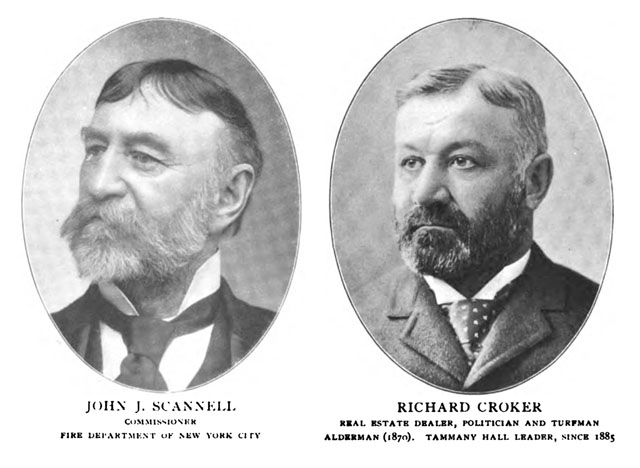
By the time that I was done with this post, I had found the young J.J. Scannell and Richard Croker sitting out a sentence in Manhattan’s “Tombs”. Quite a propitious meeting- in retrospect, one with far reaching consequence.
These two men would rise to the top of Tammany Hall one day, preside over the consolidation of the City of Greater New York from the shadowed world of the “smoke filled room”, and grow filthy rich on a buttery diet of political corruption.
Think Boss Tweed was something? In that case, you’ve never heard of Scannell and Croker.
All this because I enjoy strolling through Calvary in the afternoon while the Dropkick Murphys are playing on my headphones.
incidentally, something recently discovered (see how it works?) were these portraits of Mr.’s Scannell and Croker- found in Moses King’s “Notable New Yorkers of 1896-1899, courtesy google books

– photo by Mitch Waxman
“from some point in space“, another 2010 posting, showcases a shot of Dutch Kills acquired before a press conference which highly placed members of the Newtown Creek Alliance had asked me to represent them at (literally no one else from Queens was available).
My statement was prepared, thankfully, as I was standing next to and was introduced by Congresswoman Carolyn Maloney. Stage fright and hallucination inducing nervousness ruled my mood during the lead up.
To alleviate the anxiety while waiting for the event to begin… and as I happened to be standing in a south facing room within the Degnon Terminal’s former Loose Wiles building… which overlooks the waters of the Dutch Kills tributary of Newtown Creek- a window was soon roughly thrown open and I shot the image above.
As it happens, while attempting to research a group of heretical Quakers operating in the area just before the Revolutionary War, I came across the following image in another one of those “old and out of copyright” municipal journals which have found their way onto the web.

– Photo from 1921’s ”The Newtown Creek industrial district of New York City By Merchants’ Association of New York. Industrial Bureau”, courtesy google books
Cool, huh?
An August 2011 post, called the “the dark moor“, reversed the point of view and showed the view from infinite Brooklyn into Queens from atop the digester eggs of the Newtown Creek Waste Water Treatment Plant.
Click for details on Mitch Waxman’s
Upcoming walking and boat tours of Newtown Creek, and Staten Island’s Kill Van Kull
June 23rd, 2012- Atlas Obscura Thirteen Steps around Dutch Kills walk (this Saturday)
for June 23rd tickets, click here for the Atlas Obscura ticketing page
June 30th, 2012- Working Harbor Committee Kill Van Kull walk
for June 30th tickets, click here for the Working Harbor Committee ticketing page
July 8th, 2012- Atlas Obscura Walking Tour- The Insalubrious Valley
for July 8th tickets, click here for the Atlas Obscura ticketing page
July 22nd, 2012- Working Harbor Committee Newtown Creek Boat Tour
chaplet of vine

– photo by Mitch Waxman
All roads lead to either Calvary Cemetery and its emerald devastations or to the Shining City of Manhattan.
Oddly, modernity has severed most of the connections between the two, but the Long Island Expressway will still allow you to shuttle back and forth between them. Your humble narrator, of course, scuttles along the sidewalk to the polyandrion while shunning the metropolis.
The former is visited enthusiastically, but the latter is entered only when necessity demands so.

– photo by Mitch Waxman
Surrounded by expressways, heavy industry, and the languid mockeries of the Newtown Creek, Calvary Cemetery is 365 acres of silent and sanctified surcease from the urban milieu.
Here lie kings, gangsters, soldiers, governors, and the huddled masses whose yearnings carried them to this ultimate destination. Untold multitudes are interred in this hill of laurels, which may truly be called a home to the tomb legions of Dagger John.

– photo by Mitch Waxman
A great working will begin soon, and a colossus will be be torn away from its long habitation. In its place will rise a new shaping of steel and cement. Dire prophecies, attributed to the forest aborigines of central America, declare that 2012 will be a year of tribulation for the world.
In the case of this great bridge over the Newtown Creek, it would appear that they were correct in their assertion.
_______________________________________________________________________________
Also:
June 16th, 2012- Newtown Creek Alliance Dutch Kills walk (this Saturday)

– photo by Mitch Waxman
The Newtown Creek Alliance has asked that, in my official capacity as group historian, a tour be conducted on the 16th of June- a Saturday. This walk will follow the Dutch Kills tributary, and will include a couple of guest speakers from the Alliance itself, which will provide welcome relief for tour goers from listening to me rattle on about Michael Degnon, Patrick “Battle Ax” Gleason, and a bunch of bridges that no one has ever heard of.
for June 16th tickets, click here for the Newtown Creek Alliance ticketing page
June 23rd, 2012- Atlas Obscura Thirteen Steps around Dutch Kills walk

– photo by Mitch Waxman
Additionally- the “Obscura Day” Thirteen Steps around Dutch Kills tour proved that the efficacy and charms of the Newtown Creek’s least known tributary, with its myriad points of interest, could cause a large group to overlook my various inadequacies and failings. The folks at Atlas Obscura, which is a fantastic website worthy of your attentions (btw), have asked me to repeat the tour on the 23rd of June- also a Saturday.
for June 23rd tickets, click here for the Atlas Obscura ticketing page
June 30th, 2012- Working Harbor Committee Kill Van Kull walk

– photo by Mitch Waxman
My various interests out on the sixth borough, NY Harbor, have brought me into association with the Working Harbor Committee. A member of the group’s Steering Committee- I also serve as the “official” group photographer, am chairman and principal narrator of their annual Newtown Creek Boat Tour, and occasionally speak on the microphone during other tours (mainly the Brooklyn one). This year, the group has branched out into terrestrial explorations to compliment the intense and extant schedule of boat tours, and I’m going to be leading a Kill Van Kull walking tour that should be a lot of fun.
The Kill Van Kull, or tugboat alley as its known to we harbor rats, is a tidal strait that defines the border of Staten Island and New Jersey. A busy and highly industrialized waterfront, Working Harbor’s popular “Hidden Harbor – Newark Bay” boat tours provide water access to the Kill, but what is it like on the landward side?
Starting at the St. George Staten Island Ferry terminal, join WHC Steering Committee member Mitch Waxman for a walk up the Kill Van Kull via Staten Islands Richmond Terrace. You’ll encounter unrivaled views of the maritime traffic on the Kill itself, as well as the hidden past of the maritime communities which line it’s shores. Surprising and historic neighborhoods, an abandoned railway, and tales of prohibition era bootleggers await.
The tour will start at 11, sharp, and you must be on (at least) the 10:30 AM Staten Island Ferry to meet the group at St. George. Again, plan for transportation changes and unexpected weirdness to be revealed to you at MTA.info.
for June 30th tickets, click here for the Working Harbor Committee ticketing page


 The Newtown Pentacle