Archive for the ‘Greenpoint’ Category
The Smelling Committee

– photo by Mitch Waxman
As long time readers will recall, in the fall of 2010, the Newtown Creek Alliance and the Working Harbor Committee received a grant from the NYCEF fund of the Hudson River Foundation to conduct 4 boat tours of Newtown Creek. The plan was to do two ticketed tours for the public (the tickets were available at a steeply discounted rate), one for educators, and one for “the elected’s” of the watershed. The first three went off without a hitch, but the fourth was postponed due to the tragic helicopter crash on the East River which occurred just as we were about to board the boat.
Last Friday, the 4th of May, we accomplished the fourth tour with a modern day “Smelling Committee” onboard.
from “Annual Report of the Department of Health of the City of Brooklyn for the year 1895”, courtesy google books
Whereas, Complaint has been made to the Governor of the State of New York during the year 1894 by the citizens and residents of the Town of Newtown and the City of Brooklyn, relating to the existence of public nuisances on or near Newtown Creek, jeopardizing the health and comfort of the people in the vicinity thereof, and the Hon. Roswell P. Flower, Governor of the State of New York, did thereupon, on the 2d day of August, 1894, pursuant to Chapter 661, of the Laws of 1893, require, order and direct the State Board of Health to examine into the alleged nuiscances, and to report the result thereof…

– photo by Mitch Waxman
Important to the mission was attendance of officials from both sides of the Creek. The “center of gravity” for the advocacy of the Newtown Creek has historically been in Greenpoint, but that doesn’t mean that the folks on the Queens side haven’t been paying attention. Pictured above are Michael Gianaris and Jimmy Van Bramer, and both were anxious to visit this hidden part of their districts.

– photo by Mitch Waxman
As luck would have it, we passed by one of the many workboats which have been operating along the Newtown Creek of late. These workboats, hailing from Millers Launch on Staten Island, are carrying contractors and employees of the Federal Environmental Protection Agency who are collecting samples of the so called “black mayonnaise” sediments for laboratory analysis.

– photo by Mitch Waxman
You cannot fix something unless you understand it, and the EPA has scheduled an exhaustive “scoping period” during which a series of such tests will be performed. Since January, I have personally witnessed dozens of such operations- ranging from towing a sonar buoy up and down the waterway to establish a subsurface topographical map, to the group onboard this vessel who seemed to operating a hand operated dredge to bring materials up into the light.
Notice that the folks directly handling the sediments are wearing protective garments.

– photo by Mitch Waxman
A Newtown Creek Alliance member, Phillip Musegaas of Riverkeeper fame came along to inform about and describe the legal and policy issues surrounding the Greenpoint Oil Spill, Superfund, or any of the myriad points of law which surround the Newtown Creek. That’s Phillip on the right.
I should mention that Council Member Stephen Levin of Greenpoint was onboard as well, but was forced to stay in the cabin and deal with urgent business in his district via phone.

– photo by Mitch Waxman
A decision which I’ve been keeping to is to not bring “civilians” all the way back to English Kills on these boat tours, but this “Smelling Committee” was no mere interested group and accordingly we entered into the heart of darkness- God’s Gift to Pain itself. This is as bad as it gets along the Newtown Creek, a stinking and fetid miasma poisoned with sewage and urban runoff surrounded by waste transfer stations.
In the distance is one of the largest CSO’s in the entire city, and the Montrose Avenue Rail Bridge of the LIRR’s Bushwick Branch.

– photo by Mitch Waxman
Not just elected officials were onboard, of course, representatives of a veritable alphabet soup of three lettered agencies were also invited. Additionally, local leaders- such as Tom Bornemann from the Ridgewood Democratic Club (pictured above, in sunglasses) accompanied the tour. The microphone was passed amongst us, with Kate Zidar (NCA’s executive director), Michael Heimbinder (NCA’s chair), Laura Hoffman (Newtown Creek Monitoring Committee), Phillip Musegaas (Riverkeeper), Penny Lee (City Planning), and myself narrating at various legs of the trip.

– photo by Mitch Waxman
Pictured above are Assemblyman Joe Lentol of Greenpoint, Council Member Jimmy Van Bramer of Queens, Working Harbor Development Director Meg Black, Council Member Diana Reyna of Brooklyn, a gentleman who I’m embarrassed to say I can’t identify, and State Senator Michael Gianaris.

– photo by Mitch Waxman
The Smelling Committee of 2012 encountered a Newtown Creek swollen by days of rain, replete with oil slicks and “floatables” contamination. The term floatables is used to describe everything from stray bits of lumber and tree limbs to cast off plastic bottles and wind blown trash carried in the water, by the way. The trip was 2 hours in length, and accomplished onboard a NY Water Taxi vessel. It left from Pier 17 in Manahattan at four in the afternoon and returned at six, proceeding some three and one half miles into the Newtown Creek and required the opening of the Metropolitan Avenue Bridge.

– photo by Mitch Waxman
Along the way, sites of legal or popular interest were pointed out- including the future of the Arch Street Yard, the Hunters Point South development, SimsMetal, the Newtown Creek Waste Water Treatment Plant, the Greenpoint petroleum district, the Blissville Oil spill, the Greenpoint Oil Spill, the Phelps Dodge site, the Kosciuszko Bridge, the CSO issue, the role of Newtown Creek as a mass employer, the maritime potential of the Creek and its potential for eliminating a significant amount of trucking activity, its myriad waste transfer stations, and the plans which EPA have for the place.

– photo by Mitch Waxman
Crass observers in the antiquarian community and political operatives in both boroughs will sneer at efforts such as this, the aim of which was to create a common sense of purpose and to identify issues regarding the Creek for both the Queens and Brooklyn political establishments. Ridgewood and Bushwick, Maspeth and Greenpoint, Williamsburg and Long Island City- all parts of the Newtown Creek watershed have more in common with each other than they do with neighboring districts in either borough. They are blessed with one of the finest industrial waterfronts in the world, but cursed by its past. What the Newtown Creek will look like in fifty years time is beginning to be discussed, and it was time for this “congress of the creek” to be convened.
So much of what the people in high office know of this place is influenced by dire reportage and dry testimony, and it can be easy to overlook the past, present, and future of this maritime superhighway if you haven’t experienced it first hand.
Especially from the water.

– photo by Mitch Waxman
Several times have I witnessed the effect that this place has on first time visitors, a transformation of expression and demeanor overtakes them.
Hardened New Yorkers all, the Newtown Creek nevertheless explodes all expectations and an expression of wonderment forms upon their faces. They come to see toxic waste dumps and oil spills, but instead find Herons, Egrets, and Cormorants nesting in the broken cement of abandoned industrial bulkheads. They witness the miles wide vistas and wide open view of the City of New York from its very navel, and are thunderstruck that such a place exists- this “Insalubrious Valley” of the Newtown Creek watershed.
Every time I start to narrate on one of these tours, my first utterance is always “this is not the world you know…”.
I’m happy to say that due to the Working Harbor Committee, Newtown Creek Alliance, and the NYCEF Fund of the Hudson River Foundation- the Smelling Committee of 2012 knows this corner of the world a little bit better.
What will come of it?
Others will have to answer that, for your humble narrator must remain without and is cursed to merely observe such matters. Always, an outsider.
time convulsed

– photo by Mitch Waxman
As mentioned in yesterday’s posting, I spend an atrocious amount of time studying century old publications and journals found on google books. These periodicals, both trade and municipal in nature, often discuss the origins of the Newtown Creek as it exists today. At the beginning of the 20th century, when the Creek was at its arguable worst (environmentally speaking), there was a popular sentiment that engineering could fix all of its problems.
Hindsight suggests that they just made things worse, of course, but there’s the human condition for you. Pictured above is the Greenpoint Avenue Bridge in modernity, while below is the 1910 version.
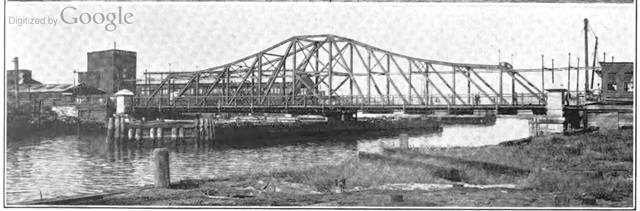
– photo from Engineering magazine, Volume 38, 1910- courtesy google books
This is the bridge that burned away in the 1919 Locust Hill Oil Refinery disaster, a swing bridge not unlike the relict Grand Street Bridge found further up the Creek. Whenever such “Now and then” shots come into my hands, especially images considered to be in the public domain- they will be eagerly shared at this- your Newtown Pentacle.
For more on the history of the Greenpoint Avenue Bridge and its environs, which I call DUGABO- Down Under the Greenpoint Avenue Bridge Onramp- click here
Also:

– photo by Mitch Waxman
An NCA event, which I for one am pretty stoked about:
April NCA meeting hosts Dr. Eric Sanderson
Thursday, April 26, 2012 at 6pm
Ridgewood Democratic Club, 6070 Putnam Avenue, Ridgewood, NY 11385
In addition to important updates from our members – in particular the Bioremedition Workgroup has been very busy! – we will be hosting a special presentation on the “Historical Ecology of Newtown Creek”.
Dr. Eric Sanderson, senior conservation ecologist at the Wildlife Conservation Society and author of “Mannahatta: A Natural History of New York City” (Abrams, 2009), will describe recent studies of the historical ecology of Newtown Creek, describing the original wetlands, creek channels, topography and vegetation of the area. He will show a series of 18th and 19th century maps of the watershed of the creek and discuss the process of synthesizing them into an integrated ecological picture that can be used to inform and inspire natural restoration and cultural appreciation of the Newtown Creek watershed. This work is part of the Welikia Project (welikia.org), an investigation into the historical ecology of the five boroughs of New York City and surrounding waters.
And this Saturday,

Obscura Day 2012, Thirteen Steps around Dutch Kills
Saturday April 28th, 10 a.m.
Your humble narrator will be narrating humbly at this year’s Obscura Day event on April 28th, leading a walking tour of Dutch Kills. There are a few tickets left, so grab them while you can.
“Found less than one mile from the East River, Dutch Kills is home to four movable (and one fixed span) bridges, including one of only two retractible bridges remaining in New York City. Dutch Kills is considered to be the central artery of industrial Long Island City and is ringed with enormous factory buildings, titan rail yards — it’s where the industrial revolution actually happened. Bring your camera, as the tour will be revealing an incredible landscape along this section of the troubled Newtown Creek Watershed.”
For tickets and full details, click here :
obscuraday.com/events/thirteen-steps-dutch-kills-newtown-creek-exploration
brief and desolate

Vintage Tugboat at Newtown Creek – photo by Mitch Waxman
Note: This is a “reblog”, and was originally presented in August of 2010.
A rare opportunity to ride up the Newtown Creek was recently enjoyed by your humble narrator, and on my journey up that maligned cataract I spotted an artifact of New York Harbor’s glorious past sneaking past Hunters Point.
from epa.gov
Blue-claw crabs, bluefish, weakfish, striped bass, and other species inhabit the creek, and fishing and crabbing for human consumption occurs [Ref. 7, pp. 2, 5; 8, p. 11; 21, p. 13; 22, pp. 1-2; 24, p. 143; 52, p. 93; 68, p. 3; 69, p. 1]. Subsistence fishing has been observed in Newtown Creek at Dutch Kills, and crabbing for consumption has been observed at the end of Manhattan Avenue in Brooklyn [Ref. 7, p. 5; 21, p. 13; 22, pp. 1-2; 68, p. 3; 69, p. 1]. These locations are both within the zone of contamination for the Newtown Creek site [Figure 2 of this HRS documentation record]. Therefore, Actual Contamination is documented, and the target fishery is evaluated for Actual Human Food Chain Contamination.

the W O Decker at Newtown Creek – photo by Mitch Waxman
Wooden hulled, its spitting steam boilers have long been replaced by modern diesel engines, this little (52 feet long) tugboat is the W O Decker.
also from epa.gov
Beginning in the late 1800s and continuing into the 1930s, Newtown Creek was widened, deepened, and lined with bulkheads to accommodate the growing traffic, leading to the destruction of all its freshwater sources [Ref. 8, p. 10; 12, p. 52]. During World War II, the government commandeered factories along the creek to make military equipment, such as a factory that made aluminum for fighter planes [Ref. 11, p. 14]. At that time, Newtown Creek was the busiest industrial port in the Northeast, with tanker traffic lining its length [Ref. 7, p. 1; 11, p. 13]. The national highway system built after the war took business away from the nation’s waterways, leading to a rapid decline in the level of industry along Newtown Creek [Ref. 7, pp. 1-2].

the W O Decker passing by the “Greenpoint Manufacturing and Design Center” – photo by Mitch Waxman
A “historic place” the Decker was originally called the Russell 1 when it was built in 1930 for the Newtown Creek Towing Company, who were specialists in berthing and towing heavy cargo along the crowded and narrow waterway.
from gmdconline.org
The Greenpoint Manufacturing and Design Center (GMDC) started in the late 1980s as an innovative intersection of two interests: reclaiming derelict factories in North Brooklyn’s Greenpoint neighborhood and sustaining industry and manufacturing in New York City. The organization formally incorporated in 1992.
From its initial purchase and redevelopment of a large facility at 1155 Manhattan Avenue for use by light manufacturers and artisans, GMDC has since expanded and today is the only nonprofit industrial developer in New York City. The organization acquires, develops, and manages industrial real estate that provides small and medium-sized manufacturing enterprises with affordable, flexible production space.

In the shot above, The Decker is passing the Newtown Creek Waste Water Treatment Facility in Greenpoint, Brooklyn – photo by Mitch Waxman
The Decker is currently a high end tour vessel, operated by and out of the South Street Seaport in Manhattan.
from seany.org
The wooden tugboat W.O. Decker was built in Long Island City, Queens in 1930 for the Newtown Creek Towing Company, a firm specializing in berthing ships and barges in the creek that separates Brooklyn and Queens. Originally called the Russell I for the towing company’s owners, she was renamed the W.O. Decker in 1946 after being sold to the Decker family’s Staten Island tugboat firm.

The shield wall of the Shining City, framed by Long Island City on the right and industrial Brooklyn on the left with the Pulaski Bridge just at Horizon – photo by Mitch Waxman
The vessel I was aboard continued on toward the Greenpoint Avenue Bridge, but the Decker turned in the narrow part of the Newtown Creek near the confluence of its tributaries Whale Creek and Dutch Kills.
Check out this 1896 article at the NYTimes, which actually interviews the manager of Newtown Creek Towing Company, John Russell, for whom the Decker was originally named.
moderate size

– photo by Mitch Waxman
The news about the Queensboro Bridge Lamp Post broke into the larger City just the other day, and your humble narrator found himself being examined and interrogated by members of the news media.
That sounds worse than it actually was, they were all actually quite charming, but the abject self loathing which defines and informs my character is always a bit put out when dragged out into the light.
For the original postings about the thing, click here for “an odd impulse” and “wisdom of crowds“

– photo by Mitch Waxman
Standing exposed, in front of a possibly angry crowd of villagers, can carry severe repercussion for so onerous an individual as that one which stares at me from beyond silvered glass.
Really, it might have been best to just pretend that I missed the message, or was out of town. Of course, it has been years since I’ve left this city for even a single day, so zero efficacy would have met the claim. Whether it be bacchanal or shift work, the megalopolis has become an involuntary prison, and I’ve learnt to obey its whims.
Like a leaf, you, and free will is some cruel myth.

– photo by Mitch Waxman
This Sunday, as detailed in the blurb below, just such random chance will carry me to the Newtown Creek Waste Water Treatment Plant Nature Walk. There, in the radiated splendors of the Newtown Creek itself, shall gather the Newtown Creek Alliance for an Earth Day Celebration and BYO Picnic.
The public is invited, and encouraged to examine and explore a fabulous waterfront space which presents an unparalleled panorama of that legendary waterway, in the company of those who understand her mysteries best. Do join, don’t let my attendance hold you back, as I plan on holding to the shadows and lurking- in fear- away from crowds.
Also from newtowncreekalliance.org

– photo by Mitch Waxman
Earth Day BYO Picnic Lunch at the Newtown Creek Nature Walk
Sunday, April 22nd at 1 p.m.
Come join in for this casual celebration of the victory that is the Newtown Creek Nature Walk. Bring your own brown bag lunch and join the Newtown Creek champions who worked hard for years to win this unique waterfront park.
Sunday, April 22nd at the Newtown Creek Wastewater Treatment Plant Nature Walk between 1pm – 2pm.
Finally,
Obscura Day 2012, Thirteen Steps around Dutch Kills
April 28th, 10 a.m.
Your humble narrator will be narrating humbly at this year’s Obscura Day event on April 28th, leading a walking tour of Dutch Kills. The tour is already two thirds booked up, so grab your tickets while you can.
“Found less than one mile from the East River, Dutch Kills is home to four movable (and one fixed span) bridges, including one of only two retractible bridges remaining in New York City. Dutch Kills is considered to be the central artery of industrial Long Island City and is ringed with enormous factory buildings, titan rail yards — it’s where the industrial revolution actually happened. Bring your camera, as the tour will be revealing an incredible landscape along this section of the troubled Newtown Creek Watershed.”
For tickets and full details, click here :
obscuraday.com/events/thirteen-steps-dutch-kills-newtown-creek-exploration
strange corridors

– photo by Mitch Waxman
Staying current on the story of Newtown Creek involves attending a lot of meetings. Some are private, most public. Often, they came rapid fire and it feels as if every other evening is consumed. One of the many community groups which hold such gatherings is the Newtown Creek Monitoring Committee. I’m a guest at this particular gathering, and as such an attempt is made to remain silent and observe the proceedings.
The group engages in a dialogue with representatives of the NYC DEP, who are offered input from community representatives regarding issues that might arise from the presence of the Newtown Creek Waste Water Treatment Plant.
One of these issues, as you would imagine, is the spread of odors emanating from the vast facility.

– photo by Mitch Waxman
The DEP contract with a company, called “Odor Science and Engineering”, who specialize in the detection and discovery as well as elimination of point sources for malodorous gases. Luckily, an inspection of the plant by the company was scheduled for the following week and Christine Holowacz (DEP community liaison) arranged for a few of us to accompany the effort.
Pictured above is Kate Zidar (Newtown Creek Alliance Executive Director) and Laura Hoffman (Newtown Creek Monitoring Committee), who with myself, showed up bright and early to be fitted with hard hats and vests.

– photo by Mitch Waxman
We were introduced to Dr. Ned Ostojic Ph.D and P.E., Odor Science & Engineering’s Vice President & Director of Engineering.
A tall and dignified fellow, Dr. Ostojic spoke with a barely detectable yet pleasant European accent and was extremely hospitable to us as he described his function at the plant. An engineer, he was tasked with not only finding the sources of odor but describing practical solutions to eliminate them.

– photo by Mitch Waxman
Dr. Ostojic produced a device whose purpose was to combat a human perception bias called environmental adaptation. To describe it simply, the human mind filters out environmental stimuli to create a sense of “normalcy”. If you live on a noisy street, your brain filters out most of that noise and you become inured to the environmental background level. The brain functions in the same way with smell, something I know to be accurate. When I encounter the smell of the Newtown Creek, or of any sewer plant, no reaction is displayed while others openly gag.
My brain has become adapted to Newtown Creek.

– photo by Mitch Waxman
He asked us not to make fun of the devices name, which was a “Nasal Ranger”.
It allows calibrated measurement of smell based on a concentrating chamber which lies behind an aperture dial. The dial allows ever smaller samples to be inhaled into the device, which can then be graded on a subjective and numerical scale. Good science, don’t forget, is all about measurement and objective recording. The Nasal Ranger removes personal interpretation from data records, as its operators are trained according to an empirical standard.

– photo by Mitch Waxman
We three accompanied Dr. Ostojic on his walk through of the plant, and his duty this day was the inspection of the settling tanks which allow sewer borne debris to drop out, or be be skimmed from, the wastewater flow before it enters those famous digester eggs which distinguish this plant and betray its location on the skyline of New York City.

– photo by Mitch Waxman
Several times has your humble narrator been allowed to enter and record the grounds of this facility, found along the Newtown Creek, but this side of things has always been off limits because of extreme danger.
One of the curious facts related to me that day was that , were one of us to slip and fall into the highly aerated water and sewage in the tanks surrounding us, the liquid would not display much buoyancy. Because of all the dissolved gas in the liquid, neither would it slow your fall much and you would plummet- as if through air- some two stories to a hard cement floor.
In no uncertain terms, I was told, you would die. This was confirmed by one of my union buddies, who works at another plant in the DEP system.

– photo by Mitch Waxman
This is somewhere around midway through the sewage treatment process, after the larger bits of solute and debris carried in the flow have been removed. When the raw flow hits the plant, it carries wood and boxes and all sorts of garbage and debris with it. This gross matter is removed mechanically at another part of the plant. Next up is grit, which can be sand, soil, or just plain old coffee grounds. The rate of speed at which the wastewater races through the system makes even such innocuous contaminants hazardous to the works, and is removed by more specialized machines housed in separate “grit buildings”.

– photo by Mitch Waxman
Of course, nothing is perfect, and the job of these settling tanks is to skim off any floatable material which has evaded prior filtration. Fats, oils, and a surprising number of cigarette butts, tampon applicators, condoms, and other floatable material is seen at the collection side of the tanks. As they are open to the air, this is one of the spots which Dr. Ostojic regularly inspects and pays a great deal of attention to. He was constantly checking his readings and observations against the prevailing winds.

– photo by Mitch Waxman
Dr. Ostojic wasn’t alone for the inspection and was working with the fellow pictured above, who introduced himself as Gary Grumley. Mr. Grumley was working with a different detection device than Dr. Ostojic, a hydrogen sulfide detector.
Hydrogen sulfide, of course, is a colorless gas which is infamous for the fecund smell of decay commonly referred to as “rotten eggs”. Such emissions are responsible for a lot of community complaints, and are unfortunately part of the complex chemistry which accompanies the disposition of sewage.

– photo by Mitch Waxman
The device itself seemed sturdy, and Mr. Grumley arranged it neatly for photographing. He had begun work several hours prior to our arrival and began transmitting his findings and observations to Dr. Ostojic.

– photo by Mitch Waxman
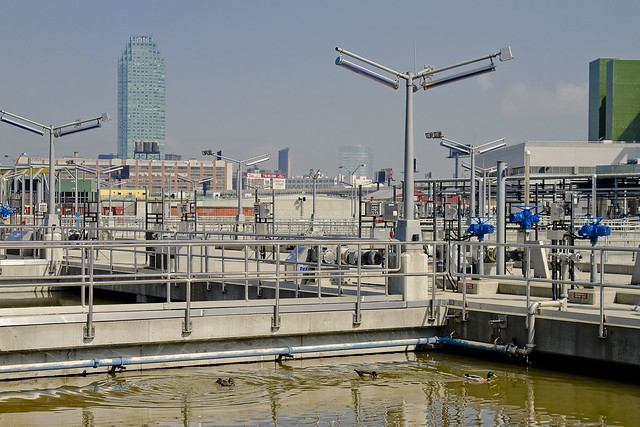
A graphic map of the plant with its multitude of buildings, service areas, and zones was on Dr. Ostojic’s clipboard.
A running tally of various areas where an unexpected or intense odor was encountered had been kept, and each occurrence was registered with a numerical value or rating. We didn’t encounter anything truly horrible btw.
– photo by Mitch Waxman
An example was offered later in the day by the DEP’s Superintendent of the Plant, Jim Pynn, of Dr. Ostojic’s contributions.
It seems that a problem had developed around the hatches leading to an underground tank, cylindrical in shape, which had been located in a rectangular shaped shaft. An onerous odor was regularly emerging from the shaft, and Dr. Ostojic was called in. He determined that as wind passed over it, a venturi was forming in the space between the cylinder and the right angled walls which suctioned the tainted air from it’s enclosure and into the open air.
Dr. Ostojic’s simple solution, adding chevrons to the sides of the tank which would abort the formation of a vortex, saved the plant a costly redesign of the affected area. The smell stayed where it was meant to, as well.

– photo by Mitch Waxman
Dr. Ostojic was gracious and quite patient with us. A loving nickname for him, which is offered with wide smiles and a wink by those who work at the plant, is “Ned the Nose”.
Usually, when one is invited to attend a meeting at an industrial site in Greenpoint, Brooklyn- with someone named Ned the Nose- the encounter seldom turns out to be as pleasant as this was.

– photo by Mitch Waxman
Newtown Pentacle, we go these places so you don’t have to.
ALSO:
Your humble narrator will be narrating humbly at this year’s Obscura Day event on April 28th, leading a walking tour of Dutch Kills. The tour is already a third booked up, and as I’m just announcing it, grab your tickets while you can.
“Found less than one mile from the East River, Dutch Kills is home to four movable (and one fixed span) bridges, including one of only two retractible bridges remaining in New York City. Dutch Kills is considered to be the central artery of industrial Long Island City and is ringed with enormous factory buildings, titan rail yards — it’s where the industrial revolution actually happened. Bring your camera, as the tour will be revealing an incredible landscape along this section of the troubled Newtown Creek Watershed.”
For tickets and full details, click here :
obscuraday.com/events/thirteen-steps-dutch-kills-newtown-creek-exploration


 The Newtown Pentacle