Archive for the ‘Long Island City’ Category
spaces and travelers

– photo by Mitch Waxman
Lonely and alienated, your humble narrator nevertheless enjoys several safe harbors where pitying hosts allow me a chance to sit and recover from my endless marching across the great human hive. One of these spots is the North Brooklyn Boat Club in DUPBO, where the tug Cheyenne recently revealed itself to me. Cheyenne is employed by DonJon Marine, and on this day was hitched up to two recycling barges- likely coming from the SimsMetal dock adjoining the Dutch Kills tributary of the loquacious and far larger Newtown Creek. Welcome to yet another Maritime Sunday, at this, your Newtown Pentacle.
Built in 1965, by Ira S. Bushey and Sons of Brooklyn, New York (hull #628) as the tug Glenwood for Red Star Towing.
In 1970, she was acquired by Spentonbush Towing where she was renamed as the Cheyenne
The tug was later acquired by Amerada Hess where she retained her name.
She was then acquired by Empire Harbor Marine where the tug retained her name. The company would later be renamed as Port Albany Ventures.
In 2009, Port Albany Ventures was acquired by the DonJon Marine Company of Hillside, New Jersey.

– photo by Mitch Waxman
The mast on Cheyenne was rigged backward, no doubt to allow passage under the Pulaski Bridge without having to waste time waiting for the bridge operators to open the span. The captain is quite visible in the wheel house, and he sounded a couple of toots to the crew at North Brooklyn Boat Club. He did seem aghast when I came into view, but who could blame anyone for reacting in shock to the sort of shambling mess and crude imposture which stares back at me from the mirror.
from donjon.com
Founded in 1964 by Mr. J. Arnold Witte, Donjon’s President and Chief Executive Officer, Donjon Marine’s principal business activities were marine salvage, marine transportation, and related services. Today Donjon Marine is a true provider of multifaceted marine services. Donjon’s controlled expansion into related businesses such as dredging, ferrous and non-ferrous recycling and heavy lift services are a natural progression, paralleling our record of solid technical and cost-effective performance.

– photo by Mitch Waxman
Cheyenne fled the scene, no doubt alerting the authorities to the weird habitation witnessed in DUPBO. Regardless of the thunder struck expression on the Captain’s face, another of the dread realizations that a sailor’s life holds, a hearty Maritime Sunday shout out is nevertheless offered.
from donjon.com
DIMENSIONS: Length Overall: 83.0 ft./ 25.30 m
CONSTRUCTION: All Steel
PROPULSION & STEERING: Main Engines: Single Screw Fairbanks Morse Diesel 1,800 bhp
Also- Upcoming tours…

for an expanded description of the October 13th Kill Van Kull tour, please click here

for an expanded description of the October 20th Newtown Creek tour, please click here
coloured hills

– photo by Mitch Waxman
There are lots of things to do this weekend, lords and ladies. To begin, or end with- depending on ones perspective- this is the closing weekend of the Newtown Creek Armada. A fun and public art project by Laura Chipley, Nate Kensinger, and Sarah Nelson Wright- the show is found at the Newtown Creek Wastewater Treatment Plant’s Nature Walk.
check out details and hours at the armada site.

– photo by Mitch Waxman
On Sunday, and this comes verbatim from newtowncreekalliance.org-
“Sept 30 – Water Quality event with North Brooklyn Coat Club and Friends
The Capitol to Capitol by Canoe expedition lands at NBBC, and a water quality discussion ensues! The event will feature presentations from a number of local organizations including the Newtown Creek Alliance, Riverkeeper, Metropolitan Waterfront Alliance and New York City Water Trails Association. We will also be celebrating the arrival of the Capital to Capitol by Canoe expedition in NYC. A project of the Canadian Wildlife Federation, this 1800 kilometer paddle will travel on rivers, lakes, canals, harbours and bays from Ottawa to Washington D.C. in a 34 foot voyageur canoe.

– photo by Mitch Waxman
Also going on this weekend- Saturday is “Field Trip Day” in Greenpoint, a free event.
Calling all urban explorers, history buffs, and lovers of Greenpoint. Drift with us through the culture and history of Greenpoint, Brooklyn, a tucked away neighborhood sculpted by its maritime and industrial past.
Field Trip day is dedicated to the art of the wander, and discovery through exploration. Come and see Greenpoint for the first time or with new eyes: for on this one day she will reveal herself through the Field Trip app, on-site installations, challenges, and quests.
Discover where colored pencils came from, get up close and personal with one of the most polluted waterways in the US, and take down your opponents in a dramatic restaging of a Civil War ironclad battle! Together we’ll find hidden places, discover secret histories, and learn skills long forgotten.
There are no right choices, no wrong turns – but there are treasures to be uncovered just out of sight.
Click here for more info and registration
endless formulae

– photo by Mitch Waxman
Welcome to DUBABO, Down Under the Borden Avenue Bridge Onramp, along the loathsome Dutch Kills tributary of the Newtown Creek. Dutch Kills is an ancestral waterway which once suffused into the swampy tidal flats which the Netherlands colonists stumbled across in the 1640’s, and which are described in the historical record as having been “malarial, and mosquito ridden”. The waterway once ran as far inland as modern day Queens Plaza, but the entire coastline of western Long Island was riddled with shallow waterways back then, which fed a thriving wetland. Sunswick, Jack’s, Wolf’s, English Kills, Maspeth, Bushwick, and the largest- Newtown- Creeks macerated the shoreline and allowed tidal nutrients to suffuse into the soil.
from a 2011 newtownpentacle posting, “uncommented masonry”
Borden Avenue is one of the older pathways in New York and particularly so for Queens, as the modern street was designated as Borden Avenue in 1868. It allowed egress from the docks at Hunters Point to the incalculably far Newtown and passed by the thriving village of Maspeth along the way. Originally a plank road set roughly into the swampy lowlands which adjoined the Newtown Creek, what would become Borden Avenue eventually progressed to the point of regular horse drawn (and then electric) street car service by the late 19th century and beginning of the 20th. It became a natural place for heavy industries to gather, and in the 1870′s and 80′s, rail road switches and “rights of way” followed their customers here.
The Long Island Railroad terminal at Hunters Point is and was on Borden Avenue, and rail tracks run parallel to Borden Avenue’s path, along what would have once been known as Creek Street. Critically, these were both freight and passenger tracks.
As of 1908, a retractile vehicle bridge crossed Dutch Kills, which we call the Borden Avenue Bridge (and which replaced the earlier wooden plank road drawbridge).

– photo by Mitch Waxman
No secret, Borden Avenue Bridge is my second favorite of the many movable spans around the Newtown Creek watershed (Grand Street is tops). The entire surface of the structure is designed to physically roll away from its piers, on rails, and retract into a pocket- ostensibly allowing maritime traffic egress to commercial docks. Dutch Kills used to be a well used and quite busy thoroughfare for such traffic, although lately- not so much.
from the NYC DOT site
Borden Avenue is a two-lane local City street in Queens. Borden Avenue runs east-west extending from Second Street at the East River to Greenpoint Avenue. The Borden Avenue Bridge over Dutch Kills is located just south of the Long Island Expressway between 27th Street and Review Avenue in the Sunnyside section of Queens. Borden Avenue Bridge is a retractile type moveable bridge. The general appearance of the bridge remains the same as when it was first opened in 1908. The bridge structure carries a two-lane two-way vehicular roadway with sidewalks on either side. The roadway width is 10.5m and the sidewalks are 2.0 m. The west approach and east approach roadways, which are wider than the bridge roadway, are 15.3m and 13.0m respectively. The bridge provides a horizontal clearance of 14.9m and a vertical clearance in the closed position of 1.2m at MHW and 2.7m at MLW.

– photo by Mitch Waxman
The water quality at Dutch Kills is fairly nightmarish, with “floatables” and wind blown trash collecting along the bulkheads. The water betrays itself with the odd colors (and colour) it displays, ranging from a reddish brown after rain events to a cadmium green during the heights of summer and depths of winter. Unnaturally still, the only flow of water here is driven by the tepid tidal flow of the larger Newtown Creek or by the expulsion of waste water and storm runoff from the Combined Sewer Outfalls found along its banks.
from wikipedia
Dutch Kills is a sub-division of the larger neighborhood of Long Island City in the New York City borough of Queens. It was a hamlet, named for its navigable tributary of Newtown Creek, that occupied what today is centrally Queensboro Plaza. Dutch Kills was an important road hub during the American Revolutionary War, and the site of a British Army garrison from 1776 to 1783. The area supported farms during the 19th Century, and finally consolidated in 1870 with the villages of Astoria, Ravenswood, Hunters Point, Middletown, Sunnyside and Bowery Bay to form Long Island City.

– photo by Mitch Waxman
Scientific analysis of the water, offered in now decades old reports by the United States Army Corps of Engineers and the far ranging Hydroqual studies of the watershed in the 1990’s, describe the presence of a millimeter thick layer of fats and lipids overlying the water. This medium allows bacterial specie to survive in the open water, and such sewage borne pathogens are abundant. Typhus, cholera, and gonorrhea- for instance- are all mentioned. Additionally, like all the waters of NY Harbor, but especially concentrated at Dutch Kills (and all around the larger Creek) due to the abundance of CSO’s- one can expect to find elevated levels of prescription drug residue carried in by sewer discharge.
from nysdot.gov
About 1900, most of the Newtown Creek was bulkheaded and occupied by about fifty industrial properties. Undeveloped or less developed sections without bulkheads included Dutch Kills, about 2,000 feet of shoreline in Queens just above Dutch Kills with two LIRR lighterage piers, about 1,000 feet of shoreline in Queens near the Penny Bridge, and about 3,500 feet of shoreline downstream of Maspeth Avenue in Brooklyn.15 Dutch Kills, and the Queens side of Newtown Creek, just upstream of Dutch Kills, were developed circa 1905-1912, largely through the efforts of the Degnon Terminal & Realty Company. The Degnon firm created an industrial park with rail and marine access around Dutch Kills between about Hunters Point and 47th Avenue, Dutch Kills subsequently was included within USACE dredging projects. Without federal assistance, Degnon created a 150-foot-wide channel with 2,400 feet of bulkhead, including a turning basin.

– photo by Mitch Waxman
DUBABO was one of the spots recently targeted by the IEC organization during “Shoreline Cleanup day”, and event in which Newtown Creek Alliance participated. IEC musters crews of volunteers who literally pick up the trash. Other harbor groups participated in the cleanup in Queens, and efforts were made literally all along the east river coast of the borough, from Astoria Park all the way to Hunters Point. Arrangements were made with a carting firm, in our case Waste Management, to dispose of the collected materials, after it had been weighed and categorized. NCA’s mission is to “Reveal, Restore, Revitalize” the Newtown Creek, after all, and “a great starting point for any project is picking the crap up off the floor first”, as my dad might have said.
from a 2011 newtownpentacle posting, “ponderous and forbidding”
All across Dutch Kills, everything bore that unmistakable colour which typifies the lament and sickness of the Newtown Creek watershed. Iridescent, it is neither black nor white nor any normal color, rather it’s is like something alien coating everything in rotten decay. Metal corrodes, wood molders, stone and cement simply crumble away.
The swampy wetlands which existed here in aboriginal times were known as the Waste Meadows in the 19th century, and perhaps this is still the appropriate terminology for them.
central chamber

– photo by Mitch Waxman
Recently, while out on the Newtown Creek on a Newtown Creek Alliance mission, the inestimable Executive Director of the group – Kate Zidar- gestured toward a certain structure on the Queens side and asked me what I knew about it. My mandate in the organization is to act as historian, as well as photographer, and the building in question is known to modernity as the “Lukoil Getty Terminal”. It’s waterfront is categorized by Dock Code 616, a 300 foot frontage, and it sits in plain view of the Greenpoint Avenue Bridge.
To me, it will always be referred to as Tidewater.
from wikipedia
Tidewater Oil Company (also rendered as Tide Water Oil Company) was a major petroleum refining and marketing concern in the United States for more than 80 years. Tidewater was best known for its Flying A–branded products and gas stations, and for Veedol motor oil, which was known throughout the world.
Tidewater was founded in New York City in 1887. The company entered the gasoline market just before World War I, and by 1920 was selling gasoline, oil and other products on the East Coast under its Tydol brand. In 1931, Tidewater expanded its reach into the midwestern U.S. by purchasing Northwestern Oil Company of Superior, Wisconsin.
Soon thereafter, Standard Oil Company of New Jersey (now ExxonMobil) gained control of Tidewater, and set up the subsidiary Mission Corporation to operate it. J. Paul Getty’s purchase of Mission in 1937 set the stage for the birth of Tidewater as a major national player in the oil industry.
In 1938, Getty merged Tidewater with Associated Oil Company, based in San Francisco with a market area limited to the Far West. Associated, founded in 1901, had created the prominent Flying A brand for its premium-grade gasoline in 1932.
With the merger and creation of Tidewater Associated Oil Company, Flying A became the primary brand name for the company, though the Tydol and Associated names were also retained in their respective marketing areas. Tydol During the 1950s, the Associated and Tydol brands gradually fell into disuse, and were dropped entirely in 1956. That same year, “Associated” was removed from the corporate name. The Veedol trademark was retained for motor oils and lubricants. BP acquired the Veedol brand when it bought Burmah-Castrol (who then owned the Veedol brand). In February 2011 announced that they wished to sell the Veedol Brand. Tidewater operated refineries on both the Atlantic and Pacific coasts, as well as a small fleet of West Coast-based tankers.

– photo by Mitch Waxman
In the early years of the American Oil industry, it seems, there were literally hundreds of small players who drilled or refined petroleum. A behemoth which emerged from the crowded field, that would dominate the sector in one way or another to this very day, was John D Rockefeller’s Standard Oil. Standard controlled the means of delivery, whether it be defacto control of the rail lines leading from oil rich regions (which were in Pennsylvania, back then) to refinery, or through ownership of the local pipelines which supplied their refined product to end use customers.
This allowed Standard to fix prices at a certain level, manipulate supply and demand in its own favor, or to keep competitors from getting their goods to market.
from 1919’s “Platts power, Volume 50“. courtesy google books
N.Y., Long Island City – The Tidewater Oil Co., 11 Broadway New York City, awarded the contract for the construction of a 2 story 30 x 140 ft warehouse on Greenpoint Ave and Newtown Creek, to H.D. Best, 949 Broadway, New York City. A steam heating system will be installed in same

– photo by Mitch Waxman
Unfair and underhanded, the Standard Trust went out of its way to destroy or stifle its competition and before long it controlled 90-95% of the oil business in the United States. Competitors came along as the years passed, most of which fell before the attentions of the Rockefellers. Some, like Charles Pratt, sold their operations to Standard and joined with it. Others were driven into bankruptcy. Technological advances and invention offered an opportunity to bypass the rail system dominated by the trust, and the dream of a pipeline which would feed oil to the independent refineries on the Atlantic coast of the United States became feasible.
The company that crystallized this challenge to Standard was the Tidewater Oil Company.
from 1889’s “Stoddart’s Encyclopaedia Americana: a dictionary of arts, sciences, and general literature“, courtesy google books

– photo by Mitch Waxman
For many years, Rockefeller and his Standard men (with their armies of bought and paid for politicians and local officials) ridiculed and fought against the pipeline company, but when his independent competitors banded together under the Tidewater brand in the 1870’s – he knew that Standard must innovate. In one of the first business moves of its kind, Standard began purchasing common stock in Tidewater, and by 1883 controlled a majority share in it.
Rather than using the well honed “breaking” techniques of industrial monopoly on the rival company, Rockefeller simply purchased his competition.
from “Harper’s magazine, Volume 72“, courtesy google books
– photo by Mitch Waxman
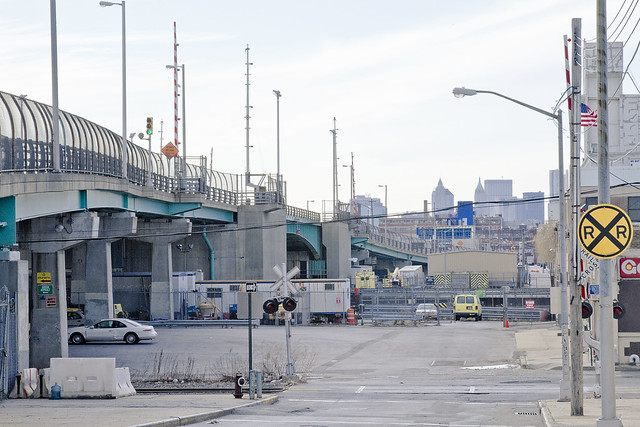
As an aside, it should be noted that the path Greenpoint Avenue takes, in modernity, as it crosses the Newtown Creek is slightly eastward of its ancient footprint. The modern bridge, which replaced an older swing bridge that carried LIRR and light rail tracks as well as vehicles, actually pulls traffic away from the ancestral road. In the early 20th century LUNA image linked to below, which is the inverse of my recent shot above, notice that only the bridge and rail tracks are still in place.
The Tidewater building would be to the left in the historic shot below.

X

– photo by Mitch Waxman
A recommended primer for anyone interested in the story of the early American Oil industry is “The History of the Standard Oil Company, By Ida Minerva Tarbell“, an admittedly biased and muckraking account told by the daughter of an oil pioneer whose business was wiped out by the Standard Trust. Tarbell disliked the term muckraker, and considering that she was a pioneering female journalist and investigative reporter in an age not exactly known for either- let’s just respect her wishes.
from “The History of the Standard Oil Company, Volume 2 By Ida Minerva Tarbell” courtesy google books

– photo by Mitch Waxman
Like most who opposed Rockefeller, who would die as the richest man in human history (in fact, adjusting for inflation- Rockefeller died richer than Augustus of Rome, and all the Pharoahs of Egypt, and all the kings of England- put together) Tidewater ended up a footnote, and being used as an instrument by which Standard could further dominate the competition.
Standard was broken up by the actions of the federal government in the early 20th century, shattered into several smaller corporations. Standard Oil Company of NY (SOCONY) was one of these, and it would become Mobil. Standard Oil Company of NJ (SOCONJ) would become Exxon.
Rockefeller’s bank account would one day attain sentience and become Chase Manhattan bank.
from wikipedia
In 1904, Standard controlled 91% of production and 85% of final sales. Most of its output was kerosene, of which 55% was exported around the world. After 1900 it did not try to force competitors out of business by underpricing them. The federal Commissioner of Corporations studied Standard’s operations from the period of 1904 to 1906 and concluded that “beyond question… the dominant position of the Standard Oil Company in the refining industry was due to unfair practices—to abuse of the control of pipe-lines, to railroad discriminations, and to unfair methods of competition in the sale of the refined petroleum products”.
effective radius

– photo by Mitch Waxman
A lesser sabbat on the great wheel of the year, at 10:49 this morning, New York City will pass through the fall equinox. Today, the day and night will oppose each other equally, and from now until March, darkness will rule as relative to light. Summer ends, and the harvest time is visited upon all that walk beneath the ever fainter emanations of the burning thermonuclear eye of god itself.

– photo by Mitch Waxman
Before long will we all be sitting before tables of bounty, gazing upon roasted meats and other oven baked fare. Just the other night, a filthy black raincoat was removed from its summer hook, and a humble narrator again filled it. Chill is the night, which grows ever longer. Soon shall we all feast, and learn new ways to laugh and revel and enjoy ourselves, as we give our so called “thanks”.

– photo by Mitch Waxman
Nepenthe is found in this season, as we slouch roughly toward Samhain and the Yule, as it’s the time of tales told. Stories of goblins and werecats, ghosts and ghasts, and the hidden world of the occultist will soon be readily revealed. On the wheel of the year, this is the start of the spooky time- when farmers fields become the property of crows and ravens, and odd occurrences abound- during the endless nights.


