Archive for the ‘New York Harbor’ Category
glassy flatness

– photo by Mitch Waxman
Odd and solitary even as a child, amongst my few friends in public school was a fellow named Brian. Despite the occasional beatings he would administer to me, which long experience has taught me to expect when interacting with others, he was an amiable kid. Brian was wont to propagate an urban legend which once permeated Brooklyn, a story which goes like this (phonetically spelled, as Brooklyn patois is critical to the telling):
“So, yooz knows about de Verryzanno Bridgde, rights? When deys wuz bilding its, and pourinz de cement- workers who fell intadee cements would just sinks rights down, and dheres nuttin that could get dones to saves ’em, so’s da bahdeez are still in da bridge. My grandfather’s brudda died dat way, my Uncle Mike…”
translation:
So, you know about the Verrazano Bridge, right? When they were building it, and pouring the cement- workers who fell into the cement would just sink in, and there was nothing that could be done to save them, so the bodies are still in the Bridge… As far as the Grandfather’s brother, versions of the story told by others involved every possible male acquaintance or familial description possible.
from nycroads.com
The foundations, which support the 264,000-ton weight of both the towers and the suspended deck, as well as a design live load of 16,000 tons on the deck, were dug 105 feet below the water on the Staten Island side, and 170 feet below the water on the Brooklyn side. Conventional foundation design called for sand islands that kept water, as well as provided working and storage space. However, because the currents were swift and the ground was unstable in the area, sand islands were not constructed. Instead, “cofferdams,” or vertically interlocking steel sheet pilings, were driven below the surface to protect the caissons. Above each 13-foot-high caisson base, muck and sand were dredged out of 66 vertical concrete shafts. When the caissons reached their predetermined depth, the shafts were filled with water, and caisson tops and bottoms were sealed with concrete. The two tower piers, which contain a combined 196,500 cubic yards of concrete, were completed in less than two years at a cost of $16.5 million.
Two anchorages were then constructed at either end of the Narrows. Each anchorage stands 130 feet high, 160 feet wide and 300 feet long. However, because of the differences below ground, the Brooklyn anchorage contains 207,000 cubic yards of concrete, while the Staten Island anchorage contains only 171,000 cubic yards of concrete. On their inshore ends, they support the two decks of bridge approaches. On their outshore ends, they carry four massive, roller-mounted saddles that support, and move with, the four cables as they change length, either because of temperature changes or because of load changes. The hand-polished concrete exteriors have diagonal patterns that continue the path of the suspension cables. Inside the anchorages, forces from the suspension are transferred at two points: the front of the anchorage (where the compacted cables bend around saddles that rest on inclined steel posts), and near the heel of the anchorage (where eyebars transfer force to inclined girders buried within the concrete). The anchorages cost $18 million to construct.

– photo by Mitch Waxman
This urban legend- and yes, it is– was once omnipresent in the land of Egg Creams and really good Pizza.
So much so that it actually made it to the movies, as you’ll observe in the clip from “Saturday Night Fever” presented below, courtesy of youtube. For a great first person description of the building of the bridge, and the remembered effects of building the Brooklyn pierage in Bay Ridge- check out the inestimable Forgotten-NY’s “Bridge in the Back Yard” posting from 2003 here.
I can tell you that the old guys in Canarsie and Flatbush who worked on the thing always “beamed” a little bit when driving down the Belt Parkway toward the City and seeing it rear up.
from youtube

– photo by Mitch Waxman
Officially, there were three deaths associated with the building of the Verrazano, and the bodies were all recovered. Brooklyn legends notwithstanding, that is actually an incredible number given the size and scope of the project.
But what else would you expect from the maestro, Othmar Amman, on his final project?
from wikipedia
The bridge is owned by New York City and operated by the Triborough Bridge and Tunnel Authority, an affiliate agency of the Metropolitan Transportation Authority. Interstate 278 passes over the bridge, connecting the Staten Island Expressway with the Gowanus Expressway and the Belt Parkway. The Verrazano, along with the other three major Staten Island bridges, created a new way for commuters and travelers to reach Brooklyn, Long Island, and Manhattan by car from New Jersey.
The bridge was the last great public works project in New York City overseen by Robert Moses, the New York State Parks Commissioner and head of the Triborough Bridge and Tunnel Authority, who had long desired the bridge as a means of completing the expressway system which was itself largely the result of his efforts. The bridge was also the last project designed by Chief Engineer Othmar Ammann, who had also designed most of the other major crossings of New York City, including the George Washington Bridge, the Bayonne Bridge, the Bronx Whitestone Bridge, the Robert F. Kennedy Bridge, and the Throgs Neck Bridge. The plans to build the bridge caused considerable controversy in the neighborhood of Bay Ridge, because many families had settled in homes in the area where the bridge now stands and were forced to relocate.
for silver
“Newtown Creek for the Vulgarly Curious” is a fully annotated 68 page, full-color journey from the mouth of Newtown Creek at the East River all the way back to the heart of darkness at English Kills, with photos and text by Mitch Waxman.
Check out the preview of the book at lulu.com, which is handling printing and order fulfillment, by clicking here.
Every book sold contributes directly to the material support and continuance of this, your Newtown Pentacle.
gentle manner

Combined Sewer Outfall BB-013, from the Pulaski Bridge – photo by Mitch Waxman
To begin- I warn you- this post will most likely “gross you out”.
In 1674, Boyle said: “I have often suspected, that there may be in the Air some yet more latent Qualities or Powers differing enough from all these, and principally due to the Substantial Parts or Ingredients, whereof it consists. For this is not as many imagine a simple and elementary body, but a confused aggregate of ‘effluviums’ from such differing bodies, that, though they all agree in constituting by their minuteness and various motions one great mass of fluid matter, yet perhaps there is scarce a more heterogeneous body in the world”.
When the pithy observation was recorded, “effluviums” were the central notion behind the miasmatic theory of disease.

CSO Outfall NC-077, Maspeth Creek, discharges 288.7M gallons per year into English Kills – photo by Mitch Waxman
The viewpoint of the learned classes in prior ages held that when certain noxious vapors produced by a mingling of soil with that standing water typically found about marsh, swamp, and sewer- then mixed with the cool night air- form so called miasmas (which is an ancient greek for pollution, I’m told).

CSO Outfall NC-077, Maspeth Creek, Tier 2 outfall – photo by Mitch Waxman
These miasmas- or “epidemic influences”- were believed to be the cause of Cholera and Typhus– and all the other plagues which would one day scythe through the crowded 18th and 19th century cities of the Industrial Revolution.
Vitruvius, in the 1st century BCE, said: “For when the morning breezes blow toward the town at sunrise, if they bring with them mist from marshes and, mingled with the mist, the poisonous breath of creatures of the marshes to be wafted into the bodies of the inhabitants, they will make the site unhealthy.”

CSO Outfall NC-077, Maspeth Creek, Ranked 25 out of over 400 in terms of volume – photo by Mitch Waxman
The air produced by, in, and around a sewer is typically an aerosol of whatever liquid solution might be floating through it. Hydroden sulfide, carbon dioxide, methane, ammonia and a host of other constituent compounds mingle and form what is generically known as “Sewer Gas”. Typically, this gas has the sulfurous smell commonly associated with rotten eggs. Otherwise lacking and poor, the average human’s sense of smell can discern this odor when its concentration in the surrounding air is minor- which speaks to an evolutionary quirk.
Obviously- our ancestors who could not detect this aerosol, or miasma, died off while while those who could detect them passed on these sensitivities on to future generations.

CSO Outfall BB-026, Dutch Kills – photo by Mitch Waxman
If you suffer from Obsessive Compulsive Disorder, this would probably be a good time to stop reading this post, incidentally. Things are about to get ugly.
As an example- When a toilet is flushed, and there is scientific evidence to back this, a plume of microscopic droplets- an aerosol– erupts from the water. These droplets carry microbes and virus particles, which then settle on surfaces around the commode facilitating the “surface to hand to mouth” vector of infection. Modern plumbing does its best to minimize this bioaerosol in the house, but routine antimicrobial maintenance with bleach and other chemicals is necessary to sterilize the potential infections which might otherwise occur.
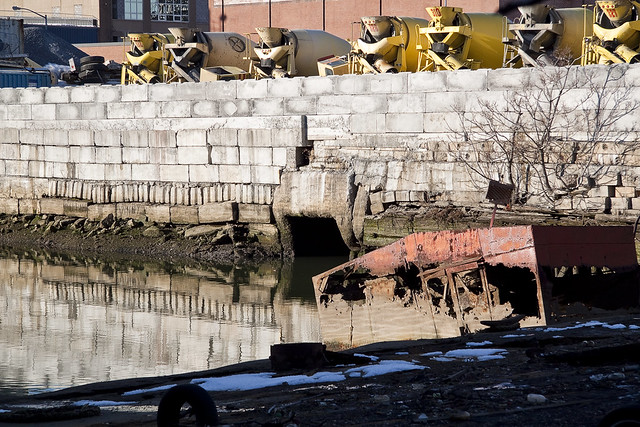
CSO Outfall BB-026, Dutch Kills – photo by Mitch Waxman
Of course, these cleaning chemicals- along with non neutralized microbes- end up in the wastewater flow, and make their way into the sewers… just like the petroleum products, volatile organic chemicals, and everything else that the human hive produces… where they swirl about beneath the streets and follow gravity to low lying areas. A properly designed system intercepts these waters, but in the case of a “CSO”, a lot of the poison makes it into the mud.

CSO Outfall BB-026, Dutch Kills – photo by Mitch Waxman
A classic example of a bacterium whose spread is defined by such aerosol dissemination is Legionella, but heavy metals and other contaminants may also find a pathway into the human body via such aerosols (let’s just call it vapor or fog). Additionally, fibers of toxic manmade substances- Asbestos for instance- are left behind during evaporation. Such deposits are then picked up on the wind, as are the dusty remains of the putrescent particulates which escape treatment by wastewater industries like the Newtown Creek Wastewater Treatment plant in Greenpoint or the Bowery Bay facility in Astoria.
During heavy rain events, some untreated sewage reaches the rivers, but a large percentage of it- the lion’s share- oozes out from the bulkheads of that assassination of joy called the Newtown Creek.

CSO Outfall NCB-632 – photo by Mitch Waxman
The Newtown Creek and its tributaries are indeed waterways, but no one ever discusses this plume of disease and contamination in the air. Fingers are pointed at certain chimneys and infamous underground lakes of petroleum and chemicals, heated discussions of when it might be safe to kayak or swim in the water are offered by interested parties, and odd admissions that there are some who actually fish in and consume the catch from these waters (which according to the EPA, are offering this catch for sale in area restaurants) both shock and titillate area wags- but what about the miasmas?

CSO Outfall NCB-632 – photo by Mitch Waxman
The sewer system of New York City is a composite beast, marrying together the municipal infrastructure of multiple communities into a single system. The cities of Brooklyn, Queens, and Manhattan (the historically agrarian and until modernity- lightly populated – Bronx has almost always been ruled over by Manhattan) each had their own standard, staring elevation, and set of regulations governing the sewers.
This NYTimes.com article from 2008 discusses recent attempts to consolidate and digitize the municipal record, and make sense out of the byzantine network of pipes which underlie the city.

CSO Outfall NCB-632 – photo by Mitch Waxman
Who can guess, all there is, that might be buried down there?
Who can speculate, all there is, which might be wafting out from these deep channels of filth and what strange aerosols are carried upon the gentle breeze- here in the Newtown Pentacle?
H.P. Lovecraft’s “The Festival”

– photo by Mitch Waxman
text quoted from H.P. Lovecraft’s “The Festival”, courtesy wikisource, where you can read the whole story
I was far from home, and the spell of the eastern sea was upon me. In the twilight I heard it pounding on the rocks, and I knew it lay just over the hill where the twisting willows writhed against the clearing sky and the first stars of evening. And because my fathers had called me to the old town beyond, I pushed on through the shallow, new-fallen snow along the road that soared lonely up to where Aldebaran twinkled among the trees; on toward the very ancient town I had never seen but often dreamed of.

– photo by Mitch Waxman
It was the Yuletide, that men call Christmas though they know in their hearts it is older than Bethlehem and Babylon, older than Memphis and mankind. It was the Yuletide, and I had come at last to the ancient sea town where my people had dwelt and kept festival in the elder time when festival was forbidden; where also they had commanded their sons to keep festival once every century, that the memory of primal secrets might not be forgotten. Mine were an old people, and were old even when this land was settled three hundred years before. And they were strange, because they had come as dark furtive folk from opiate southern gardens of orchids, and spoken another tongue before they learnt the tongue of the blue-eyed fishers. And now they were scattered, and shared only the rituals of mysteries that none living could understand. I was the only one who came back that night to the old fishing town as legend bade, for only the poor and the lonely remember.

– photo by Mitch Waxman
Then beyond the hill’s crest I saw Kingsport outspread frostily in the gloaming; snowy Kingsport with its ancient vanes and steeples, ridgepoles and chimney-pots, wharves and small bridges, willow-trees and graveyards; endless labyrinths of steep, narrow, crooked streets, and dizzy church-crowned central peak that time durst not touch; ceaseless mazes of colonial houses piled and scattered at all angles and levels like a child’s disordered blocks; antiquity hovering on grey wings over winter-whitened gables and gambrel roofs; fanlights and small-paned windows one by one gleaming out in the cold dusk to join Orion and the archaic stars. And against the rotting wharves the sea pounded; the secretive, immemorial sea out of which the people had come in the elder time.

– photo by Mitch Waxman
Beside the road at its crest a still higher summit rose, bleak and windswept, and I saw that it was a burying-ground where black gravestones stuck ghoulishly through the snow like the decayed fingernails of a gigantic corpse. The printless road was very lonely, and sometimes I thought I heard a distant horrible creaking as of a gibbet in the wind. They had hanged four kinsmen of mine for witchcraft in 1692, but I did not know just where.

– photo by Mitch Waxman
As the road wound down the seaward slope I listened for the merry sounds of a village at evening, but did not hear them. Then I thought of the season, and felt that these old Puritan folk might well have Christmas customs strange to me, and full of silent hearthside prayer. So after that I did not listen for merriment or look for wayfarers, kept on down past the hushed lighted farmhouses and shadowy stone walls to where the signs of ancient shops and sea taverns creaked in the salt breeze, and the grotesque knockers of pillared doorways glistened along deserted unpaved lanes in the light of little, curtained windows.
dark apertures

– photo by Mitch Waxman
“The daily reminder”:
Please consider purchasing a copy of the first Newtown Pentacle book:
“Newtown Creek for the Vulgarly Curious” – a fully annotated 68 page, full-color journey from the mouth of Newtown Creek at the East River all the way back to the heart of darkness at English Kills, with photos and text by Mitch Waxman.
Lamentable, this dark part of of the solar cycle both frustrates and delights.
Unwelcome, the return of frigid conditions renders my wrecked health tremulous. Unbalanced, my delicate constitution reaches out desperately for amusement and titillation. Tenebrous- the light of December is thin, ephemeral, a cloying charlatan.
I’m all ‘effed up.
from wikipedia
Anxiety is a generalized mood condition that can often occur without an identifiable triggering stimulus. As such, it is distinguished from fear, which is an emotional response to a perceived threat. Additionally, fear is related to the specific behaviors of escape and avoidance, whereas anxiety is related to situations perceived as uncontrollable or unavoidable. An alternative view defines anxiety as “a future-oriented mood state in which one is ready or prepared to attempt to cope with upcoming negative events”, suggesting that it is a distinction between future vs. present dangers which divides anxiety and fear.
Physical effects of anxiety may include heart palpitations, muscle weakness and tension, fatigue, nausea, chest pain, shortness of breath, stomach aches, or headaches. The body prepares to deal with a threat: blood pressure and heart rate are increased, sweating is increased, blood flow to the major muscle groups is increased, and immune and digestive system functions are inhibited (the fight or flight response). External signs of anxiety may include pale skin, sweating, trembling, and pupillary dilation. Someone who has anxiety might also experience it as a sense of dread or panic. Although panic attacks are not experienced by every person who has anxiety, they are a common symptom. Panic attacks usually come without warning, and although the fear is generally irrational, the perception of danger is very real. A person experiencing a panic attack will often feel as if he or she is about to die or pass out.

– photo by Mitch Waxman
Loathsome, the reflection which gazes from every shop window and puddle of urine during my long walks is that of something which can only be superficially referred to as a man.
Filthy and blackened by time, my garb has become tattered and beggarly of late. Financial hardship experienced over a long and sordid lifetime instructs that only the coarse and lasting textiles worn by beasts of burden should be considered for replacements, as they will outlast the fancy caprices of fashion and comfort by virtue of their sheer and stolid composition. These are hard times my friends, and the hard rain has already fallen.
A season of the witch is apparent, Lords and Ladies, and Woody Guthrie would recognize our time immediately as his own.
from wikipedia
Self-Awareness Theory states that when we focus our attention on ourselves, we evaluate and compare our current behavior to our internal standards and values. We become self-conscious as objective evaluators of ourselves. Various emotional states are intensified by self-awareness, and people sometimes try to reduce or escape it through things like television, video games, drugs, etc. However, some people may seek to increase their self-awareness through these outlets. People are more likely to align their behavior with their standards when made self-aware. People will be negatively affected if they don’t live up to their personal standards. Various environmental cues and situations induce awareness of the self, such as mirrors, an audience, or being videotaped or recorded. These cues also increase accuracy of personal memory.

– photo by Mitch Waxman
Lutescent, my skin color produces impressions of some jaundiced ginger candy lightly drizzled over with a thin syrup of sweat, a noted change from the sun baked complexion which was earned during the many maritime adventures of the vernal months that were described at this, your Newtown Pentacle.
A recent observation of myself at 4:30 AM in the bathroom mirror, after having spent a considerable number of hours researching a certain bridge which crosses that malign influence known as the Newtown Creek, was the moment when I realized that I had let my beard grow unchecked for better than 60 days and allowed my external appearance to betray my state of mind. The wild eyed thing staring back at me… reaching out to me as I did the same to him… surely it remains trapped in that pane of mirrored glass.
I went to the barber the next morning, and as Joe of “Joe and Tony’s” dragged a straight razor across my throat and scratched off months of neglect- for the first time in ages- I was able to relax.
from wikipedia
Clinicians assess the physical aspects such as the appearance of a patient, including apparent age, height, weight, and manner of dress and grooming. Colorful or bizarre clothing might suggest mania, while unkempt, dirty clothes might suggest schizophrenia or depression. If the patient appears much older than his or her chronological age this can suggest chronic poor self-care or ill-health. Clothing and accessories of a particular subculture, body modifications, or clothing not typical of the patient’s gender, might give clues to personality. Observations of physical appearance might include the physical features of alcoholism or drug abuse, such as signs of malnutrition, nicotine stains, dental erosion, a rash around the mouth from inhalant abuse, or needle track marks from intravenous drug abuse. Observations can also include any odor which might suggest poor personal hygiene due to extreme self-neglect, or alcohol intoxication. Gelder, Mayou & Geddes (2005) tells us to look out for weight loss. This could signify a depressive disorder, physical illness, anorexia nervosa or chronic anxiety.

– photo by Mitch Waxman
Labefaction of my very self continues unabated, and flavor is absent from all the elixirs of joy.
Sleep, and concurrent dreaming, has plagued me with its insistence and Antaeus like grip. When the oppression of these periods of unconscious hallucinations lift, I force myself from home and wander the streets in the manner and aforementioned garb of a mendicant. Drifting like some cast off ember caught on the wind, I follow the sun but as always- I am relegated to stand in the shadows of this world and its bright places are reserved for others to enjoy. Outside, in the cold and filth is where I belong- not amongst bright and happy faces chortling over shared intimacies and embarrassing overtures.
Inevitability is enjoyed by the sleepy, for in the end, they shall drop off.
from wikipedia
Depersonalization (or depersonalisation) is a malfunction or anomaly of the mechanism by which an individual has self-awareness. It is a feeling of watching oneself act, while having no control over a situation. It can be considered desirable, such as in the use of recreational drugs, but it usually refers to the severe form found in anxiety and, in the most intense cases, panic attacks. Sufferers feel they have changed, and the world has become less real, vague, dreamlike, or lacking in significance. It can be a disturbing experience, since many feel that, indeed, they are living in a “dream”. Depersonalization is a subjective experience of unreality in one’s sense of self, while derealization is unreality of the outside world. Although most authors currently regard depersonalization (self) and derealization (surroundings) as independent constructs, many do not want to separate derealization from depersonalization.Chronic depersonalization refers to depersonalization disorder, which is classified by the DSM-IV as a dissociative disorder. Though depersonalization-derealization feelings can happen to anyone subject to temporary severe anxiety/stress, chronic depersonalization is more related to individuals who have experienced a severe trauma or prolonged stress/anxiety. Depersonalization-derealization is the single most important symptom in the spectrum of dissociative disorders, including Dissociative Identity Disorder and Dissociative Disorder Not Otherwise Specified (DD-NOS). It is also a prominent symptom in some other non-dissociative disorders, such as anxiety disorders, clinical depression, bipolar disorder, borderline personality disorder, obsessive-compulsive disorder, migraine, sleep deprivation, and some types of epilepsy.

– photo by Mitch Waxman
Lexiphanic lickspittle, the lickerish lientery offered today is limaceous, foully libanophorous, and is admittedly… logorrhoea.
The question you may be asking, of course, might be “What exactly does this all have to do with anything, and what’s up with dem boids?”. Simply put, today is the beginning of the Roman festival of Saturnalia, a day of tricks and treats- and described as the “best of days” by the poet Catullus.
Traditionally, it was the day when masters and slaves would trade places. What fun that would be.
from wikipedia
Mad hatter disease describes the symptoms of mercury poisoning, specifically its effect on the nervous system. These include paraesthesias, vision and hearing impairment, slurred speech, anxiety, hallucinations, irritability, depression, lack of coordination, and tremors. The condition was observed among workers in the hat-making industry in the 1800s. Chronic mercury exposure was common in hatters who used a mercury solution during the process of curing animal pelts. Poor ventilation in the workshops of the time resulted in the hatters breathing in the fumes of this highly toxic metal, leading to an accumulation of mercury in the workers’ bodies. Metal toxicity was poorly understood and the broad range of symptoms were also associated with insanity.The phrase mad as a hatter is derived from the condition, and commonly associated with Lewis Carroll’s character the Mad Hatter in Alice’s Adventures in Wonderland. While the character’s eccentricities differ from those suffering from mercury poisoning (the Hatter was likely inspired by Theophilus Carter, a furniture dealer), Lewis Carroll grew up near the town of Stockport, where hatting was the dominant trade.


 The Newtown Pentacle