Archive for the ‘DUKBO’ Category
warnings and prophecies
2011’s Greatest Hits:

– photo by Mitch Waxman
In January of 2011, while walking along in knee deep snow, your humble narrator happened across this enigmatic and somehow familiar item sitting in a drift at the NYC S.E.M./Signals Street Light Yard of the DOT at 37th avenue near the Sunnyside and Astoria border. It looked familiar to me, but I didn’t recognize it for what it was until sharp eyed reader TJ Connick suggested that this might be the long missing Light Stanchion which once adorned the Queensboro Bridge’s Manhattan landing.
These two posts: “an odd impulse“, and “wisdom of crowds” discuss the discovery and identification in some detail.
Some good news about this iconic piece of Queens history will be forthcoming, but I’ve been asked to keep it quiet for the moment.

– photo by Mitch Waxman
In February of 2011, “Vapour Soaked” presented a startling concurrence of comparitive detail for the discerning viewer, when the shot above was presented in contrast with a 1920’s shot from The Newtown Creek industrial district of New York City By Merchants’ Association of New York. Industrial Bureau, 1921″, (courtesy Google Books).
Admittedly, not quite as earth shaking as January’s news, but cool nevertheless. I really like these “now and then” shots, expect more of the same to come your way in the future.

– photo by Mitch Waxman
In March of 2011, “first, Calvary” discussed the epic (for me) quest to find a proverbial “needle in a haystack” within First Calvary Cemetery- the grave of its very first interment, an Irish woman named Esther Ennis who died in 1848. I have spent an enormous amount of time searching for this spot, where Dagger John Hughes first consecrated the soil of Newtown.

– photo by Mitch Waxman
In April of 2011, the world lost one of its best people and my official “partner in crime”, Bernard Ente.
He was ill for awhile, but asked me to keep the severity of things quiet. He passed in the beginning of April, and one of the last requests he made of me (along with “taking care” of certain people) was to continue what he had started along the Newtown Creek and all around NY Harbor.
This was when I had to step forward, up my game, and attempt to fill a pair of gargantuan boots. Frankly, I’m not even half of who he was, but I’m trying. That’s when I officially stepped forward and began introducing myself as a representative of Newtown Creek Alliance, and joined the Working Harbor Committee– two organizations which Bernie was committed to. I’m still trying to wrap my head around his loss.

– photo by Mitch Waxman
In May of 2011, while attempting to come to terms with my new roles in both organizations, it was decided that a fitting tribute to our fallen comrade would be the continuance of his annual “Newtown Creek Cruises” and the date of May 21 was set for the event. An incredible learning experience, the success of the voyage would not have been possible without the tutelage of WHC’s John Doswell and Meg Black, NCA’s Katie Schmid, or especially the aid of “Our Lady of the Pentacle” and the Newtown Pentacle’s stalwart far eastern correspondent: Armstrong.
Funny moments from during this period included the question “Whom do you call to get a drawbridge in NYC to open for you?”.
During this time, I also became involved with Forgotten-NY’s Kevin Walsh and Greater Astoria Historical Society’s Richard Melnick and their ambitious schedule of historical tours.

– photo by Mitch Waxman
In June of 2011, the earliest Newtown Creek Chemical Factory which I’ve been able to find in the historical record, so far, was explored in the post “lined with sorrow“- describing “the Bushwick Chemical Works of M. Kalbfleisch & Sons”.
Additionally, my “Newtown Creek Magic Lantern Show” was presented to a sold out and standing room only crowd at the Greater Astoria Historical Society.
This was also the beginning of a period which has persisted all year- in which my efforts of behalf of the various organizations and political causes which I’m advocating for had reduced my output to a mere 15 or fewer postings a month.
All attempts are underway to remedy this situation in 2012, and apologies are offered.

– photo by Mitch Waxman
In July of 2011, another Newtown Creek boat tour was conducted, this time for the Metropolitan Water Alliance’s “City of Water Day”. The “Newtown Creek Magic Lantern Show” was also performed at the Admiral’s House for a packed room.
Additionally, my so called “Grand Walk” was presented in six postings. This was an attempt to follow a 19th century journey from the Bloody Sixth Ward, Manhattan’s notorious Five Points District, to Calvary Cemetery in Queens. Once, this would have been a straightforward endeavor involving minimal connections of Trolley and Ferry, but today one just has to walk. These were certainly not terribly popular posts, but are noteworthy for the hidden and occluded horde of forgotten New York history which they carry.
From the last of these posts, titled “suitable apparatus“- “As the redolent cargo of my camera card revealed- this “Grand Walk”, a panic induced marathon which carried your humble narrator across the East River from St. Patrick’s Old Cathedral in Manhattan into Williamsburg and up Grand Street to Maspeth and the baroque intrigues of the Newtown Creek– wound down into it’s final steps on Laurel Hill Blvd.”

– photo by Mitch Waxman
In August of 2011, “the dark moor” presented intriguing aerial views of the Newtown Creek Watershed, and “sinister exultation” shared the incredible sight of an Amtrak train on fire at the Hunters Point Avenue station in Long Island City. “revel and chaff” explored the aftermath of Hurricane Irene in LIC’s Zone A, and an extraordinary small boat journey around Dutch Kills was detailed in: “ponderous and forbidding“, “ethereal character“, “pillars and niches“, and “another aperture“.
This was an incredible month.

– photo by Mitch Waxman
In September of 2011, a posting called “uncommented masonry” offered this declaration:
” By 1915, there approximately 40,000 automotive trucks plying the streets of New York City.
What’s surprising is that 25% of them were electric.
Lords and ladies of Newtown, I present to you the last mortal remains of the General Electric Vehicle Company, 30-28 Starr Avenue, Long Island City– manufacturer of a substantial number of those electrical trucks.”
I’m particularly fond of this post, as this was a wholly forgotten moment of Newtown Creek and industrial history which I was able to reveal. Organically born, it was discovered in the course of other research, and I believed at the time that it was going to be the biggest story that I would present all year about Blissville.

– photo by Mitch Waxman
In October of 2011, a trio of Newtown Creek Tours (two public and one for educators) were accomplished. The public tours were full to capacity, as were the Open House New York tours I conducted on the 15th and 16th of that Month. Also, the Metropolitan Water Alliance invited me to photograph their “Parade of Boats” on October 11th, and I got the shot below of the FDNY Fireboat 343.

– photo by Mitch Waxman

– photo by Mitch Waxman
In November of 2011, a visit to Lovecraft Country in Brooklyn was described in “frightful pull“, and “vague stones and symbols” came pretty close to answering certain mysteries associated with the sky flung Miller Building found at the foot of the Greenpoint Avenue Bridge in Brooklyn.

– photo by Mitch Waxman
A December 2011 post titled “An Oil spill… in Queens” broke the news that petroleum products are seeping out of the bulkheads of Newtown Creek, this time along the Northern shoreline, which lies in the Queens neighborhood of Blissville.
Rest assured that your Newtown Pentacle is on top of the story of “the Blissville Oil Spill”, lords and ladies of Newtown, and will bring you breaking news as it develops in 2012.
crystal oblivion
– photo by Mitch Waxman
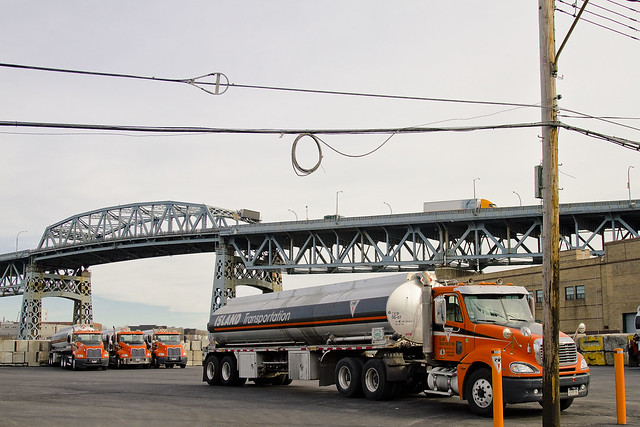
The other day I had the pleasure of some company on one of my little walks, Ms. Heather from NY-Shitty, and together we perambulated the hinterlands of Brooklyn- a no mans land between Greenpoint and East Williamsburg which has long been referred to as DUKBO in postings at this, your Newtown Pentacle.
This is a dusty, worn down, and fairly evocative place, crammed to the gills with industrial yards and century old mill buildings. A palpable evil lurks about the place, and the colour coats every surface. As a boy, when I asked my dad what was down there- he would turn pale, and demand promises that I never visit this area. This is the darkest of the hillside thickets found along the Newtown Creek, after all, legendary homeland of all that might go wrong under the American system of government.
Sorry Pop.
from the “Fellowship of the Ring” by Peter Jackson, et al.
Boromir: One does not simply walk into Mordor. Its black gates are guarded by more than just orcs. There is evil there that does not sleep, and the Great Eye is ever watchful. It is a barren wasteland, riddled with fire and ash and dust, the very air you breathe is a poisonous fume. Not with ten thousand men could you do this. It is folly.

– photo by Mitch Waxman
There was a pretty good reason that I was in the neighborhood, which will be discussed in later postings, but we soon found ourselves traipsing along beneath the rotting steel of the Kosciuszko Bridge. This is a fairly dangerous place, from a pedestrian point of view. Trucks rattle by at full throttle, sidewalks (when they exist) exhibit broken concrete and pooled water. Hideously barbed weeds sprout from the shattered roadbeds, and from every abyss something or someone stares back suspiciously.
There is nowhere to run to, in this abattoir of hope- your best hope is to attempt to fit in.
This clip from the same director’s “Return of the King” neatly encapsulates the sort of day Ms. Heather and I experienced:
w

– photo by Mitch Waxman
Mad stories have been told to me by those who labor in the area about what transpires in the fuligin hours around these parts, tales which I am duty bound not to repeat. Suffice to say that certain “ethnic fraternities” and other “ad hoc associations” maintain a certain presence in this locale, the members of which desire privacy and the cover of night to pursue their crafts. Said privacy is zealously guarded, as much of the City has been denied them by the efforts of an alliance of regional and national law enforcement.
Even during the daylight hours, the sure knowledge of their presence informs and constrains my movements and actions, but I’m from Brooklyn and know that what lurks around these parts both demand and deserves “Respect”.
As I’ve been told in the past by members of these groups- “Don’t ‘eff around back here”. Additionally, scholastic and mainstream critics have accused me of describing this area as “Mordor”, and that its not that bad.
from wikipedia
Three sides of Mordor were bounded by mountain ranges, arranged in a rough rectangle: Ered Lithui, translated as ‘Ash Mountains’ in the north, Ephel Dúath, translated as ‘Fence of Shadow’ in the west, and an unnamed (or was possibly still called Ephel Dúath) range in the south. In the northwest corner of Mordor, the deep valley of Udûn formed the region’s gate and guard house. That was the only entrance for large armies, and was where Sauron built the Black Gate of Mordor, and later where Gondor built the Towers of the Teeth. Behind the Black Gate, these towers watched over Mordor during the time of peace between the Last Alliance and Sauron’s return. In front of the Morannon lay the Dagorlad or the Battle Plain.
Within this mountainous region, Sauron’s main fortress Barad-dûr formed its tower, at the foothills of Ered Lithui. To southwest of Barad-dûr lay the arid plateau of Gorgoroth, forming the region’s keep, and Mount Doom its forge. To the east lay the plain of Lithlad.

photo courtesy wikipedia-
Mount Doom and Sauron’s tower of Barad-dûr in Mordor, as depicted in the Peter Jackson film

– photo by Mitch Waxman
Of course, that’s a ridiculous charge.
When have I ever suggested that there is some disembodied evil, a great eye, lurking at the top of a tower that looks down over some ash blasted wasteland which has a river of poison flowing through it?
disjointed jargon

– photo by Mitch Waxman
Whilst marching past the sky flung and quite cyclopean walls of First Calvary Cemetery, which form the border between life and death along Review Avenue here in Queens, your humble narrator found himself stricken with certain longings for times past. Not the usual longings, borne of long nocturnal studies into the occluded and dim history of the fabled Newtown Creek and environs, but instead a desire to return to that moment in time when it was all new to me- just a few years ago. Far have my solitary marches across the concrete desolations of the Newtown Pentacle taken me from that original path.

– photo by Mitch Waxman
When that hellish green flame of revelation was first lit, before I found out about Conrad Wessel and Cord Meyer and had no idea who Michael Degnon or Dagger John might be, the wonderland of Newtown Creek was merely another industrial area which had fallen on hard times and the sort of place which I always found myself wandering through. As a kid, it was south Brooklyn and the maritime era leave behinds which adorn Jamaica Bay. These days I’m conducting tours of the area for academic and political crowds, and speaking extemporaneously on the historic ramifications of it. Fear has risen in me that I’m losing my focus.
I almost walked past this glob of risible decay without photographing it, for instance.

– photo by Mitch Waxman
Recent inundation, which has been typical for the storm addled year of 2011, has saturated the low lying alluvial plain around the Creek and betrayed its past as wetlands. Accordingly, anything lying on an open patch of dirt immediately becomes soaked. I couldn’t tell you what this glutinous mass with a vaguely fibrous texture once was, but I am oh so glad I was still capable to notice it. The thing about the Newtown Pentacle, a term coined to describe the pentangular geographic distribution of the early European colonies in western Queens and Northern Brooklyn, is that the devil is always in the details.

– photo by Mitch Waxman
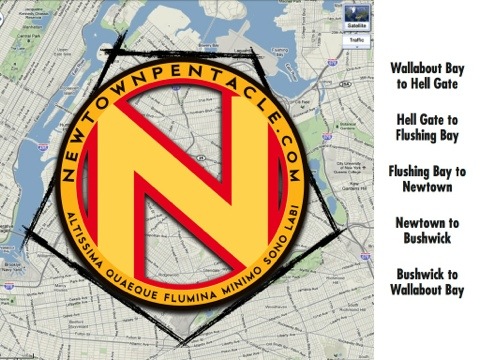
Microscopy upon any subject often obscures the larger themes surrounding it, in essence when you follow Alice down the rabbit hole, you forget that the shire still lies without. The pile of discarded newspapers in the shot above, which are curiously and analogously arranged in the shape of a fallen man, obscured a bag of pots and pans. Repulsively filthy, one of the cooking pans was filled with human excrement.
Curiously, the pans were in the approximate location that a pelvis might be found on a human.

– photo by Mitch Waxman
It has been painful to stand in public, as to be seen by so many diminishes me. Duty, however, demands that I tell the story of this place, no matter the personal cost.
This Sunday, the public tours of Newtown Creek will be departing from Pier 17 at South Street Seaport. The afternoon session is already sold out, but a few tickets are still available for the morning one. Heavily discounted (and I would point out that I have zero financial interest in the tours) at $10, due to a grant from NYCEF fund of the Hudson River Foundation, these will most likely be the last chance for the general public to see the Newtown Creek by boat until the spring.
And your humble narrator is anxious to get back out on the streets and find more mystery globs of risible decay, altars of unknown and foreign gods, and the graves of both Battle Ax Gleason and “he who must not be named”…
Happy Birthday, Kosciuszko Bridge

– photo by Mitch Waxman
A virtual guarantee is offered that this is the only posting you will see today commemorating and wishing the Kosciuszko Bridge a happy 72nd birthday. Some 26,298 days ago, Robert Moses saw the first link in a crazy idea of his which would one day be called the “Brooklyn Queens Connecting Highway” open for business.

– photo by Mitch Waxman
The Meeker Avenue Bridge opened on August 23rd, 1939 (renamed in 1940 as The Kosciuszko Bridge) – some 631, 152 hours ago. It was promised to allow easy egress to the World’s Fair, and was a showpiece project for the Great Builder.

– photo by Mitch Waxman
From a Newtown Pentacle posting of December 8, 2010– in which the big K was described as thrice damned:
Damned Once- The Kosciuszko Bridge catches radio frequency emissions from several nearby commercial radio broadcast antennas. A lot of it.
Whatever knows fear burns at The Kosciuszko Bridge’s touch.
Damned Twice- The Kosciuszko Bridge is at extreme risk in the eventuality of a seismic event. The Brooklyn pier actually sits on the Creek bed, some 6 meters below grade, but the Queens side is anchored on piles driven into the mud. The hard soil around Queens Plaza will merely shake, but the land surrounding the Newtown Creek will liquify.
Damned Thrice- The Kosciuszko Bridge once had pedestrian walkways, but they were removed in 1961. Can you imagine what kind of photos would be possible on a pedestrian walkway 124 feet over the Newtown Creek?
– photo by Mitch Waxman
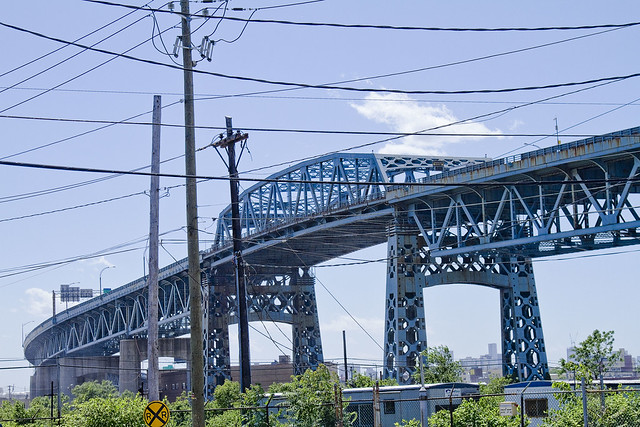
Like many things and people who are 72 years old, the Kosciuszko Bridge is not long for this world. Why not raise a glass to it tonight, and acknowledge its long service to the City?
Click here for a sentimental slideshow of the old girl from the last couple of years
paramount desire

– photo by Mitch Waxman
The final series of images which were discovered on my camera card, product of a trance like “Grand Walk” which carried me through an ancient corridor of the megalopolis, corroborated my theory that indeed- all roads always have and always will lead to Calvary.
Calvary Cemetery hosts the hoary remnants of an ancient clan of Anglo Saxons called the Alsops, who are buried in a family plot maintained as separate and distinct from the necropolis which surrounds it. Protestant land, officially, the earliest grave found here is meant to be the one housing the sire of the line- that of Thomas Wandell, but if there was ever a marker it is long vanished.
There are several members and generations of the Alsop family interred here, alongside their unnamed and oft unmentioned African slaves in this hidden corner of the Newtown Pentacle.
The oldest stone extant is that of Richard Alsop, a crumbling example of the carvers art which dates to 1718.
from The Eastern District of Brooklyn By Eugene L. Armbruster, courtesy google books
The Alsop farm, on the Queens County shore of the Newtown Creek, was the grave of Thomas Wandell, the former owner of the farm, who died in 1691. A large part of the farm became the site of Calvary Cemetery, but the Alsop family burial ground, by a reservation to the family, still remains Protestant ground.

– photo by Mitch Waxman
Alsop was quite a fellow by all reports, a very public man who acted as judicial magistrate and executor of inheritances for the simple farmers of Newtown. One of his descendants, John Alsop of Connecticut and Long Island, was a delegate to the Constitutional Conventions which initiated the “American experiment” in the 1770’s and 80’s.
The last of the Alsop line in Newtown – also named Richard Alsop- died without heirs, and a vast plantation estate that stretched along the then vernal Newtown Creek was offered up for sale.
It found interested buyers in a group of Irishmen hailing from Mulberry Street, across the river in New York, who worked for a large firm headquartered in Rome.
from Publication Fund series By New-York Historical Society, courtesy google books
Thomas Wandell, Maspeth Kills. “The last will and Testament of Thomas Wandell of Maspeth Kills in the bounds and limits of Newtown upon Long Island; being subject to sudden sickness and knowing the certainty of death.” Leaves all estate, except the following legacies, to his wife Audry Wandell, and makes her his sole executrix.
I leave to my cousin Richard Alsop, the piece of salt meadow that lieth within his fence, that incompasseth his dwelling house.
Also 2 steers and a case of pistols already in his possession.

– photo by Mitch Waxman
Long has your humble narrator desired to look upon the monument of “he who must not be named” and the long journey which carried me here actually began when I was contacted via “electronic mail” by a stranger who claimed to possess first hand information- an actual burial plot address here at Calvary.
He described himself as belonging to a faction of the “Ancient Order of Hibernians” which had splintered away from the mainstream group in 1921 over a silly doctrinal dispute. His forebears had stored away a copy of the burial and business records of Calvary Cemetery, a singular item since the original documents possessed by the Church were immolated in an outwardly suspicious fire.
Insisting that our meeting be privately attended yet in a public place is what led me to St. Patrick’s Old Cathedral in the first place, a seemingly natural location given the circumstances, and one that might provide certain literary symmetries if the story was later told.
As is habitual for one like myself, an attempt was made at an early arrival, and when my appointee arrived- he was not alone nor was he unobserved.
from Historical records and studies, Volume 1 By United States. Catholic Historical Society, courtesy google books
In the meeting of trustees, Sept. 19, 1845, it was announced that the Alsop Farm, consisting of about 115 acres, in Newtown Township, Long Island, had been secured for a cemetery. The deeds are dated Oct. 29, 1845. On July 31, 1848, at a special meeting of the board, it was resolved that “the cemetery at Newtown Creek, recently consecrated in part, should be called Calvary, and placed at the disposal of the public; that after August 2d the 11th Street burial-ground, as well as the free vault at 50th Street, should be permanently closed.”
Calvary Cemetery began to be used August 4, 1848. The first interment was that of Esther Ennis. Sections 1, 2, 3, 4, and 5 had been previously blessed. No record is preserved, however, of the ceremony.
Formerly, as is well known, every farm had its ” wood-lot” for fuel. The Alsop Farm had reserved 11 acres for this purpose, and the wood-lot has remained undisturbed to the present time. About 30 acres, lying in low ground near the water, were sold many years ago. The remaining 73 95-100 acres of the original Alsop Farm were devoted to and are still used for cemetery purposes.

– photo by Mitch Waxman
It was the sight of his companions that shocked me into flight, as reported in the first post of this series, and I will confess to experiencing a sort of racism that has nothing to do with national origin or ethnicity having been kindled in me. Rather than ethnographic it was something ancestral and instinctual, a genetic memory of some other specie of intelligent ape which our wholesome ancestors saw fit to exterminate in some long ago savannah.
I’m not altogether sure that these 2 companions of his were members of the “human race” itself, you see – with rounded jowls and underdeveloped chins they appeared to have a snout rather than a face- and what hung hairily beneath their wrists are better described as paws rather than hands. Their clothing was unseasonable and several years behind current fashions- flannel jackets and watch caps worn on a warm summer afternoon. The Anti Hibernian I was meant to meet did most of the talking in low whispers, and hoarse grunts were the only responses the two man shaped creatures offered in return which I could make out.
The exact moment which brought on this latest surrender to “one of my states”, triggering a multiple hour flight which carried me across half of New York City in a foot blistering haze, happened when I was peeking out from behind one of the columns at St. Patrick’s Old Cathedral in the manner of some mouse who has just noticed the presence of predators.
also from Historical records and studies, Volume 1 By United States. Catholic Historical Society, courtesy google books
At present there are over five miles of flag walks in Calvary. The cost of the headstones, monuments, etc., is roughly estimated as exceeding $6,000,000. A force of about 150 men is constantly occupied in attending to the burials, adapting and preparing the grounds for future use. A characteristic feature of Calvary, as of all Catholic cemeteries in contradistinction to large burial corporations formed with a view to personal profit, is the provision made for the benefit of the poor and destitute. According to the direction of the ritual and the spirit of Christian charity, the needy are interred as a work of mercy. In fact, more than one tenth of all the burials are gratuitous.
The entire number of interments since the opening of the cemetery in August, 1848, to January, 1898, is 644,761.

– photo by Mitch Waxman
Bits of it, like words on the tip of your tongue, are available to me as fragmented images lensed through the curious distortions of a migraine headache….
- A metallic cylinder of some kind, the thickness of a young child’s index finger, passing between the man who contacted me and his conspirators.
- The oddly green color and outmoded cut and style of the sports jacket worn by the man I was meeting, gaudily ornamented with a purple blossom of unknown breed which emitted a sickly lemon like smell
- The odd juxtaposition of muddy workman boots worn under suit pants seemingly chosen to match the flower.
- The horrible countenance and bestial appearance of his companions, augmented by the jiggling folds produced where their jowled necks became occluded beneath shirt collar.
from the Friends’ intelligencer, Volume 35, courtesy google books
The early history of Friends in Newtown and Maspeth Kills is marred by the irregularities of the Ranters, who claimed to be Friends, and intruded on their meetings.
Such was Thomas Case, who (1674) was forbidden by the Court to entertain the wife of William “Smith. His wife, Mary Case, was fined £5 for interrupting Rev. William Leveridge, while preaching, by saying to him: “Come down, thou whited wall that feedest thyself and starvest the people.” Samuel Scudder sent a long, scandalous letter to Mr. Leveridge.
The Court put Case and Scudder under bonds not “to seduce and disturb the people.”

– photo by Mitch Waxman
But this was not the least, for the event which set off my spell is also contained in one of these glimmer images…
I noticed that all three bore that unmistakable colour often commented on around the Newtown Creek, an iridescent hue which is neither black nor white nor any recognizable color of the wholesome earth, rather it is something alien- like a colour out of space.
When one observes this colour, especially within the elite corridors and behind the mirrored shield wall of the Shining City of Manhattan itself, it is obvious that something from the tainted Creeklands is nearby.
from The annals of Newtown, in Queens County, New York, containing its history from its first settlement, together with many interesting facts concerning the adjacent towns, courtesy openlibrary.org
Mr. Wandell, according to reminiscence in the Alsop family, had been a major in Cromwell’s army ; but, having some dispute with the protector, was obliged to flee for safety, first to Holland, and thence to America.
But some doubt of this may be justly entertained; because Mr. Wandell was living at Mespat Kills in 1648, which was prior to the execution of King Charles, and when Cromwell enjoyed but a subordinate command in the parliamentary army. Mr. Wandell m. the widow of Wm. Herrick, whose plantation on Newtown Creek, (originally patented to Richard Brutnell,) he bought in 1659, afterwards adding to it fifty acres, for which Richard Colefax had obtained a patent in 1652.
On this property, since composing the Alsop farm, Mr. Wandell resided.
He was selected, in 1665, as one of the jury for the trial of Ralph Hall and his wife for witchcraft, (the only trial for witchery in this colony,) and shared the honor of acquitting the accused. Some years later, he made a voyage to England, returning by way of Barbadoes, and, it is supposed, brought with him from England his sister’s son, Richard Alsop, who, about this time, came to America, and was adopted by Mr. Wandell as his heir, he having no issue. He d. in 1691, and was interred on the hill occupied by the Alsop cemetery.
Many years after his death, the silver plate of his cofiin was discovered, in digging a new grave.

– photo by Mitch Waxman
That malign and impossible intelligence which cannot possibly exist in the crown of this “Sapphire Megalith of the Long Island“, a thing which neither thinks nor breathes but instead hungers, gazing down on the folly of knowing the past and chuckling deeply (it does laugh, I am told). Protected and coddled by its mercenary army of human acolytes, it must wonder “what profit can there be in these pursuits?”.
And in the deep past- hidden behind the orthodoxy of 20th century historians- are found hidden references to Hannah Alsop (widow of Richard) having hosted meetings of so called “Friends” (Quakers in modernity) on the Alsop plantation. A nameless cult of some kind, these apostates are remembered only by their presence along Newtown Creek, troublemaking further east on Long Island, and by the colloquial name of “Case’s Crew”.
from Potter’s American Monthly, Volume 1, courtesy google books
There had scarce been any profession of the christian religion among the people of that town. They had scarcely any notion of religion but Quakerism. The Quakers had formerly a meeting there; but many of them became followers of Tho’s. Case, and were called ‘Case’s Crew,’ who set up a new sort of Quakerism, and among other vile principles, condemned marriage and said it was of the Devil, perverting that text of Scripture. ‘The children of the resurrection neither marry nor are given in marriage,’ and they said ‘they were the children of the resurrection.
‘ This mad sort of Quakerism held that ‘they were come already to the resurrection and had their vile bodies already changed.'”


 The Newtown Pentacle