Archive for the ‘newtown creek’ Category
ethereal character

– photo by Mitch Waxman
The launch we were in had been referred to as the “tin boat” by the Riverkeeper folks, but it was more a smallish rowboat with an outboard engine than anything else. This is the second post of this adventure, click here for the first one.
We had just passed beneath the two rail bridges which vouchsafe and isolate Dutch Kills from the main body of the Newtown Creek, and were heading in the general direction of Queens Plaza when we approached the Borden Avenue Bridge.

– photo by Mitch Waxman
Of course, this century old structure has recently undergone a radical schedule of repairs when it was discovered that one of its abutments had begun to shift, and no small amount of complaint arose at the inconvenience from the legions of truckers and ordinary drivers who mourned its unavailability.
Down on the water however, things were pretty intense, from a purely existential point of view.

– photo by Mitch Waxman
Those bubbles of gas mentioned in yesterday’s post, which were erupting even when the water was unmolested by our passing, delivered a slightly petrochemical smell when they burst. Another member of the Newtown Creek Alliance who was sitting next to me in the boat began muttering “Oh my god” over and over at this point in time.
It wasn’t fear in his eyes, it was disbelief.

– photo by Mitch Waxman
My companion was no virgin or first time visitor to the Creek, of course, in fact his experience of the place is broad and far reaching. When all of your senses get involved with the atmosphere of ruination here, however, one tends to become a bit overwhelmed as your brain attempts to interpret and process the impossible data it is presented with.
The canalized bulkheads of Dutch Kills also tower over you from the water level, creating a sense of forced perspective and inevitability.

– photo by Mitch Waxman
The first thing you see when passing the Borden Avenue Bridge is an archaic sewer outfall, and were the brush not at it’s mid summer height, one would observe the shanty home of the Blue Crow above.
For those of you not familiar with this term, Crow is a name assigned in my little section of Astoria to the myriad metal and refuse collectors known to haunt the neighborhood on “Bulk Pickup Day”. Leave something shiny on the sidewalk, a crow will sweep in and grab it.
Metals are collected and sold by the pound in the scrap and recycling markets of Greenpoint and Long Island City, and these guys make their living from hunting and gathering. I assign them color names based on vehicle, or clothing choices.
There’s also a red crow out there.

– photo by Mitch Waxman
Here is a winter shot from road grade level which shows the sewer and the ever expanding hut of this particular crow. There is a photo of him to be in this Newtown Pentacle posting from February of 2010. Don’t be mistaken, I am not insulting either his industriousness or tenacity, if I were in a similar situation things would go far worse for your humble narrator. This man has been surviving in what has to one of the world’s most extreme environments for years now, and rent free.

– photo by Mitch Waxman
Looking back toward the Borden Avenue Bridge, the ominous humming which echoed along the bulkheads and emanated from above signaled that we had passed under another of the bridges of Dutch Kills. This bridge was built high, and called an expressway by Robert Moses himself.

– photo by Mitch Waxman
Some 106 feet over road grade, the high flying Queens Midtown Expressway leg of the larger Long Island Expressway feeds into the yawning mouth of the Queens Midtown Tunnel less than a mile from here. I call this part of Dutch Kills DULIE, or Down Under the Long Island Expressway.
One of the common complaints heard by eastern bound commuters in the early days of the 20th century was about the horrible smells they encountered when crossing through Long Island City. Moses built his auto bridge as high as engineering and budgetary considerations allowed in response to the plume of industrial outgassing which distinguished a trip through the area in his time.

– photo by Mitch Waxman
Dutch Kills is a particularly important tributary of the Newtown Creek, from an industrial history point of view. What is today a relict of brown fields, industrial spills, and toxic leave behinds was once the economic and manufacturing heartland of New York City. The heavy infrastructure here is no accident, and the waterway was a critical feature that drew one of the great (and largely forgotten) men of Queens to the Waste Meadows at the start of the early 20th century.

– photo by Mitch Waxman
At the end of the 19th century, none of this was here. Sure, there was a muddy road made of creosoted wood blocks and riprap bulkheads called Hunters Point Avenue which ran between isolated industrial sites, and a slightly more modern causeway called Borden Avenue which hosted a few large operations, but this was a swampy and pestilential bog. Brackish creeks wound along knolls of marsh grass and the stubby trees held together mud islands.
The place was lousy with all the junk floating down from Blissville and the sewers in Brooklyn and only Mosquitos and ticks found the place hospitable.
Dutch Kills needed to be fixed.
– photo by Mitch Waxman
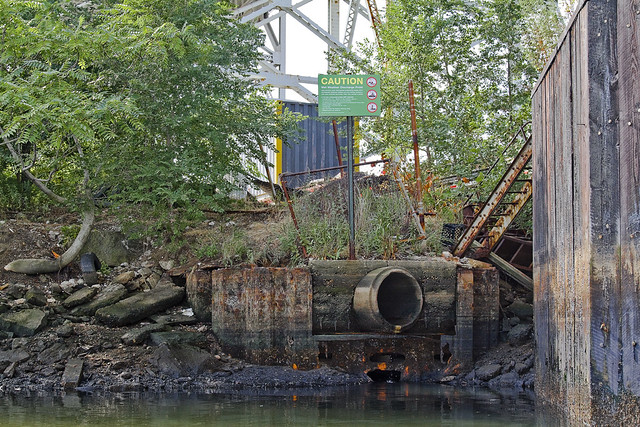
Another sewer outfall is found directly after passing the LIE’s massive footing, which is the sort of improvement that benefited somewhere else rather than Dutch Kills. It was decided by the city fathers in the first years of the 20th century that something had to be done with these swampy wetlands, so close to Manhattan and the gold coast of the Newtown Creek.
Something was needed- a plan with vision, executed by someone who understood the byzantine politics of Tammany Hall and the recently consolidated City of Greater New York. Additionally, it would have to someone with proven “know how” who could “get it done”.

– photo by Mitch Waxman
From the mid 1930’s on, that person would have been Robert Moses. The ultimate political fixer, Moses employed the greatest engineering minds of a generation to shape and design our modern City. While Moses was still in diapers, however, no shortage of great men existed in the City. A plan was presented, and approved, and in both Albany and Washington- strings were pulled by the Tammany men and budgets were approved.
The Army Corps of Engineers were assigned here to canalize, deepen, straighten and erect industrial bulkheads at Dutch Kills in 1914. Land was reclaimed by dumping the fill and spoils produced by the digging of the Belmont Subway Tunnels (leading to to Manhattan) amongst wooden pilings driven deeply into the mud.
The modern shoreline of Queens began to assume it’s current shape.

– photo by Mitch Waxman
It is apparent what happened here, when you see the Hunters Point Avenue Bridge appear before you.
Progress had arrived in Queens, and his name was Michael Degnon.
ponderous and forbidding

– photo by Mitch Waxman
As mentioned in a post the other day, an opportunity arose for me to accompany a representative of Riverkeeper on a survey mission to Newtown Creek recently.
Demanded by the top leadership of the Newtown Creek Alliance itself, this was an expedition whose agenda would require the photographic documentation of bulkheads and shoreline conditions all along the Creek. Of special interest to those involved in the renewal and resuscitation of brownfield sites, the mission as put forward was to get a shot of everything possible. This survey would include observation of the lesser known tributaries of the Creek- Dutch and English Kills, as well as Maspeth Creek, and the East and West Branches which lie beyond the Grand Street Bridge.

– photo by Mitch Waxman
The barriers which guard the secrets of Dutch Kills, which branches from the main body of Newtown Creek just .8 of a mile from it’s locus point with the East River, are two rail bridges. As mentioned in the past, I am no expert on the intricacies of the trackways which snake around the Queens side of the Creek. The expert on this subject was Bernard Ente, who recently passed away, and I wouldn’t offend his memory by pretending to know more than the following:
Neither Bridge (both are moveable) has opened for some time, and it is my understanding that they are part of the “Montauk Cutoff”.

– photo by Mitch Waxman
The survey team was small, as we were in a tiny craft. Hardly more than a rowboat with an outboard motor, three of us sat less than a few inches above the water. There was a mist hanging in the air, as it was early morning, which was quite invisible to the eye but will occasionally become visible in these shots (when I fired off the flash).
Our plan was to take advantage of high and low tides to gain access to the various sections which we were mandated to record, and the low ceiling of the swing bridge at Dutch Kills demanded we make our attempt at ebb tide and exit the tributary before it again flooded.

– photo by Mitch Waxman
I will admit to prayer that a train might pass overhead, for this would be a prize photo for your humble narrator, but alas- no such luck. I don’t know very much about the rails, but I do like taking pictures of trains from odd angles. There was a ghastly sensation afoot in me as well, as I knew that the very air which we were breathing was a hideous miasma of vapor emissions rising from the poison sediments which line the bed of Dutch Kills.
Everywhere, there were tiny bubbles erupting to the surface of the water, and as we disturbed them- mephitic smells swirled about and enveloped the boat.

– photo by Mitch Waxman
Many times have I been down Newtown Creek on the water, but it has always been in nothing smaller than a NY Water Taxi. Additionally, Dutch Kills is “mine”, a branch of the Creek that has received extensive study and historical analysis here at Newtown Pentacle as well as having been thoroughly catalogued photographically. No surprises in store here thought I, English Kills is a bit more “unknown territory” and would likely yield something to hang my hat on.
That is what I thought at the start of this trip.

– photo by Mitch Waxman
To start, the first rail bridge seems to be in a deep state of corrosion, which would make sense given its century long existence. I am no engineer, of course, but this thing hasn’t seen a paint brush in a very long time.
Witnessing the rust and metal fatigue on this bridge actually made me glad that a train wasn’t passing by overhead. The works and motors which power this bridge’s swing action have been burnt out for some time I am told.

– photo by Mitch Waxman
I have never seen it happen (as you would have seen a photo of it here by now) but word is that if the bridge needed to be opened, rail workers would utilize the sort of tow trucks known as “wreckers”, situated at both banks, to winch the thing open.
Sounds bizarre, but the aforementioned Bernard Ente told me that one, and “Bernie was always right” about this sort of thing. Can’t tell you how many crazy stories he would tell me about the history and lore of this place, which my own research would prove him to have been purposely understating.

– photo by Mitch Waxman
All across Dutch Kills, everything bore that unmistakable colour which typifies the lament and sickness of the Newtown Creek watershed. Iridescent, it is neither black nor white nor any normal color, rather it’s is like something alien coating everything in rotten decay. Metal corrodes, wood molders, stone and cement simply crumble away.
The swampy wetlands which existed here in aboriginal times were known as the Waste Meadows in the 19th century, and perhaps this is still the appropriate terminology for them.
– photo by Mitch Waxman
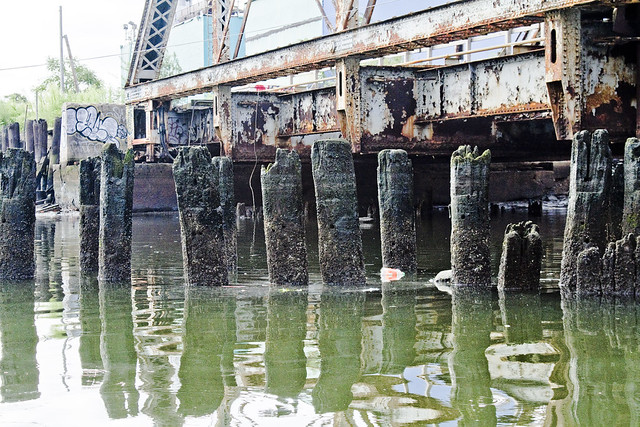
Pilings and structural elements squamously protrude from the water, whose surface seems thicker than expectation would predict. Normal fluid dynamics apply of course, but the turgid waves behaved in the manner of a broth or syrup as opposed to the more wholesome (but still polluted) water found on the nearby East River.
Additionally, high tide was not marked by invertebrate communities of barnacles or mussels here, but rather by tree ring like deposits of sediment.

– photo by Mitch Waxman
Looking back toward the swing bridge, in the direction of infinite Brooklyn, a long walkway is attached to the pier which the bridge is anchored into.
One thing which I can categorically show in these “bulkhead survey” shots of the Newtown Creek, is that much of the so called land along the Queens bank of the Creek (and large parts of English Kills in Brooklyn) is actually an engineered surface of pilings intermixed with fill and capped with a cement slab- reclaimed land.
One of the scarier ramifications of this, and again– not an engineer- is witnessed in the deleterious condition of these century old wood pilings visible from the water’s edge.

– photo by Mitch Waxman
Next up on this trip is the truss rail bridge, which is built quite a bit higher in elevation than the initial structure and is found at the other side of the pier and walkway which connects to the Swing Bridge. It’s a drawbridge, and the elevated height must have been part of a plan to reduce the need to open the span for water traffic on the once busy Dutch Kills.

– photo by Mitch Waxman
Apologies are offered for vagueness, lords and ladies, as I fear that I’ve spoiled you over the last several years with vulgar displays of “info-porn”. Normally, you’d be reading stats and figures, hearing the name of engineers and learning of long forgotten disasters. Unfortunately, as these two bridges are not publicly accessible, and to study them in any real detail would mean trespassing and demand mandatory jail time… these are the bridge structures which I can describe in the least detail anywhere along Newtown Creek.
Railfans of NYC, anonymous LIRR employees, please leave a comment below and share the wisdom.
As mentioned in the past- I never trespass- like a Vampire your humble narrator needs to be invited inside to do his best work and in the age of terror- no one is invited to look too closely at railroad infrastructure.

– photo by Mitch Waxman
Others, however, are not as constrained as I.
A garish banner caught my eye as we passed beneath the truss bridge. My mind concocted that I was seeing just another windblown tarp or plastic container bag at first, but then as we approached… I realized that it was some kind of painting.

– photo by Mitch Waxman
Hung at a level which allows it to interact with the high tide level, this painting seems to depict- to my eye- a middle eastern city withering in flame beneath the burning thermonuclear eye of god.
What’s more, for once, I can brag to Ms. Heather, over at ny-shitty.com, that I finally got something before she did.
Note: as always, clicking the photo will open a new window at Flickr. Clicking the view all sizes option under the “actions” tab will take you to ever larger incarnations of the shot for closer examination. If anyone knows who the artist is, or what this situation is about, I’d love to hear about it.

– photo by Mitch Waxman
It would seem that someone has set up camp under here, or perhaps it is just a studio space. The undocumented men and women who live in both these “Waste Meadows” -and the Newtown Creek watershed as a whole- are too numerous to count. Many are exactly where they belong, while others are trapped by circumstance and ill omen.
All need to be coaxed away from this place, before the Creek does to them what it has to so many others in Greenpoint and Long Island City.

– photo by Mitch Waxman
No human being should be living in this place, except as part of a penal sentence for an especially heinous offense. Trolls live under bridges, not Americans. Additionally, in the age of terror, how exactly does this go unnoticed by the gendarme?
I cannot stress how often I ask this question as I wander across the Creeklands.

– photo by Mitch Waxman
Despite the fearful atmospherics and forbidding appearance of the water, we pressed on. Our steward from Riverkeeper kept a steady hand on the outboard motor and the tiny boat slid forward across Dutch Kills. This shot is looking back at the two rail bridges of the Montauk Cutoff which we had just passed beneath.
Still no trains.

– photo by Mitch Waxman
Dead ahead was the Borden Avenue Bridge and the high flying Long Island Expressway, the experiencing of which which will be discussed tomorrow at this- your Newtown Pentacle.
the dark moor

– photo by Mitch Waxman
Lucid and unwholesome, witness this sky flung perspective of the backbone of New York City- vantaged from several hundred feet above the Newtown Creek and it’s little known tributary- Whale Creek, and high atop the digester eggs of the Newtown Creek Wastewater Treatment Plant.
Gaze in wonder at the majesty of western Queens.
Additionally, click here to see this view reversed, and witness the parallel horizon of infinite Brooklyn.

– photo by Mitch Waxman
That’s the Thomas D. Witte tugboat maneuvering a barge into position at the SimsMetal dock, and the rusty crossing in the background is the non functioning swing bridge which spans the larger Queens side tributary of Newtown Creek called Dutch Kills.

– photo by Mitch Waxman
That’s the LIRR moving along the ancient rail tracks which have blessed the industries and cursed the residents of this area since the early 19th century. The general area that the locomotive track is passing through, employed to this very day by petrochemical interests, is the former Queens location of Standard Oil at Newtown Creek.

– photo by Mitch Waxman
In the distance, from left is Lindenthal’s magnificent Queensboro, the Big Allis power plant, the omnipresent Sapphire megalith, the high flying Long Island Expressway, and a substantial portion of the vast industrial quarters of Long Island City which I call “The Empty Corridor“.
paramount desire

– photo by Mitch Waxman
The final series of images which were discovered on my camera card, product of a trance like “Grand Walk” which carried me through an ancient corridor of the megalopolis, corroborated my theory that indeed- all roads always have and always will lead to Calvary.
Calvary Cemetery hosts the hoary remnants of an ancient clan of Anglo Saxons called the Alsops, who are buried in a family plot maintained as separate and distinct from the necropolis which surrounds it. Protestant land, officially, the earliest grave found here is meant to be the one housing the sire of the line- that of Thomas Wandell, but if there was ever a marker it is long vanished.
There are several members and generations of the Alsop family interred here, alongside their unnamed and oft unmentioned African slaves in this hidden corner of the Newtown Pentacle.
The oldest stone extant is that of Richard Alsop, a crumbling example of the carvers art which dates to 1718.
from The Eastern District of Brooklyn By Eugene L. Armbruster, courtesy google books
The Alsop farm, on the Queens County shore of the Newtown Creek, was the grave of Thomas Wandell, the former owner of the farm, who died in 1691. A large part of the farm became the site of Calvary Cemetery, but the Alsop family burial ground, by a reservation to the family, still remains Protestant ground.

– photo by Mitch Waxman
Alsop was quite a fellow by all reports, a very public man who acted as judicial magistrate and executor of inheritances for the simple farmers of Newtown. One of his descendants, John Alsop of Connecticut and Long Island, was a delegate to the Constitutional Conventions which initiated the “American experiment” in the 1770’s and 80’s.
The last of the Alsop line in Newtown – also named Richard Alsop- died without heirs, and a vast plantation estate that stretched along the then vernal Newtown Creek was offered up for sale.
It found interested buyers in a group of Irishmen hailing from Mulberry Street, across the river in New York, who worked for a large firm headquartered in Rome.
from Publication Fund series By New-York Historical Society, courtesy google books
Thomas Wandell, Maspeth Kills. “The last will and Testament of Thomas Wandell of Maspeth Kills in the bounds and limits of Newtown upon Long Island; being subject to sudden sickness and knowing the certainty of death.” Leaves all estate, except the following legacies, to his wife Audry Wandell, and makes her his sole executrix.
I leave to my cousin Richard Alsop, the piece of salt meadow that lieth within his fence, that incompasseth his dwelling house.
Also 2 steers and a case of pistols already in his possession.

– photo by Mitch Waxman
Long has your humble narrator desired to look upon the monument of “he who must not be named” and the long journey which carried me here actually began when I was contacted via “electronic mail” by a stranger who claimed to possess first hand information- an actual burial plot address here at Calvary.
He described himself as belonging to a faction of the “Ancient Order of Hibernians” which had splintered away from the mainstream group in 1921 over a silly doctrinal dispute. His forebears had stored away a copy of the burial and business records of Calvary Cemetery, a singular item since the original documents possessed by the Church were immolated in an outwardly suspicious fire.
Insisting that our meeting be privately attended yet in a public place is what led me to St. Patrick’s Old Cathedral in the first place, a seemingly natural location given the circumstances, and one that might provide certain literary symmetries if the story was later told.
As is habitual for one like myself, an attempt was made at an early arrival, and when my appointee arrived- he was not alone nor was he unobserved.
from Historical records and studies, Volume 1 By United States. Catholic Historical Society, courtesy google books
In the meeting of trustees, Sept. 19, 1845, it was announced that the Alsop Farm, consisting of about 115 acres, in Newtown Township, Long Island, had been secured for a cemetery. The deeds are dated Oct. 29, 1845. On July 31, 1848, at a special meeting of the board, it was resolved that “the cemetery at Newtown Creek, recently consecrated in part, should be called Calvary, and placed at the disposal of the public; that after August 2d the 11th Street burial-ground, as well as the free vault at 50th Street, should be permanently closed.”
Calvary Cemetery began to be used August 4, 1848. The first interment was that of Esther Ennis. Sections 1, 2, 3, 4, and 5 had been previously blessed. No record is preserved, however, of the ceremony.
Formerly, as is well known, every farm had its ” wood-lot” for fuel. The Alsop Farm had reserved 11 acres for this purpose, and the wood-lot has remained undisturbed to the present time. About 30 acres, lying in low ground near the water, were sold many years ago. The remaining 73 95-100 acres of the original Alsop Farm were devoted to and are still used for cemetery purposes.

– photo by Mitch Waxman
It was the sight of his companions that shocked me into flight, as reported in the first post of this series, and I will confess to experiencing a sort of racism that has nothing to do with national origin or ethnicity having been kindled in me. Rather than ethnographic it was something ancestral and instinctual, a genetic memory of some other specie of intelligent ape which our wholesome ancestors saw fit to exterminate in some long ago savannah.
I’m not altogether sure that these 2 companions of his were members of the “human race” itself, you see – with rounded jowls and underdeveloped chins they appeared to have a snout rather than a face- and what hung hairily beneath their wrists are better described as paws rather than hands. Their clothing was unseasonable and several years behind current fashions- flannel jackets and watch caps worn on a warm summer afternoon. The Anti Hibernian I was meant to meet did most of the talking in low whispers, and hoarse grunts were the only responses the two man shaped creatures offered in return which I could make out.
The exact moment which brought on this latest surrender to “one of my states”, triggering a multiple hour flight which carried me across half of New York City in a foot blistering haze, happened when I was peeking out from behind one of the columns at St. Patrick’s Old Cathedral in the manner of some mouse who has just noticed the presence of predators.
also from Historical records and studies, Volume 1 By United States. Catholic Historical Society, courtesy google books
At present there are over five miles of flag walks in Calvary. The cost of the headstones, monuments, etc., is roughly estimated as exceeding $6,000,000. A force of about 150 men is constantly occupied in attending to the burials, adapting and preparing the grounds for future use. A characteristic feature of Calvary, as of all Catholic cemeteries in contradistinction to large burial corporations formed with a view to personal profit, is the provision made for the benefit of the poor and destitute. According to the direction of the ritual and the spirit of Christian charity, the needy are interred as a work of mercy. In fact, more than one tenth of all the burials are gratuitous.
The entire number of interments since the opening of the cemetery in August, 1848, to January, 1898, is 644,761.

– photo by Mitch Waxman
Bits of it, like words on the tip of your tongue, are available to me as fragmented images lensed through the curious distortions of a migraine headache….
- A metallic cylinder of some kind, the thickness of a young child’s index finger, passing between the man who contacted me and his conspirators.
- The oddly green color and outmoded cut and style of the sports jacket worn by the man I was meeting, gaudily ornamented with a purple blossom of unknown breed which emitted a sickly lemon like smell
- The odd juxtaposition of muddy workman boots worn under suit pants seemingly chosen to match the flower.
- The horrible countenance and bestial appearance of his companions, augmented by the jiggling folds produced where their jowled necks became occluded beneath shirt collar.
from the Friends’ intelligencer, Volume 35, courtesy google books
The early history of Friends in Newtown and Maspeth Kills is marred by the irregularities of the Ranters, who claimed to be Friends, and intruded on their meetings.
Such was Thomas Case, who (1674) was forbidden by the Court to entertain the wife of William “Smith. His wife, Mary Case, was fined £5 for interrupting Rev. William Leveridge, while preaching, by saying to him: “Come down, thou whited wall that feedest thyself and starvest the people.” Samuel Scudder sent a long, scandalous letter to Mr. Leveridge.
The Court put Case and Scudder under bonds not “to seduce and disturb the people.”

– photo by Mitch Waxman
But this was not the least, for the event which set off my spell is also contained in one of these glimmer images…
I noticed that all three bore that unmistakable colour often commented on around the Newtown Creek, an iridescent hue which is neither black nor white nor any recognizable color of the wholesome earth, rather it is something alien- like a colour out of space.
When one observes this colour, especially within the elite corridors and behind the mirrored shield wall of the Shining City of Manhattan itself, it is obvious that something from the tainted Creeklands is nearby.
from The annals of Newtown, in Queens County, New York, containing its history from its first settlement, together with many interesting facts concerning the adjacent towns, courtesy openlibrary.org
Mr. Wandell, according to reminiscence in the Alsop family, had been a major in Cromwell’s army ; but, having some dispute with the protector, was obliged to flee for safety, first to Holland, and thence to America.
But some doubt of this may be justly entertained; because Mr. Wandell was living at Mespat Kills in 1648, which was prior to the execution of King Charles, and when Cromwell enjoyed but a subordinate command in the parliamentary army. Mr. Wandell m. the widow of Wm. Herrick, whose plantation on Newtown Creek, (originally patented to Richard Brutnell,) he bought in 1659, afterwards adding to it fifty acres, for which Richard Colefax had obtained a patent in 1652.
On this property, since composing the Alsop farm, Mr. Wandell resided.
He was selected, in 1665, as one of the jury for the trial of Ralph Hall and his wife for witchcraft, (the only trial for witchery in this colony,) and shared the honor of acquitting the accused. Some years later, he made a voyage to England, returning by way of Barbadoes, and, it is supposed, brought with him from England his sister’s son, Richard Alsop, who, about this time, came to America, and was adopted by Mr. Wandell as his heir, he having no issue. He d. in 1691, and was interred on the hill occupied by the Alsop cemetery.
Many years after his death, the silver plate of his cofiin was discovered, in digging a new grave.

– photo by Mitch Waxman
That malign and impossible intelligence which cannot possibly exist in the crown of this “Sapphire Megalith of the Long Island“, a thing which neither thinks nor breathes but instead hungers, gazing down on the folly of knowing the past and chuckling deeply (it does laugh, I am told). Protected and coddled by its mercenary army of human acolytes, it must wonder “what profit can there be in these pursuits?”.
And in the deep past- hidden behind the orthodoxy of 20th century historians- are found hidden references to Hannah Alsop (widow of Richard) having hosted meetings of so called “Friends” (Quakers in modernity) on the Alsop plantation. A nameless cult of some kind, these apostates are remembered only by their presence along Newtown Creek, troublemaking further east on Long Island, and by the colloquial name of “Case’s Crew”.
from Potter’s American Monthly, Volume 1, courtesy google books
There had scarce been any profession of the christian religion among the people of that town. They had scarcely any notion of religion but Quakerism. The Quakers had formerly a meeting there; but many of them became followers of Tho’s. Case, and were called ‘Case’s Crew,’ who set up a new sort of Quakerism, and among other vile principles, condemned marriage and said it was of the Devil, perverting that text of Scripture. ‘The children of the resurrection neither marry nor are given in marriage,’ and they said ‘they were the children of the resurrection.
‘ This mad sort of Quakerism held that ‘they were come already to the resurrection and had their vile bodies already changed.'”
suitable apparatus
– photo by Mitch Waxman
As the redolent cargo of my camera card revealed- this “Grand Walk”, a panic induced marathon which carried your humble narrator across the East River from St. Patrick’s Old Cathedral in Manhattan into Williamsburg and up Grand Street to Maspeth and the baroque intrigues of the Newtown Creek– wound down into it’s final steps on Laurel Hill Blvd.
Examining the images recorded on my camera, photos which I don’t remember taking, the ineluctable feeling that something was missing from the modern scene was inescapable.
from wikipedia
Nichols, along with his son Charles W. Nichols, helped organize the merger of 12 companies in 1899 to create General Chemical. Under his leadership, the company grew its asset base and increased its earnings threefold, making Nichols a force in America’s fledgling chemical industry. His vision of a bigger, better chemical company took off when he teamed up with investor Eugene Meyer in 1920. Nichols and Meyer combined five smaller chemical companies to create the Allied Chemical & Dye Corporation, which later became Allied Chemical Corp., and eventually became part of AlliedSignal, the forerunner of Honeywell’s specialty materials business. Both men have buildings named after them at Honeywell’s headquarters in Morristown, New Jersey. His original plant along the Newtown Creek in Queens is infamous for its legacy of pollution. Nichols is rumored to have once emptied vats of excess sulfuric acid into the creek rather than sell it cheaply to a businessman he had no respect for.

– photo by Mitch Waxman
Nichols Chemical, from which the legendary Phelps Dodge Laurel Hill plant would someday sprout, would have been found along the Newtown Creek nearby the thrice damned Kosciuszko Bridge – which is itself doomed and consigned to the stuff of future reminiscence. At it’s apex, this industrial site employed 17,500 people and squatted along some 36 square acres of the Creeklands.
The tallest chimneys in the United States (at the time) stabbed at the sky from here, painting the Newtown sky with poison effluvium whose pH content was sufficient to cause marble and granite to melt like ice cream left to the merciless gaze of the burning thermonuclear eye of god itself.

– photo by Mitch Waxman
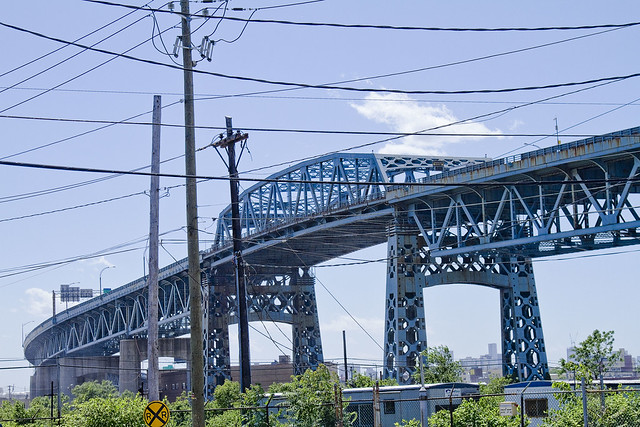
The Kosciuszko Bridge is slated for demolition and replacement in a few short years of course, and this scene will irrevocably alter when a modern structure is put in place. The high flying bridge was built large to accommodate the sort of ocean going craft which were common in the 1930’s- cargo and passenger vessels with enormous smokestacks that would have been serviced and outfitted by other corporations just up the Creek.
Additionally, the war department held certain intentions and reserved the option to sequester battleships in Newtown Creek, with the intentions of protecting the vital industrial center from a safe inlet, were an invasion of North America attempted by hostile European adversaries via New York Harbor.
When a manufacturing establishment decides to increase its output fivefold; when it decides to tear down its present buildings and put up new ones; and when it owns valuable waterfront which is marketable at a high price, that concern considers carefully the question whether it will remain in its present location or move to some other. Now our friends above mentioned would doubtless at once aver that, if this concern was a New York concern and found itself in this situation, there could be but one answer—”To Jersey for us”— or to some other place near land’s end where land can be purchased for a song, where government regulations are unknown and where, in addition, the manufacturer would find himself surrounded by a great and aching void.
But all these prophesies are as wormwood and the pessimists are confounded. Over In the wilds of Queens there Is a place—look it up on the map—called Laurel Hill.
Laurel Hill is not a place of beauty. The undulating hills in them neighborhood are covered with cemeteries, rocks, and ugly houses and through the midst of it all (lows the far-famed Newtown Creek, covered at all times during the day and night with busy water craft. But Laurel Hill is one of the most important manufacturing districts in Greater New York and Newtown Creek is one of the foremost commercial arteries in or about NewYork City.

– photo by Mitch Waxman
One of the aphorisms which has emerged in my studies of Newtown Creek and the surrounding communities is this: “all roads lead to Calvary“.
Whether it be ancient ferry lines which fed the street car roads, or the occluded pathways of the aboriginal Mespaetche and Decadent Dutch, all the roads of western Queens and North Brooklyn point inevitably to this spot. Semi conscious during this “Grand Walk”, your humble narrator nevertheless found himself at the corner of Laurel Hill Blvd. and Review Avenue once again, standing before the great and sacred Polyandrion of the Roman Catholic church in New York City.
Perhaps the foremost industry at Laurel Hill is the Nichols Copper Company. To this factory each year come by boat and by rail thousands of tons of copper, some of it in the raw state— the ore—and much of it already in bars ready for the final refining. The copper is refined here and put into a variety of forms and shapes ready for the market. The raw material comes in from the Lake Superior region, from Mexico, and even from more distant South America. The finished product goes to manufacturers in all parts of the world. The annual value of this product is over $60,000,000, and there are between seventeen hundred and eighteen hundred men engaged in converting the raw copper into the refined product which has made this factory famous tne world over.
In this factory, located within Greater New York, there is three times as much copper refined as in any other factory in the United States.

– photo by Mitch Waxman
Here lies Tammany, the Dead Rabbits, and a good percentage of those colorful characters who populated the “Bloody Sixth Ward” of the Five Points in 19th century New York. Here lies the Newsboy Governor, the “Original Gangster“, and the rightful heirs to the throne of Ireland rest within the ground consecrated by the legendary prelate called “Dagger John” alongside the “Fighting 69th” and “the 21” and the “Abbot“. Here is the secretive cruciform shaped repository which contains the remains of thousands of priests and nuns, in a catacomb which lies some 50 feet below the Almirall Chapel.
Additionally, here might be found the grave of a man who died in 1718, lying with both his descendants and his african slaves in the only Protestant burial ground entirely contained by a Catholic cemetery in North America.
And from above, that thing in the Sapphire Megalith which neither thinks nor breathes but instead hungers, watches.
from Illustrated history of the borough of Queens, New York City, 1908, courtesy google books
The Alsop family was also among the early settlers. Richard Alsop, the first of the name to locate here, came at the request of his uncle, one Thomas Wandell, who was said to have left England because he had become involved in a quarrel with Oliver Cromwell, though this report is doubtful, for it is known that Wandell was living at Mespat Kills in 1648, or before Charles I was put to death. He had secured a considerable tract of land by patents and purchase which he left to his nephew, Richard Alsop. The family he founded became extinct in 1837 when the last of the name died without issue.


