Archive for the ‘Tugboat’ Category
life, matter, and vitality

– photo by Mitch Waxman
Paramount in my apprehensions about this unremembered walk- which began at St. Patrick’s Old Cathedral, continued down Delancey Street, went over the Williamsburg Bridge, staged into Williamsburg, and continued up Grand Street in the direction of that assassination of joy called the Newtown Creek- is the ideation that something happened to me in the ancient church.
Remember, this unknown fellow from the interwebs offered me information which is dearly sought, the location of a certain interment lost in the ghoulish multitudes of Calvary Cemetery which I have spent too much time searching for. When my anonymous assignee walked into the church with two troglodyte ruffians, I panicked and fled… but a nagging suspicion that something else might have happened in there torments me.

– photo by Mitch Waxman
Could a mere intuition have sent me into this flaming paroxysm of cowardly flight, carrying me blind miles in a stupor? A delicate constitution and deep physical cowardice are my hallmarks, yes, but a multiple mile flight which propelled me across most of the eastern districts of Brooklyn? Nevertheless, according to my camera card, I had nevertheless returned to the loathsome lands of the Newtown Creek and was standing upon the Metropolitan Avenue Bridge once again.
The coincidental concurrence of my route with certain long forgotten street car (trolley) routes continues to intrigue me as I write this in the sober and controlled environment of Newtown Pentacle HQ.

– photo by Mitch Waxman
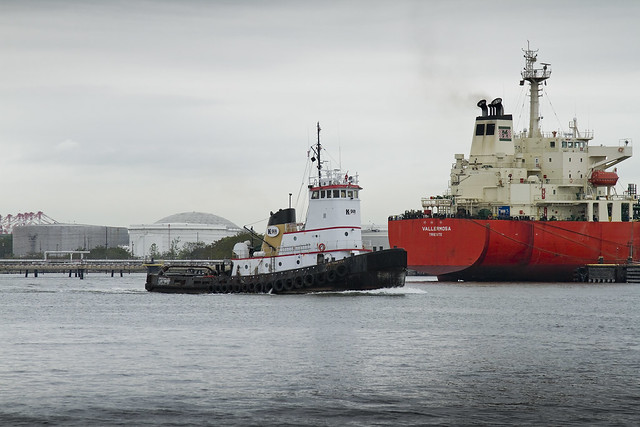
The tugboat which is often noticed here is the “Mary H.” which runs fuel barges from the outer harbor to the Bayside Oil depot located on Metropolitan Avenue itself, near it’s junction with Grand Street. The section of the Creek visible in these shots is actually a tributary, called English Kills. Two ancient pathways, which we call Grand St. and Metropolitan Avenue these days, cross each other here at a sharp angle.
Metropolitan was formerly known as the Williamsburgh and Jamaica Turnpike, and it connected Newtown in Queens with the Eastern District of Brooklyn- Bushwick, Williamsburg, and Greenpoint. The crossing of Grand and Metropolitan was also one of the stops on the New York and Manhattan Beach Railroad, its depot would have found at the foot of Greenpoint’s Quay Street in 1912.

– photo by Mitch Waxman
A theory which guides me of late requires a paradigm shift in thought and perception, simply put- the older communities of western Queens and north western Brooklyn have more in common with each other than they do with the boroughs they reside in. In earlier times, before the bridges, intimate (and railroad) ties knit these communities together and Bushwick has more in common with Astoria than it does with Flatbush.
The unifying principal, the organizing principal in fact, was access to the waterfront not just at the East River- but all along the various creeks and kills which once penetrated inland. The culture which grew along Sunswick and Newtown and Bushwick Creeks is lost to time and shifting populations, buried beneath centuries of concrete and the remnants of long vanished industry.

– photo by Mitch Waxman
It would seem that your humble narrator continued down Grand Street from Metropolitan, toward the border of Brooklyn and Queens at the Grand Street Bridge, and area I dare to call DUGSBO- Down Under the Grand Street Bridge Onramp.
This section of the City of Greater New York, incidentally, is called East Williamsburg by modern cartographers.

– photo by Mitch Waxman
Fear exists in my heart for the noble little Grand Street Bridge, as modern traffic races across it’s delicate mechanisms. Long has it been since boat traffic has crossed it, the last official opening was in 2002. One misstep by a careless trucker and this historic structure would require replacement, no doubt by an economical fixed span.
Who speaks for it, save I? It deserves a better advocate.

– photo by Mitch Waxman
An oddity and relict vehicle appears next in this fever dream found on my camera’s memory card, which is most probably a 1940 Ford Deluxe Coupe. It appears to be a loving restoration, although a powerful and enigmatic auto like this should either be painted black or fire engine red in my eyes.
What do I know, after all, I’m some guy who gets scared of strangers in the City and then wanders around the boroughs in a haze of panic and all the while I’m taking pictures that I don’t remember taking…

– photo by Mitch Waxman
It’s actually funny, considering that in this odd state which I was suffering from, that when seeking a safe haven my subconscious mind bought me here to the Newtown Creek. It has been some time since warnings and admonishments to newcomers about this place have been offered at this- your Newtown Pentacle.
Irresponsible of me, in fact.
This carrion relict of a forgotten age is not the world you know, and those rules and conventions which govern the City that encompasses it’s district do not always apply here. Trucks and railroads operate at high speed along these streets, the very air you breathe is a fume, and there are malign forces long thought dead or neutered which still thrive here. The ground is a broken minefield of powdered glass and tetanus tainted metal, and just below the surface is a writhing agglutination of the very worst stuff that the 20th century ever managed to conjure. Who can guess all there is, that might be buried down there?
Welcome to the Newtown Creek.
Note: apologies for the absent updates this last week, but the City of Water Day Newtown Creek Tour and Magic Lantern Show seriously drained my strength. To be seen by so many diminishes me.
burst open

– photo by Mitch Waxman
Recent business, if you must ask, is the reason I found myself visiting …Staten Island… Kevin Walsh of forgotten-ny.com wanted, sensibly enough given the sylvan landscaping and thoughtful architecture of the place, to offer a walking tour of St. George as part of his ambitious schedule of “2nd Saturday” walking tours. As an accomplice in his fiendish revelations, I was forced to return to this place by land.
It is one thing to motor past …Staten Island… on a ship or highway, and another thing entirely to touch it with your feet. This is when you are helpless, a pedestrian lost in a land of motor vehicles and steep hills, and movement noticed behind dark curtains might said to be an implied rather than suggested hint of an occluded occupant.
from silive.com
For the past two days, visitors to a park in Staten Island’s Fort Wadsworth section have stumbled upon a gory mystery — a mutilated animal, possibly a dog or a goat, wrapped in a white sheet.
Parkgoers found two such animals in Von Briesen Park yesterday and this morning, city Parks Department officials confirmed.
The discovery has sparked speculation of ritual sacrifice and cult activity, and has led one Port Richmond woman to douse part of the ground where one animal was found with holy water, in an attempt to ward off what she believes is an evil presence.
– photo by Mitch Waxman
Overly sensitive to sleights, always ready to interpret malicious intent in an innocent gesture, your humble narrator nevertheless prides himself on what Brooklyn kids might call “spidey sense”. When certain instincts and triggers begin to fire off, the imperative to “get out of dodge” becomes overwhelming and flight ensues, if I am clever enough to acknowledge this “tingle”.
Every time I’m on the island which Richmond County squats upon, I start to tingle.
from silive.com
Staten Island ranks second in the overall suicide rate out of all five boroughs, behind only Manhattan, according to the most recent state Department of Health statistics.
In 2005, the most recent year available, there were 6.9 suicides on the Island per 100,000 people. Manhattan was the only borough that had more, with 7.6 suicides per 100,000; rates for the Bronx, Brooklyn and Queens were 4.8, 4.6 and 5.4, respectively.
Sudden changes in behavior or personality; feelings of desperation, helplessness, hopelessness, aloneness, loss and depression; previous suicide attempt; and most importantly, suicide statements expressing a desire or intention to die are all some of the warning signs that sometimes go overlooked, experts say.

– photo by Mitch Waxman
Over the years paying attention to this “tingle”, sometimes felt by Our Lady of the Pentacle instead of me, has aided me in avoiding multiple encounters with the Constabulatory, allowed me to escape a burning building twice, and facilitated in sidestepping some of the dire consequences of a degenerate youth. Additionally, I seem to know which days it would be fortuitous to call in sick to work, intuitively avoid traffic jams and transit logjams, and when some baser denizen of the NY streets sets their sights on me- I know it.
It has long been my belief that physical cowardice is a genetic inheritance, a gift from timorousness ancestors who managed to run away before the Vikings or Mongols found them.
from wikipedia
Snug Harbor was founded by the 1801 bequest of New York tycoon Captain Robert Richard Randall for whom the nearby neighborhood of Randall Manor is named. Randall left his country estate, Manhattan property bounded by Fifth Avenue and Broadway and Eighth and 10th Streets, to build an institution to care for “aged, decrepit and worn-out” seamen. The opening of the sailor’s home was delayed by extended contests of the will by Randall’s disappointed heirs. When Sailors’ Snug Harbor opened in 1833, it was the first home for retired merchant seamen in the history of the United States. It began with a single building, now the centerpiece in the row of five Greek Revival temple-like buildings on the New Brighton waterfront.
Captain Thomas Melville, a retired sea captain and brother of Moby-Dick author Herman Melville, was governor of Snug Harbor from 1867 to 1884.
In 1890, Captain Gustavus Trask, the governor of Snug Harbor, built a Renaissance Revival church, the Randall Memorial Chapel and, next to it, a music hall, both designed by Robert W. Gibson.
Approximately 1,000 retired sailors lived at Snug Harbor at its peak in the late 19th century, when it was among the wealthiest charities in New York. Its Washington Square area properties yielded a surplus exceeding the retirement home’s costs by $100,000 a year.

– photo by Mitch Waxman
There are places which terrify, and intimidate. …Staten Island… with it’s hoary past and terrifying implications of Old World conspiracy- accomplishes both for me. I prefer to focus on what floats past the place, observing from the safety of running water, rather than delve too deeply into the rumors of those things which have been witnessed in the trees near Willowbrook.
from artsjournal.com
All “aged decrepit and warn-out sailors” were accepted. Even some blacks. Eventually the Harbor also allowed steamboat sailors and inland sailors from lakes and rivers too, but they were no doubt frowned upon as not being adventurous enough. Once, while trying to affix a sculpture to one of the walls, we found a sealed-off compartment containing a book of photographs of hundreds of inmates (as the retired seamen were called). Here and there were some dark faces. All races and nationalities were welcomed. Only “habitual alcoholics and those with contagious disease or immoral character were banned.”
tentacled starers

– photo by Mitch Waxman
The courthouse in Staten Island, found in St. George near the Borough Hall, has always filled me with some nameless dread- an unknowable and substantive certainty that behind it’s gabled window sashes, there exists a brain blasting horror and existential truth which would shatter my sanity were the curtains to shift and reveal what lurks within.
Since childhood, when school trips or camp outings would bring me to this jutting littoral outcrop from my homeland of infinite Brooklyn, I’ve always maintained that there is just something wrong about the place.
If you think about it, the decline of New York City as an industrial and cultural leader began when the Verrazano Narrows Bridge was completed.
from nyc.gov
Borough Hall was designed by Carrere & Hastings, one of the most influential firms in this country in the early twentieth century. John Carrere (1858-1911) and Thomas Hastings (1860-1929) both attended the Ecole des Beaux Arts in Paris and worked at the firm of McKim, Mead & White. They started their firm in 1885. Carrere, a resident of Staten Island, helped select the dramatic hilltop site of Borough Hall, and was involved with the plan and development of the Civic Center. The firm designed the Richmond County Courthouse next door, the Ferry Terminal (burned) and the St. George Branch Library.

– photo by Mitch Waxman
It must be admitted that …Staten Island… is actually quite lovely in spots and that the prejudice I bear the place is entirely between my own ears. Another perfectly lovely community in the United States- Boulder, Colorado- also receives an unreasoning enmity from your humble narrator. No reasonable explanation can be offered except that both make me itchy and uncomfortable, representative of a way of life unattractive to my personality and tastes. Funny thing is, half of my old neighborhood from Brooklyn moved out here, including my own parents.
If you’re from …Staten Island… and reading this, just chalk it up to inter borough antagonism, and allow me to just rattle on…
from wikipedia
McKim, Mead & White was a prominent American architectural firm at the turn of the twentieth century. The firm’s founding partners were Charles Follen McKim (1847–1909), William Rutherford Mead (1846–1928) and Stanford White (1853–1906). The firm was a major training ground for many other prominent architects -partners, associates, designers and draftsmen.
McKim and Mead joined forces in 1872 and were joined in 1879 by White who, like McKim, had worked for architect Henry Hobson Richardson. Their work applied the principles of Beaux-Arts architecture, the adoption of the classical Greek and Roman stylistic vocabulary as filtered through the Parisian Ecole des Beaux-Arts, and the related City Beautiful movement after 1893 or so, which aimed to clean up the visual confusion of American cities and imbue them with a sense of order and noble formality.
Mead was the last of the firm’s founding partners to die in 1928, after McKim (1909), and White (1906). The firm retained its name after the death of Mead, until partner James Kellum Smith’s death in 1961. The firm – primarily Smith – designed the prominent National Museum of American History in Washington DC, one of the firm’s last works, opening in 1964. McKim, Mead & White was also involved with an urban renewal project at Pratt Institute in Brooklyn in the 1950s and designed three buildings as part of the project: DeKalb Hall, ISC Building and North Hall.
In 1961, McKim, Mead & White was succeeded by the firm Steinman, Cain, and White, which by 1971 had become Walker O. Cain and Associates.

– photo by Mitch Waxman
Perhaps it’s just a psychic charge which the place has carried since the maritime days, when old sailors who had capsized into Snug Harbor would dialogue with the locals in area taverns, exchanging wild stories of the south seas for a shot of whiskey or a glass of beer. Squid like monstrosities worshipped like heathen gods, or a 50 foot shark which bit the prow from a boat, Fijian mermaids, and even stranger reports entered the folkloric gene pool here and mixed in with the hybrid pestilence of both English and Dutch superstitions. Isolation too, held special horrors for …Staten Island…
from wikipedia
Stanford White (November 9, 1853 – June 25, 1906) was an American architect and partner in the architectural firm of McKim, Mead & White, the frontrunner among Beaux-Arts firms. He designed a long series of houses for the rich and the very rich, and various public, institutional, and religious buildings, some of which can be found to this day in places like Sea Gate, Brooklyn. His design principles embodied the “American Renaissance”.
In 1906, White was murdered by millionaire Harry Kendall Thaw over White’s affair with Thaw’s wife, actress Evelyn Nesbit, leading to a trial which was dubbed at the time “The Trial of the Century”

– photo by Mitch Waxman
Rumors abound as to the mission of a certain Catholic Lay organization, based in a dormitory skyscraper on 34th street and Madison in Manhattan- and why certain members of that group (who believe even the Knights of Loyola to have lost their way) seem to spend quite so much of their time on …Staten Island…
One theory which has gained my attention suggests that the Masonic Treasures of Garibaldi still lie extant and occluded in the vast acreage of the place, and that the Holy See wishes to see these relics returned to Roman hands. However, one cannot trust in conspiracy, although… Garibaldi did conspire to overthrow the papal states here, and later succeeded in doing so… But that doesn’t prove anything!
from wikipedia
Thaw was born on February 12, 1871 to Pittsburgh coal and railroad baron William Thaw. Violent and paranoid from a very young age (his mother claimed his problems had started in the womb), he spent his childhood bouncing from private school to private school in Pittsburgh, never doing well and described by teachers as unintelligent and a troublemaker. Still, as the son of William Thaw, he was granted admission to the University of Pittsburgh, where he was to study law, though he apparently did little studying. After a few years he used his name and social status to transfer to Harvard University.
Thaw later bragged that he had studied poker at Harvard. He also went on long drinking binges, attended cockfights, and spent much of his time romancing young women. He was expelled after being picked up for chasing a cab driver through the streets of Cambridge with a shotgun, though he claimed it was unloaded.
Thaw has been credited with the invention of the speedball, an injected combination of morphine and/or heroin along with cocaine sometime between 1896 and 1906. He was also reported by newspapers at the time of his trial to have once consumed an entire bottle of laudanum in a single sitting and carry a special silver case full of syringes and other parts of a large “outfit” of injecting equipment.

– photo by Mitch Waxman
The woodlands of …Staten Island… betray it’s nature to visitors who observe the glacial erratics and kettle ponds which would be recognizable to the antediluvian dwellers of the place some 14,000 years ago. The predatory bipeds referred to as the “Clovis Culture” left behind evidence of their presence, and then dropped off the map entirely. The next direct evidence of occupancy, this time of recognizable humans, was some 5,000 years ago. What happened during the nine millennia between 3,000 and 12,000 B.C.? How does it relate to the stories told by the old mariners at Snug Harbor?
from wikipedia
The towns and villages of Staten Island were dissolved in 1898 with the consolidation of the City of Greater New York, with Richmond as one of its five boroughs.
The construction of the Verrazano Bridge, along with the other three major Staten Island bridges, created a new way for commuters and tourists to travel from New Jersey to Brooklyn, Manhattan, and areas farther east on Long Island. The network of highways running between the bridges has effectively carved up many of the borough’s old neighborhoods.
The Verrazano had another effect, opening up many areas of the borough to residential and commercial development, especially in the central and southern parts of the borough, which had previously been largely undeveloped. Staten Island’s population doubled between from about 221,000 in 1960 to about 443,000 in 2000.
Throughout the 1980s, a movement to secede from the city steadily grew in popularity, reaching its peak during the mayoral term of David Dinkins. In a 1993 referendum, 65% voted to secede, but implementation was blocked in the State Assembly.
time stained

– photo by Mitch Waxman
Business carried me to… Staten Island… recently, and as always the charms of the place were lost upon my dross sensibilities. To one of my peculiar fascinations, the two most interesting things about the place are what’s floating around it on the Kill Van Kull, and the queer but persistent rumors that when Garibaldi hid from the Papists on Staten Island in the last century, he was in possession of certain Masonic treasures which did not make the return trip to Italy with him and that said antiquities might lie extant still somewhere on the Island.
It’s actually a lovely part of the City of Greater New York, of course, which I bear an unreasoning prejudice against… I’m all ‘effed up.
from wikipedia
The Kill Van Kull is a tidal strait between Staten Island, New York and Bayonne, New Jersey in the United States. Approximately 3 miles (4.8 km) long and 1,000 feet (305 m) wide, it connects Newark Bay with Upper New York Bay. The Robbins Reef Light marks the eastern end of the Kill, Bergen Point its western end. Spanned by the Bayonne Bridge, it is one of the most heavily travelled waterways in the Port of New York and New Jersey.

– photo by Mitch Waxman
The maritime culture of Staten Island, once a thriving and all encompassing economy, has been reduced but it still quite active. The looming question of the landmarked Bayonne Bridge, which is now considered to be an impediment to further expansion and modernization of the portages at Newark and Elizabeth continues. The latest plan I was privy to described a process which would scrub the current roadway and build a newer deck that would allow egress to the gargantuan class of ships called “Panamax” which will dominate the transoceanic shipping trade within a few years.
An inability to access the docks in New Jersey would result in Asian and European cargo being unloaded in another state and municipality, which would drive a stake directly into the heart of our local maritime industry, and chart out a declining future for the Port of New York.
from wikipedia
Seagoing tugboats are in three basic categories:
The standard seagoing tugboat with model bow that tows its “payload” on a hawser.
The “notch tug” which can be secured in a notch at the stern of a specially designed barge, effectively making the combination a ship. This configuration, however, is dangerous to use with a barge which is “in ballast” (no cargo) or in a head or following sea. Therefore, the “notch tugs” are usually built with a towing winch. With this configuration, the barge being pushed might approach the size of a small ship, the interaction of the water flow allows a higher speed with a minimal increase in power required or fuel consumption.
The “integral unit,” “integrated tug and barge,” or “ITB,” comprises specially designed vessels that lock together in such a rigid and strong method as to be certified as such by authorities (classification societies) such as the American Bureau of Shipping, Lloyd’s Register of Shipping, Indian Register of Shipping, Det Norske Veritas or several others. These units stay combined under virtually any sea conditions and the “tugs” usually have poor sea keeping designs for navigation without their “barges” attached. Vessels in this category are legally considered to be ships rather than tugboats and barges must be staffed accordingly. Such vessels must show navigation lights compliant with those required of ships rather than those required of tugboats and vessels under tow. Articulated tug and barge units also utilize mechanical means to connect to their barges. ATB’s generally utilize Intercon and Bludworth connection systems. Other available systems include Articouple, Hydraconn and Beacon Jak. ATB’s are generally staffed as a large tugboat, with between seven to nine crew members. The typical American ATB operating on the east coast, per custom, displays navigational lights of a towing vessel pushing ahead, as described in the ’72 COLREGS.

– photo by Mitch Waxman
Enthusiasts and colleagues always try to disabuse me of my dislike for the Island, and it’s rich history does tantalize. Vanderbilts, and Kreischers, and Willowbrook, and Snug Harbor are oft mentioned but the modern island- with it’s hideous modernist residences and consumerist population- causes me to shrink away and shun it’s charms. As mentioned, this is dictionary prejudice, and I’m not trying to start a fight with my counterparts in the antiquarian community of the Island.
Better that I stick to Richmond Terrace, with it’s spectacular maritime theatrics, than delve too deeply into the place lest I betray a mind closed to possibilities.
from nan.usace.army.mil
The Kill van Kull deepening project is part of the overall NY & NJ Harbor Deepening (50 feet) $1.6 billion project to deepen certain channels to 50 feet in order to allow the safe and economically efficient passage of the newest container ships serving the Port of NY & NJ. The first Corps contract was awarded in March 2005 for the Kill Van Kull Channel, S-KVK-2. Dredging for this contract started west of the Bayonne Bridge and worked east through the channel. Since the area along Bergen Point is made up of diabase rock, drilling and blasting was required.
with palpitant heart

– photo by Mitch Waxman
Startlingly interesting is the only way to describe the experiences of the preceding year. Attempts have been made to cogently describe and colorfully illustrate the encounters your humble narrator has enjoyed in this 10th year of the millennium. For those of you who have just recently started to read this, your Newtown Pentacle, this is your chance to check out some of the highlights of 2010 (according to me), and for the veteran Lords and Ladies of the Pentacle an opportunity to review.
If you’ll indulge me…
January, 2010- The Abbot

The sort of posting which satisfies me deeply, “The Abbot” monument found at Calvary focused my attentions on certain realities of 19th century New York, and proved my theory that Calvary Cemetery is the single greatest historical resource in Queens. Obviation of my satisfaction with the posting is provided by the admission that I had noticed the stone peripherally, found it interesting, and started shooting it with no idea at all about its meaning. Only at home, when reviewing the photos did the whole story come together. Al Smith is buried at Calvary as well (he’s the fellow who built the skyscraper seen in the night shot at the head of this post) but this paragraph is about January 2010 and Governor Smith’s story was told in 2009.
January, 2010- The Great Machine

Also in January, a pet ideation was advanced, one not of theory but of perception. The notion of the megalopolis figures heavily in my thinking- a concept that sees the eastern seaboard of the United States not as a series of cities, but rather one vast urban zone of varying densities with New York City at the titular center of a web of industry, transport, and agricultural systems. The center of the web has a center itself, which is Manhattan- specifically where it connects to “the Great Machine” of the Queensboro bridge and it’s corollaries.

– photo by Mitch Waxman
February 2010– Affordable Housing Development on Borden Avenue

This post, “Affordable Housing Development on Borden Avenue“, is included in the year end wrap up simply because it ended up being one of the more widely read and commented upon endeavors presented in 2010. Most likely, it was the linking shout out from Queenscrap that made it so, rather than any subjective quality or incisive observation. Homeless camps abound in the Newtown Pentacle, hidden away on seldom trodden lanes and along backwater pathways- in this case it’s alongside the oft delayed construction project at the Borden Avenue Bridge which spans Dutch Kills.
February 2010– horrible and unearthly ululations…

A lot of time was spent in 2010 trying to wrap my head fully around the story of the Newtown Creek (which culminated ultimately in the late October release of the first Newtown Pentacle book- Newtown Creek for the vulgarly curious) and “horrible and unearthly ululations…” was the first of several posts which attempted to boil complicated and obscure snippets of historical lore into a cohesive and accessible form. So much is made of the Greenpoint Oil Spill and the Meeker Avenue Plumes by the legal community, whose hungry jowls slaver and shake at the financial possibilities offered by the EPA’s superfund designation and various court decisions, that the true and terrible wonder of the Newtown Creek is often overlooked. This post and several others of its ilk attempt to present a fuller version of things, and act as reminders that what was may once again be.

– photo by Mitch Waxman
March 2010– The Shadow over Sunnyside

The St. Pat’s Day for All parade in Sunnyside is a yearly event which draws in a citywide coterie of political entities, all desperate for attention and attribution as being friendly to the GLTG members of the electorate. The parades origins are a reaction against the banning of outwardly gay marchers in the RC church’s own St. Patricks day parade in Manhattan. Despite its politically contentious birthing, the Sunnyside parade is actually a fun and light hearted event, and signals the coming of springtime in the Newtown Pentacle. While there principally to get shots of the political master race which rules over us, amongst the crowd I noticed small clots of dire intent armed with ugly signage. Research into this group, which was clearly coordinated and queerly ominous, revealed them to be adherents to a bastardized form of Catholic fundamentalism which has been outlawed and defined as a dangerous cult by several Nation-states. A shadow over Sunnyside indeed.
March 2010– Exhausted
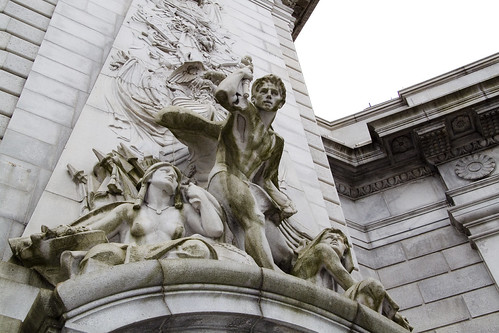
A brighter experience for your humble narrator was the Manhattan Bridge Centennial Time Capsule event, on March 5. Interactions and conversations were enjoyed by the least of men with certain powers and potentates of the City of Greater New York and entry to the interior space of the Manhattan Bridge was obtained. One of the high points of my year, “Exhausted” detailed the embedding of a time capsule in the East River Bridge #2- aka the Manhattan Bridge. Remarkable self control was exercised when I met the DOT Commissioner, Jeanette Sadik-Khan. My sincerest desire was to bend her ear with my alleged wisdom about bike lanes and bridge safety- but self control was ascendent that day and only congratulations were offered to both her and the other staffers at DOT.

– photo by Mitch Waxman
April 2010– City of Marble and Beryl
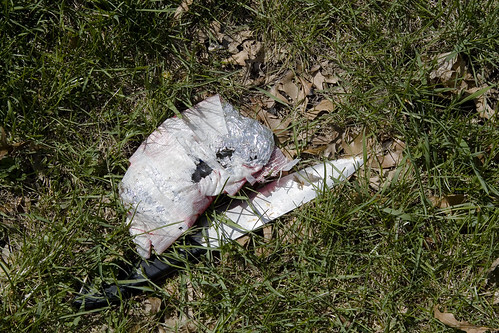
Odd shenanigans were observed at St. Michael’s Cemetery here in Astoria, which were of a decidedly magickal nature. A ritual site that your humble narrator stumbled across was examined and evidentiary examination suggested that certain third world cults were extant here in the old village of Astoria, conducting midnight bacchanals concurrent with the lunar cycle. “City of Marble and Beryl” was but the first of many moons which witnessed a working of will amongst the desolations of our kind.
April 2010– Searching for Gilman

A good part of 2010 was spent “Searching for Gilman” at First Calvary Cemetery, which I am doing as you are reading this, assuming it’s the start of 2011 whenever you do. Gilman is the source of no small amount of pain and financial hardship around these parts, as your humble narrator has become dangerously obsessive and paranoid around the subject. A psychotic need to find Gilman’s grave torments me, coloring my days and painting my dreams a dull yellow.

– photo by Mitch Waxman
May 2010– the king in yellow, brick
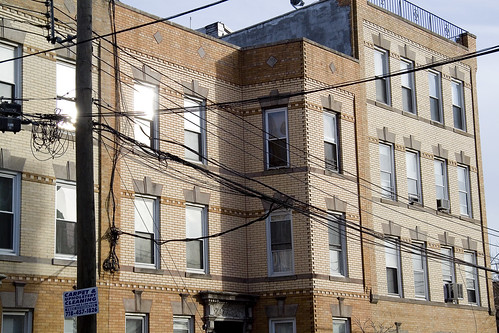
Remiss would be apparent were I to not mention the “Madison Avenue Bridge Centennial” but “the king in yellow, brick” advanced another of my pet theories and served up a fascinating (to me at least) sequence of events and relationships which attempts to explain why those yellow Kreischer bricks are all over the older sections of Queens.
May 2010– after cycles incalculable

“After cycles incalculable” is another one of those perfect posts, from a personal perspective. Wandering around with a friend, which is a disturbing trend which developed over the course of 2010, at Skillman Avenue’s start we observed the Lemuria hatching in concordance with the anniversary of the Roman festival of Lemuralia in Long Island City.

– photo by Mitch Waxman
June 2010– from Hells Gate, loosed upon the world

When I set out on my little walks, there is seldom a destination in mind. Literally wandering, obscure symbols and pseudo occultism guide my steps- I’ll follow a black cat, or merely adopt a roughly heliotropic path using my own shadow as compass. At the very end of May, my feet carried me toward Astoria Park and the notorious section of the East River known as Hells Gate. The odd craft, an “unidentified floating object” if you would, which sped past my lens required more than a small bit of detective work to identify- which was detailed in “from Hells Gate, loosed upon the world“.
June 2010– Gods Gift to Pain

English Kills, which is the logical and modern end of Newtown Creek, is a heavily industrialized and largely anaerobic tributary of the larger waterway and is seldom visited (by me, at least) at its extant. One fine day, while hanging out with another Creek enthusiast (you should not go to this place alone), we decided to enter the largely hidden urban foyer which leads here- despite the fact that we were most likely trespassing- which violates Newtown Pentacle policy. The title of the post- “Gods Gift to Pain” was lifted from an enigmatic and appropriate bit of graffiti observed in this forgotten pace of dissolution and poison.

– photo by Mitch Waxman
The reason for Brooklyn, and Queens- why it was a viable alternative to living in Manhattan in the 19th century was defined by the horrors of tenement life. The grand old buildings with their high ceilings, thick plastered walls, convenient dumbwaiters, and incredibly ornate lobbies- the structures which distinguished and made life desirable in the incalculably distant boroughs, were built as an alternative to the crowded and dangerous tenements of “The City”- especially the warren which was known as the “Five Points“. Additionally, Calvary Cemetery (of particular interest to me, and perhaps, to you) was founded by the parishioners of Old St. Patrick’s Cathedral which is smack dab in the middle of this ancient labyrinth of poverty, crime, and squalor. It was decided that to fully understand what one observes in the remains of the supposed “answer to the problem”, exploration of “the problem” itself is required.
July 2010– Bandits Roost, 2010

Ideal source material for the textural and societal milieu of the Five Points is the admittedly biased “How the Other Half Lives” by 19th century do-gooder Jacob Riis. Speaking the truth that power wants to hear is always a sound move if one considers fiscal realities and historical reputation. Attempts were made to find the modern locale in which Riis shot some of his more famous shots, such as this visit to “Bandits Roost 2010“.
July 2010– The house of Dagger John

Another critical visitation for me, as part of my larger education and study of the early development of the City of Greater New York was occasioned on the day when I went to “The house of Dagger John“. Old St. Patrick’s Cathedral satisfies both my continuing fascination with the counterpoint of sacred and profane in the story of the Megalopolis, and figures largely in the predictions of certain obscure lore which governs the schedule of my researches.

– photo by Mitch Waxman
August 2010– not to harsh anyone’s buzz… but…

August of 2010 brought a posting which garnered a lot of attention, due to curbed.com noticing and linking to it. Simply noticing that a growing proliferation of small boats were berthing illegally at the Vernon Avenue street end, it would be irresponsible of me- given everything that I know about the location not to point out the mortal and existential danger that the operators of these boats were placing themselves in. It’s not even the water, really, its the high pressure natural gas line- the enormous CSO which drains LIC- the omnipresent heavy industrial maritime traffic- which makes the spot so hazardous. Mortal threats were received via email (which I’ve kept private), and the comments thread displayed an angry and accusatory tone. As is the case with all such critique, these comments were presented verbatim- here’s a taste: “i have red your article in which you show a great deal of unger towards me and my friends . i believe that you base your article on many misconceptions that are rooted in a lack of communication”, “Blogger or not, the prudent journalist would make an effort to uncover basic facts before publishing a story full of assumptions”, “are you just the type of little man that tells teacher when the cool kids make you feel inferior. The water is public domain! And according to maritime law it is not illegal to moor a boat as long as it safe and looked after.”, “They are not bothering anyone. And get sick from the canal, come on. They are not living down there as far as I know. Parking your boat in the canal is not going to get them sick! Stop over doing it.” Check out “not to harsh anyone’s buzz… but…“.
August 2010– lively antics

One of the greatest joys of living in Queens are the chance encounters you’ll have with people who hail from the furthest points of the compass, such as this Bouzouki player during another visit to Hells Gate. His “lively antics” added splendor to a brightly lit walk around Astoria.

– photo by Mitch Waxman
September 2010– Lucky Shot

Although veteran photographers caution me against use of this term, I call the photo above my “shot of the year”. The steel structure attached to the bottom of the Brooklyn Bridge was installed as part of a bridge painting and maintenance project, and I was luckily along on a Working Harbor trip just as the sun was setting. Right place, right time, it was a “Lucky Shot“.
September 2010– stronger than fear

The dynamic new Safeboats utilized by NYPD and other entities around the harbor were a frequent subject over several of the Working Harbor expeditions I was lucky enough to attend. The many shapes, colorways, and missions of these quick little patrol boats are a delight to observe- and to those who would work maritime malice upon the metropolis- they are the head of the spear. Check out “stronger than fear“.

– photo by Mitch Waxman
A high of the year was the Newtown Creek Cruise which I had the honor of co-narrating with Bernard Ente on October 24th, of course, but the main topic of conversation amongst the antiquarian and environmental communities of the Newtown Pentacle in October revolved around the EPA’s superfund announcement about Newtown Creek at the very end of September. October is spooky time around these parts, and I spent a little time digging around the area for thrills and chills as well.
October 2010– blurred outlines

As part of series of postings detailing what might be seen in the Brooklyn neighborhood of Greenpoint, “blurred outlines” discusses the alleged appearance of a pyrokinetic at 84 Guernsey Street in January of 1895.
October 2010– scenes familiar, and loved

One of my frequent walks through Calvary Cemetery took me to the curiously empty chapel which enjoys the paramount of Laurel Hill. I will admit that I came here this day seeking two things- one was a likely entrance to a vast subterranean structure which underlies the area- the other was a vain hope that the grave of Gilman might present itself in a section which was, at the time, not terribly familiar to me as I normally stay close to the fringes of the place where the whipporwills wail. I very well might have captured what mass media paranormal media sources describe as a ghost orb in “scenes familiar, and loved“.

– photo by Mitch Waxman
November 2010– peace rests nevermore

One of the goals of this, your Newtown Pentacle, is to provide some sort of documentation about this terrible and wonderful place called the Newtown Creek- and I’m happy to say that I was there when the then Attorney General and Governor Elect Andrew Cuomo announced the settlement of a lawsuit brought by his office on behalf of New York State against Exxon-Mobil which involved the Greenpoint Oil Spill. “Peace rests nevermore” indeed.
November 2010– shocking coruscations

Entertaining maritime folklore from past centuries was offered in “shocking coruscations“, which is told against a series of twilight photos from good old Hells Gate between the two great bridges.

– photo by Mitch Waxman
During the cold, when inclement clime restricts my movements and the black dog nips at my heels, I tend toward shorter postings- and in December of 2010 there were two “Then and Now” postings that really took my fancy. These posts are difficult because of the scarce source material available in the public domain, but fun nevertheless. In my usual fashion “dumb idiot” fashion, I had shot the modern views completely unaware of the original photo. Our friends at the Greater Astoria Historic Society have recently released a book of similar historical views, which is worthy of consideration.
December 2010– Bowery Savings Bank 2010 and 1903

As the title states, this is the iconic shell of a once essential and awesomely powerful institution called the Bowery Savings Bank in Manhattan, with a 1903 photo from a similar perspective.
December 2010– Hunters Point Avenue Bridge Centennial

If you told me a year ago that I’d end up doing a press conference with a United States Congresswoman, I’d have hit you. That’s how I ended up at the Degnon Terminal’s own Sunshine Biscuits (LaGuardia Community College) building though, and by an odd coincidence- found myself standing in nearly the same spot as some unknown photographer did in 1921. This posting was built around the announcement of the “Hunters Point Avenue Bridge Centennial” event.

– photo by Mitch Waxman
Overall, a positive and exciting year, despite the deaths of several members of my family.
For a while, I enjoyed a spot on the board of the nascent Newtown Historical Society as a trustee, which is a position that I’ve had to resign for a variety of personal reasons- but I’d like to thank fellow board members Kevin Walsh, Christina Wilkinson, Steve Garza, and Bob Singleton for an interesting and educational experience. Kevin Walsh of forgotten-ny gets a personal call out, as his support, knowledge, and encouragement has been invaluable. Special thanks also are extended toward Capt. John Doswell and Meg Black of the Working Harbor Committee, all the guys and gals aboard the John J. Harvey fireboat, and everybody else who allowed a piss poor specimen such as myself to come along on adventures. Bernard Ente of the Newtown Creek Alliance, Working Harbor, and others also receives a heartfelt gratitude and shout out from this humble mendicant. Standing on the shoulders of giants is difficult if you suffer from altitude related nosebleeds.
What’s next?
Tell you what, feel like taking a walk?
Meet me at the border of Brooklyn and Queens – bring a camera… and ID… I’ll show you something cool…


 The Newtown Pentacle