Posts Tagged ‘Astoria’
heavy rumblings
It’s National Panini Day, in these United States.

– photo by Mitch Waxman
On this day, in 3,114 B.C.E., the Mayans began their “long count” calendar. Today’s also the day, in 480 B.C.E., that Leonidas and his 300 Spartans finally succumbed at Greece’s Thermopylae to the human wave attacks of the Persian armies of Xerxes. In 1929, Babe Ruth became the first baseball player to achieve 500 career home runs, and in 1972 the United States exited its last combat units from Viet Nam. Today is the day that industrialist Andrew Carnegie died in 1919, the painter Jackson Pollock also kicked the bucket in 1956, and we also lost comedian Robin Williams on this day in 2014. In 1992, the Mall of America opened for business, and in 1965 the Watts riots kicked into gear in Los Angeles.
Me? I don’t have too much to do today, but it’s going to be a fairly busy weekend.

– photo by Mitch Waxman
I’m planning on checking out the “Queens Anti-Gentrification” march on Saturday afternoon in LIC. What I’ve read about, and offered by, this group doesn’t exactly jibe with reality as I know it, but I figure if somebody is willing to stick their neck out and offer their views and opinions in public you owe it to them to at least listen to what they have to say. So far, I haven’t been a fan of their tactics either, but there you are. After that, I’m hopping on a ferry to Pier 11 in Manhattan, where I’ll be boarding a boat with the Working Harbor Committee. I’ll be sharing the microphone with Andrew Gustafson of Turnstile Tours and we will be talking about the Brooklyn Waterfront’s (Newtown Creek to Sunset Park) “Past, Present, and Future.”

– photo by Mitch Waxman
I’ll be up early on Sunday to conduct the “Poison Cauldron of the Newtown Creek” walking tour for Newtown Creek Alliance. This is one of my favorite excursions to conduct, and it tells the story of the oil and energy industries in North Brooklyn from the 1850’s all the way to the present. It also moves through one of the most god awful areas NYC has ever created, so how’s that for a selling point?
Upcoming Tours and events
Brooklyn Waterfront Boat Tour, with Working Harbor Committee – Saturday August 12th, 6 p.m. – 8 p.m.
Explore the coastline of Brooklyn from Newtown Creek to Sunset Park, with NCA Historian Mitch Waxman, Andrew Gustafson of Turnstile Tours, and Gordon Cooper of Working Harbor Committee on the narrating about Brooklyn’s industrial past and rapidly changing present. – details here.
The Poison Cauldron of the Newtown Creek Walking Tour, with Newtown Creek Alliance – Sunday August 13th, 11 a.m. – 1:30 p.m.
Explore the hellish waste transfer and petroleum districts of North Brooklyn on this daring walk towards the doomed Kosciuszko Bridge, with NCA Historian Mitch Waxman – details here.
Two Newtown Creek Boat Tours, with Newtown Creek Alliance and Open House NY – Wednesday August 16th, 5 p.m. and 7 p.m.
The neighborhoods surrounding Newtown Creek are home to the densest collection of these garbage facilities anywhere in the city and collectively, the waste transfer stations around and along Newtown Creek handle almost 40% of the waste that moves through New York. Join Newtown Creek Alliance’s Mitch Waxman and Willis Elkins to learn about the ongoing efforts to address the environmental burden that this “clustering” has caused. – details here.
DUPBO Newtown Creek Walking Tour, with NYCH20 – Thursday August 24th, 7 p.m. – 9 p.m.
Explore Greenpoint and Hunters Point, with NCA Historian Mitch Waxman – details here.
“follow” me on Twitter- @newtownpentacle
narrow mounting
It’s National Ice Cream Sandwich Day, in these United States.

– photo by Mitch Waxman
One was hanging around Astoria at the local pub recently, and while enjoying a lovely pint of beer and carousing with the local crowd, a group of scabs were busily at work doing an installation for Time Warner Spectrum cable.
As you may or may not know, the worst company in America has been involved in a labor strike by the International Brotherhood of Electrical Workers Local 3. The fellows pictured in today’s post, who are scabs, were employed by some non union shop in LIC that’s handling the conglomerate’s business while its actual employees stand up for their rights and a fairer contract.

– photo by Mitch Waxman
Being the sort of arse that I am, I started playing the Dropkick Murphys cover of “which side are you on” on my phone, and let the union guys inside the bar know that a couple of scabs were undercutting organized labor as a whole outside. We all marveled as these scabs were running wires across Broadway and right through traffic, and at their complete lack of regard for the safety of passing pedestrians or bicyclists. There were no safety cones, except around their trucks. Kids and passerby were just allowed to step over their wires and under their ladders.
As a note, I’ve got no skin in the union game. Thing is, as a history minded fellow who has in particular studied the industrial past rather extensively, one of the greatest cons ever offered to Americans is that unions are somehow bad. You work an eight hour day? Get hurt on the job and receive compensation? Unemployment benefits? Have health insurance? A retirement plan or pension? You owe all of that to organized labor.

– photo by Mitch Waxman
Speaking of safety, the personal rigs you’d normally see the International Brotherhood of Electrical Workers Local 3 wearing to vouchsafe themselves against falls were not anywhere to be seen, and as mentioned above the scabs thought it was just fine to allow pedestrians to walk under their ladders while they did their thing up on the utility poles.
The only interjection which one offered to them was that the DSNY collection baskets on the corners were not meant to be receptacles for their trash, and my attention to the matter caused them to scoop out the forty to fifty feet of coaxial cable which they had decided to attempt disposal of in the corner bin.

– photo by Mitch Waxman
It is my distinct desire, once this strike has been settled, that our local elected officials can find a way to compel the worst company in America to do something about the hopeless tangle of wires which sway from the utility poles here in Astoria.
I like the idea of that, for aesthetic reasons alone. I’d also like to see some sort of penalty applied to Spectrum’s management which would also create a huge block of overtime pay for the men and women of the International Brotherhood of Electrical Workers Local 3 to earn and collect, from the worst company in America.
Rewiring Astoria would cost Spectrum millions, I suspect.
Upcoming Tours and events
The Insalubrious Valley of the Newtown Creek Walking Tour, with Newtown Creek Alliance – Saturday August 5th, 11 a.m. – 1;30 p.m.
Century old movable bridges, the remains of a 19th century highway between Brooklyn and Queens, and explore two of the lesser known tributaries of the troubled Newtown Creek watershed. For the vulgarly curious, Conrad Wissell’s Dead Animal and Night Soil wharf will be seen and described, with NCA Historian Mitch Waxman – details here.
Brooklyn Waterfront Boat Tour, with Working Harbor Committee – Saturday August 12th, 6 p.m. – 8 p.m.
Explore the coastline of Brooklyn from Newtown Creek to Sunset Park, with NCA Historian Mitch Waxman, Andrew Gustafson of Turnstile Tours, and Gordon Cooper of Working Harbor Committee on the narrating about Brooklyn’s industrial past and rapidly changing present. – details here.
The Poison Cauldron of the Newtown Creek Walking Tour, with Newtown Creek Alliance – Sunday August 13th, 11 a.m. – 1:30 p.m.
Explore the hellish waste transfer and petroleum districts of North Brooklyn on this daring walk towards the doomed Kosciuszko Bridge, with NCA Historian Mitch Waxman – details here.
Two Newtown Creek Boat Tours, with Newtown Creek Alliance and Open House NY – Wednesday August 16th, 5 p.m. and 7 p.m.
The neighborhoods surrounding Newtown Creek are home to the densest collection of these garbage facilities anywhere in the city and collectively, the waste transfer stations around and along Newtown Creek handle almost 40% of the waste that moves through New York. Join Newtown Creek Alliance’s Mitch Waxman and Willis Elkins to learn about the ongoing efforts to address the environmental burden that this “clustering” has caused. – details here.
DUPBO Newtown Creek Walking Tour, with NYCH20 – Thursday August 24th, 7 p.m. – 9 p.m.
Explore Greenpoint and Hunters Point, with NCA Historian Mitch Waxman – details here.
“follow” me on Twitter- @newtownpentacle
unsigned letter
It’s National Drive-Thru Day, in these United States.
– photo by Mitch Waxman
Ain’t nothing like a heat wave in NYC, huh? Regardless of tropical clime, nor distances involved, a humble narrator nevertheless surged forward into the wilds of Long Island’s western tip recently to gather photographs and experience the truculent realities of our time.
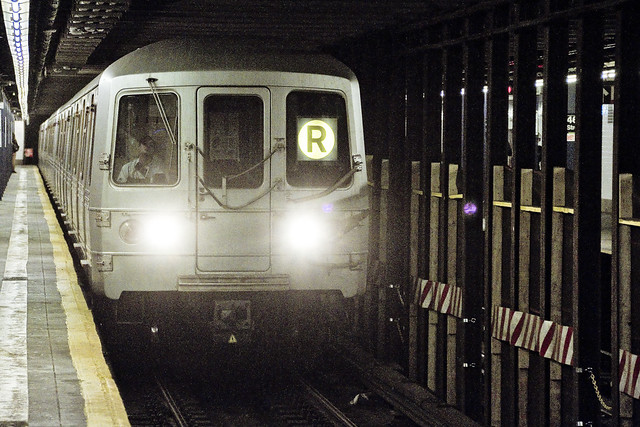
One left Point A in Astoria via the usual means, onboard the so called “R” or Broadway Local Line .
from wikipedia
The R Broadway Local is a rapid transit service in the B Division of the New York City Subway. Its route emblem, or “bullet”, is colored yellow since it uses the BMT Broadway Line in Manhattan.
The R operates local between 71st Avenue in Forest Hills, Queens and 95th Street in Bay Ridge, Brooklyn at all times except nights when it short turns at Whitehall Street–South Ferry in Lower Manhattan from Brooklyn.
– photo by Mitch Waxman
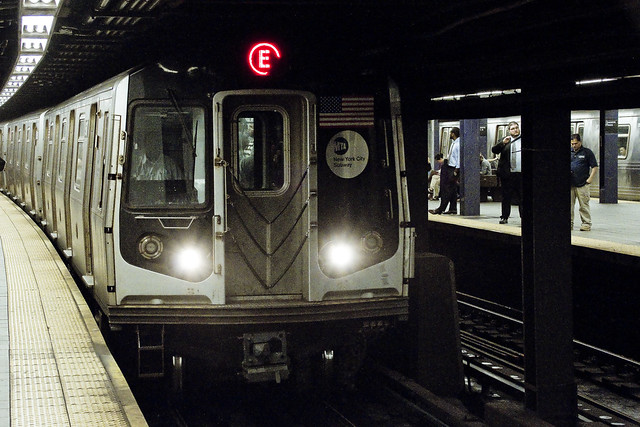
Ultimately, one sought to gain access to the Crosstown or “G” line, which the MTA folks annoyingly force one to enact two transfers to get to from Point A, despite the platform’s location less than a mile and a half from my starting point (and the fact that the G used to run through the same station which I caught the R at). Accordingly, at the sweltering bunker of dripping masonry which the MTA designates as “Queens Plaza,” one debarked the R and vouchsafed a single station ride upon the “E” – or Eighth Avenue Local Line – to the Court Square station where yet another transfer was enacted to access the G.
Urine, it smelled deeply of urine, at the Court Square station.
from wikipedia
The E Eighth Avenue Local is a rapid transit service in the B Division of the New York City Subway. Its route emblem, or “bullet”, is blue since it uses the IND Eighth Avenue Line in Manhattan.
The E operates at all times between Jamaica Center–Parsons/Archer in Jamaica, Queens, and Chambers Street–World Trade Center in Lower Manhattan, running express on the IND Queens Boulevard Line in Queens (except nights when it serves all stops) and local in Manhattan. E trains also serve two local stops in eastern Queens (75th Avenue and Briarwood) on evenings and weekends.

– photo by Mitch Waxman
My penultimate destination, on this particularly warm evening, was Sunset Park – which adjoins the legend choked streets of the Red Hook section of Brooklyn. One does realize, of course, that the R could have taken me all the way to this area which is called “Sunset Park,” but that would have multiplied my travel time due to a circuitous route which transverses all of Manhattan and a good chunk of Brooklyn.
The G discharged a humble narrator, vomiting me forth onto the platforms at the sky flung Smith/9th street station, high over the loathsome and shadow haunted Gowanus Canal. The Gowanus Canal smells of urine (and other things) as well, of course.
from wikipedia
The G Crosstown Local is an 11.4-mile-long (18.3 km) rapid transit service in the B Division of the New York City Subway. Its route emblem, or “bullet”, is colored light green since it uses the IND Crosstown Line.
The G operates at all times between Court Square in Long Island City, Queens and Church Avenue in Kensington, Brooklyn via the IND Crosstown and Culver lines. In Queens, it only serves two stations – Court Square and 21st Street, both in Long Island City – but previously served all stations to and from 71st Avenue in Forest Hills on the IND Queens Boulevard Line.
– photo by Mitch Waxman
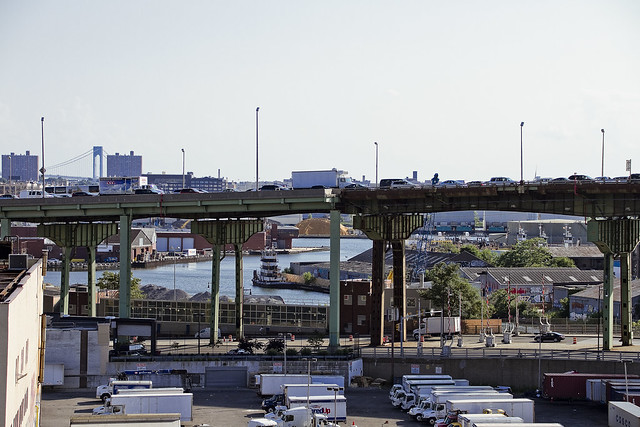
My plan was to pass through the “House of Moses” and under the Gowanus Expressway section of the Brooklyn Queens Expressway, exploiting the shaded path which is offered by this elevated roadway, and head south towards Sunset Park. It should be mentioned, incidentally, that this is perhaps the least pedestrian friendly area in all of Brooklyn. Brobigdagnian trucks whiz about at high speed, angry motorists lurch their vehicles to and fro in frustrated bursts, and the pavement is both shadowed by the expressway above and in a delitorious state of repair.
Also, there’s vampires hiding in the rafters of the Gowanus Expressway.
from nycroads.com
The Gowanus Expressway, which serves as the southern extension of the Brooklyn-Queens Expressway, also connects the Brooklyn-Battery Tunnel approach, the Prospect Expressway (NY 27), the Belt Parkway and the Verrazano-Narrows Bridge. Although guide signs and maps refer to this segment of I-278 as the Brooklyn-Queens Expressway, it is known locally as the Gowanus Expressway.
Beginning in 1939, Robert Moses oversaw construction of the Gowanus Parkway, an elevated highway placed on top of the pillars of the old 3rd Avenue BMT Elevated Line through the Sunset Park and Gowanus sections of Brooklyn. It would eventually become part of a limited-access parkway loop encircling four of the five boroughs. Since the Gowanus Parkway was to be constructed atop a pre-existing elevated facility, Moses had little trouble getting his project approved by the New York City Council.
However, the Gowanus Parkway would require more land for a wide roadway and entrance-exit ramps. This required the demolition of many homes and businesses along Third Avenue, a tightly knit block of Northern and Western European immigrants.

– photo by Mitch Waxman
There are charming sights to be found along the Gowanus Canal, I should mention, lest you think I’m prejudiced against the “Superfund Sister to the South” of my beloved Newtown Creek. Abundant waste transfer and oil distribution facilities, endemic pollution, lakes of unknown chemical constitution lurking just below the streets, untreated sewage oozing out of unmarked pipes? These are all the things I love.
One has never understood the appeal of “going to the country” and vacationing amongst the rural yokels. Camping? Are you insane? I’ve got a dry bed and a door that locks here in NYC, where I get to witness a looming infrastructure crisis and unfolding environmental apocalypse whenever I want to.
from wikipedia
The Gowanus Canal is a canal in the New York City borough of Brooklyn, on the westernmost portion of Long Island. Connected to Gowanus Bay in Upper New York Bay, the canal borders the neighborhoods of Red Hook, Carroll Gardens, and Gowanus, all within South Brooklyn, to the west; Park Slope to the east; Boerum Hill and Cobble Hill to the north; and Sunset Park to the south. It is 1.8 miles (2.9 km) long. There are seven bridges over the canal, carrying Union Street, Carroll Street (a landmark), Third Street, Ninth Street, Hamilton Avenue, the Gowanus Expressway, and the IND Culver Line of the New York City Subway.

– photo by Mitch Waxman
That’s part of the Gowanus Canal, pictured above, as shot from the Hamilton Avenue Bridge and looking back north towards the Smith/9th street station which the G line disgorged me into. Used as I am to the wild expanses and geographic extent of Newtown Creek, my thoughts always turn to compactness when I’m at the Gowanus. Thing is, just like Newtown Creek and its tributaries – two of which the Gowanus would tuck neatly into – the canal interacts with ground water and flows beneath the streets via its connections with the sewer system. Just like Newtown Creek, many of the sewers connected to the Gowanus are in fact former tributary waterways which were converted and buried at the end of the 19th and start of the 20th centuries. Who can guess, all there is, that might be buried down there?
Additionally, both Gowanus Canal and Newtown Creek sport maritime industrial bulkheads along most of their length which are little more than artifacts of the Second Industrial Age, in our modern day NYC.
from nyc.gov
The Hamilton Avenue Bridge is a bascule bridge with two parallel leafs, one carrying the northbound roadway and the other carrying the southbound roadway. Most of the length of Hamilton Avenue runs below the elevated portion of the Gowanus Expressway, including the bridge. The bridge connects Smith Street and Second Avenue over the Gowanus Canal and is the first canal crossing north of the Gowanus Bay.

– photo by Mitch Waxman
Regardless of musings about the wasted space, lack of public access, and utter degradation of the air, water, and soil – one had somewhere to be, and a little bit of walking was required to get there. A humble narrator put his head down, leaned into a southerly declination, and scuttled off into the clouds of auto exhaust mixing with the humid air.
The Gowanus Expressway dwelling Vampires be damned, I needed to get to Sunset Park.
from wikipedia
A vampire is a being from folklore that subsists by feeding on the life essence (generally in the form of blood) of the living. In European folklore, vampires were undead beings that often visited loved ones and caused mischief or deaths in the neighbourhoods they inhabited when they were alive. They wore shrouds and were often described as bloated and of ruddy or dark countenance, markedly different from today’s gaunt, pale vampire which dates from the early 19th century.
Vampiric entities have been recorded in most cultures; the term vampire, previously an arcane subject, was popularised in the West in the early 19th century, after an influx of vampire superstition into Western Europe from areas where vampire legends were frequent, such as the Balkans and Eastern Europe; local variants were also known by different names, such as shtriga in Albania, vrykolakas in Greece and strigoi in Romania. This increased level of vampire superstition in Europe led to mass hysteria and in some cases resulted in corpses being staked and people being accused of vampirism.
Upcoming Tours and events
The Insalubrious Valley of the Newtown Creek Walking Tour, with Newtown Creek Alliance – Saturday August 5th, 11 a.m. – 1;30 p.m.
Century old movable bridges, the remains of a 19th century highway between Brooklyn and Queens, and explore two of the lesser known tributaries of the troubled Newtown Creek watershed. For the vulgarly curious, Conrad Wissell’s Dead Animal and Night Soil wharf will be seen and described, with NCA Historian Mitch Waxman – details here.
Brooklyn Waterfront Boat Tour, with Working Harbor Committee – Saturday August 12th, 6 p.m. – 8 p.m.
Explore the coastline of Brooklyn from Newtown Creek to Sunset Park, with NCA Historian Mitch Waxman, Andrew Gustafson of Turnstile Tours, and Gordon Cooper of Working Harbor Committee on the narrating about Brooklyn’s industrial past and rapidly changing present. – details here.
The Poison Cauldron of the Newtown Creek Walking Tour, with Newtown Creek Alliance – Sunday August 13th, 11 a.m. – 1:30 p.m.
Explore the hellish waste transfer and petroleum districts of North Brooklyn on this daring walk towards the doomed Kosciuszko Bridge, with NCA Historian Mitch Waxman – details here.
Two Newtown Creek Boat Tours, with Newtown Creek Alliance and Open House NY – Wednesday August 16th, 5 p.m. and 7 p.m.
The neighborhoods surrounding Newtown Creek are home to the densest collection of these garbage facilities anywhere in the city and collectively, the waste transfer stations around and along Newtown Creek handle almost 40% of the waste that moves through New York. Join Newtown Creek Alliance’s Mitch Waxman and Willis Elkins to learn about the ongoing efforts to address the environmental burden that this “clustering” has caused. – details here.
“follow” me on Twitter- @newtownpentacle
quiet steps
It’s National Caviar Day, in these United States.

– photo by Mitch Waxman
The shot above was captured at the corner on the Astoria side of Northern Blvd. and 47th street, a couple of weeks ago. If it was shot a hundred years ago, this location would have been described as the corner of Jackson Avenue and 17th avenue (aka 19th century Oakley Street) nearby Long Island City’s border with Woodside. Back then, there would have been streetcars (trolleys) rolling through the shot. That’s the sort of thing which I wish the NYC EDC’s BQX team would think about – putting streetcars back where they belong, along these old routes currently serviced by MTA’s buses. This particular trolley route was one that rolled off the Queensborough Bridge, the New York and Queens County Railroad.
The street grid of modern day Sunnyside continued through to the north towards Astoria across what’s now the Sunnyside Yards and those huge used car dealerships you see in the shot above, which are found on the southern side of Northern Blvd. in modern times.

– photo by Mitch Waxman
Northern Blvd. is a widened version of Jackson Avenue, which is another one of the many road projects overseen by Robert Moses in the early 20th century. Another one of Mr. Moses’s projects was both the creation of the Grand Central Parkway (which fed traffic to his Triborough Bridge from Eastern Queens and Long Island) and the redesignation of Astoria Avenue into Astoria Blvd.
FDNY’s Engine 263 and Ladder 117 are housed in a consolidation era firehouse, pictured above, which predates the Grand Central’s construction. There’s a shot of the place from ca. 1920 you might be interested in perusing at this dcmny.org link which shows what things looked like back in the post WW1 period here in Western Queens. The historic shot looks west down Astoria Avenue towards Steinway Street.

– photo by Mitch Waxman
That’s the Long Island Rail Road as it rolls out of the 1870 vintage LIC Passenger Yard towards the Hunters Point Station. The incredible trainsarefun.com is an invaluable resource for studying this particular rail empire, and they offer this incredible aerial image from 1940 which shows the LIRR operation at probably its grandest moment.
Upcoming Tours and events
The Poison Cauldron of the Newtown Creek Walking Tour, with Atlas Obscura – July 22nd, 11 a.m. – 2 p.m..
Explore the hellish waste transfer and petroleum districts of North Brooklyn on this daring walk towards the doomed Kosciuszko Bridge, with NCA Historian Mitch Waxman – details here.
“follow” me on Twitter- @newtownpentacle
risible talisman
It’s National Blueberry Muffin Day, in these United States.

– photo by Mitch Waxman
July 11th, 1936. That’s the day that the Triborough Bridge was dedicated and opened for business. The favorite child of Robert Moses, this was the epicenter of the master builder’s early empire of highways, bridges, and parks. It’s the main room in the “House of Moses,” and the center of a web of concrete and steel that extends for hundreds of miles in all directions. All of Moses’ many roads ultimately lead to the toll booths at Triborough.
The bridge serves as a backdrop in tens of thousands of family photos found in the Astoria section of Queens, but there’s only a handful of living Astorians still left above the ground who can recall a time before there was a Triborough Bridge.

– photo by Mitch Waxman
Robert Caro, who wrote the definitive biography of Robert Moses, described the bridge as a “traffic machine.” Caro was being critical (as in the bridge generates and amplifies traffic congestion rather than solving it), of course, but I think Moses (who often opined that without high speed roads, the traffic would still be there but moving along local streets instead) would have had an affinity for the term.
There’s an exceptionally brief and easily digestible history of the Triborough Bridge (more accurately the Triborough Bridges and Highways complex) in this 2006 NY Times piece, for the curious.

– photo by Mitch Waxman
Robert Moses is famously and rightly associated with the Triborough, but it was Mayor Jimmy Walker who turned the first ceremonial shovel of dirt in Astoria Park on October 25 in 1929.
The bridge was conceived of, designed by, and it’s construction overseen (during most of construction) by the Chief Engineer of the NYC Department of Plant and Structures, Edward A. Byrne (who is coincidentally the fellow who did the Hunters Point Avenue and Borden Avenue Bridges over the Dutch Kill tributary of, and the vanished Vernon Avenue bridge at, Newtown Creek). Byrne became the first Chief Engineer of Moses’ Triborough Bridge Authority in 1933, but a silly political conflict forced him to resign and retire in 1934.

– photo by Mitch Waxman
Reliable government source numbers I’ve reviewed, referring back to calendar 2015, inform that the Triborough Bridge hosts about 92,000 vehicle trips a day. That would shake out to something close to 33.6 million vehicle trips per annum.
Maybe “traffic machine” is the right description?
At any rate, Happy Birthday to Mighty Triborough, from here in Astoria, Queens.
Upcoming Tours and events
13 Steps Around Dutch Kills Walking Tour, with Newtown Creek Alliance – July 15th, 10 a.m. – 1 p.m..
The “then and now” of Newtown Creek’s Dutch Kills tributary in LIC, once known as the “workshop of the United States.” with NCA Historian Mitch Waxman – details here.
The Poison Cauldron of the Newtown Creek Walking Tour, with Atlas Obscura – July 22nd, 11 a.m. – 2 p.m..
Explore the hellish waste transfer and petroleum districts of North Brooklyn on this daring walk towards the doomed Kosciuszko Bridge, with NCA Historian Mitch Waxman – details here.
“follow” me on Twitter- @newtownpentacle


 The Newtown Pentacle