Posts Tagged ‘Dutch Kills’
dull wonder

– photo by Mitch Waxman
Ongoing observations of the FedEx construction project at Dutch Kills are impossible for your humble narrator to avoid, as my daily travels often necessitate that my incessant marching carry me past the place. Luckily, recent phases of the project have created lapses in the fencing around the site which have allowed visual access that doesn’t require climbing upon or dangling from either traffic signals or the Long Island Expressway.
from dutchkillscivic.com
In 1642, licenses were granted to some Dutch citizens to settle in Queens. “Kill” is a Dutch word meaning “little stream.” Since Dutch men settled around the “Kill,” (in Long Island City) the name Dutch Kills was adopted. The “Kill” (or stream) is a tributary of Newtown Creek, which divides Queens from Brooklyn.
During the Revolutionary War, British troops were billeted in a series of farmhouses on 39th Avenue (Beebe Avenue). These houses stood until 1903 when they were torn down to make way for the railroad. In the early 1900’s the Queensborough Bridge was opened. Proximity to Manhattan, presence of railroads, and Long Island all contributed to the importance of Dutch Kills.

– photo by Mitch Waxman
I’ve conducted a few private walking tours of the area around Dutch Kills in recent weeks, mainly for groups of European and American students, many of whom were aghast at the scale of this endeavor and stunned by the lack of dust abatement going on. Wisely, several of them held handkerchiefs to their mouth and nose while walking by.
from wikipedia
Dust abatement refers to the process of inhibiting the creation of excess soil dust, a pollutant that contributes to excess levels of particulate matter.
Frequently employed by local governments of arid climates such as those in the Southwest United States, dust abatement procedures may also be required in private construction as a condition of obtaining a building permit.
Dust abatement methods include the regular spraying of water on loose dirt in construction sites, the paving of or applying magnesium chloride to dirt roads, and restricting access to dusty areas.
Abatement oil (an organic, lubricating and penetrating oil) most commonly used to remove debris such as dust and asbestos. Application of this product is normally done by lathering onto the surface and then removing with a clean dry cloth.

– photo by Mitch Waxman
One of the things which I’m growing increasingly apprehensive about is the “occupational exposure” to the endemic pollutants surrounding and suffusing the Newtown Creek waterway. As mentioned in earlier postings, when visiting a sewer plant I no longer react to the smell and consider a visit to a Waste Transfer station on the banks of English Kills to be a pleasurable diversion.
The sudden illness and death of my friend and mentor Bernie Ente a year ago weighs heavily on my mind even now, and little doubt exists in my mind that the Creek had at least a tangential role in his decline.
from wikipedia
An occupational exposure limit is an upper limit on the acceptable concentration of a hazardous substance in workplace air for a particular material or class of materials. It is typically set by competent national authorities and enforced by legislation to protect occupational safety and health. It can be a tool in risk assessment and in the management of activities involving handling of dangerous substances. There are many dangerous substances for which there are no formal occupational exposure limits. In these cases, control banding strategies can be used to ensure safe handling.

– photo by Mitch Waxman
In the world of the Newtown Creek- where the very air you breathe is a poisonous fume, where sickly trees fed by a morbid nutrition struggle to burst forth from the shattered cement, where the water is a sickly shade of antifreeze green, and where every surface is coated with a queer and iridescent “colour”- what strange and undesirable substance might be carried by the lightest of breezes?
Who can guess all there is, that might be buried down there, which has been granted freedom?
from dec.ny.gov
To protect humans and the environment from damage by air pollution, DEC continually measures levels of pollutants in the air. DEC regularly reports the results of these measurements — in the case of ozone, which at high levels can be a threat to human health, the results and predicted pollution levels are reported in real time, on DEC’s website and through broadcast media.
DEC measures air pollutants at more than 80 sites across the state, using continuous and/or manual instrumentation. These sites are part of the federally-mandated National Air Monitoring Stations Network and the State and Local Air Monitoring Stations Network. Real time direct reading measurements include gaseous criteria pollutants (ozone, sulfur dioxide, oxides of nitrogen, carbon monoxide), PM2.5 (fine particulate with diameter less than 2.5 microns), and meteorological data. Filter based PM2.5, lead, and acid deposition samples are collected manually and shipped to the laboratory for analysis.
Monitoring air for pollutants is a complex technical task, requiring not only direct measurement, but also measurement standards and quality assurance to ensure that the information provides a correct understanding of air quality in New York State. Ambient air quality reports provide the data and interpretations to the technical community and the public.

– photo by Mitch Waxman
These concerns about exposure to the poisons of the watershed have been expressed to the team of medical professionals who keep my health at delicate balance. Queries are advanced from this group of doctors as to why I just can’t leave this place to its own devices and disposition. What compulsion is it that drives one time and again to venture into this veritable lions den of carcinogens, corrosives, and environmental corruption?
from wikipedia
In human context, self-destructive behaviour is a widely used phrase that conceptualises certain kinds of destructive acts as belonging to the self. It also has the property that it characterises certain kinds of self-inflicted acts as destructive. The term comes from objective psychology, wherein all apparent self-inflicted harm or abuse toward oneself is treated as a collection of actions, and therefore as a pattern of behaviour.
Acts of “self-destruction” may be merely metaphorical (“social suicide”) or literal (suicide). Generally speaking, self-destructive actions may be deliberate, born of impulse, or developed as a habit. The term however tends to be applied toward self-destructions that are potentially habit-forming or addictive, and are thus potentially fatal.

– photo by Mitch Waxman
Simply put, it has become my belief that if Newtown Creek and it’s tributaries can “be solved”, a thorough understanding of the problem- both historical and modern- will be required. Such a magnificent puzzle as the one this place represents, located at the very navel of New York City, might offer a solution to larger national puzzles. It’s my hope that in some small way, this blog can help to “connect the dots” when somebody far more intelligent than myself applies themselves to the issue in the future.
The answer won’t be offered by me, of course, as I must always remain an outsider cursed to watch and record but never to participate in such things.
from wikipedia
The optimisism bias (also known as unrealistic or comparative optimism) is a self-serving bias where an individual perceives that they are less at risk of experiencing a negative event compared to others. The optimistic bias is seen in a number of different scenarios, including causing individuals to believe that they are less at risk of being a victim of a crime, smokers to believe they are less likely to contact lung cancer or disease than other smokers, and even first-time bungee jumpers believe that they are less at risk of an injury than other jumpers. Although this bias occurs in both positive and negative events, there is more research and evidence that the bias is stronger for negative events. However, there are different consequences that come from these events: positive events often result in feelings of well being and self-esteem, while negative events lead to consequences with more risk, such as engaging in risky behaviors and not taking precautionary measures. The optimistic bias can also be viewed in terms of expectancies about specific events
yellow rays

– photo by Mitch Waxman
Recorded recently in the neighborhood of Dutch Kills, not the waterway but the neighborhood which the waterway once flowed into. It’s confusing, as the waterway is often cited or mentioned in these postings and is “way over there” from the perspective of the neighborhood- which is found between Ravenswood, the East River, and Astoria. Large hotels are on the rise in the area, and there’s a whole lot of construction underway. For street artists, this is a bit of a playground.

– photo by Mitch Waxman
Personally, this is my kind of stuff. Garish in color and whimsical, not like the dark sarcasm and obviate ideations often observed in Brooklyn. Moreover, where one would expect to find elaborate renderings of “tags”, figurative cartooning trumps.

– photo by Mitch Waxman
A fairly even temper hangs about the brow of a humble narrator today, and this splash of color is much appreciated by this withering shadow.
transparent walls

– photo by Mitch Waxman
Criticism received for the Newtown Pentacle posting “Dim Entity” included the terms “false and misleading” and offered that the post’s assertation that the Federal Express site at Dutch Kills was offered as compensation for the loss of their location in Manhattan to make room for the new construction of luxury housing was abjectly false. Instead, this particular depot has instead been relocated to the Bronx rather than Queens, I have been informed.
As is Newtown Pentacle policy on the subject, and has been since day one, when I’m wrong corrections are eagerly accepted and passed on to you, my Lords and Ladies of Newtown.

– photo by Mitch Waxman
In defense, the term “I guess” was used several times in the post, and it doesn’t change my allegation that hundreds if not thousands of truck trips through western Queens will be engendered by the siting of this facility. For those of you who do not live in the immediate locale, a dire and growing problem experienced by the populations of North Brooklyn and Western Queens is the geometric growth of trucks passing through the area.
Natural consequence of geography, being the terminal point of Long Island closest to the shining city of Manhattan, heavy trucks move constantly around us. Exhaust fumes paint the faces of our children with soot, and during humid weather the air is heavy with smoky effluvium.

– photo by Mitch Waxman
Regardless of personal feeling about the matter, the fact of the siting of this depot was implied as being a quid pro quo, which offended sources have flatly denied. As such, retraction of that implication is offered.

– photo by Mitch Waxman
Doesn’t change the fact that whenever a dirty industrial business needs land, it is found in Queens or Brooklyn or the Bronx or Staten Island. Look at the recent series of announcements of forthcoming municipal projects planned for possible construction within a mile of Newtown Creek as proof of this- whether it be a power plant that runs on sewage emissions, or one that runs on garbage instead.
dim entity

– photo by Mitch Waxman
On the 24th of February, a Newtown Pentacle posting was offered in which description of an astounding demolition which had occurred along 30th street in Long Island City, and whose purpose was to clear the way for a gargantuan FedEx trucking depot and shipping center. Attempting to describe the sheer scale of this to friends and Our Lady of the Pentacle simply proved that words would be inadequate to convey the scale of it all.
So, a humble narrator went back, and did a little bit of climbing.

– photo by Mitch Waxman
Having once been a child in Brooklyn, you humble narrator learned to climb the urban landscape like a monkey. This skill is something that still comes in handy, especially when something which needs photographing is behind a ten foot tall plywood construction fence. The shot above is a “stitched panorama” which incorporates around 16 individual exposures into a single image- encouragement is offered to click through to the largest incarnation of this shot at flickr (click here) to appreciate the massiveness of the footprint.
Click here to see it on a google map.

– photo by Mitch Waxman
From the decking of the Borden Avenue Bridge, you can see that the construction site extends all the way to the Dutch Kills tributary of the malign Newtown Creek. FedEx must need an awful lot of space.
Wonder why?

– photo by Mitch Waxman
Well to begin with, the entirely coincidental condemnation and demolishing of the FedEx World Service Center building in Manhattan (528-556 West 34th Street) to make room for the Hudson Yards residential development has robbed the shipping giant of certain capabilities. My guess, and it’s a guess, is that they were offered Queens instead.
And once again, Manhattan exports its problems to Queens, I guess.

– photo by Mitch Waxman
When this site has been mentioned, those who live and work in Queens get a wild look in their eyes. They ask “Wait, where will all those trucks go when heading into Manhattan?”. Sure, they’ll be taking truck routes, but what happens when they bottleneck at Queens Plaza, the Midtown Tunnel, or the Triborough? Care to guess?
What about the tractor trailers leaving from LaGuardia and Kennedy, how will they get to Long Island City?

– photo by Mitch Waxman
A bit of that climbing talent bragged about at the beginning of this posting, and a switch of POV to Hunters Point Avenue brings you this “stitched panorama” of the rubble beyond the fence. Notice the lack of water being sprayed on the shattered masonry, or any attempt at dust abatement, and remember that the factories which stood here for nearly a century adjoin the monstrous pollution of the Dutch Kills tributary.
This is no land that the site stands on either, rather it’s a construct. This area was filled in by Michael Degnon in the early 20th century with rubble from the Belmont Tunnel construction, and that the bulkheads which defined the modern shape of Dutch Kills were only installed in 1914 by the United States Army Corps of Engineers. This rubble is coated with a century worth of “the colour”.

– photo by Mitch Waxman
Around thirty or forty feet down, the waters of the Newtown Creek gurgle about boulder and gravel, and around the wooden piles which the concrete mastabas of modernity stand upon. The Creek is eternal, and water always- inevitably and eternally and patiently- wins.
Like many things around the Newtown Creek, and Queens in particular, you must just accept the decisions of your betters in Manhattan- I guess. They wish to install playgrounds for the idle rich along the Hudson, erect fanciful condominiums for their comfort, and soaring office towers to administer and employ them. Why should those of us in Queens complain, when they export their waste, their trucking facilities, or their garbage to us?
The needs of the many outweigh the needs of the few, I guess?
ALSO:
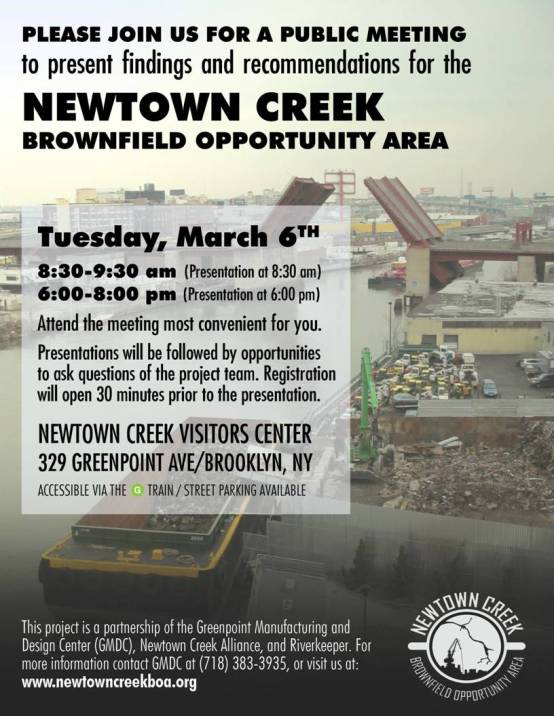
March 6th, as in tonight
Magic Lantern Show in Ridgewood

Your humble narrator will be narrating humbly on Friday, February 24th at 7:30 P.M. for the “Ridgewood Democratic Club, 60-70 Putnam Avenue, Ridgewood, NY 11385” as the “Newtown Creek Magic Lantern Show” is presented to their esteemed group. The club hosts a public meeting, with guests and neighbors welcome, and say that refreshments will be served.
The “Magic Lantern Show” is actually a slideshow, packed with informative text and graphics, wherein we approach and explore the entire Newtown Creek. Every tributary, bridge, and significant spot are examined and illustrated with photography. This virtual tour will be augmented by personal observation and recollection by yours truly, with a question and answer period following.
For those of you who might have seen it last year, the presentation has been streamlined, augmented with new views, and updated with some of the emerging stories about Newtown Creek which have been exclusively reported on at this- your Newtown Pentacle.
For more information, please contact me here.


