Posts Tagged ‘East River’
shadowed lips

– photo by Mitch Waxman
The fairly excellent Watercourses blog presents this post on Sunswick Creek, a waterbody which once existed here in Astoria, and still runs to the East River through manmade corridors deep below the modern streets. No, really. Watercourses has been down there and has photos! More importantly, the post also carries two maps from the 1870’s which show the early street plan of Astoria.
You’ll notice, on the 2nd one, a “Ridge St.” and a “Camelia St.”. The road running between them is Broadway, and at its intersection with Vernon Ave. the latter takes a wicked hook and becomes Sunswick Creek XXX (at this moment, it remains obfuscated to me whether this is a street or avenue or road, I think I can hear somebody at Greater Astoria Historic Society sighing right now).
This bit of geographic reckoning, of course, is simplified by saying- “Stevens Est.” = Costco, and that weird mouth of the creek is Socrates Sculpture Garden, and these photos were shot just beyond where that little dock shape is, between the “n” and second “s” in Sunswick. (I also wanted to send a shout out to Watercourses. Well Done!)
Whew!

– photo by Mitch Waxman
According to certain sources, two aboriginals named Shawestcont and Erramorhar (as witnessed by their cohorts Warchan and Kethcanaparan) sold much of what we know as Astoria (but which they called Sintsinck) to William Hallett (who was similarly accompanied by a company of witnesses and countrymen) on August 1, 1664- which is how the place got its name.
For a more complete view of highlights from Hallets Cove, and Sunswick Creek- check out this Newtown Pentacle post from February of 2010, and the “The Horrors of Hallet’s Cove“ from June of 2009.
The very fact that temperatures have risen once again to the point at which the atmosphere can sustain water in a liquid state, by the way, is a font of joy for your humble narrator- as walking the East River shoreline is once more possible for both man and duck. Which means that a winter’s worth of book research can finally be explored materially.
Whew!
I’ll be that weirdo in the dirty black raincoat you might spy scuttling along the waterfront…
glassy flatness

– photo by Mitch Waxman
Odd and solitary even as a child, amongst my few friends in public school was a fellow named Brian. Despite the occasional beatings he would administer to me, which long experience has taught me to expect when interacting with others, he was an amiable kid. Brian was wont to propagate an urban legend which once permeated Brooklyn, a story which goes like this (phonetically spelled, as Brooklyn patois is critical to the telling):
“So, yooz knows about de Verryzanno Bridgde, rights? When deys wuz bilding its, and pourinz de cement- workers who fell intadee cements would just sinks rights down, and dheres nuttin that could get dones to saves ’em, so’s da bahdeez are still in da bridge. My grandfather’s brudda died dat way, my Uncle Mike…”
translation:
So, you know about the Verrazano Bridge, right? When they were building it, and pouring the cement- workers who fell into the cement would just sink in, and there was nothing that could be done to save them, so the bodies are still in the Bridge… As far as the Grandfather’s brother, versions of the story told by others involved every possible male acquaintance or familial description possible.
from nycroads.com
The foundations, which support the 264,000-ton weight of both the towers and the suspended deck, as well as a design live load of 16,000 tons on the deck, were dug 105 feet below the water on the Staten Island side, and 170 feet below the water on the Brooklyn side. Conventional foundation design called for sand islands that kept water, as well as provided working and storage space. However, because the currents were swift and the ground was unstable in the area, sand islands were not constructed. Instead, “cofferdams,” or vertically interlocking steel sheet pilings, were driven below the surface to protect the caissons. Above each 13-foot-high caisson base, muck and sand were dredged out of 66 vertical concrete shafts. When the caissons reached their predetermined depth, the shafts were filled with water, and caisson tops and bottoms were sealed with concrete. The two tower piers, which contain a combined 196,500 cubic yards of concrete, were completed in less than two years at a cost of $16.5 million.
Two anchorages were then constructed at either end of the Narrows. Each anchorage stands 130 feet high, 160 feet wide and 300 feet long. However, because of the differences below ground, the Brooklyn anchorage contains 207,000 cubic yards of concrete, while the Staten Island anchorage contains only 171,000 cubic yards of concrete. On their inshore ends, they support the two decks of bridge approaches. On their outshore ends, they carry four massive, roller-mounted saddles that support, and move with, the four cables as they change length, either because of temperature changes or because of load changes. The hand-polished concrete exteriors have diagonal patterns that continue the path of the suspension cables. Inside the anchorages, forces from the suspension are transferred at two points: the front of the anchorage (where the compacted cables bend around saddles that rest on inclined steel posts), and near the heel of the anchorage (where eyebars transfer force to inclined girders buried within the concrete). The anchorages cost $18 million to construct.

– photo by Mitch Waxman
This urban legend- and yes, it is– was once omnipresent in the land of Egg Creams and really good Pizza.
So much so that it actually made it to the movies, as you’ll observe in the clip from “Saturday Night Fever” presented below, courtesy of youtube. For a great first person description of the building of the bridge, and the remembered effects of building the Brooklyn pierage in Bay Ridge- check out the inestimable Forgotten-NY’s “Bridge in the Back Yard” posting from 2003 here.
I can tell you that the old guys in Canarsie and Flatbush who worked on the thing always “beamed” a little bit when driving down the Belt Parkway toward the City and seeing it rear up.
from youtube

– photo by Mitch Waxman
Officially, there were three deaths associated with the building of the Verrazano, and the bodies were all recovered. Brooklyn legends notwithstanding, that is actually an incredible number given the size and scope of the project.
But what else would you expect from the maestro, Othmar Amman, on his final project?
from wikipedia
The bridge is owned by New York City and operated by the Triborough Bridge and Tunnel Authority, an affiliate agency of the Metropolitan Transportation Authority. Interstate 278 passes over the bridge, connecting the Staten Island Expressway with the Gowanus Expressway and the Belt Parkway. The Verrazano, along with the other three major Staten Island bridges, created a new way for commuters and travelers to reach Brooklyn, Long Island, and Manhattan by car from New Jersey.
The bridge was the last great public works project in New York City overseen by Robert Moses, the New York State Parks Commissioner and head of the Triborough Bridge and Tunnel Authority, who had long desired the bridge as a means of completing the expressway system which was itself largely the result of his efforts. The bridge was also the last project designed by Chief Engineer Othmar Ammann, who had also designed most of the other major crossings of New York City, including the George Washington Bridge, the Bayonne Bridge, the Bronx Whitestone Bridge, the Robert F. Kennedy Bridge, and the Throgs Neck Bridge. The plans to build the bridge caused considerable controversy in the neighborhood of Bay Ridge, because many families had settled in homes in the area where the bridge now stands and were forced to relocate.
a ghastly plot
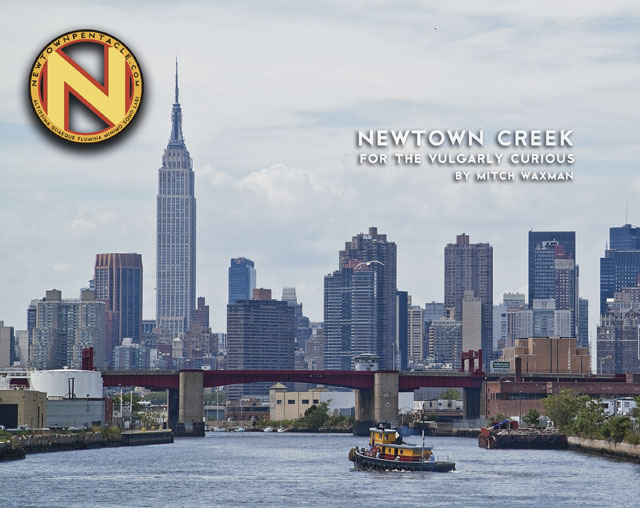
“Newtown Creek for the Vulgarly Curious” is a fully annotated 68 page, full-color journey from the mouth of Newtown Creek at the East River all the way back to the heart of darkness at English Kills, with photos and text by Mitch Waxman.
Check out the preview of the book at lulu.com, which is handling printing and order fulfillment, by clicking here.
Every book sold contributes directly to the material support and continuance of this, your Newtown Pentacle.
for silver
“Newtown Creek for the Vulgarly Curious” is a fully annotated 68 page, full-color journey from the mouth of Newtown Creek at the East River all the way back to the heart of darkness at English Kills, with photos and text by Mitch Waxman.
Check out the preview of the book at lulu.com, which is handling printing and order fulfillment, by clicking here.
Every book sold contributes directly to the material support and continuance of this, your Newtown Pentacle.
a creeping run

– photo by Mitch Waxman
Of late, when staring into the occluded depths of those waters which line the littoral rim of western Queens and north Brooklyn, ones’ fancies dwell on exactly what it might be that could be down there.
While my wild speculations and bizarre imaginings are fixed upon robotic submersibles and benthic monstrosities, the reality of those things which dwell below the sun kissed surface is vast. Great and metropolitan, the community of flora and fauna which underlies the harbor know nothing of political boundaries, and spread into every available crevice.
also from nycedc.com
Two separate but intermingled benthic invertebrate subcommunities have been identified in the East River on the basis of sediment hardness (Hazen and Sawyer 1983).
The hard substrate community is characterized by organisms that are either firmly attached to rocks and other hard objects (e.g., mussels or barnacles) or that build or live in tubes. Other species of polychaetes and amphipods also occur on the hard bottom surfaces, and several species utilize the East River’s hard bottoms and rapid currents by colonizing the abandoned tubes or shells of other species. The soft substrate community occurs in the more protected areas within the East River where detritus, clay, silt, and sand have accumulated in shallow, lower velocity areas near piers and pilings. Common soft substrate organisms include oligochaete worms, the soft-shelled clam Mya arenaria, and a variety of flatworms, nemerteans, polychaetes, and crustaceans (Hazen and Sawyer 1985).

– photo by Mitch Waxman
These creatures, which flip and flop and crawl through the contamination and filth at the bottom- a sort of natural selection is at work which will only allow those that might thrive in such a chemically complex environment to multiply and dominate their individual niches. Said niches, mind you, very well might be a sewer pipe, pier, or a masonry seawall concealing long forgotten chemical tanks and pipelines.
One wonders… Darwinian theory states that these environmentally catastrophic chemicals loosed in our waters are acting in a selective manner- weeding out the so called weak in favor of the so called strong, and if so- what might be evolving that can thrive in Benzene or other Petroleum products?
from nycedc.com
The hard substrate community is characterized by organisms that are either firmly attached to rocks and other hard objects (e.g., mussels or barnacles) or that build or live in tubes. Other species of polychaetes and amphipods also occur on the hard bottom surfaces, and several species utilize the East River’s hard bottoms and rapid currents by colonizing the abandoned tubes or shells of other species. The soft substrate community occurs in the more protected areas within the East River where detritus, clay, silt, and sand have accumulated in shallow, lower velocity areas near piers and pilings. Common soft substrate organisms include oligochaete worms, the soft-shelled clam Mya arenaria, and a variety of flatworms, nemerteans, polychaetes, and crustaceans (Hazen and Sawyer 1985).
In 2003, DSNY conducted field studies for the marine transfer station sites (MTS) as part of the environmental evaluation of the New York City Comprehensive Solid Waste Management Plan (DSNY 2005). Streblospio benedicti (oligochaete) was the most abundant infaunal macroinvertebrate collected in the bottom sediment of Newtown Creek near the Greenpoint MTS, with a density of 80,000 individuals per square meter. The dominant epifaunal macroinvertebrates included Corophium insidiosum (amphipods), Molgula manhattensis (sea grape), and Polydora species (polychaete worms), as well as hydrozoans, and mud and algal film. All of these organisms are tolerant of degraded environments.

– photo by Mitch Waxman
Will the future consider this barrage of environmental stressors- the PCB’s and VOC’s and PAH’s and TPH and all the rest- to have been an attempt at some kind of selective breeding- or will their children just take for granted whatever debased life is witnessed in the water in the same way that we think Cows and Chickens somehow resemble their progenitors?
Rapid environmental change leads to catastrophic extinction events, but the altered environment favors those who are left behind with little or no competition. Look at the odd species of chemosynthesizing bacteria that thrive around deep sea vents, or the bizarre Archaea speciations for examples of such specialization and deviation from the orthodox cycles of more wholesome life.
Who can guess what it is, that might be breeding down there, in the methanogenic waters of the cuprous Newtown Creek?
from epa.gov
EPA conducted an Expanded Site Investigation (ESI) of Newtown Creek in 2009 as part of the Hazard Ranking System scoring process for NPL listing under Superfund. Based on the ESI, which was focused on Newtown Creek itself and not its tributaries, EPA concluded that metals, volatile organic compounds, and semi-volatile organic compounds (including polycyclic aromatic hydrocarbons and polychlorinated biphenyls) were present in Creek sediments at elevated concentrations. The variety and distribution of the detected contaminants suggests that they originated from a variety of sources. Previous environmental investigations of Newtown Creek, or specific portions of the Creek, also disclosed that sediments in Newtown Creek are contaminated by a wide variety of hazardous substances. Environmental investigations of upland parcels adjacent to or nearby the Creek have disclosed contamination of those parcels by hazardous substances similar to hazardous substances found in sediments in Newtown Creek.

– photo by Mitch Waxman
Certain components of the liquid (English Kills is pictured above, but the water quality all along the Newtown Creek displays disturbingly heterogeneous qualities) found in Newtown Creek (the Anilines and Bromines in particular, but all the base analogs which might alter genetic structure are extant in the depths) are known to be mutagens.
A mutagen, incidentally, doesn’t simply give you cancer, nor does it turn you into an X-Man- it garbles genetic reproduction and causes errors to appear in DNA by chemically substituting one molecule for another. It turns “Newtown Creek” into “Newton Cweerk” as replication errors occur, and can ultimately spawn entirely new species over the course of a few generations.
Umm… mutagens also do cause cancer.
from The Eastern District of Brooklyn By Eugene L. Armbruster, via google books
BEYOND THE NEWTOWN CREEK
In the olden times the lands on both sides of Newtown Creek were most intimately connected. County lines were unknown, the creeks were dividing lines between the several plantations, for the reason that lands near a creek were taken up in preference to others, and the creeks were used in place of roads to transport the produce of the farms to the river, and thus it was made possible to reach the fort on Manhattan Island.
The territory along the Newtown Creek, as far as “Old Calvary Cemetery” and along the East River to a point about where the river is now crossed by the Queensboro bridge and following the line of the bridge past the plaza, was known as Dutch Kills. On the other side of Old Calvary was a settlement of men from New England and, therefore, named English Kills. The Dutch Kills and the English Kills, as well as the rest of the out-plantations along the East River, were settlements politically independent of each other and subject only to the Director-General and Council at Manhattan Island, but became some time later parts of the town of Newtown.

– photo by Mitch Waxman
Organochemistry is a subject I failed in high school, as my mathematic abilities are underdeveloped and weak. A layman’s understanding, however, is still able to conceive of certain possibilities and potentialities which can occur in the industrial witches brew of pharmaceuticals, sewage, and chemical pollution which swirls along the slime coating the Newtown Creek’s bed. There is 20 feet of the worst stuff imaginable down there, along with those blind things which wriggle about in the so called “Black Mayonnaise”. What will be found when the Federal authorities begin their work in earnest is enough to make me shudder.
Another disconcerting observation are the little bits of sawed bone and scraps of flesh I’ve been noticing along area pathways of late- all within 100 feet of the waterline- a new and enigmatic horror, here in the Newtown Pentacle.
from nytimes.com
Long Island City is in trouble, and fully 2,000 of her citizens are almost staring death in the face. The explanation is simple. Along the line of Jackson-avenue and Newtown Creek are several bone-boiling, fertilizer, and bad-smell factories which make no pretense of conforming to sanitary laws and regulations.


 The Newtown Pentacle