Posts Tagged ‘Long Island City’
utmost interest
It’s World Hijab Day.

– photo by Mitch Waxman
Boy oh boy, it has been a fairly depressing couple of weeks, huh?
As mentioned in the past, several of the casual friendships I enjoy at my local saloon include fellows who were Trump supporters. They’ve been forcing the rest of us to eat crow since the election, a phenomena which I’ve termed as being “sore winners.” Funny bit is, last week I was sitting alongside one of them “shooting the shit” when his phone began to light up as his union coworkers began teasing him that he’s too fat to be able to climb back in to the country over Trump’s wall. He, Mumbly Joe that is, presumed that when Mr. Trump talked about illegal aliens or those who have overstayed their visa period it was in reference to Mexicans and not Croatians. In my neighborhood, here in Astoria, back in the 1970’s when the predominant numbers of Yugoslavian and Greeks emigrated – it was far easier to get citizenship and green card paperwork fulfilled by certain distaff members of the Italian community for a fee than it was to “go through channels” with the Feds. This is also true for the Irish emigres of the 70’s and 80’s, incidentally.
As always – be careful what you ask for, as you just might get it.

– photo by Mitch Waxman
One has truly enjoyed watching Mayor de Blasio attempting to position himself as figure of national importance during all this, presenting himself as the opposition to the current administration in Washington. The Mayor of NYC is an important position, of course, but City Hall does not “get you a seat on the rocket” which will launch and preserve the lives of important people as the world is ending. It’s also been a joy comparing him to Dickens’ Jakob Marley, dragging the chains of his own perfidy and legal trouble around as he has postured on the national stage.
Speaking on a strictly local level – why are we taxpayers expected to pay the nearly twelve million bucks for the legal defense teams that will attempt to keep the “dope from Park Slope” and his cronies from paying the piper for his sins?

– photo by Mitch Waxman
It has actually been a pleasure watching the Democrats, both national and local, trying to figure out a way to attach themselves to the spontaneous and self organizing protests springing up all around them. Ever since the 1990’s, the national party has been operating in a space which – back in the 1980’s and 90’s – would have labeled them as centrist Republicans. Big business, corporatism, a deep embrace of the “forever war.”
When I’ve had labels thrown at me in the last few years – libtard, liberal, etc. – I’ve asked “What does that mean”? There hasn’t been a true liberal in the national sense since President Johnson (or just maybe Carter) and the last “actual” conservative on the Republican side was Bush the elder. Bill Clinton and Obama were actually left leaning conservatives, Bush the younger was a “radical,” and what we’ve got now… well, there isn’t a name for what Trump is yet.

– photo by Mitch Waxman
My buddies at the bar all tell me “give him a chance.”
I respond that Trump has already blown that chance, just in the first days he’s been in office. I’ve been following with great interest the early signs of factionalization amongst the National Republicans, as the actual “conservatives” are beginning to break away from the White House. One thing that’s been truly interesting to consider is the observation that Speaker of the House Paul Ryan is actually the most powerful person in the country right now, simply because it’s the Speaker of the House who holds the switch that triggers impeachment. In the meantime, Donald Trump has nuclear, biological, and chemical weapons, as well as the ability to unleash the greatest military machine in human history on anyone he wants.
The Congress hasn’t held this much actual power since the early days of the imperial Presidency back in the 1950’s, incidentally.

– photo by Mitch Waxman
That’s it for my little missive about National and Local Politics. As I’ve been saying since the election, National stuff is way above my pay grade, and I’m laser focused on local matters which directly affect me and mine. The Sunnyside Yards decking battle is coming, and the Superfund situation on a certain local waterway is about to come to a head. We are being developed to death by the Real Estate shit flies, and Western Queens is under siege by opportunists from Manhattan. There’s an Underground Railroad to set up for the Mexicans… simply put, there’s lots to do.
Bill de Blasio and his vainglory must be sent back to Park Slope, and ultimately – Carthage must be destroyed.
“follow” me on Twitter- @newtownpentacle
modern matters
It’s Street Children’s Day, in the Republic of Austria.
– photo by Mitch Waxman
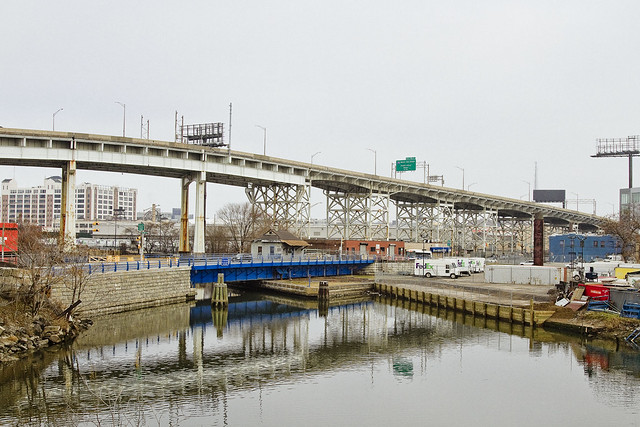
Dutch Kills, a tributary of Newtown Creek which abruptly turns north off the main channel three quarters of a mile east of the East River, is entirely contained within Long Island City. It’s crossed by five bridges – the LIRR bridges DB Cabin and Cabin M, the Borden Avenue Bridge, the Queens Midtown Expressway truss, and the Hunters Point Avenue Bridge. Dutch Kills, like all of Newtown Creek’s tributaries and the main channel itself, is lined with a toxic sediment referred to as “Black Mayonnaise.” This sediment is composed of coal tar, petroleum and refining byproducts, industrial waste of various provence and typology, as well as human excrement deposited by NYC’s open sewers.
At its northern terminus, Dutch Kills is across the street from a CUNY college and several charter schools serving high school and junior high school aged kids. One of the most significant build outs in recent real estate history is happening less than a quarter mile from that spot, along LIC’s Jackson Avenue in an area referred to as “Court Square.”

– photo by Mitch Waxman
Due to a non functioning railroad swing bridge at Dutch Kill’s junction with Newtown Creek’s main channel, there is absolutely zero maritime industrial activity along the tributary. The bulkheads along its reach generally date back about a century, to a massive “improvement” conducted around the time of the First World War which saw the marshes and swamps it fed drained and both the Sunnyside Yards and the Degnon Industrial Terminal constructed.

– photo by Mitch Waxman
The streets surrounding Dutch Kills offer fleeting glimpses of the waterway, and many of them are not City streets at all but “railroad access roads” owned by the MTA. You can almost always smell the waterway before you can see it, and whereas I can tell you a few spots to access the water, none of these are “legal” and all involve trespass of private or government property. You can legally observe it from the Borden Avenue or Hunters Point Avenue bridges, however.
At it’s terminus – or “turning basin,” there are two abandoned oil barges rusting and rotting away into the water.

– photo by Mitch Waxman
Illegal dumping, the native art form of the Borough of Queens, is practiced hereabouts with relish and abandon. The DSNY garbage bin in the shot above appeared on 29th street back in November, and I’ve been watching it steadily fill up and overflow. DSNY doesn’t seem to remember where they put it, as I haven’t seen it empty since the day it arrived.

– photo by Mitch Waxman
Amidst the sheens of oil and grease you’ll observe on Dutch Kills, which are both historic and newly spawned, there are what the NYC DEP would describe as “floatables.” That’s government code for garbage that’s either been flushed or has been swept into the sewer grates on every street corner in NYC. In the case of Dutch Kills, the “sewer shed” that feeds these floatables into it extends all the way to East Elmhurst and Woodside to the east, Sunnyside and Astoria to the north, and the rapidly growing Long Island City which Dutch Kills is a part of.
The sewer plant that handles this burgeoning area was opened in 1931, and Fiorello LaGuardia cut the ribbon to open it.

– photo by Mitch Waxman
There is going to be a meeting tomorrow, the latest of many, of the Newtown Creek Community Advisory Group (CAG) on the first of February. If the shot above looks good to you, and you’d like to see more of the same – don’t come. If you care about not having a billion and a half gallons of raw sewage a year spilling onto mounds of poisonous and century old industrial waste, do come. Pipe up, we need voices and perspectives from outside the echo chamber.
Details on the meeting – time, place, etc. – can be accessed at this link. We could really use some Queensican bodies and voices in the room.

– photo by Mitch Waxman
As evinced by the corpse pictured above, life has actually begun to recolonize this waterway in recent years. The presence of higher mammals hereabouts speaks to an ecosystem that is beginning to recover from centuries of industrial and municipal abuse. Of course, nothing is going to save a raccoon from getting ground into hamburger by the wheels of a semi truck.
At Newtown Creek Alliance, we’ve been cataloging and observing for a while now. There’s more than seventy individual species of birds for instance – including Great Blue Herons and Ospreys – living along the lugubrious Newtown Creek. Their presence speaks to a growing population of prey animals (fish) present in the water column, and to a broader environmental recovery happening along this industrial waterway at the literal center of NYC.
“follow” me on Twitter- @newtownpentacle
open window
It’s National Police Day in the Arab Republic of Egypt.

– photo by Mitch Waxman
Continuing a wintry night time walk to Brooklyn, one prepared to surmount the Pulaski Bridge over Newtown Creek. As you’d imagine, one spends quite a bit of his time walking back and forth over this crossing. Not only does the bridge rise to a fairly high altitude which allows for spectacular views of Newtown Creek, East River, and the skyline of the Shining City of Manhattan – the Pulaski Bridge walk is actually pretty good cardio.

– photo by Mitch Waxman
Mentioned in yesterday’s post was the fact that I was employing my “night kit” lenses. Longtime and frequent commenter Georgtheatheist inquired as to the specifics of my kit, and wondered why I carried both the Sigma 50-100mm f 1.8 and a Canon 50mm f 1.8, given that they replicate each other’s range. Accordingly, I’m “lifting the hood” on today’s post, and talking a little bit about how the engine runs here at your Newtown Pentacle.
Short answer is this – the Sigma lens is BIG, and incredibly heavy. Being a large lens, it gathers a lot of attention to itself, which can be problematic when encountering baser members of the street population – that’s part of it. The other is purely ergonomic – as mentioned above it’s quite heavy, and gets in the way when I’m walking along at my usual brisk pace. George asked why I don’t just use an “extender” on the 50mm prime lens, and part of the answer is that I’d have to sacrifice some of the light gathering wide apertures of the lens if I did. The other is that I’ve timed myself and I can do a lens swap, from in the bag to triggering the shutter, in around 15-20 seconds.
There’s also a difference in the esthetic quality and rendering of the shots, as captured by the individual pieces of glass. The first shot in today’s post was captured using the aforementioned 50-100, while the one above was gathered using a wider angle Sigma lens – the 18-35 f 1.8. The one below is from the Canon 50mm. There are minor differences in exposure times on them, but shots 2 & 3 are within 1/75th of a second of each other, with identical ISO sensitivity and aperture. Just because two lenses have the same specifications doesn’t mean that the shots gathered with them look the same.

– photo by Mitch Waxman
The whole point of what I’ve been working on for a while now is to capture a reasonable amount of image fidelity and quality in low light situations without using camera supports like a tripod. These are all hand held shots, gathered in the same manner which I would employ when the burning thermonuclear eye of God itself is bobbing around in the vault of the sky.
That “manner” is basically me walking along and saying “wow, look at that.”

– photo by Mitch Waxman
Where things get weird with this whole night shooting business is in an area described as “color temperature.” The new LED luminaire heads that NYC DOT has been installing around NYC throw off a bluish light that’s officially “4300 Kelvin” but which the camera will render as orange if you set it to that. In Canon camera world, that 4300K is best reset to about 3100K. If you’re in an area which has a monotypical series of these LED’s, the developing scenario is simple.
It’s when you see the old school sodium lamps on the same street as the LED’s that things go “ass over tits.” Check out the blue LED light meeting the orange sodium lamps in Greenpoint’s DUPBO – Down Under the Pulaski Bridge Onramp.

– photo by Mitch Waxman
A digital image is composed of three “plates” which mix and form a color image. RGB as the color space is known, the Red and Green plates are supplying most of the color information to the image above, and the Blue is where the shadows are being formed. Because of the orange sodium light mixing with the “Pulaski Red” paint color of the bridge, when this image came off my camera card it was practically flourescent.
A problem inherent with high ISO images, this one is 6400, is image noise. It’s produced by the sensor itself during the gathering process, and most of it manifests on the red and green plates. Finding the right balance between color temperature at the time of capture versus the time of developing the digital negative – or RAW format – file is important. Beyond the technical stuff, it’s also important to remember what the subject actually looked like while you were shooting.

– photo by Mitch Waxman
The shot above, depicting a NYC DOT truck parked under the Pulaski, was a difficult one. It’s a yellow truck, bathed in orange sodium light, with blue LED street lights peeking in from behind the fences. The original RAW file was basically a study in orange and black. The color temperature was adjusted down, as was saturation and half a dozen other developing options.
Back tomorrow with something completely different, at this – your Newtown Pentacle.
“follow” me on Twitter- @newtownpentacle
displayed during
It’s National Peanut Butter day, here in these United States.

– photo by Mitch Waxman
Occasion carried me towards Brooklyn recently, at a chronological interval during which the burning thermonuclear eye of God itself had already dipped behind the mysteries of New Jersey. Accordingly, I packed up my “night kit” and headed south from “Point A” in Astoria and down to the flood plains of Williamsburg in Brooklyn.
My night kit, as previously mentioned, are my two Sigma zoom lenses – the 50-100 f1.8, and 18-35 f1.8, as well as a trusty Canon “nifty fifty” 50mm f1.8 prime lens.

– photo by Mitch Waxman
My path was simply scouted. Heading south along Steinway and across the “Carridor” of Northen Blvd., west on Skillman and then south to the Pulaski Bridge, across Newtown Creek, then west on Greenpoint’s Franklin Avenue, and then south to my destination on Williamsburg’s north side near Berry street.
This somewhat photogenic route resulted in the crossing of wonders and landmarks like the Sunnyside Yards, the Skillman Avenue Corridor, and the legendary Newtown Creek. I could have just taken the train, but then you don’t get to see the wonders of Western Queens and North Brooklyn on your way.

– photo by Mitch Waxman
Couldn’t help but utilize one of the many “holes in the fence” at Sunnyside Yards which I’ve mapped and catalogued over the years ,and grabbing some shots of a passing rush hour Long Island Railroad unit heading towards Woodside and points further to the east. Gotta love the interlockings, I always say.

– photo by Mitch Waxman
One turned right (or west) onto the Skillman Avenue corridor, and the incredible horizon of rampant gentrification it displays. In pre industrial times, just a block or two away, you’d have been able to visit a “pest house” where suffers of contagious diseases were quarantined and left to die by their loved ones.

– photo by Mitch Waxman
Skillman Avenue took me to Queens Plaza, where one crossed under the tracks of the 7 Line and across one of the worst pedestrian intersections in all of NYC. Drivers here exhibit the same sort of behavior as stampeding cattle in this spot, moving from the feedlot to the abattoir.

– photo by Mitch Waxman
In my opinion, should the large scale decking of the Sunnyside Yards, as proposed by our Mayor – the Dope from Park Slope – happens, it will encompass the area pictured above will be first, an acreage which spans the area between Thomson Avenue and Queens Plaza. There’s a triangular section found at Jackson Avenue and 21st street which will happen initially, but that will merely be an air raid siren signaling the coming of the Luftwaffe over London. This is where the blitzkrieg will happen.

– photo by Mitch Waxman
Once the “Subway Building,” which housed both the offices of the Borough President of Queens and those of master builder Michael Degnon, the Paragon Oil building is being converted from a documents storage building over to office space as you read this. This seems to be “stage 2” of the LIC buildout, the construction and conversion of former industrial buildings over to commercial – rather than residential – usage.

– photo by Mitch Waxman
The Subway Building overlooks the Hunters Point Avenue stop of the LIRR, and sits astride the Hunters Point stop of the IRT Flushing – or “7” – line. The LIRR station is criminally underused by the MTA, IMHO.
“follow” me on Twitter- @newtownpentacle
future freedom
It’s Revolution and Youth Day, in the nation of Tunisia.

– photo by Mitch Waxman
Another day in Calvary, another dead New York City Irishman who changed the world.
During the period between the Civil and First World Wars, the well fed Upper Classes began to comment on the physical degeneracy of the Working Class. Back then, it was expected for an employee to labor 16 hours a day for six days a week. Sunday morning was for Church, but Sunday afternoons saw huge numbers filing into saloons and bars and getting hammered on Liquor. Government wise, it’s the reason why the so called “blue laws” were passed – banning the sale of alcohol on Sundays, but there’s always a way to find a drink (or Heroin, in the modern sense). The working class exhibited horrible levels of physical fitness back then – I guess something about having been a starving peasant who survived a transatlantic journey in steerage and now working sixteen hour shifts in some hellish fertilizer mill or sugar plant, being exposed to every conceivable industrial poison and darting amongst dangerous machines with zero safeguard… it wears you down. The tenement life, with its disease, crowding, poor quality food and water probably didn’t help either.
Across the industrial world, team sports and “physical culture” were created and encouraged, and modern day sports like Baseball and “track and field” promulgated to the unwashed. All roads lead to Calvary, of course, but the general idea was that by getting a bit of exercise – the road to the grave could be lengthened. The creation of the modern Olympic Games were a part of this physical culture movement. You couldn’t work in a factory if you could barely stand up, after all, so the famously sober Captains of Industry supported this burgeoning movement. After all – a well muscled employee can probably do the work of two and spare you a payroll expense.

– photo by Mitch Waxman
Amateur Athletic Associations were formed, with the goal of toughening up the working class and getting them to lower the shot glass in the name of hurling a javelin, or sprinting a hundred yards, or tossing a ball around. Knowing that the fathers of America’s working class were already ruined, the organizers of this new physical culture movement decided to focus in on the sons. The fathers mainly became interested in “athletics” when they realized a new excuse to bet and gamble had appeared that wasn’t as “fixable” or rigged by the Upper Classes (like betting on the horses), but there you go.
In New York City, the Public Schools Athletic Committee was formed, and was headed by a fellow named James E. Sullivan.
Native to New York City, James E. Sullivan lived his entire life in what would be considered southern Harlem today, and his last address was found on 114th street. He was the assistant director of the American team sent to the 1900 Olympic Games in Paris, and Secretary for the American team at the 1904-1912 games in St. Louis, London, and Stockholm. Sullivan was everywhere in the 19th century United States that an athletics competition was underway, and served NYC’s “Metropolitan Association of the Amateur Athletic Union” in various functions on its board of directors for thirty four years. Sullivan’s professional life was in the publishing field, and he was the founder and publisher of “The Athletic News.”
James E. Sullivan wasn’t just successful in life, he was adored by all the right people. He was honored by and appointed to various National roles by Presidents McKinley, Teddy Roosevelt, and Taft. The Kings of Greece and Sweden both decorated him, and honored him with feudal associations in Europe (specifically the Golden Cross of the Knights of the Saviour).
That’s his grave in LIC’s Calvary Cemetery above, and when his funeral cortège was moving from there (Roman Catholic Church of St. Aloyslus, at 132d Street and Seventh Avenue) to here at Calvary, the road was lined with 60,000 schoolboys mourning his passing – according to the NY Times.

– photo by Mitch Waxman
James E. Sullivan died on a surgeons table in Manhattan’s Mt. Sinai Hospital at 11 a.m., on the 16th of September in 1914. He was being treated for an intestinal condition. Sullivan had been ill since surviving a train wreck in 1911, over in Fort Wayne, Indiana.
Inscribed with a white bronze plaque, the monument is dedicated to “James Edward Sullivan, born Nov. 18, 1862 and passed on Sept. 16, 1914. A second carving lists Margaret Eugenia Sullivan, born July 26, 1856 and died July 16, 1923.”
The plaque’s inscription reads “A tribute from the Metropolitan Association of the Amateur Athletic Union.”

– photo by Mitch Waxman

– photo via Wikipedia, click it for their page on James E. Sullivan.
You never know who, or what you’re going to find at Calvary Cemetery in LIC’s Blissville neighborhood. It’s a history book written in marble and bronze, found along the banks of the lamentable Newtown Creek in the borough of Queens.
Tomorrow, something completely different – at this, your Newtown Pentacle.
“follow” me on Twitter- @newtownpentacle


 The Newtown Pentacle