Posts Tagged ‘New York City’
uncanny library
It’s National Breadstick Day, in these United States.

– photo by Mitch Waxman
Pictured above is an example of the ultimate reason as to why the proposed BQX trolley line is infeasible, what with the blinking signal arm barriers and the train horn blowing – which rail is required to do at grade crossings such as the Borden Avenue location adjoining the Pulaksi Bridge and Queens Midtown Tunnel pictured above in LIC. One doesn’t want to deep dive on that topic today, however, as thinking about the Mayor depresses me and I don’t want to be “blue.”
A humble narrator was on his way to a “thing” in LIC when this train began to move across Borden Avenue, an occurrence which caused him to utter something which sounded like “squeeeee,” drop to one knee in the middle of the street, and laugh maniacally while waving the camera around.

– photo by Mitch Waxman
The Long Island Railroad uses their nearby Hunters Point Yard to stage train sets for rush hour duty, and the tracks lead across Borden Avenue over to the Hunters Point Avenue stop at the southern extant of the Sunnyside Yards. From there, the trains head into the City and Penn Station, before heading out to Woodside, Jamaica, and then Long Island.
At least, that’s what I think happens. I’m not a rider of the LIRR except for rare occasion, and mainly I just like taking pictures of trains moving around in crowded urban settings.

– photo by Mitch Waxman
Now that tour season is just about over, and my weekends are my own again, plans for how to spend my time are being laid. I’ve got more than a few things to shoot on my list, which I can’t tell you how much I’m looking forward to.
It really bakes my muffins when I don’t get to regularly wave the camera around at cool things, and despite the amazing places I’ve been this summer, I’ve generally been the tour guide or if onboard a vessel – on the mike – and I’ve barely been able to “do my thing.” I’ll sneak the occasional photo in when conducting a tour, but it’s a snapshot, not a photograph (there’s a difference).

– photo by Mitch Waxman
Good news is that the weather is finally in the “filthy black raincoat” range of temperatures, and since I don’t have to maintain my summertime “early bird” schedule quite as stringently – late night shooting is back on the menu.
Where will I go first? Things to do, things to see, people to avoid – here in the great metropolitan city…
Upcoming Tours and events
Exploring Long Island City, from Luxury Waterfront to Abandoned Factories Walking Tour,
with NY Adventure Club – Sunday, November 12th, 2:30 p.m. – 4:30 p.m.
Long Island City is a tale of two cities; one filled with glittering water-front skyscrapers and manicured parks, and the other, a highly active ground transportation & distribution zone vital to the New York economy — which will prevail? With Newtown Creek Alliance Historian Mitch Waxman – details here.
“follow” me on Twitter- @newtownpentacle
furtive fragments
It’s National Greasy Foods Day, in these United States.

– photo by Mitch Waxman
Working Harbor Committee, a non profit whose mission is “to educate the public about the Harbor and New York and New Jersey” and which a humble narrator is both the official photographer for and a member of the organization’s steering committee, called a meeting recently. We had some organizational business to conduct, voting on Board members and other nitty gritty at an annual meeting.
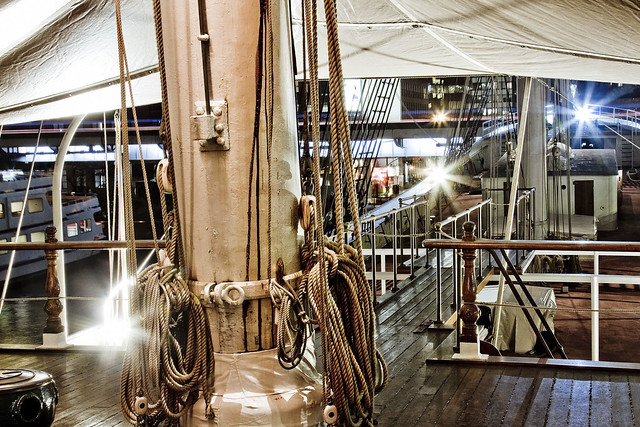
Instead of some banal office, however, this time our annual gathering occurred at the South Street Seaport Museum’s Wavertree. a historic sailing vessel which dates back to 1885 and which is the flagship for the museum.

– photo by Mitch Waxman
It should be mentioned that a humble narrator isn’t possessed of the same sense of wonder and excitement that some of my cohorts at WHC are when the subject of sailing vessels comes up, but it was pretty cool to be able to visit an artifact of the “forest of masts” era on NY Harbor.
The Wavertree recently spent some time at Cadell’s shipyard on Staten Island, wherein the old girl received expert attention and refitting. The renovations and so on are still ongoing.

– photo by Mitch Waxman
There are just a few historic ships in NY Harbor, with the South Street Seaport museum hosting the majority. Given NYC’s predilection towards annihilating anything older than a few decades old whether terrestrial or maritime, the presence of Wavertree in Lower Manhattan is a not insignificant thing.

– photo by Mitch Waxman
This shot, and the following, are tripod shots captured from onboard the ship itself. The far background in them will appear a bit blurry, as Wavertree was bobbing about a bit in the tide. It was interesting, from a behind the camera POV, to have the fixed point in my focal zone set for the ship I’m on rather then some thing which is off in the distance – the opposite of what I normally do when onboard a vessel.

– photo by Mitch Waxman
That’s some complicated rigging up there, and I joked around with one of my WHC pals about him going all “Burt Lancaster” and swinging around on the ropes. My pal assured me that he was not going to go all “Burt Lancaster.”

– photo by Mitch Waxman
From the quarterdeck looking across the East River towards Brooklyn.
– photo by Mitch Waxman
Also from the quarterdeck, and looking west towards Manhattan.
Upcoming Tours and events
Exploring Long Island City, from Luxury Waterfront to Abandoned Factories Walking Tour,
with NY Adventure Club – Sunday, November 12th, 2:30 p.m. – 4:30 p.m.
Long Island City is a tale of two cities; one filled with glittering water-front skyscrapers and manicured parks, and the other, a highly active ground transportation & distribution zone vital to the New York economy — which will prevail? With Newtown Creek Alliance Historian Mitch Waxman – details here.
“follow” me on Twitter- @newtownpentacle
excite attention
It’s National Bologna Day, in these United States.

– photo by Mitch Waxman
For many reasons, a humble narrator has found himself at Hallets Cove along the Astoria waterfront in recent weeks. Partially, this recent focus was related to a humble narrator being invited to write a guest blog for the NYC Ferry service’s new Astoria stop (check it out here), but didn’t go “super granular” with it in my usual manner. Something I learned while writing my old Brownstoner Queens column was sometimes you need to approach a story, and a more general audience, with a different voice than you normally would (the NYC Ferry is operated by the Hornblower company, under the auspices of the NYC EDC, in case you’re wondering).
The other reason I’ve been down at Hallets Cove a lot in recent weeks has been to actually use the Ferry to get to and from work, as the MTA has seemingly deduced that nobody in Queens needs to get to and from Manhattan on the weekends. Luckily, my destination for conducting boat tours is Pier 11, which is one of the terminal stops for the ferry, so problem solved.

– photo by Mitch Waxman
The kids of Queens never disappoint, as evinced by these phalluses recently scratched into the sand at Hallets Cove. There’s actually a lot of fine detail to appreciate in these, from the spurts to the hairy sacks. Good show.
As a note, I know of just three sandy beaches along the East River, Hallets Cove being one.

– photo by Mitch Waxman
The future site of a floating “Eco Dock” as my pals from the Waterfront Alliance call it, one has long been fascinated by the muddy flats underlying a discarded pier found at the entrance to the NYCHA Astoria Houses on what is historically known as Lawrence Point, but which has been rechristened as “Astoria Point” by real estate interests and elected officialdom alike.
This sort of marshy area is immensely important to the ecology of the waters surrounding NYC, as my pals from Riverkeeper will tell you, and you don’t see very much of it.

– photo by Mitch Waxman
There’s a derelict pier overflying those muddy flats, which as mentioned, will be replaced with an eco dock. My understanding is that the pier was installed to support a radio station’s broadcast tower, specifically WLIB, back in 1953. Further, I’m told that the radio station abandoned this location in 1967, and that the structure has been feral ever since.

– photo by Mitch Waxman
If you haven’t tried out the new ferry service leaving from Astoria yet, I recommend it for nothing other than seeing the sights. The route carries you along the east channel of the East River, which transits between the Ravenswood section of Long Island City and Roosevelt Island. You’ve got some pretty incredible stuff along the route, including both the Roosevelt Island Lift bridge and the amazing Queensboro bridge, and the Big Allis power plant is on display as well.
This particular ferry service makes an amended series of stops as compared to the longer tenanted East River route, stopping first at Roosevelt Island, then the northern ferry stop at Hunters Point, 34th street and then Pier 11/Wall Street in Manhattan. Im personally really looking forward to the upcoming Soundview route, opening in 2018, which will go to the southeastern Bronx – which is the unknown country for one such as myself.
Check the Astoria ferry out, what else have you got to do?
Upcoming Tours and events
Exploring Long Island City, from Luxury Waterfront to Abandoned Factories Walking Tour,
with NY Adventure Club – Sunday, November 12th, 2:30 p.m. – 4:30 p.m.
Long Island City is a tale of two cities; one filled with glittering water-front skyscrapers and manicured parks, and the other, a highly active ground transportation & distribution zone vital to the New York economy — which will prevail? With Newtown Creek Alliance Historian Mitch Waxman – details here.
“follow” me on Twitter- @newtownpentacle
quiet removal
It’s National Boston Creme Pie Day, in these United States.

– photo by Mitch Waxman
If you want to know what the end of the world looks like, I can take you there. It’s about 3.8 miles from the East River, in an area of Brooklyn that is clearly Bushwick but which the real estate people refer to as East Williamburg. The end of the world is surrounded by heavy industry and waste transfer stations, and is crossed by a railroad bridge. It’s defined by a waterbody called English Kills, which is a dead end tributary of the fabulous Newtown Creek.
Just last week, a visit was paid to this paradise of nihilism.

– photo by Mitch Waxman
The open sewers are just one of the apocalyptic factors back here, as is the enormous waste transfer station operated by a transnational conglomerate that handles about a third of the black bag (or putrescent) garbage collected by the Department of Sanitation. There is virtually zero laminar flow to the water here, which means that the rising and falling of the tide is a vertical affair rather than a horizontal one, creating stinking shoals along the banks and allowing sediment mounds to rise from the channel. It often smells like rubber cement thinner along this stretch of English Kills, the waters are greasy, and they commonly exhibit an uncommon and unnatural coloration highlighted by patches of weird iridescence.
Men and women seem to become possessed by the spirit of the place, wildly dumping garbage into the shallows with a gleeful abandon.

– photo by Mitch Waxman
References in the historical record refer to distinct periods in English Kills’ existential course. Once, a mostly fresh water stream fed by the springs and streams of a Bushwick that drew German beer Brewers to the area, which bled sweet water into the main body of Newtown Creek, just a decade after the American Civil War English Kills began to be described as the “industrial canals of Brooklyn.” By the time that the Army Corps of Engineers oversaw the WW1 era shaping of the Newtown Creek watershed into something we would recognize on a google map in modernity, English Kills had open pipes carrying industrial and chemical waste products into the water from acid factories and the other dirty industries surrounding it. The upland springs and steams which drew the brewers here were paved over or turned into sewers, and the only naturally occurring liquid entering the narrow channel afterwards was a tepid trickle of brackish East River water (which was itself terribly compromised) weakly pulsing in with the daily tide, or storm runoff from the streets.
Brooklyn legend suggests this area was used as a graveyard by mobsters, but that’s just a legend. Gangsters dump bodies into fast moving or oceanic water bodies like Jamaica Bay or the Hudson River. The idea is to get rid of the evidence, not to leave something incriminating in a place where it can be found.
Whatever enters English Kills stays in English Kills.

– photo by Mitch Waxman
The structure pictured above is the Montrose Avenue Railroad Bridge, part of the Bushwick Branch lead tracks of the Long Island Ralroad. The bridge, and adjacent fencelines, are covered in odd graffiti which is in English but drawn with characters that betray a runic influence. The screeds warn of witches and other mythological creatures.
This is what the end of the world looks like, if… like me… the borders of your world are defined and bisected by that lugubrious ribbon of urban neglect known as the Newtown Creek.
Upcoming Tours and events
Exploring Long Island City, from Luxury Waterfront to Abandoned Factories Walking Tour,
with NY Adventure Club – Sunday, November 12th, 2:30 p.m. – 4:30 p.m.
Long Island City is a tale of two cities; one filled with glittering water-front skyscrapers and manicured parks, and the other, a highly active ground transportation & distribution zone vital to the New York economy — which will prevail? With Newtown Creek Alliance Historian Mitch Waxman – details here.
“follow” me on Twitter- @newtownpentacle
doomed intuitions
It’s National Chocolate Cupcake Day, in these United States.

– photo by Mitch Waxman
Legend has it that on one particular evening Mose the Fireboy, who was the legendary “sachem” and hero of the Bowery B’hoys gang in 19th century NYC, heard that a sea serpent had appeared on the East River. Mose, a giant whose legends are similar to those of the gargantuan lumberjack Paul Bunyan, rowed out onto the river and plucked the leviathan from the water with his bare hands. Strangling the monster in his iron grip, Mose then skinned the great beast and brought his prize to McGurk’s Suicide Parlor – a bar formerly found on the west side of the Bowery, nearby Cooper Square at east 4th street. It’s said that the skin hung over the bar afterwards, as a totem of the mysteries of the harbor and testament to the great strength and power of Mose. Mose supposedly could extinguish blazes by clapping his hands and was known to smoke three cigars at the same time. If his horse wasn’t pulling the fire wagon fast enough, Mose would pick up the horse in one hand and the wagon in the other and carry them. Mose the fireboy was apparently quite a fellow, so much so that he was a regular character appearing in Bowery theater productions centered around “life in our town.”
The largest known specie of eel, incidentally, is the European Conger, which is known to grow to lengths of nearly ten feet and achieve body weights of up to 240 pounds. They’re native to the eastern Atlantic Ocean and tend towards the European coastline. They’re carnivorous, feeding on all sorts of deep sea critters, and have been found at depths of up to 3,840 feet. The American Eel is a relative dwarf in comparison, achieving lengths of up to 4 feet and body weights of up to 17 pounds.

– photo by Mitch Waxman
The largest living crab, and largest arthropod as well, is the Japanese Spider Crab. Large specimens can spread their clawed arms out to span 18 feet, and they can weigh as much as 42 pounds. Closer to home, the American Lobster (Homarus americanus) is known to achieve weights of 44 pounds and body lengths of two feet – excluding their claws. Both are members of the Malacostraca class of crustaceans, whose ancestors first appear in the fossil record during the Cambrian age. All sorts of large marine animals are spotted in the East River from time to time – including cetaceans like Whales and Dolphins, large bony fish and living fossils like the Sturgeon, and occasionally sea turtles.
The leatherback sea turtle is the largest extant turtle and fourth largest living reptile, and can be found in nearly all of the world’s ocean waters. Leatherbacks can grow to nearly seven feet in length and achieve body weights of up to 2,000 pounds. Sea Turtle ancestry dates back to the Triassic age.

– photo by Mitch Waxman
In 1895, the NY Times offered reports of a sea serpent of more than 100 feet in length moving quickly through New York Harbor about a half mile from shore. According to the testimony of one Willard P. Shaw of Wall Street, it repeatedly raised its head out of the water more than ten feet above the waves. Shaw’s story was confirmed by other witnesses.
This sounds like the sort of thing we would need Mose the Fireboy to handle.
Who can guess, all there is, that might be sloshing and swimming around down there?
“follow” me on Twitter- @newtownpentacle


