Posts Tagged ‘newtown creek’
with an atomic, or molecular, motion

– photo by Mitch Waxman
Another interesting event set to occur on May 21st, which has been scheduled against my Newtown Creek Cruise- I would add, seems to be the apocalypse.
On my way to a meeting at Greater Astoria Historical Society on Sunday, the purpose of which was to discuss the upcoming Forgotten-NY tour of Staten Island’s Livingston neighborhood, I came across this pamphleteer who was proselytizing passers by to prepare for the coming tribulation and offering advice for making it through the end times which are meant to begin on a specific date not far in the future.
from wikipedia
The 2011 end times prediction is a prediction made by Christian preacher Harold Camping that the Rapture (in Christian belief, the taking up into heaven of God’s elect people) will take place on May 21, 2011 and that the end of the world as we know it will take place five months later on October 21, 2011. These predictions were made by Camping, president of the Family Radio Christian network, who claims the Bible as his source. Believers claim that around 200 million people (approximately 3% of the world’s population) will be raptured.

– photo by Mitch Waxman
This sort of millennialist doom saying is nothing new, remember the UFO people in California, the Branch Davidians in Texas, and the Solar Temple cult in Switzerland, just to refresh somewhat recent memories.
At the turn of the last century, one needed to have looked no further than the so called Millerites to find the originators of this sort of proclamation.
from wikipedia
The Great Disappointment was a major event in the history of the Millerite movement, a 19th century American Christian sect that formed out of the Second Great Awakening. William Miller, a Baptist preacher, proposed based on his interpretations of the prophecies in the book of Daniel (Chapters 8 and 9, especially Dan. 8:14 “Unto two thousand and three hundred days; then shall the sanctuary be cleansed”), that Jesus Christ would return to the earth during the year 1844. A more specific date, that of October 22, 1844, was preached by Samuel S. Snow. Although thousands of followers, some of whom had given away all of their possessions, waited expectantly, Jesus did not appear as expected on the appointed day and as a result October 22, 1844, became known as the Great Disappointment.

– photo by Mitch Waxman
Your humble narrator would hope that if the world does indeed end on the 21st of May, that you can enjoy the view of Manhattan disintegrating from those vantage points which the scenic waters of Newtown Creek offer with me. Destruction not withstanding, there is still a heck of a lot to see.
Assuming that some multi headed dragoness isn’t raining brimstone down upon us by then, I would also remind you of a Magic Lantern Show on the subject of Newtown Creek I’ll be presenting at the aforementioned Greater Astoria Historical Society on June 6th ($5- cheep).
May 21st

– photo by Mitch Waxman
The show must go on, as they say, yet your humble narrator is of heavy heart in announcing the Newtown Creek tour of May 21st, 2011- which is offered for your consideration by the Working Harbor Committee.
It is not the task of course, which tempers the normal ebullience experienced when an opportunity to share the wonders of the Newtown Creek with a group of enthusiasts from the comfort and safety of a modern vessel like the MV American Princess (which is outfitted with all the amenities one would expect to find during a harbor trip in a tourist Mecca such as New York City), crosses my path.
It is not that unnatural and uncontrollable timorousness which plagues me when I am asked to speak before “this group of pale enthusiasts” or “that gang of antiquarians”. Revealing and sharing the history of this amazing place is one the things I revel in, and brings me close to understanding what joy must be like.
from workingharbor.com
Visit Beautiful Newtown Creek Saturday, May 21, 2011
On MV American Princess, Boat departs from Pier 17, South Street Seaport, Manhattan NYC, 10am – 1pm
Souvenir Tour Brochure with historical information and vintage maps. Narration by experienced historical and environmental guest speakers. Complimentary soft drinks will be served. Come aboard for an intense Newtown Creek exploration! Our comfortable charter boat will travel the length of Newtown Creek. The tour will pause at many interesting locations for narration and discussion. Guest narrators will cover historical, environmental, and conservation issues. Large comfortable vessel with indoor & outdoor seating. Cruise runs rain or shine. Price: $60
To purchase tickets click here
or contact Tour Chairman Mitch Waxman: waxmanstudio(AT)gmail.com

– photo by Mitch Waxman
This is where the Industrial Revolution happened, and this trip will transverse and offer certain observations about the Newtown Creek’s present form and usage, and reveal a potentially bright future which this neglected ribbon of water- which provides the currently undefended border of Brooklyn and Queens- were it to be revitalized and renewed, might offer the future.
After boarding at South Street seaport, Working Harbor’s maritime experts will discuss the waterfront of Brooklyn as we pass beneath the Brooklyn Bridge and Manhattan Bridge, and finally passing under the Willamsburg Bridge. Our vessel will smoothly move past the neighborhoods of Dumbo, Williamsburg, and Greenpoint in Brooklyn, and offer spectacular views of Manhattan. This entire trip will be a photographer’s delight, incidentally, offering spectacular and unreal urban panoramas.

– photo by Mitch Waxman
At Long Island City, your humble narrator will presume to expose you to a short history of the Newtown Creek, and offer an identity to some of the enigmatic structures arrayed around the troubled industrial waterway.
Luckily for all concerned, there are other speakers who will relieve the crowd from my droning prattle, maritime experts and environmentalists included. Around Newtown Creek Alliance headquarters, there is some buzz amongst the staff about which one of the heavyweight orators will be onboard.
Soft drinks, one to a customer, will be complimentary as well.

– photo by Mitch Waxman
The American Princess will proceed past the titan Newtown Creek Waste Water Treatment Plant, the malign Dutch Kills, the cyclopean SimsMetal dock, the brutal symmetry of the Greenpoint Avenue Bridge, through the agglutinated heart of the Greenpoint Oil Spill, past the severed Penny Bridge at Meeker Avenue, and beyond the emerald devastations of Calvary Cemetery.
Then, we’re going to take a moment to remember our fallen friend… for just a moment.
I’m hesitant to mention this… as this is not what this trip is meant to be about, this is not a memorial event… but Bernie Ente is and will be so profoundly missed by many of us who will be conducting this tour, of which he is the originator and founder of… it would be in bad taste if a moment of silence to remember him, in this place which he expended so much of his attentions revealing and teaching and guiding about, were not offered. More on this in a later posting, but as the initial line says “the show must go on”, and that is exactly what Bernie would have us do.

– photo by Mitch Waxman
The course will continue, past the middle point of the Newtown Creek, and will plunge past the Maspeth Plank road, past the Phelps Dodge site and the Kosciusko Bridge. At the branching of the Newtown Creek which exists at the confluence of the East Branch and English Kills, we will witness the remains of the Maspeth Plank Road and approach the wicked end of the navigable section of the Newtown Creek itself and approach one the hydra like tributaries which spread languishing tendrils of rotting bulkheads and unused yet prime industrial waterfront locations all across Brooklyn and Queens.
This is not the world you know.

– photo by Mitch Waxman
Witness the startling elegance of the Grand Street Bridge, a century old swing bridge connecting Brooklyn and Queens, which signals the entrance to English Kills has been reached. Industrial heartland, this is a grossly contaminated section of the waterway which has- of course- been designated as a Federal Superfund site. Seeing the Newtown Creek in this state, this bizarre half life which is neither tick nor tock- industrial nor residential, is a fairly short term proposition.
Vast changes are coming which will literally alter the very landscape.

– photo by Mitch Waxman
The Kosciusko Bridge replacement, and the enormous new populations and residential conversion in progress and expected in Hunters Point South and Greenpoint, and the EPA conducting the initial stages of Superfund remediation (which will involve dredging and vast public works projects conducted by hundreds of contractors) will all be happening in roughly the same timeframe. Ten years from now, it will hard to recognize the place, and twenty more will render it a stranger to those who know it today.
In the English Kills, you will become transfixed by a waterfront frozen in some other century, and witness the extant vitality of those economies of heavy industry which build, and drain, and recycle, and dispose of. You don’t get Manhattan without a Newtown Creek, after all.

– photo by Mitch Waxman
We will proceed into the depths of English Kills near the Third Ward in East Williamsburg, Brooklyn. Our journey will cross the navigable sections of the Newtown Creek and begin it’s return journey to the Shining City of Manhattan and the South Street Seaport, leaving Greenpoint and Long Island City behind.
The plan for the return narration includes a full description and explanation of the Superfund situation by representatives of the Newtown Creek Alliance, and a return to Manhattan’s South Street Seaport. Personally, I’ll be at the bow during this part of the trip, as the photographic possibilities of moving languidly along the Creek with the sun behind us and illuminating both the creek lands and the Shining City as we smoothly speed across the East River beyond will be awe inspiring.
You haven’t experienced the Newtown Creek until you’ve sailed down it, and such a trip will disabuse you of viewing it with anything but wonder afterward. Simply, what is offered is a new perspective on the City of New York, one that less than 10% of New Yorkers have ever even heard of.

– photo by Mitch Waxman
Once again…
from workingharbor.com
Visit Beautiful Newtown Creek Saturday, May 21, 2011
On MV American Princess, Boat departs from Pier 17, South Street Seaport, Manhattan NYC, 10am – 1pm
Souvenir Tour Brochure with historical information and vintage maps. Narration by experienced historical and environmental guest speakers. Complimentary soft drinks will be served. Come aboard for an intense Newtown Creek exploration! Our comfortable charter boat will travel the length of Newtown Creek. The tour will pause at many interesting locations for narration and discussion. Guest narrators will cover historical, environmental, and conservation issues. Large comfortable vessel with indoor & outdoor seating. Cruise runs rain or shine. Price: $60
To purchase tickets click here
or contact Tour Chairman Mitch Waxman: waxmanstudio(AT)gmail.com
squat creatures

– photo by Mitch Waxman
An interesting conversation with someone who had just moved into the Long Island City area, whom I met at the after party for the recent Forgotten NY “2nd Saturday” Skillman avenue walking tour, involved the environmental and health consequences of living so close to Newtown Creek and the heavy infrastructure around LIC.
She was part of that group often referred to in a denigrating manner by area wags as “tower people”, and desperate to describe her new neighborhood as “not that bad”- she began making references to far off catastrophic environmental situations. Delicate turf for one such as myself, whose taciturn visage and brusque “matter of fact” mannerisms have never proven popular in polite circles- and extra hazardous as it involves Newtown Creek.
from wikipedia
Long Island City station was built on June 26, 1854, and was rebuilt seven times during the 19th Century. On December 18, 1902, both the two-story station building, and an office building owned by the LIRR burned down. The station was rebuilt on April 26, 1903, and was electrified on June 16, 1910.
Before the East River Tunnels were built, the Long Island City station served as the terminus for Manhattan-bound passengers from Long Island, who took ferries to the East Side of Manhattan. The passenger ferry service was abandoned on March 3, 1925, although freight was carried by car floats (see Gantry Plaza State Park) to and from Manhattan until the middle twentieth century.

– photo by Mitch Waxman
The specific structure she dwells in is a newly realized and daring escapade which sits directly next to the Midtown Tunnel and the Pulaski Bridge, and is only a few blocks from the Newtown Creek. On the next corner one may find one of the Belmont Tunnels which carries both 7 train and Long Island Railroad to Manhattan, and the LIRR main line tracks weave through the area as well. She described the experience of living in this new building as fantastic, but overhearing your humble narrator as he proselytizes and promotes awareness of the Newtown Creek, grew increasingly uneasy as she heard an alternate description of her new home.
This is not my intention, nor what I intend when discussing the Creek and it’s environs in public.
from newtownpentacle posting of June 10, 2009
In the late 1860′s, Newtown Township was being run, politically, by a group of country hicks from eastern Long Island who wouldn’t know a good deal if it bit them on the bottom. All the sweat and blood being shed in Hunter’s Point, and along Newtown Creek- servicing the exploding populations of the two cities (Brooklyn and especially Manhattan)- it was the East River’s taxes that were building elaborate courthouses and paving roadways (in Jamaica, Queens and other unimaginably eastward points)- but what were these “New Men of industry” getting back from Newtown Township?
Was it those baronial Dutch farmers from Elmhurst who built the ironclad Monitors that redefined naval warfare? Was it they who had set up the casino riverboats, and a Turtle Bay to Hunters point ferry service to bring in the rubes, when Manhattan outlawed card rooms and horse betting parlors? Did those cloud watchers and pig farmers build the greatest and most productive shipyards in the entire world on Newtown Creek, or was it men like Cord Meyer and Daniel Pratt? The entrepreneurial explosion of the industrial revolution, the future, was happening right now on the East River and especially on the Newtown Creek, notLong Island Sound or Jamaica Bay.
These farmers from Flushing were standing in the way of progress, and holding on to an agrarian way of life that the railroad was obviously going to destroy. Besides, all the farm goods on Long Island would still have to go through the docks in Hunters Point and Astoria on their way to Manhattan anyway. The shores of Newtown Creek were bulkheaded and straightened by Newtown Township in 1868 in an effort to boost navigability.
In 1870- the leading men of the communities of Astoria, Ravenswood, Blissville, Sunnyside, Dutch Kills, Bowery Bay, and Middleton combined their considerable political patronage and their vast fortunes together and formed Long Island City. The population of the new city didn’t quite number 10,000, but the great unwashed- like we modern multitudes- were just along for the ride.
All this was far more than the men who owned and operated the 800 pound gorilla, also known as the Long Island Rail Road, could have asked for.
Industrialists and gangsters all over the new city vied for position on the train tracks, waiting for the iron road to lead the world directly to their door.

– photo by Mitch Waxman
Here’s the thing… I can’t lie to the LIC Tower people about the history of the place and the leave behinds in the ground and water that are extant still, but by the same token, don’t want to breathe fire in their direction either. Attempts were made to explain her new role not as some mere resident of LIC, but as an actual stakeholder in it’s future. Careful shepherding by the actual community, rather than some external agency, is what LIC needs. Burying ones head in the sand works badly for Ostriches, and worse for primates.
She didn’t see it that way and insisted that things weren’t so bad around these parts, and that proximity to the admittedly excellent Sweetleaf Coffee shop trumped other concerns.
We laughed.
from ny1.com
Residents of a building in Long Island City, Queens say they are near their wits’ end over the noise from train engines that idle all day in a nearby yard, and want the MTA to put the brakes on it. Borough reporter Ruschell Boone filed the following report.
For some Long Island City residents, the sound of idling train engines plow through their day.
“I’m not here to observe it all day. I wouldn’t want to be here five days a week,” said resident Mark Goetz.
“It’s really horrible. I mean, like I wake up to this noise every morning,” said resident Lillian Marchena.
Marchena’s apartment is directly across the street from the Long Island Rail Road rail yard. She says residents have been complaining for years about the diesel engine trains that sit idling during the day.
“It’s actually gotten a little bit better from the beginning when I first moved in, but it’s still a big problem,” she said.
Over the last two years, the LIRR has turned off some of the engines during the day and placed some trains in other parts of the rail yard as part of a compromise, but some residents said the noise is starting to increase again.
“From 7:30 in the morning ’til 5:30 at night, Monday through Friday,” said Community Board 2 Chairman Joe Conley.
It is a harsh reality for new residents moving to the once-industrial area. The rail yard has been there for more than 100 years, but residents want the diesel engines turned off during the day.

– photo by Mitch Waxman
The Greenpoint side of the Newtown Creek is actually a hotbed of neighborhood activism, which is reflected by the abundance of grant money funding community projects there. Greenpoint of course, is a multi generational community, whose population is largely anchored in place and possessed of an “institutional memory” that remembers the sins of the past. The Queens side, not so much.
A not so funny joke I tell is: the borough motto should be “welcome to Queens, go fuck yourself“.
The reason it’s not funny is that it’s largely true, and something as simple as a blizzard or a blackout will concretize that rather quickly. It’s also why our neighborhoods are viewed as transient way stations on the way east by the elites of Manhattan, and it is something that needs to addressed, should we desire to see the “American Style” of government continue throughout the 21st century.
The trains and the Creek and the commuter traffic and the noise, you see, are not going to be leaving the scene anytime soon and frankly- compared to a hundred years ago, things are just grand.
from the 1898 “NEW AMERICAN SUPPLEMENT TO THE LATEST EDITION OF THE ENCYCLOPEDIAE BRITANNICA A” STANDARD WORK OF REFERENCE IN ART, LITERATURE, SCIENCE. HISTORY, GEOGRAPHY, COMMERCE, BIOGRAPHY, DISCOVERY AND INVENTION EDITED UNDER THE PERSONAL SUPERVISION OF DAY OTIS KELLOGG, D.D. -courtesy Google Books”
LONG ISLAND CITY, a city of New York, separated from Brooklyn by Newtown Creek, with Hunter’s Point as its southwestern portion. It is the terminus of the Long Island and the Flushing and North Side railroad. It has large oil-refineries, sulphuric-acid factories, and many other large and important manufacturing establishments.
Blissville, now incorporated within the city limits, on Newtown Creek, is the seat of large distilleries, and of factories for compressed yeast, fertilizers, etc.
Astoria, the northwestern portion of Long Island City, contains carpet and piano factories, and many good residences.
The part of the city called Ravenswood contains also many handsome residences, Long Island City has an extensive front along the East River, Newtown Creek and Long Island Sound, Newtown Creek being navigable at this point.
The city has water-works, gas and electriclight plants and street-railways. The public schools have an enrollment of over six thousand pupils. Both Jamaica and Long Island City claim to be the county capital, each having several county buildings. Population of the city 1890, 30,506.
colossal and protuberant

– photo by Mitch Waxman
There I sat, broken hearted…
Somehow that old Brooklyn Public School aphorism was on my mind as I scuttled along the street ends of Greenpoint. These shots were attained at India Street’s junction with the East River and depict the shield wall of a Shining City as viewed from the collapsing pierages of an ancient and crumbling competitor.

– photo by Mitch Waxman
It’s difficult for us to think of the Boroughs as separate cities… well, it’s hard to imagine Brooklyn, Queens, and the Bronx as separate while with Staten Island it’s quite easy… but they were. This location upon which I was standing was, until quite recently (from a historical perspective), heavily industrialized. A workshop, this section of Greenpoint is in many ways responsible for the ascendency of Manhattan over not just it’s local competition but the Nation itself.

– photo by Mitch Waxman
This is another of the zones which the City fathers has designated for whatever they call “urban renewal” these days, and plans are both afoot and underway to convert certain structures to residential use (such as the “Pencil Factory”) or to clear away the existing building stock to make way for new construction.
The good news, or bad depending on your perspective, is that a condition set forward to the real estate interests by the City is that a waterfront pedestrian concourse not unlike the one nearing completion across the Newtown Creek in Long Island City must be built in return for certain laxities of enforcement regarding the zoned height of waterfront development.
At least there’ll still be a place down by the water where the kids in Greenpoint can go and dream of an age when you needn’t have to commute to get to work.
Additionally, the following event will be happening in Greenpoint on May 4th, 2011. I’ve met Shawn Shafner and he’s got a LOT of good stuff to say about some very bad stuff indeed. I’ll be there- at the Temple of Cloacina- how about you, Citizen?
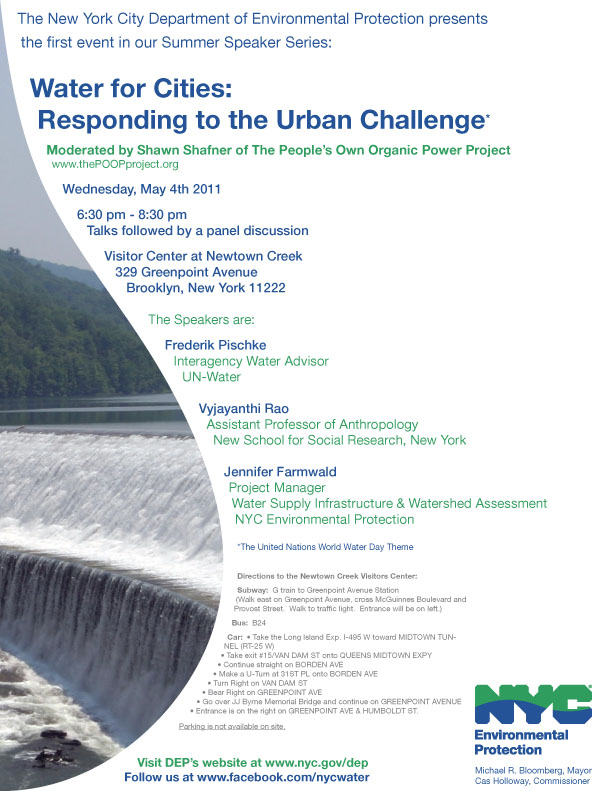
Text from the flyer with links:
Water for Cities: Responding to the Urban Challenge*
Moderated by Shawn Shafner of The People’s Own Organic Power Project www.thePOOPproject.org
Wednesday, May 4th 2011 6:30 pm – 8:30 pm Talks followed by a panel discussion
Visitor Center at Newtown Creek 329 Greenpoint Avenue Brooklyn, New York 11222
The Speakers are: Frederik Pischke Interagency Water Advisor UN-Water, Vyjayanthi Rao Assistant Professor of Anthropology New School for Social Research, New York, Jennifer Farmwald Project Manager Water Supply Infrastructure & Watershed Assessment NYC Environmental Protection.
Visit DEP’s website at www.nyc.gov/dep Follow us at www.facebook.com/nycwater
The Bowie effect

-photo by Mitch Waxman
There are those who like to tell your humble narrator that he is given to hyperbole if not outright fraud, and although I will admit to a weakness for theatrical effect, the odd subjects and situations described in these posts are not contrivances or banal set pieces. When I tell you of the odd polydactyl cats around the Grand Street Bridge or the eyeless things that wriggle in the mud during low tide at Maspeth Creek, rather than smile kindly and nod your head, shudder audibly at the terrible implications arising from their existence- which, if generally known, might herald a turning away from science by a beaten human race gladly retreating into a new dark age.
Here then is one of the curiously heterochromiatic cats found in hoary Greenpoint, which is one of the “you just make this stuff up” sore spots for a humble narrator.
from wikipedia
In anatomy, heterochromia refers to a difference in coloration, usually of the iris but also of hair or skin. Heterochromia is a result of the relative excess or lack of melanin (a pigment). It may be inherited, or caused by genetic mosaicism, disease or injury.
Eye color, specifically the color of the irises, is determined primarily by the concentration and distribution of melanin. The affected eye may be hyperpigmented (hyperchromic) or hypopigmented (hypochromic). In humans, usually, an excess of melanin indicates hyperplasia of the iris tissues, whereas a lack of melanin indicates hypoplasia. Heterochromia of the eye (heterochromia iridis or heterochromia iridum; the common wrong form “heterochromia iridium” is not correct Latin) is of two kinds. In complete heterochromia, one iris is a different color from the other. In partial heterochromia or sectoral heterochromia, part of one iris is a different color from its remainder.

-photo by Mitch Waxman
This was just one member of a colony of cats living on Commercial Street, and the rest scattered before the coloration of their ocular organs could be ascertained. Luckily this stalwart maintained a steady position, and despite the clear annoyance displayed at the horrible scuttling thing waving around a camera before it, stood it’s ground. As a fellow child of infinite Brooklyn, such tenacity did not go unnoticed. Odd eye colored Cats are special, from a symbolic point of view, and have no small amount of mythic significance – even the prized cat of the prophet, called Muezza, was odd eyed.
from wikipedia
The Cat Sìth (Scottish Gaelic: [kʰaht̪ ˈʃiː]) or Cat Sidhe (Irish: [kat̪ˠ ˈʃiː], Cat Sí in new orthography) is a fairy creature from Celtic mythology, said to resemble a large black cat with a white spot on its breast. Legend has it that the spectral cat haunts the Scottish Highlands. Some common folklore suggested that the Cat Sìth was not a fairy, but a transformed witch.
The legends surrounding this creature are more common in Scottish folklore, but a few occur in Irish as well.

-photo by Mitch Waxman
There are many odd things around the Newtown Creek, hidden away beneath the cracked cement and amongst the dripping masonry walls of those long buried and forgotten building foundations which lie just below the facade of modernity. Here you are then, the “Bowie Effect” of the Cats of the Creek is offered. Still working on getting the six toed critters in DUGSBO though…
Who can guess what other anomalous and unwholesome alterations our common urban fauna might have undergone, or are undergoing, in some runaway Darwinian reaction to those environmental stressors they have suffered over the centuries at Newtown Creek?
from wikipedia
In Irish mythology, the aos sí (Irish pronunciation: [iːs ˈʃiː], older form aes sídhe [eːs ˈʃiːə]) are a supernatural race comparable to the fairies or elves. They are said to live underground in the fairy mounds, across the western sea, or in an invisible world that coexists with the world of humans. This world is described in “The Book of Invasions” (recorded in the Book of Leinster) as a parallel universe in which the aos sí walk amongst the living.
In the Irish language, aos sí means “people of the mounds” (the mounds are known in Irish as “the sídhe”). In Irish literature the people of the mounds are also referred to as the daoine sídhe (“deena shee”), and in Scottish Gaelic literature as the daoine sìth or daoine sìdh. They are said to be the ancestors, spirits of nature, or goddesses and gods.
note: The large blue box in the background of these shots seems to have been designed to act as some sort of feral cat shelter rather than a Tardis, and bore a screed proselytizing the curious to visit the website found at neighborhoodcats.org/


