Posts Tagged ‘railroad’
augmented party
Today’s post shows you how to wash a dirty locomotive.

– photo by Mitch Waxman
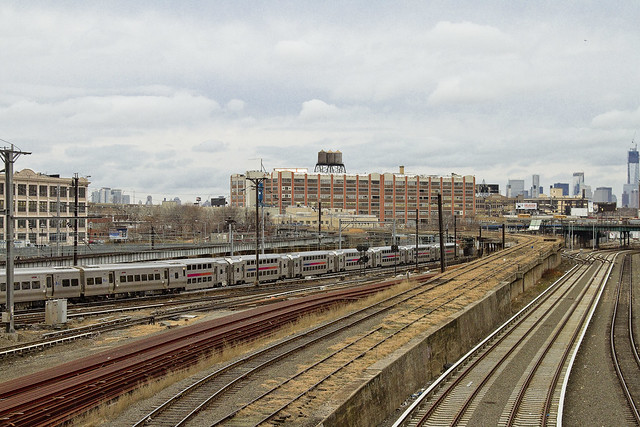
Hanging about and walking around Queens with a friend one afternoon, our path carried us up Skillman Avenue and past the gargantuan Sunnyside Yards. Luckily, something I’ve been trying to catch as it happens began to happen when Amtrak 934 sauntered into view.
from wikipedia
The Pennsylvania Railroad (PRR) completed construction of the yard in 1910. At that time Sunnyside was the largest coach yard in the world, occupying 192 acres (0.78 km2) and containing 25.7 mi (41.4 km) of track. The yard served as the main train storage and service point for PRR trains serving New York City. It is connected to Pennsylvania Station in Midtown Manhattan by the East River Tunnels. The Sunnyside North Yard initially had 45 tracks with a capacity of 526 cars. The South Yard had 45 tracks with a 552 car capacity.

– photo by Mitch Waxman
It seems that there is an entire industrial sector for whom the manufacture and maintenance of “train washes” is a focal point. It also seems to be the case that having a shiny clean locomotive pays a dividend in terms of aerodynamic drag and that the cleaner your train is, the more efficiently it runs.
from wikipedia
The AEM-7 is a twin-cab B-B electric locomotive that is used in the United States on the Northeast Corridor between Washington DC and Boston and the Keystone Corridor between Philadelphia and Harrisburg in Pennsylvania. They were built by Electro-Motive Division from 1978 to 1988. In the Boston Mechanical Department of Amtrak they are known as “Meatballs” and in the Washington Mechanical Department they are known as ASEAs since some of their major parts and components were designed in Sweden by ASEA (Allmänna Svenska Elektriska Aktiebolaget; translation: General Swedish Electrical Inc), which merged with Brown Boveri in 1988 forming ABB. They are also referred to as “toasters” by railfans, owing to their boxy appearance.

– photo by Mitch Waxman
One is informed by railfans that once upon a time, this was a tedious task accomplished by a sizable crew of laborers, who used pole mounted brushes to clean away the grime. The “modern” system (the unit pictured is somewhat archaic by 2013 standards) is far more efficient and highly automated.

– photo by Mitch Waxman
Fundamentally, its the same thing that happens when you wash your car, except for scale. The train rolls past water jets and a system of rotary brushes which chip away the patina of dead insects and grime which the train picks up during normal operation.

– photo by Mitch Waxman
This train wash is nothing new, of course, and has been on my radar for awhile. Were my methodology the same that is employed by most, I would have just lingered around this spot until I got my shots, but that’s not how your humble narrator rolls.

– photo by Mitch Waxman
Instead, if its not happening while I’m passing by, it might not have happened at all for all I care. You can’t force Queens into revealing herself to you, instead, you must trust in serendipity and that she will position you in the right place and at the right time.
“follow” me on Twitter- @newtownpentacle
Want to see something cool? June 2013 Walking Tours-
The Poison Cauldron– Saturday, June 15, 2013
Newtown Creek walking tour with Mitch Waxman and Atlas Obscura, tickets now on sale.
Kill Van Kull– Saturday, June 22, 2013
Staten Island walking tour with Mitch Waxman and Working Harbor Committee, tickets now on sale.
The Insalubrious Valley– Saturday, June 29, 2013
Newtown Creek walking tour with Mitch Waxman and Newtown Creek Alliance, tickets now on sale.
decreasing wind
“follow” me on Twitter at @newtownpentacle

– photo by Mitch Waxman
Foaming, your humble narrator was scuttling his way to Brooklyn recently when sonic evidence of certain titanic exertions, whose only source could be a locomotive engine at work, penetrated through my ever present head phones.
On this particular afternoon, nearby the so called “Bliss Tower” along those tracks of the Long Island Railroad which snake along beneath the Greenpoint Avenue Bridge in a nameless section of Queens, once known as Blissville but which I describe as DUGABO, it was a NY and Atlantic freight operation which was raising the ruckus.
from anacostia.com
New York & Atlantic Railway began operation in May 1997 of the privatized concession to operate freight trains on the lines owned by Long Island Rail Road. The railway serves a diverse customer base and shares track with the densest passenger system in the United States.

– photo by Mitch Waxman
My headphones were not playing Norwegian Black Metal, nor late 80’s NYC Hardcore. They were not transmitting one of my many H.P. Lovecraft audio books, the soundtrack from the first Omen movie, or any of my usual playlists of childish anthems and guitar driven ballads.
Instead, the audio files I was enthralled by were podcasts, specifically Dan Carlin’s “Wrath of the Khans” series, which is presented episodically at his Hardcore History show.
If you’re not listening to Dan, you’re missing out.
from wikipedia
There is an urban legend that Julius Caesar specified a legal width for chariots at the width of standard gauge, causing road ruts at that width, so all later wagons had to have the same width or else risk having one set of wheels suddenly fall into one deep rut but not the other.
In fact, the origins of the standard gauge considerably pre-date the Roman Empire, and may even pre-date the invention of the wheel. The width of prehistoric vehicles was determined by a number of interacting factors which gave rise to a fairly standard vehicle width of a little under 2 metres (6.6 ft). These factors have changed little over the millennia, and are still reflected in today’s motor vehicles. Road rutting was common in early roads, even with stone pavements. The initial impetus for the ruts probably came from the grooves made by sleds and slide cars dragged over the surfaces of ancient trackways. Since early carts had no steering and no brakes, negotiating hills and curves was dangerous, and cutting ruts into the stone helped them negotiate the hazardous parts of the roads.
Neolithic wheeled carts found in Europe had gauges varying from 130 to 175 centimetres (4 ft 3 in to 5 ft 9 in). By the Bronze age, wheel gauges appeared to have stabilized between 140 to 145 centimetres (4 ft 7 in to 4 ft 9 in) which was attributed to a tradition in ancient technology which was perpetuated throughout European history. The ancient Assyrians, Babylonians, Persians and Greeks constructed roads with artificial wheelruts cut in rock spaced the wheelspan of an ordinary carriage. Such ancient stone rutways connected major cities with sacred sites, such as Athens to Eleusis, Sparta to Ayklia, or Elis to Olympia. The gauge of these stone grooves was 138 to 144 centimetres (4 ft 6 in to 4 ft 9 in). The largest number of preserved stone trackways, over 150, are found on Malta.
Some of these ancient stone rutways were very ambitious. Around 600 BC the citizens of ancient Corinth constructed the Diolkos, which some consider the world’s first railway, a granite road with grooved tracks along which large wooden flatbed cars carrying ships and their cargo were pulled by slaves or draft animals. The space between the grooved tracks in the granite was a consistent 1.5 metres (4 ft 11 in).
The Roman Empire actually made less use of stone trackways than the prior Greek civilization because the Roman roads were much better than those of previous civilizations. However, there is evidence that the Romans used a more or less consistent wheel gauge adopted from the Greeks throughout Europe, and brought it to England with the Roman conquest of Britain in AD 43. After the Roman departure from Britain, this more-or-less standard gauge continued in use, so the wheel gauge of animal drawn vehicles in 19th century Britain was 1.4 to 1.5 metres (4 ft 7 in to 4 ft 10 in). In 1814 George Stephenson copied the gauge of British coal wagons in his area (about 1.42 metres (4 ft 8 in)) for his new locomotive, and for technical reasons widened it slightly to achieve the modern railway standard gauge of 1.435 metres (4 ft 8.5 in).

– photo by Mitch Waxman
Normally, the media I consume is not something I think people would be interested in, at least that’s been my experience in real life. A recent conversation with Kevin Walsh of Forgotten-NY fame, wherein that intrepid explorer queried me about where to find some of these Lovecraft audio files which are so often mentioned, forced me to reconsider that maxim. Accordingly, since its a holiday weekend and you might have some free time, here you go.
The Atlanta Radio Theater Company is great. The website… their stuff is available as mp3’s at itunes and others, so go hunt them down.
The astounding H.P. Lovecraft Historical Society.
ARTC made a better Dunwich, by my taste, but HPLHS did both “Mountains of Madness” and “Shadow Out of TIme” better and they made a freaking “Call of Cthulhu” silent movie as well as the unbelievably great “Whisperer in Darkness” film. Dark Adventure Radio Theatre just rocks.
Huge talents, a podcast performed by two of its associates is HPPodcraft.com.
Incidentally, just like the LIRR Engine 102 featured in yesterday’s post, today’s NY&A engine is an EMD SW1001.
from wikipedia
The EMD SW1001 was a 1,000-horsepower (750 kW) diesel locomotive for industrial switching service built by General Motors’ Electro-Motive Division between September 1968 and June 1986. A total of 230 examples were constructed, mainly for North American railroads and industrial operations.
The SW1001 was developed because EMD’s SW1000 model had proved unpopular among industrial railroad customers, as the heights of its walkway and cab eaves were much greater than those of earlier EMD switcher models. The overall height was similar, but the SW1000′s roof was much flatter in curvature. Industrial railroads that only operated switchers often had facilities designed to the proportions of EMD’s earlier switchers.

– photo by Mitch Waxman
Gold standard, the best of the best unabridged readings are from Audiorealms, featuring narrator Wayne June. Flat out readings of the Lovecraft Texts by professional voice talent in a studio. Genre defining, these are commercial works which really deserve support. Buy em, highest Mitch Waxman ratings- lengthy, mellifluous, well worth the hard slaved money. Six volumes, covering all the really good stuff. I think I got them through iTunes, although audible.com has them for sale.
The unmentionable Jeffry Combs reads “Herbert West Re-Animator.”
Additional mentions for theatrical productions of “Call of Cthulhu” and “Lurking Fear,” pro recordings from “back in the day,” when audio books were released on things called “audio cassettes.” Check out lovecraftzine.com for a list of free downloads which includes these two gems.
Archive.org is hosting Maria Lectrix‘s readings of “The Dream Quest of Unknown Kadath.“ Free, and open sourced, go get em. Poke around at archive.org, by the way. This isn’t the only Lovecraft audio there- look for “Herbert West: Reanimator” and others.
from nyc.gov
Greenpoint Avenue is a four-lane local street in Queens and Brooklyn, running northeast from the East River in Greenpoint, Brooklyn to Roosevelt Avenue in Sunnyside, Queens. The Greenpoint Avenue Bridge, also known as the J. J. Byrne Memorial Bridge, is located approximately 2.2 km from the mouth of Newtown Creek. The bridge is situated between Kingsland Avenue in Greenpoint, Brooklyn and Review Avenue in the Blissville section of Queens.
shines thinly
“follow” me on Twitter at @newtownpentacle

– photo by Mitch Waxman
Early will your humble narrator be rising today, with intentions of loitering about the neighborhood for an extended period. It’s been a few weeks since my last merry perambulation carried me across the Pentacle and I look forward to where my feet may take me.
– photo by Mitch Waxman
Supernal glories abound, sights to see and inventory. Queens is calling.

– photo by Mitch Waxman
Of course, that thing which cannot possibly exist at the cupola of the Sapphire Megalith in Long Island City will be watching. What’s a Saturday without a sense of latent menace and paranoia, after all?
ancient idol
“follow” me on Twitter at @newtownpentacle

– photo by Mitch Waxman
Skillman Avenue in Queens is one of the thoroughfares via which pedestrian transits are accomplished between the blessed hillocks of Astoria and the lamentable post industrial flats surrounding the Newtown Creek. It is all downhill from here, your humble narrator often tells people, but at least there is some spectacular scenery along the route. To wit, the Sunnyside Yards.
Mayan Apocalypse Countdown: just 9 days left until the 13th b’ak’tun ends, initiating the Mayan Apocalypse on December 21st. Tick, tock.

– photo by Mitch Waxman
Illegal dumping is an art form here in Queens, with scatter dash arrangements of discarded goods lining both fence and wall. An odd thing I’ve noticed over the last few years is the presence of discarded single shoes. I’d be able to look over a pair of shoes, but everywhere I go these days, I’m seeing single shoes. That is weird, and there’s a story behind it, I am sure. It will likely involve a serial killer, I think.

– photo by Mitch Waxman
This beautiful bit of detritus, arranged upon the old iron fence of the rail yard, has obviously been in place for a long time. Many questions occur to me, regarding it, but like many of the things which Queens wishes to have noticed- there will never be an answer. Queens is like that.
blurred and fragmentary

– photo by Mitch Waxman
The scions who run the Newtown Creek Alliance declared that we all gather for a meeting recently, and not wanting to be mocked in absentia (rather in person), your humble narrator set out for the gathering. Only issue with this caucus was that it was being held in far off Ridgewood at the Onderdonk house, which is a pretty long walk from Newtown Pentacle HQ here in Astoria. After having moved things around, schedule wise, a vast scuttle was instituted. The shot above depicts the East Branch of the Newtown Creek at its terminus on Metropolitan Avenue.

– photo by Mitch Waxman
Along the way, I decided to check out the Scott Avenue footbridge. This is a rusted metal and rotting concrete structure which rises over the tracks of the LIRR’s Bushwick Branch, allowing pedestrian traffic egress to Flushing Avenue- a structure seen from distance but never traversed. Due to the aforementioned distance from my quarters, it will be admitted, this is the section of the Newtown Creek watershed with which I am the least familiar and one which still offers pleasant surprises when visited. In the shot above, what you’re looking at is the northward facing tracks of the Bushwick Branch as they head towards Fresh Ponds.

– photo by Mitch Waxman
The inverse view, to the south and the infinity of Brooklyn. The train cars, homogenous and numerous, are awaiting service by the NY and Atlantic freight railway. What is colloquially known as the “garbage train”, they are gathered for usage at the Varick Street Waste Management facility which is nearby and adjoins the bitter end of the Newtown Creek tributary known as English Kills near Johnson and Morgan avenues. The undefended border of Brooklyn and Queens is also present in this shot, although I cannot tell you exactly where. Additionally, I am unsure as to whether these cars were loaded with their putrescent charge when I gathered these images.

– photo by Mitch Waxman
The Newtown Pentacle postings “approaching locomotive” and “skillfully wafted” discuss the Bushwick Branch and the Waste Management facility at Varick Street in some detail, why not check them out? Luckily, lords and ladies, your humble narrator goes to these spots so you don’t have to. If you did want to see some of the wonders described within these postings- why not consider coming on one of the upcoming excursions I’ll be leading?

for an expanded description of the October 20th Newtown Creek tour, please click here

for more information on the October 27th Newtown Creek Boat Tour, click here

for more information on the November 9th Newtown Creek Magic Lantern Show, click here

for an expanded description of the November 11th Newtown Creek tour, please click here


