Posts Tagged ‘Things to do’
Modern Corridor
Want to see something cool? Bring a camera, and follow me.

– photo by Mitch Waxman
When I decided to start doing walking tours of the Newtown Creek watershed a few years ago, I found myself presented with a significant organizational issue. There’s a different story to be told about Maspeth than there is about Greenpoint (also, there are arguably two Greenpoints), yet… the two communities are inextricably linked up. Same thing with Bushwick and Ridgewood, or the residential centers at the Creek’s intersection with the East River. 3.8 miles long by around a mile wide, the Creeklands are vast when on foot. There is also SO much information to pass along, not just about the Creek’s past, but about all the stuff that’s going on right now- EPA, Superfund, the cool things my pals in NCA are doing with Green Infrastructure and Citizen Science…

– photo by Mitch Waxman
My solution was to simply to connect the stories of these places up along the ancient roads or paths along which they grew, and follow the water from one borough to another. “Poison Cauldron” does the Greenpoint to Bushwick route, “Insalubrious Valley” follows a colonial era turnpike path, “Glittering Realms” moves from residential East River Greenpoint back to the industrial zone along another colonial pathway, and “13 Steps around Dutch Kills” traces the Queens tributary back to the Creek and ends at its smaller counterpart Whale Creek in Brooklyn.
The new one- “Modern Corridor”- is all about Hunters Point, one of the least known sections of New York City, which sits directly opposite the Shining City of midtown Manhattan.

– photo by Mitch Waxman
This “Modern Corridor” walking tour starts at the old city center, nearby Jackson Avenue and Court Square, and explores the brave new world rising from the ashes of a 19th century industrial titan- the independent municipality of Long Island City. Writ large, the growing community of the titan real estate development which has reshaped the colonial vintage section of Queens called Hunters Point will be encountered, and one of the finest parks in the entire city visited. This park is built upon a significant piece of rail infrastructure which once allowed train cars to be loaded onto barges for maritime transport to Manhattan and points west.

– photo by Mitch Waxman
Then we walk through to the proverbial wrong side of the tracks, and to the industrial machine surrounding the infamous Newtown Creek. Former home to sugar refineries and cargo docks, rail yards and powerhouses, this will be the future home of thousands who will live in the forthcoming Hunters Point South development which has already begun construction. See it as it is, before the towers rise and the land is reshaped to modern wants and desires.
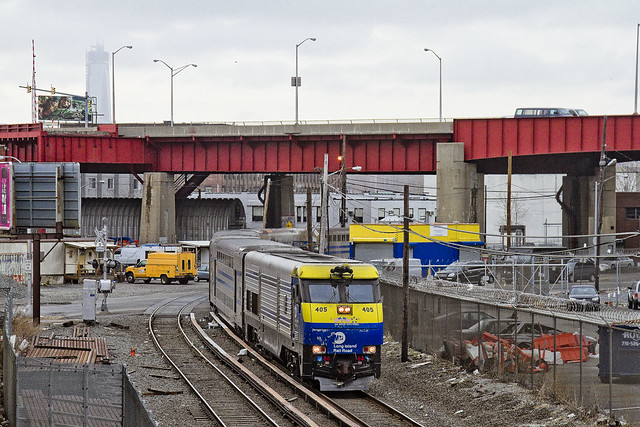
– photo by Mitch Waxman
Skirting along the Creek, you’ll see vast infrastructure, visit DUPBO (Down under the Pulaski Bridge Onramp), and walk over railroad tracks as we head back to the modern incarnation of Long Island City. Bring your cameras, as your friends won’t believe you when you try to describe the places you’ve witnessed. Closed toe shoes are also highly recommended, as is a hat or parasol as there will be little to no shelter from the burning thermonuclear eye of god itself. The walk will be approximately 2 hours in length and will cross all sorts of ground. There will be one flight of stairs involved.
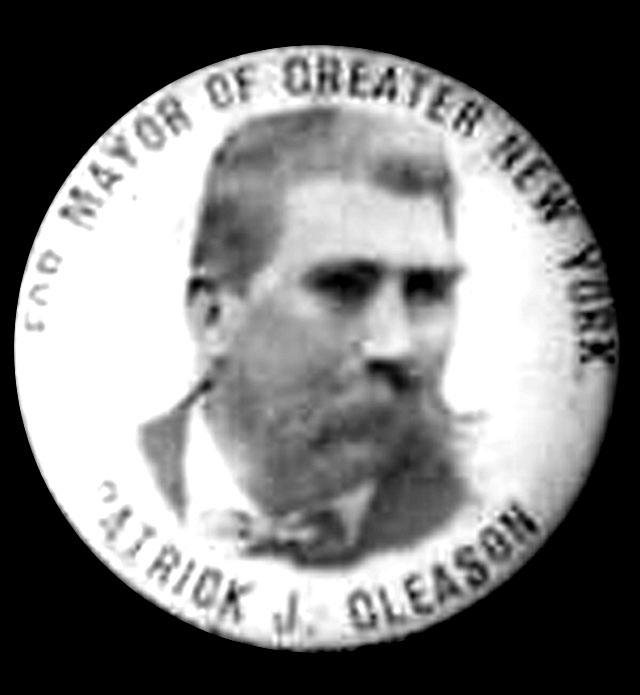
– photo by Mitch Waxman
We’ll be passing from the 21st century all the way back to the 1600’s with particular emphasis on the late 19th century, when the fellow pictured above- the notorious Patrick “Battle-Ax” Gleason, served as the last Mayor of Long Island City. Gleason was personally responsible for the construction of the exquisite PS1 schoolhouse pictured in the second shot above, which nearly bankrupted LIC- amongst other imbroglios. Dogged by claims and accusations (and at least one conviction) of corruption- Gleason used to sit in a barber chair outside the Miller Hotel- which is today the LIC Crab House- and hold court with constituent and passerby alike. This was his favorite spot, directly across the street from the LIRR train and ferry terminal. He told those he met to avoid addressing him as “Mayor”, instructing them instead to “Just call me Paddy.”
Hope you can come along, this Saturday at 10- meetup at Court Square Station on Jackson Avenue.
gleaming image

– photo by Mitch Waxman
It should be mentioned that under normal circumstance, the narration recited on board one of the Newtown Creek boat tours which I’ve been a part of in the recent past has been “the straight story”. By that, I mean that the normal narrative which readers of this blog have grown used to is toned down a bit, and a more mainstream presentation is offered. There are still plenty of “night soil and offal dock” stories, but as I have a relatively short amount of time to tell the story of Newtown Creek, a lot of the more… colourful… stuff gets trimmed out. Luckily, the Newtown Creek Alliance is producing a “spooky” Halloween tour this Saturday (October 27), and I get to go to town on this one.

– photo by Mitch Waxman
In addition to weaving the Blissville Banshee, Maspeth Gypsies, and witch panics into my speech- there are two other factors which make this tour special. First and foremost is the price, subsidized by grant money from the NYCEF fund of the Hudson River Foundation – which allows NCA to offer the trip at an amazing price of just $25. Secondly, the time at which we will be embarking is late in the afternoon, which should offer spectacular sunset lighting of the Creek for photographers and sensitives alike.

– photo by Mitch Waxman
This is a two hour excursion, leaving from Manhattan’s South Sea Seaport on board a comfortable NY Water Taxi (which, yes, has bathroom facilities). NCA is encouraging the wearing of seasonal costuming to celebrate and acknowledge the Halloween holiday. Scheduled speakers include your humble narrator and NCA Executive Director Kate Zidar. Whatever there is, which cannot possibly exist, lurking in the Black Mayonnaise which underlies the cursed waters of that cataract of agony known as the Newtown Creek has refused to make an appearance sans ritual sacrifice- something NCA cannot have any involvement with due to the intricacies of its 501/3c non profit status. The thing in the megalith will be watching, however.

– photo by Mitch Waxman
The question of what sort of costume I will be wearing is still up in the air. Attempts to borrow a death cloak have so far been unsuccessful, despite the fact that several people I know own such raiments. Click the banner just below this paragraph for ticketing information and fulfillment. Do you dare to enter this nightmare world of the Newtown Creek, or will you instead cling to the illusion of sanity which exists beyond its banks?
Also- Upcoming Newtown Creek tours and events:

for more information on the October 27th Newtown Creek Boat Tour, click here

for more information on the November 9th Newtown Creek Magic Lantern Show, click here

for an expanded description of the November 11th Newtown Creek tour, please click here
excellent care

– photo by Mitch Waxman
I’ve recently had the honor of making the acquaintance of the Queens Borough Historian, Dr. Jack Eichenbaum, and when I heard that he was going to conduct a walking tour around a section of Newtown Creek for the Municipal Art Society- I asked if I could come along. Luckily he consented, and even introduced me to his group. They were a little taken aback, as you’d imagine, as your humble narrator is extremely horrible in appearance and manner.
from geognyc.com
I hold a Ph.D. in urban geography (University of Michigan, 1972) where my dissertation was titled Magic, Mobility and Minorities in the Urban Drama. I’m a lifelong observer of NYC and other large cities around the world. My expertise lies particularly in quantitative methods, historical urban geography, migration, ethnicity, and technological change. I maintain a storehouse of urban concepts, researched facts, and biased memories of bygone eras.
Much of what I know about digital NYC comes from a career in the Property Division of the NYC Department of Finance collecting data and modeling valuation of tax parcels. Most of whom I know in NYC comes from founding and coordinating GISMO, NYC’s GIS user group, participating in non-profit institutions like the Municipal Art Society, and teaching at Hunter College (CUNY). I continually update my familiarity with NYC by walking, walking, and walking in all five boroughs.
In June, 2010, I was appointed Queens Borough Historian. My agenda includes advising the Borough President, convening people and organizations concerned with Queens history, education at all levels, promoting Queens’ history-related attractions and changing cultures, and introducing the concept of “digital history.”

– photo by Mitch Waxman
One thing you should know, lords and ladies, is that the historical community here in Queens spends most of its time fighting with each other. Often, I’m angry at someone, who hates me back. Alternately, this historical society is at war with that one, usually over some small point of contention. Everyone is actually pretty ok, and most of the arguments- which seem like the end of the world when they’re ongoing- settle out after a period of time. Such heated discourse, however, is something which I avoid at all costs and is why I spend my time- alone- down by the Creek. I would hate having Jack’s job as Borough Historian, and don’t know how he deals with the politics and backbiting without striking out or fleeing into the night. He’s a cooler cat than I.
from wnyc.org
They give lectures and tours and help New Yorkers learn about their neighborhoods. Their positions are mandated by state law…but they don’t make a penny for the job. They’re the five city historians, one for each borough. This summer, we’ll be meeting them and finding out some of the secret knowledge about their respective ‘hoods.
Queens Borough Historian Jack Eichenbaum is the new kid on the block. He got his job in June, promising not to hide behind books.
In the Flushing apartment he’s lived in for decades, Eichenbaum looks tan and fit in a t-shirt, royal blue track shorts and running shoes. He’s lived nearly all of his 67 years in Queens — a place he believes is still undervalued by the rest of the city.
The people who act like Manhattan is the center of the known universe? Don’t even get him started.

– photo by Mitch Waxman
Along the way, Dr. Eichenbaum had arranged to meet up with George Trakas at the Newtown Creek Waste Water Treatment Plant Nature Walk. Mr. Trakas, who designed the Nature Walk, is a terrific guy and a fantastic ambassador for his inimitable public space. The Newtown Creek Armada art installation was also in place at the Nature Walk that day, which titillated the crowd.
from urbanomnibus.net
Newtown Creek’s notoriety as one of the most polluted waterways in the country belies its peculiar beauty and uncommon potential to provide vistas of New York’s industrial history and the scale of the city’s waste management machine. It’s also a wicked cool place to impress a date with a surprise picnic.
Artist George Trakas saw the potential of this canalized estuary as he navigated the waterways of New York over the past forty-five years. When the City’s Department of Environmental Protection launched a $3 billion upgrade of the wastewater treatment facility in the late 1980s, Trakas was able to seize the opportunity – through the City’s Percent for Art program – to go beyond the brief and to provide public access to the water for treatment facility employees and local residents. And by access, he means access: visitors won’t merely see the water from above, behind a fence. Rather, you can descend staged granite steps to the water’s edge and sit (or dock your boat) on a series of getdowns perforating the bulkhead along the Whale Creek tributary. It’s part amphitheatre and part shore, with horticultural and sculptural references to local history, geology, and geography. But it’s also a model of a successful community engagement process. Trakas participated in meetings with the Newtown Creek Monitoring Committee every month for the past ten years, incorporating community feedback and priorities into his design. Instead of using art to conceal environmental hazards with decorative band-aids, Trakas has created a Nature Walk that provides an interpretive frame on its surroundings and invites visitors to share his delight in water, industry and the urban beauty of the overlooked.

– photo by Mitch Waxman
There was a cool dog who came along as part of the group, said canine seemed transfixed by what he was seeing and hearing along the way. Can you imagine what Newtown Creek must smell like to a dog?
There is so much interest in Newtown Creek amongst the general public, something I learned personally this last summer, and it was quite spectacular to hear Jack’s take on the place. The Municipal Art Society sent along blogger Kate Lenahan to record the event, and her post can be accessed here. Additionally, I got mentioned in a third party’s blog post, linked to below.
from downwithtyranny.blogspot.com
First, when I first did the walk, some 15 months ago, the primary attraction was laying eyes on Newtown Creek, which to my knowledge I had never done before. You have to remember that like most industrial waterfronts it was pretty well closed off to civilian eyes and feet. But in that intervening year and a quarter I had done more walks around various parts of the creek than I can remember and also cruised the creek, mostly under the auspices of the Newtown Creek Alliance (it’s definitely worth signing up for their e-mail list), and mostly with NCA historian Mitch Waxman (whose blog, “The Newtown Pentacle,” is always worth checking out).
Second, there’s the Jack Eichenbaum factor. In all the many walks I’ve done with Jack, I can hardly remember one where I didn’t learn something of near-life-changing importance — certainly a change in my way of perceiving the city, and likely the world around me. Walking with Jack, you learn to see how basic factors of physical and human geography have shaped the way regions and neighborhoods have developed and redeveloped.

– photo by Mitch Waxman
Dr. Eichenbaum led the group over the Pulaski Bridge and into Long Island City, but I had to split off and stay in DUPBO. Another event was scheduled to begin later in the day, a presentation on water quality at the North Brooklyn Boat Club. The very good news was that they had beer, and a campfire going down there.
Also- Upcoming Newtown Creek tours and events:

for an expanded description of the October 20th Newtown Creek tour, please click here
for more information on the October 27th Newtown Creek Boat Tour, click here
for more information on the November 9th Newtown Creek Magic Lantern Show, click here
for an expanded description of the November 11th Newtown Creek tour, please click here
immemorial past

– photo by Mitch Waxman
Not unlike the woodland elves described in Tolkien stories, the Dutch had been diminishing for some time in their former free holds, and by the middle of the 19th century they had largely departed for that place where the burning thermonuclear eye of god goes at the end of the day. Their old haunts had grown lousy with the English, Germans, and Irish by this point in time anyway and they must have realized that their time had come to an end on Long Island’s western tip. Sightings of them continued right up to the beginning of the 20th century, but these days the Dutch in Ridgewood are functionally extinct. There may still be one or two, but these are anachronistic individuals.
from onderdonkhouse.org
The Vander Ende-Onderdonk House, located in Ridgewood on the border of Queens and Brooklyn, is the oldest Dutch Colonial stone house in New York City. Peter Stuyvesant granted the land it sits on in the mid-seventeenth century, and by 1660, Hendrick Barents Smidt occupied a small house on the site. In 1709, Paulus Vander Ende of Flatbush purchased the farm and began construction of the current house. The building was a prominent marker in the 1769 settlement of the boundary dispute between Bushwick in Kings County and Newtown in Queens County.

– photo by Mitch Waxman
Reports from the time describe an odd and curiously industrious people, possessed of peculiar notions considered alien and sinister by the English (and eventually American) gentry who replaced them. These Dutchmen allowed property to fall into the hands of female heirs, considered their slaves to be indentured servants rather than livestock, and even tolerated congregations of Jews and Catholics gathering for their sabbaths (provided that they show discretion and deference, of course). Savages, atavist savages, they were.
from 1910’s “Genealogy of the Onderdonk Family in America By Elmer Onderdonk“, courtesy google books
“On Saturday, Sept. 21, 1776, the day after the great fire in N. Y., a detachment of Col. Birch’s 17th Light Dragoons visited Great Neck, Cow Neck, and in the afternoon they reached the house of Adrian Onderdonk, which they instantly surrounded, when an officer went in and searched every part up and down stairs, thrusting his sword into every secret place. The object of their pursuit happened to be at home, and on being arrested, he asked the reason of it, and in reply was informed “that your neighbors complain of you.” The officer then mounted his horse and rode off with the troopers, perhaps in quest of other Whigs on Cow Neck.
Adrian Onderdonk was taken as far as Flushing and shut up in the Friends Meeting House that night. The next day he was taken to New York, and on his arrival at the city he with other prisoners were paraded, with a gang of loose women marching before them to add insult to suffering.

– photo by Mitch Waxman
When they went into the west, these Knickerbockers failed to leave behind much other than a few place names and old houses, and the English speaking world was never apt to do much more than mention them in passing. Certainly, there were some Dutchmen who remained in their anglicized home, and their names are writ large across the historical record. Roosevelt, Van Cortlandt, Vanderbilt- all conjure some immediate memory or reactive instinct in modern audiences- but all in connection with Manhattan or “New York” rather than Long Island.
from 1911’s “American Prisoners of the Revolution, by Danske Dandridge“, courtesy google books
After nearly four weeks imprisonment the friends of Adrian Onderdonk procured his release. He was brought home in a wagon in the night, so pale, thin, and feeble from bodily suffering that his family scarcely recognized him. His constitution was shattered and he never recovered his former strength.
Onderdonk says that women often brought food for the prisoners in little baskets, which, after examination, were handed in. Now and then the guard might intercept what was sent, or Cunningham, if the humor took him, as he passed through the hall, might kick over vessels of soup, placed there by the charitable for the poor and friendless prisoners.

– photo by Mitch Waxman
Authors and orators created a narrative in the early middle 19th century about these original european colonizers of the New York archipelago, a whimsical and semi ironic one, and they came to be regarded as a primitive group of peasant “hay seeds”. Washington Irving and others wove together an image of a good natured yet quite illiterate and impressionable race of farmers and merchants often at the mercy of superstition and fate. Not much mention of religious remonstrances or the complicated political deals entered into with powerful aborigine nation states (which surrounded and vastly outnumbered them) is commonly spoken of, but lurks just below the surface of the English speaking origin mythology of the United States.
from bklyn-genealogy-info.com, where they have historic photos of the place!!!
It is called the ONDERDONK House because on April 27, 1821, Adrian ONDERDONK purchased the 58-acre farm with the house and barn for $6,000. The farm extended south from Flushing Avenue to what is now Catalpa Avenue. During the 1820’s, Adrian ONDERDONK erected a small frame addition to the stone house immediately above the remnants of the foundation of the 1660 building. Its architectural features are typical of Dutch buildings in this period: a gambrel roof, Dutch doors, central hallway and double hung windows with shutters.
Immediately west of the ONDERDONK Farm was the COVERT Farm of 48 acres. It is thought the original Dutch grant covered what was in the early 1800s the ONDERDONK and COVERT farms.
In 1819, Adrian ONDERDONK, married Anna WYCKOFF, daughter of Peter WYCKOFF, who had a large farm nearby on Flushing Avenue.
In 1865, Gertrude ONDERDONK SCHOONMAKER, daughter of Adrian ONDERDONK, was the owner of the farms. She sold off 30 acres, but continued to live on the farm.
In the 1890s, she sub-divided the balances of the farm and sold building lots.

– photo by Mitch Waxman
Progressive revisionism, a style of historical interpretation which reinforces a certain political philosophy popular in the United States during the middle and late 20th century, embraces a version of the “noble savage” concept. This is an old trope in European thought, which presupposes that the so called American Indians were possessed of neither property nor base motives prior to the arrival of the Europeans, and lived in some sort of vast peaceful commune with each other that celebrated naught but the world of nature. The “noble savage” population of North and South America concept originates centuries ago with Columbus, and has caused a terrific amount of carnage and suffering since.
from wikipedia
Originally, Ridgewood was part of the Dutch settlement Boswijk (Bushwick) and was later incorporated into the village of Breuckelen (Brooklyn). A legacy of this past stands today; Onderdonk House, which was erected in 1709. The house is the oldest Dutch Colonial stone house in New York City. Also located at the Onderdonk House site is Arbitration Rock, which was a marker for the disputed boundary between Bushwick and Newtown and essentially Brooklyn and Queens.

– photo by Mitch Waxman
The actual history of the aboriginal occupants of North America, in the time before the plagues of Europe were unleashed upon them, is less than bucolic according to a fragmentary and badly documented historical recod. To the north were found Seneca and Mohicans, to the east were the Rockaway, south and west were found the Lenape. These were just the big guys- the regional players- and a complicated web of suzerainty and an homage based economy sustained and involved thousands of smaller groups in a web of trade and diplomatic relations. The first attempt at establishing a colony in Maspeth failed precisely because the Dutch had underestimated the strength, sophistication, and reach of one of these tribal groups- and the States General and Dutch East India Company decided that it would just be easier to buy the land from the Indians than fight them for it. The Indians, by all reports, could not believe that these odd trouser wearing people from overseas wanted to actually live year round in a swamp. NY State, incidentally, has preserved several of the property contracts entered into by the Dutch with the natives.
from wikipedia
The Arbitration Rock was set in 1769 as the boundary marker between the two Long Island townships of Newtown and Bushwick. Since Newtown was in Queens County and Bushwick in Kings County, this rock the size of a Volkswagen Beetle also served to mark the dividing line between these two colonial New York counties.
An acrimonious dispute over the boundary lines between the two townships had started as far back as 1661. “The feeling ran so high than men of one community would stone those of another.” To a large extent, the dispute reflected the conflict between the original Dutch settlers of Bushwick with the burgeoning English colonists of Newtown, New York.
In 1768, “a bill was passed in the legislature for a commission to draw a line to designate the boundary between the two townships.” In 1769, the borderline between the two towns and counties was established measured from this large rock that would ultimately be referred to as the “Arbitration Rock”. Still the dispute was not settled until 1880, when the state sent surveyors to verify the point on the old rock made in 1661.

– photo by Mitch Waxman
As mentioned, earlier this week, your humble narrator had found himself drawn to the Onderdonk site on Flushing Avenue in Ridgewood in the name of attending a meeting of the Newtown Creek Alliance. In a somewhat metaphoric setting – beneath a big tent- the group discussed current projects and certain plans for the near future. The Ridgewood Historic Society Group acted as our hosts, and this- like the disappearance of both the Indians and the Dutch from western Long Island- requires comment. Thanks are offered to them for their hospitality.
from nyc-arts.org
On display inside the house are objects found during excavations conducted in the 1970s and 1980s as well as architectural and historical exhibits. The house was built by Paulus Vander Ende, a Dutch farmer, about 1709. The smaller wooden wing was erected much later. In the early 1800s, the house was purchased by the Onderdonk family. After the last Onderdonk moved out, successive owners used the house as a livery stable, speakeasy, office and, most recently, as a factory for parts for the Apollo space program. The Greater Ridgewood Historical Society was formed to save the house, which was nearly destroyed by fire in 1975. It opened to the public in 1982.
Also- Upcoming Newtown Creek tours and events:
for an expanded description of the October 20th Newtown Creek tour, please click here
for more information on the October 27th Newtown Creek Boat Tour, click here
for more information on the November 9th Newtown Creek Magic Lantern Show, click here
for an expanded description of the November 11th Newtown Creek tour, please click here


 The Newtown Pentacle