Posts Tagged ‘Tugboat’
certain reminder

– photo by Mitch Waxman
The Brian Nicholas oozing onto and smoothly navigating the lugubrious waters of an urban waterway called the Newtown Creek. Some 75 feet long, with a gross tonnage of 104 GRT, the Brian Nicholas is a creature of DonJon towing whose motive power is supplied by 2 850 HP engines that was built in 1966 and retrofitted in 2010.
from docs.google.com
This past June, Donjon completed the top-to-bottom refit and replacement of the main engines, generators, gears and related equipment of its tug Brian icholas. The refit was performed in house at Donjon’s Port Newark, New Jersey facility under the supervision of Donjon’s Gabe Yandoli and Robert Stickles. As a result of the refit, the Brian Nicholas is now a “green” tug, compliant with all applicable EPA and Tier 2 marine emissions regulations.
The rebuild included a repowering of the main propulsion with Cummins K38-M Marine engines, which were specifically developed by Cummins to meet EPA and Tier 2 marine emissions regulations. The new engines also meet the IMO, MARPOL and EU Stage 3A requirements. Similarly, the generators were upgraded to incorporate John Deere 4045TFM75 engines, also Tier 2 compliant. In addition to the replacement of the aforementioned engines, the project required virtually total replacement of exhaust lines and routing of new control lines and panels in the engine room and wheelhouse.
brief and desolate

Vintage Tugboat at Newtown Creek – photo by Mitch Waxman
Note: This is a “reblog”, and was originally presented in August of 2010.
A rare opportunity to ride up the Newtown Creek was recently enjoyed by your humble narrator, and on my journey up that maligned cataract I spotted an artifact of New York Harbor’s glorious past sneaking past Hunters Point.
from epa.gov
Blue-claw crabs, bluefish, weakfish, striped bass, and other species inhabit the creek, and fishing and crabbing for human consumption occurs [Ref. 7, pp. 2, 5; 8, p. 11; 21, p. 13; 22, pp. 1-2; 24, p. 143; 52, p. 93; 68, p. 3; 69, p. 1]. Subsistence fishing has been observed in Newtown Creek at Dutch Kills, and crabbing for consumption has been observed at the end of Manhattan Avenue in Brooklyn [Ref. 7, p. 5; 21, p. 13; 22, pp. 1-2; 68, p. 3; 69, p. 1]. These locations are both within the zone of contamination for the Newtown Creek site [Figure 2 of this HRS documentation record]. Therefore, Actual Contamination is documented, and the target fishery is evaluated for Actual Human Food Chain Contamination.

the W O Decker at Newtown Creek – photo by Mitch Waxman
Wooden hulled, its spitting steam boilers have long been replaced by modern diesel engines, this little (52 feet long) tugboat is the W O Decker.
also from epa.gov
Beginning in the late 1800s and continuing into the 1930s, Newtown Creek was widened, deepened, and lined with bulkheads to accommodate the growing traffic, leading to the destruction of all its freshwater sources [Ref. 8, p. 10; 12, p. 52]. During World War II, the government commandeered factories along the creek to make military equipment, such as a factory that made aluminum for fighter planes [Ref. 11, p. 14]. At that time, Newtown Creek was the busiest industrial port in the Northeast, with tanker traffic lining its length [Ref. 7, p. 1; 11, p. 13]. The national highway system built after the war took business away from the nation’s waterways, leading to a rapid decline in the level of industry along Newtown Creek [Ref. 7, pp. 1-2].

the W O Decker passing by the “Greenpoint Manufacturing and Design Center” – photo by Mitch Waxman
A “historic place” the Decker was originally called the Russell 1 when it was built in 1930 for the Newtown Creek Towing Company, who were specialists in berthing and towing heavy cargo along the crowded and narrow waterway.
from gmdconline.org
The Greenpoint Manufacturing and Design Center (GMDC) started in the late 1980s as an innovative intersection of two interests: reclaiming derelict factories in North Brooklyn’s Greenpoint neighborhood and sustaining industry and manufacturing in New York City. The organization formally incorporated in 1992.
From its initial purchase and redevelopment of a large facility at 1155 Manhattan Avenue for use by light manufacturers and artisans, GMDC has since expanded and today is the only nonprofit industrial developer in New York City. The organization acquires, develops, and manages industrial real estate that provides small and medium-sized manufacturing enterprises with affordable, flexible production space.

In the shot above, The Decker is passing the Newtown Creek Waste Water Treatment Facility in Greenpoint, Brooklyn – photo by Mitch Waxman
The Decker is currently a high end tour vessel, operated by and out of the South Street Seaport in Manhattan.
from seany.org
The wooden tugboat W.O. Decker was built in Long Island City, Queens in 1930 for the Newtown Creek Towing Company, a firm specializing in berthing ships and barges in the creek that separates Brooklyn and Queens. Originally called the Russell I for the towing company’s owners, she was renamed the W.O. Decker in 1946 after being sold to the Decker family’s Staten Island tugboat firm.

The shield wall of the Shining City, framed by Long Island City on the right and industrial Brooklyn on the left with the Pulaski Bridge just at Horizon – photo by Mitch Waxman
The vessel I was aboard continued on toward the Greenpoint Avenue Bridge, but the Decker turned in the narrow part of the Newtown Creek near the confluence of its tributaries Whale Creek and Dutch Kills.
Check out this 1896 article at the NYTimes, which actually interviews the manager of Newtown Creek Towing Company, John Russell, for whom the Decker was originally named.
present position

– photo by Mitch Waxman
Maritime Sunday is with us once again, happening to coincide with Greek or Eastern Orthodox Easter (known as greester here in Astoria) as well as the 100th anniversary of the well known Titanic disaster. That subject will be explored by everyone else, I suspect, so instead let’s check out the scene on the Kill Van Kull.
from wikipedia
The Bayonne Bridge is the fourth-longest steel arch bridge in the world, and was the longest in the world at the time of its completion. It connects Bayonne, New Jersey with Staten Island, New York, spanning the Kill Van Kull. Despite popular belief, it is not a national landmark.
The bridge was designed by master bridge-builder Othmar Ammann and the architect Cass Gilbert. It was built by the Port of New York Authority and opened on November 15, 1931, after dedication ceremonies were held the previous day.

– photo by Mitch Waxman
These shots were captured while onboard one of the many Working Harbor Committee excursions I attended last summer, and portrays one of those summer days which New York is infamous for. Heavy clouds of humidity dangle, and inescapable temperatures render the entire archipelago in a tropical aspect.
from wikipedia
The Kill Van Kull is a tidal strait between Staten Island, New York and Bayonne, New Jersey in the United States. Approximately 3 miles (4.8 km) long and 1,000 feet (305 m) wide, it connects Newark Bay with Upper New York Bay. The Robbins Reef Light marks the eastern end of the Kill, Bergen Point its western end. Spanned by the Bayonne Bridge, it is one of the most heavily travelled waterways in the Port of New York and New Jersey.

– photo by Mitch Waxman
From this cauldron of wet heat emerged the vermillion hull of a Bouchard tug, the Frederick E Bouchard. It was returning from the gargantuan Port Newark complex, where it’s unknown mission seemed to have been accomplished.
From his first voyage at eleven years of age as a cabin boy on a sailing ship bound for China, Captain Bouchard knew that shipping would be his life. By 1915, he was the youngest tugboat captain in the Port of New York.
On July 30, 1916, while on watch of the tug C. GALLAGHER of the Goodwin, Gallagher Sand Co., Captain Bouchard witnessed the infamous Black Tom Explosion, which detonated $22 Million dollars worth of WW I munitions. Always one to set out to accomplish what few others could, he took his tug from the Long Dock at Erie Basin in Brooklyn and headed for New Jersey. Amongst continuing explosions, which blew the glass panes and lights out of his tug, he worked to rescue the 4,000-ton Brazilian steamer TIJOCA RIO, and the schooner GEORGE W. ELEZY, of Bath, ME. Later the US District Court awarded the Captain a salvage award and an additional award for personal bravery, which totaled $9,000. He quickly invested the salvage award to create his own company, Bouchard Transportation Company, which was incorporated in 1918.

– photo by Mitch Waxman
A fairly large boat, for NY Harbor at least, the tug made good time against the tide. Models like this one are used by the petroleum industry to ferry fuel barges from point to point along the waterfront, ensuring that bulk delivery of “product” to local distribution depots happens in a timely fashion.
Built in 1975, by Halter Marine of New Orleans, Louisiana (hull #437) as the Frederick E. Bouchard for Bouchard Transportation of Melville, New York.
She is a twin screw tug rated rated at 3,900 horsepower.

– photo by Mitch Waxman
Omnivorous, of course, the Frederick E Bouchard has also been personally observed handling non volatile cargos as well. You have to stay busy in the maritime industry, and cargo is cargo. The actual nature of the cargo may change, requiring special handling dictated by custom and regulations, but at the end it’s physics and profit margin that define the mission carried out by maritime professionals.
Law of Gross Tonnage
The law, which is more common sense then explicitly written in the code, goes like this: “The heavier vessel always has the right-of-way.”
This is based on simple Newtonian physics. Newton’s first law talks about objects in motion stay in motion unless another force is acted upon it. In other words, if a boat is moving a 5 mph east and you were in the vacuum of space, it would never stop traveling east at 5 mph. However, we all know when we stop our engine on our boat, we slow down.
How long it takes to go from 5 mph to zero, depends on wind, and current. Even if there was no wind or current, we’d still slow down, because the water itself provides friction upon the hull of the boat, and that in itself acts as a brake.
We all have, by observation found that the bigger the object, the longer it takes to slow down. Newton’s second law of physics talks about how the amount of force required to move an object is inversely proportional to the mass of the object.
So, if a tug and barge were traveling down a narrow channel, and you stopped your boat 1,000 feet away, right in front of the tug and barge; and, if the master of the tug saw you immediately; and if the master of the tug immediately began to stop the tug and barge; you’d have less than one minute to move your vessel.
Because if you didn’t move your vessel in less than 60 small seconds, the tug and barge would just run right over you. It would be impossible for the master of the tug to stop, based of the collective mass of both the vessel and the barge, in 1,000 feet.
The law of gross tonnage is un-relenting. It is a fact of life. What also is a fact of life, is that you should not depend on the master of the tug or any other large vessel is able to see you, either visually or on radar.

– photo by Mitch Waxman
As mentioned at the start of this post, today is Easter Sunday to adherents of the Eastern Orthodox church, but oddly enough, it coincides with a decidedly goddess based celebration which the Roman Empire celebrated called Fordicidia.
from wikipedia
In ancient Roman religion, the Fordicidia was a festival of fertility, held April 15, that pertained to animal husbandry. It involved the sacrifice of a pregnant cow to Tellus, or Mother Earth, in proximity to the festival of Ceres (Cerealia) on April 19.
On the Roman religious calendar, the month of April was in general preoccupied with deities who were female or ambiguous in gender, opening with the Feast of Venus on the Kalends. Several other festivals pertaining to farm life were held in April: the Parilia, or feast of shepherds, on April 21; the Robigalia on April 25, to protect crops from blight; and the Vinalia, or one of the two wine festivals on the calendar, at the end of the month. Of these, the Fordicidia and Robigalia are likely to have been of greatest antiquity. William Warde Fowler, whose early 20th-century work on Roman festivals remains a standard reference, asserted that the Fordicidia was “beyond doubt one of the oldest sacrificial rites in Roman religion.”
visual landmarks

– photo by Mitch Waxman
Just a short posting, as today isn’t just maritime sunday, it’s also Easter Sunday at this- your Newtown Pentacle. Enjoy the holiday, unlike the crews of the many Tugs which are undoubtedly hard at work while you’re reading this.
garret studio

– photo by Mitch Waxman
There’s a whole lot of dredging going on.
It seems that the Harbor of NY itself is desirous of silting up, which would destroy its value as a commercial port. What the Harbor is actually doing is attempting to revert to the shallow estuary it once was, following the methodologies set down by nature, but this would impede navigation and be catastrophic for both the economic and urban activities of man.
When the terrorist is nature incarnate- the Marines, Army, or Air Force can’t help you at all. Forget about Homeland Security, for any problem that involves a whole lot of dredging you send in the United States Army Corps of Engineers!
from nan.usace.army.mil
New York Harbor encompasses approximately two-dozen separately authorized and maintained Federal navigation channels. These projects, whose authorized depths vary from 8 feet to 50 feet, along with the privately operated berthing areas, generate approximately 1 to 2 million cubic yards of sedimentary material annually from maintenance dredging alone. Further, several of these channels are either under construction or in plans for deepening in the upcoming years to accommodate larger vessels calling at the port. The construction of these deeper channels will also generate substantial amounts of dredged material. The DMMP process seeks to identify and implement options to manage the material generated from both the federal and non-federal maintenance and deepening of the Port through the year 2065.

– photo by Mitch Waxman
The USACE has over the course of time reshaped the course of mighty rivers, eradicated tall mountains, and they’ve even bent the Helegaat to its will. The USACE has powers and abilities far beyond those of ordinary men, which they employ in a neverending battle for the American Way. In the case of the modern dredging observed around the Kill Van Kull and Port Newark, the Corps are ensuring that the soft bottom of the waterway will be deep enough to allow an enormous class of cargo ship called “Panamax” to safely navigate the port.
This involves the movement and dispersal of a whole lot of dredging spoils.
from nytimes.com
For more than a decade, workers using giant digging machines have scooped up enormous mounds of rock, clay, sand and silt from the waters around New York to deepen the shipping channels to accommodate giant cargo vessels that will navigate the widened Panama Canal starting in the middle of the decade.
The dredging has produced millions of cubic yards of muck.

– photo by Mitch Waxman
There’s a few different machines which are involved in this sort of thing, and not just the claw bucket derricks which are filling barges in these shots. Lots of private contractors actually do the work, with a few key players getting the lion’s share.
Some effort has been made to find shots of these various devices- photos which a humble narrator clearly remembers shooting- but they are currently lost amongst the nearly 20,000 shots which I’ve obtained and uploaded for usage at Newtown Pentacle in the last few years.
As far as my hard drives go, there’s a whole lot of dredging that needs to be done.
from epa.gov
The Administrator of the EPA and the Secretaries of the Army and of Transportation agreed to close the Mud Dump Site for disposal of dredged material in their 1996 Three Party Letter. This was in response to surveys that had shown that contaminants in the dredged material caused sediment toxicity and bioaccumulation effects in estuarine organisms. For example, worm tissue at the disposal site was found to accumulate dioxins, and both dioxin and polychlorinated biphenyl (PCB) contamination was found in lobsters. Individual elements of the aforementioned data do not prove that sediments within the HARS are imminent hazards to the New York Bight Apex ecosystem, living resources or human health. However, the collective evidence presents cause for concern, and justifies the finding that a need for remediation exists, that the site is Impact Category I (see, 40 CFR 228.10), and that the site should be managed to reduce impacts to acceptable levels.

– photo by Mitch Waxman
There’s little controversy around the idea that the government needs to keep these channels open, and lots of acrimony about what to do with the often toxic materials which are brought up to the surface. According to most sources, the sediment which rests on the floor of the harbor contains a cocktail of industrial leave behinds. Concerns are also voiced about sediments which reenters the water column and proceeds to swirl and shoal in new places.
Which brings us back to “What do you do with a whole lot of dredging spoils?”.
from nan.usace.army.mil
To accommodate the increasing need for the disposal of the assorted material, The Office of Supervisor of New York Harbor was established by an act of Congress in 1888. The Harbor Supervisor, acting through the Office of the Chief of Engineers (of the U.S. Army Corps of Engineers), was responsible for the designation of specific disposal sites and for ensuring that ocean disposal would not be detrimental to navigation or pollute adjacent beaches (Williams and Duane, 1974).
Materials including garbage, city refuse, cellar dirt (natural rock and soil excavated during building construction), floatable materials, and sediments derived from dredging during the maintenance, deepening and construction of new channels in New York Harbor, were dumped at specific locations in the New York Bight Apex. Records indicate that approximately six locations were selected to receive this wide range of materials. As the material accumulated at these locations, the sites were relocated farther seaward where increased water depths alleviated concerns of potential navigation threats posed by accumulation of materials.
Hydrographic data spanning the period from 1845 to 1934 revealed that mounds of material were being formed in the general area of the submerged Hudson Shelf Valley (Christiaensen Basin), the Ambrose Light Station (Diamond Hill), and the Scotland Light Buoy. By 1914, shoaling at one of the sites reserved for dredged material and cellar dirt became a critical factor in the decision of the Supervisor of New York Harbor to separate the site usages and thus segregate the material being disposed at each site.

– photo by Mitch Waxman
Were there just some seemingly limitless abyss, an infinity of dark and cold which might just swallow up the sins of the world. Indigo, this ideal dump would boast colossal pressure and unimaginable cold whose combination might vouchsafe whatever poisons you might secret away against future discovery. Some sunken Grand Canyon, which might be neither too far, nor too close.
This would be a great place, a historic one, to dispose of a whole lot of dredging spoils.
from wikipedia
The Hudson Canyon is a submarine canyon that begins from the shallow outlet of the estuary at the mouth of the Hudson River. It extends out over 400 nmi (740 km) seaward across the continental shelf finally connecting to the deep ocean basin at a depth of 3 to 4 km below sea level. It begins as a natural channel of several kilometers width, starting as a 20-40 m depression at Hudson Channel southward from Ambrose Light, then carving through a deep notch of about 1 km depth in the shelf break, and running down the continental rise. Tidally associated flows of about 30 cm/s (1 km/h) up and down the deeper parts of the canyon have been recorded. As silt, sand and mud are carried down the Hudson River, they flow into the canyon and out into the deep sea.
The Hudson Canyon proper is located about 100 miles (160 km) east of the mouth of the Hudson River off the New Jersey coast. Its walls rise three-quarters of a mile from the canyon floor making it comparable to the Grand Canyon, whose cliffs are over a mile deep and 270 miles (430 km) long. It is the largest known ocean canyon off the East Coast of the United States, and one of the largest submarine canyons in the world. The canyon is located near the 100 meter isobath on the continental shelf and is 2,200 m (7,217 ft) deep at the base of the continental slope. Over an 80 km (50 mi) distance, the average slope of the canyon floor is 1.5°. At this point the canyon is as much as 12 km (7.5 mi) wide (from east rim to west rim) and as much as 1,100 m (3,609 ft) deep from canyon rim to canyon floor across the continental slope. The floor of the canyon is less than 0.5 km (1,640 ft) wide across the upper part of the slope and broadens to about 0.9 km (~3,000 feet) at the base of the slope.

– photo by Mitch Waxman
The deeps have been explored a bit, but not enough, by the federal agency NOAA. They report that the canyon is littered with sunken sailing ships, indian canoes, even ocean going diesel freighters of relatively recent vintage. Can you imagine, all there is, that might be down there?
from pubs.usgs.gov
The 150-km-long Hudson Shelf Valley, the largest physiographic feature on the mid-Atlantic continental shelf, bisects the New York Bight region. The Valley is the submerged seaward extension of the ancestral Hudson River drainage system that, unlike other valleys on the Atlantic shelf, has not been filled with sediment. A survey of the topography and backscatter intensity of the valley has been carried out using a Simrad Subsea EM 1000 multibeam sea floor mapping system. The valley head is located in a broad shallow basin and extends offshore 5-40 m below the shelf surface to a seaward terminus at a shelf-edge delta. The valley can be divided into upper, middle, lower and outer sections based on the topography, surficial sediments, and drainage pattern. The middle valley is characterized by 5 local topographic lows along the valley axis that have relief of 3-11 m below the valley floor. The northwestern portion of the study area has been affected by disposal of dredged and other materials since the late 1800’s. Part of this area has been designated as the Historic Area Remediation Site (HARS). The sea floor of the HARS is being remediated by placing at least a one-meter cap of clean dredged material on top of the existing surface sediments that exhibit varying degrees of degradation. A large field of sand waves is located in the lower valley in 70-80 m water depth that cover an area approximately 30 km long and 4 km wide. This sand wave field is hypothesized to be part of a flood deposit that formed as a result of the break-out of glacial lakes in upstate New York approximately 13,500 years BP. In the eastern-most part of the survey area in water depths greater than about 110 m, the sea floor is marked by long narrow northeast-southwest-trending grooves that are interpreted to be iceberg scour marks.
ALSO:
March 5th, as in Monday night:
Riverkeeper and NCA ask: How’s the Water? How’s Newtown Creek?
Join Riverkeeper and the Newtown Creek Alliance for a presentation on water quality in the Hudson River Estuary and its tributaries, focusing on the waters around Manhattan Island and in Brooklyn’s Gowanus Canal and Newtown Creek.
March 5, 2012, 7:30PM to 9:30PM
Brooklyn Brewery, 79 North 11th Street, NY map
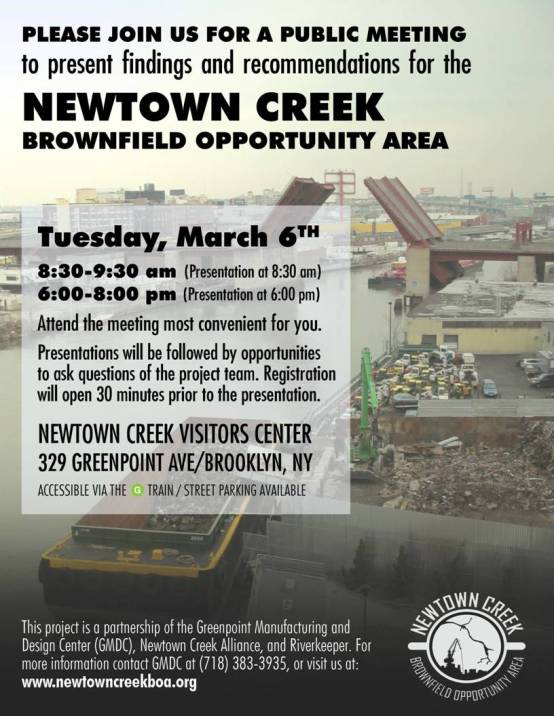
and March 6th, as in Tuesday


 The Newtown Pentacle