Archive for May 2012
form or matter

– photo by Mitch Waxman
Gaze in bewilderment upon the under cobbled lanes of fabled Astoria, hoary and venerable, one of the last locations within the megalopolis which actually resembles New York City. The human infestation is dense here, where an effervescent melange of cultures nevertheless vies to ignore each others presence. Many of my neighbors have told tall tales of “back home”, all of which are unsavory to my American ears. The wonder of this place is that the cultural stressors which tear and gnash have more to do with parking spots and loud music than centuries old blood feuds and the inheritances of Eurasian nationalism.
People in Astoria pride themselves on minding their own business, which has become kind of an issue of late.
from wikipedia
A blood feud is a feud with a cycle of retaliatory violence, with the relatives of someone who has been killed or otherwise wronged or dishonored seeking vengeance by killing or otherwise physically punishing the culprits or their relatives. Historically, the word vendetta has been used to mean a blood feud. The word is Italian, and originates from the Latin vindicta (vengeance). In modern times, the word is sometimes extended to mean any other long-standing feud, not necessarily involving bloodshed. Sometimes, it is not mutual but a prolonged series of hostile acts waged by one person against another without reciprocation.

– photo by Mitch Waxman
Do not mistake the place for a paradise, nor blankly accept the soporific descriptions of Astoria offered by Real Estate Industrial Complex operatives or the political class. One cannot ignore the omnipresent darkness which emerges in the ancient village. Just down my block, a couple of summers ago, an old man died in his house at the height of summer and his mouldering corpse lay undiscovered for several weeks- the explosive result forced a tear down renovation of his living quarters- an expense which forced his landlord to sell the building. Another neighbor, suffering from severe depression, attempted suicide via hanging several years ago. He was clinically dead when the paramedics arrived, but resuscitated. Unfortunately, other members of his creed, adherents to ancient superstition, believe him to be animated by the devil itself and shun him. “The Man with no Soul”, as he is called, wanders the neighborhood blankly and brain damaged.
Also, there is the odd fat man on 34th avenue and his criminal army of juvenile devotees…
from wikipedia
A nachzehrer is created most commonly after suicide, and sometimes from an accidental death. According to German lore, you don’t become one from being bitten, or scratched. It is just something that happens. Nachzehrers are also related to sickness and disease. If a large group of people died of the plague, the first person to have died is believed to be a nachzehrer.
Typically a Nachzehrer devours its family members upon waking. Its also been said that they devour themselves, including their funeral shroud, and the more of themselves they eat, the more of their family they physically drain. It is not unlikely that the idea of the dead eating themselves might have risen from bodies in open graves who had been partly eaten by scavengers like rats.
Some Kashubes believed that the Nachzehrer would leave its grave, shapeshifting into the form of a pig, and pay a visit to their family members to feast on their blood. In addition, the Nachzehrer was able to ascend to a church belfry to ring the bells, bringing death to anyone who hears them. Another lesser known ability of the Nachzehrer is the power it had to bring death by causing its shadow to fall upon someone. Those hunting the Nachzehrer in the graveyard would listen for grunting sounds that it would make while it munched on its grave clothes.

– photo by Mitch Waxman
Brutal homicides and bizarre occurrences permeate the recent past here- on the corner pictured above, there was a gun battle and fatal shooting just last year. An uptick in public drunkenness, petty vandalism, and large groups of carousing youths has been commented on more than once by area wags in recent months. Disturbingly, the social contract seems so tattered that public defecation and urination are now the norm on Broadway, despite the easy availability of lavatories at any number of bars and restaurants. As is the way with Queens, many complain, but few step forward to confront and chase away the chaos.
They shrug, and accept, and forget all about Kitty Genovese.
from wikipedia
Catherine Susan “Kitty” Genovese (July 7, 1935 – March 13, 1964) was a New York City woman who was stabbed to death near her home in the Kew Gardens neighborhood of the borough of Queens in New York City, on March 13, 1964.
The circumstances of her murder and the lack of reaction of numerous neighbors were reported by a newspaper article published two weeks later; the common portrayal of neighbors being fully aware but completely nonresponsive has since been criticized as inaccurate. Nonetheless, it prompted investigation into the social psychological phenomenon that has become known as the bystander effect or “Genovese syndrome” and especially diffusion of responsibility.
obscure world

– photo by Mitch Waxman
As described in prior postings, 58th road and Maspeth Avenue were once connected by a plank road which last crossed the Newtown Creek in 1875 and which was established as early as the 1830’s. What’s important about this is that the street grid in this spot hasn’t appreciably changed since the late 19th century, and it’s one of the few places around the creek where maps require little or no “interpretation”. That’s the Maspeth Avenue side pictured above.
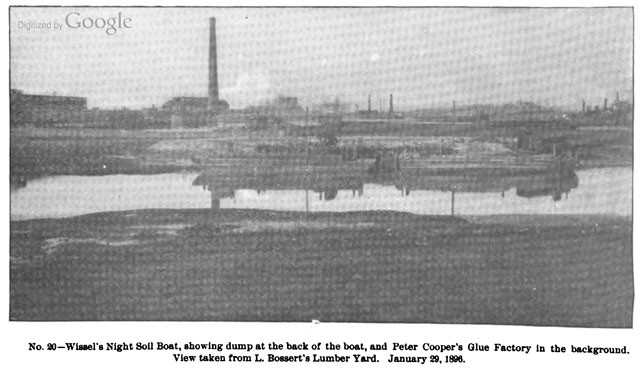
– photo from 1896’s Report By Brooklyn (New York, N.Y.). Dept. of Health, Brooklyn (New York, N.Y.). Health Board, courtesy google books
One of those little nuggets which has fascinated me since beginning to learn about the Creek has been references to “Conrad Wissel’s Dead Animal Wharf” or alternately “night soil dock”. Imagine my surprise when I found a photo of the place from 1896 the other night. In the far left corner of the frame, you can just make out the Maspeth Avenue Plank Road. Wo!
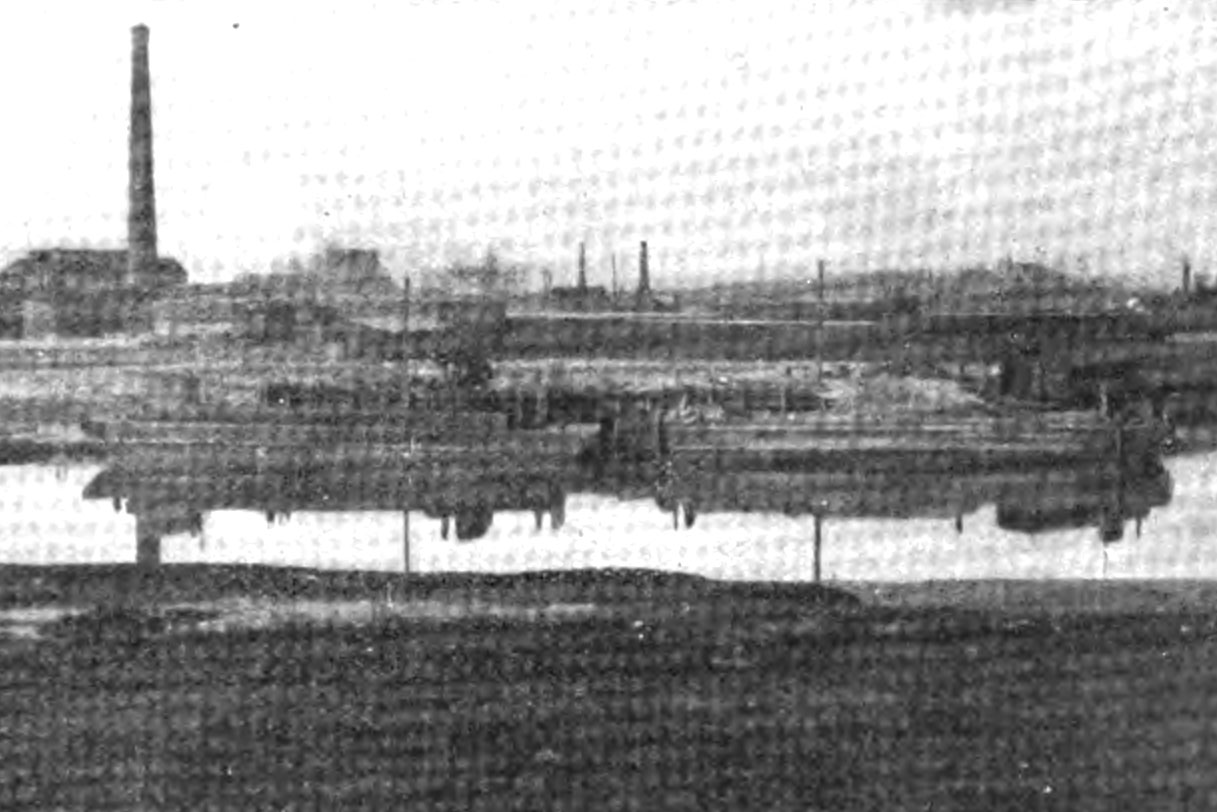
– photo from 1896’s Report By Brooklyn (New York, N.Y.). Dept. of Health, Brooklyn (New York, N.Y.). Health Board, courtesy google books
A little photoshopping has been applied here, improving contrast and attempting to remove some of the moire in google books’s scan of the original.
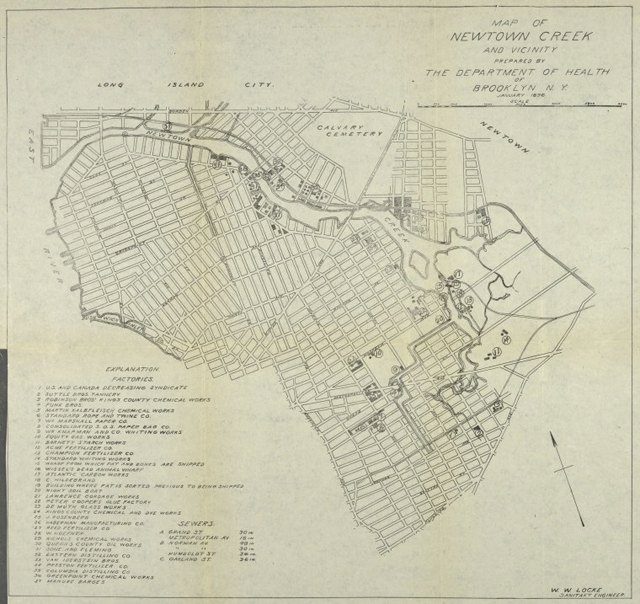
– map from 1896’s Report By Brooklyn (New York, N.Y.). Dept. of Health, Brooklyn (New York, N.Y.). Health Board, courtesy digitalgallery.nypl.org
The NY Public Library hosts the image above, which is the map that was included in the volume that the photo originates in. Click the image to access a zoom able version, whose key lists the Wissel’s dock as number 16.
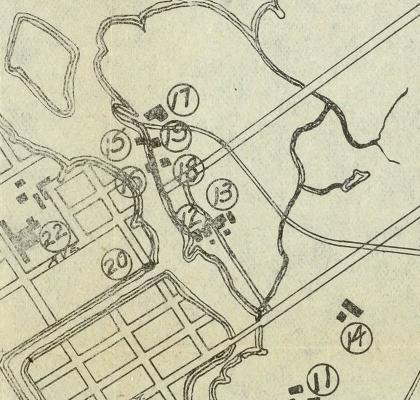
– map from 1896’s Report By Brooklyn (New York, N.Y.). Dept. of Health, Brooklyn (New York, N.Y.). Health Board, courtesy digitalgallery.nypl.org
In this detail from the map, number 16 is clearly just west of the Maspeth Avenue Street end. That’s one mystery solved.

– photo by Mitch Waxman
Here’s another view in modern times, the Wissel property would be just starting on the right side of the frame. The shot is from the Queens side, of course, as is the original- and captured at approximately where the “18” is on the detail of the map. The 1896 photographer would have standing around 500 feet to the right of this vantage point.
The Smelling Committee

– photo by Mitch Waxman
As long time readers will recall, in the fall of 2010, the Newtown Creek Alliance and the Working Harbor Committee received a grant from the NYCEF fund of the Hudson River Foundation to conduct 4 boat tours of Newtown Creek. The plan was to do two ticketed tours for the public (the tickets were available at a steeply discounted rate), one for educators, and one for “the elected’s” of the watershed. The first three went off without a hitch, but the fourth was postponed due to the tragic helicopter crash on the East River which occurred just as we were about to board the boat.
Last Friday, the 4th of May, we accomplished the fourth tour with a modern day “Smelling Committee” onboard.
from “Annual Report of the Department of Health of the City of Brooklyn for the year 1895”, courtesy google books
Whereas, Complaint has been made to the Governor of the State of New York during the year 1894 by the citizens and residents of the Town of Newtown and the City of Brooklyn, relating to the existence of public nuisances on or near Newtown Creek, jeopardizing the health and comfort of the people in the vicinity thereof, and the Hon. Roswell P. Flower, Governor of the State of New York, did thereupon, on the 2d day of August, 1894, pursuant to Chapter 661, of the Laws of 1893, require, order and direct the State Board of Health to examine into the alleged nuiscances, and to report the result thereof…

– photo by Mitch Waxman
Important to the mission was attendance of officials from both sides of the Creek. The “center of gravity” for the advocacy of the Newtown Creek has historically been in Greenpoint, but that doesn’t mean that the folks on the Queens side haven’t been paying attention. Pictured above are Michael Gianaris and Jimmy Van Bramer, and both were anxious to visit this hidden part of their districts.

– photo by Mitch Waxman
As luck would have it, we passed by one of the many workboats which have been operating along the Newtown Creek of late. These workboats, hailing from Millers Launch on Staten Island, are carrying contractors and employees of the Federal Environmental Protection Agency who are collecting samples of the so called “black mayonnaise” sediments for laboratory analysis.

– photo by Mitch Waxman
You cannot fix something unless you understand it, and the EPA has scheduled an exhaustive “scoping period” during which a series of such tests will be performed. Since January, I have personally witnessed dozens of such operations- ranging from towing a sonar buoy up and down the waterway to establish a subsurface topographical map, to the group onboard this vessel who seemed to operating a hand operated dredge to bring materials up into the light.
Notice that the folks directly handling the sediments are wearing protective garments.

– photo by Mitch Waxman
A Newtown Creek Alliance member, Phillip Musegaas of Riverkeeper fame came along to inform about and describe the legal and policy issues surrounding the Greenpoint Oil Spill, Superfund, or any of the myriad points of law which surround the Newtown Creek. That’s Phillip on the right.
I should mention that Council Member Stephen Levin of Greenpoint was onboard as well, but was forced to stay in the cabin and deal with urgent business in his district via phone.

– photo by Mitch Waxman
A decision which I’ve been keeping to is to not bring “civilians” all the way back to English Kills on these boat tours, but this “Smelling Committee” was no mere interested group and accordingly we entered into the heart of darkness- God’s Gift to Pain itself. This is as bad as it gets along the Newtown Creek, a stinking and fetid miasma poisoned with sewage and urban runoff surrounded by waste transfer stations.
In the distance is one of the largest CSO’s in the entire city, and the Montrose Avenue Rail Bridge of the LIRR’s Bushwick Branch.

– photo by Mitch Waxman
Not just elected officials were onboard, of course, representatives of a veritable alphabet soup of three lettered agencies were also invited. Additionally, local leaders- such as Tom Bornemann from the Ridgewood Democratic Club (pictured above, in sunglasses) accompanied the tour. The microphone was passed amongst us, with Kate Zidar (NCA’s executive director), Michael Heimbinder (NCA’s chair), Laura Hoffman (Newtown Creek Monitoring Committee), Phillip Musegaas (Riverkeeper), Penny Lee (City Planning), and myself narrating at various legs of the trip.

– photo by Mitch Waxman
Pictured above are Assemblyman Joe Lentol of Greenpoint, Council Member Jimmy Van Bramer of Queens, Working Harbor Development Director Meg Black, Council Member Diana Reyna of Brooklyn, a gentleman who I’m embarrassed to say I can’t identify, and State Senator Michael Gianaris.

– photo by Mitch Waxman
The Smelling Committee of 2012 encountered a Newtown Creek swollen by days of rain, replete with oil slicks and “floatables” contamination. The term floatables is used to describe everything from stray bits of lumber and tree limbs to cast off plastic bottles and wind blown trash carried in the water, by the way. The trip was 2 hours in length, and accomplished onboard a NY Water Taxi vessel. It left from Pier 17 in Manahattan at four in the afternoon and returned at six, proceeding some three and one half miles into the Newtown Creek and required the opening of the Metropolitan Avenue Bridge.

– photo by Mitch Waxman
Along the way, sites of legal or popular interest were pointed out- including the future of the Arch Street Yard, the Hunters Point South development, SimsMetal, the Newtown Creek Waste Water Treatment Plant, the Greenpoint petroleum district, the Blissville Oil spill, the Greenpoint Oil Spill, the Phelps Dodge site, the Kosciuszko Bridge, the CSO issue, the role of Newtown Creek as a mass employer, the maritime potential of the Creek and its potential for eliminating a significant amount of trucking activity, its myriad waste transfer stations, and the plans which EPA have for the place.

– photo by Mitch Waxman
Crass observers in the antiquarian community and political operatives in both boroughs will sneer at efforts such as this, the aim of which was to create a common sense of purpose and to identify issues regarding the Creek for both the Queens and Brooklyn political establishments. Ridgewood and Bushwick, Maspeth and Greenpoint, Williamsburg and Long Island City- all parts of the Newtown Creek watershed have more in common with each other than they do with neighboring districts in either borough. They are blessed with one of the finest industrial waterfronts in the world, but cursed by its past. What the Newtown Creek will look like in fifty years time is beginning to be discussed, and it was time for this “congress of the creek” to be convened.
So much of what the people in high office know of this place is influenced by dire reportage and dry testimony, and it can be easy to overlook the past, present, and future of this maritime superhighway if you haven’t experienced it first hand.
Especially from the water.

– photo by Mitch Waxman
Several times have I witnessed the effect that this place has on first time visitors, a transformation of expression and demeanor overtakes them.
Hardened New Yorkers all, the Newtown Creek nevertheless explodes all expectations and an expression of wonderment forms upon their faces. They come to see toxic waste dumps and oil spills, but instead find Herons, Egrets, and Cormorants nesting in the broken cement of abandoned industrial bulkheads. They witness the miles wide vistas and wide open view of the City of New York from its very navel, and are thunderstruck that such a place exists- this “Insalubrious Valley” of the Newtown Creek watershed.
Every time I start to narrate on one of these tours, my first utterance is always “this is not the world you know…”.
I’m happy to say that due to the Working Harbor Committee, Newtown Creek Alliance, and the NYCEF Fund of the Hudson River Foundation- the Smelling Committee of 2012 knows this corner of the world a little bit better.
What will come of it?
Others will have to answer that, for your humble narrator must remain without and is cursed to merely observe such matters. Always, an outsider.
perpetually ajar

– photo by Mitch Waxman
Recent serendipity found your humble narrator onboard a vessel plying the languid waters of the Newtown Creek. This particular adventure was part of a larger and laudable effort which will be the subject of a posting later in the week, but urgent demands and unavoidable deadlines preclude discussion of the outing at this point. Instead, one is anxious to share the scenic wonders and hidden landscape of this water body that defines the currently undefended border of Brooklyn and Queens.
Captured in the heart of DUMABO (Down Under the Metropolitan Avenue Bridge), the shot above depicts the far off and omnipresent Sapphire Megalith rising over industrial Brooklyn and framed by the Metropolitan Avenue Bridge while opening at English Kill.

– photo by Mitch Waxman
The self same Megalith again provides geographic context for the scene, and the thrice damned Kosciuszko Bridge and Calvary Cemetery occupy the foreground.
To the right is the Phelps Dodge site, and to the left is found the lurking fear and that rampant darkness which lurks on the Brooklyn side of DUKBO (Down Under the Kosciuszko Bridge Onramp).

– photo by Mitch Waxman
In the shot above, gaze in wonder at the skyline of the Shining City itself, as framed by the titan National Grid tanks and the myriad works of infrastructure arrayed across the Brooklyn flood plain. Inextricably linked, the heavy industries and energy installations along the Newtown Creek allow the Shining City to maintain the facade of assumptions which Manhattanites prefer to believe about this place where aspirant and realist metaphors clash.
More, on why exactly I was on this boat, will be forthcoming. Apologies for brevity and obfuscation.
hideous meaning

– photo by Mitch Waxman
Startling, recent transmissions and recitations from a weird and alien country called Albany brought word that the Governor of New York State has arranged to accelerate the Kosciuszko Bridge project. Complicated planning, difficult execution, and extreme expense hang gruesomely around this project- originally scheduled to commence in 2014, and now expected to begin in 2013.
from nydailynews.com
Construction on a new bridge is now expected to begin in spring 2013 — a year ahead of schedule, thanks to $460 million made available for the job by Gov. Cuomo’s New York Work initiative.
The 73-year-old bridge, which carries the Brooklyn-Queens Expressway over the Newtown Creek, qualified for the money in part because it is on the state’s “deficient bridge” list.
The initial phase of construction will build an eastbound lane next to the existing bridge, according to the state Department of Transportation, the agency overseeing the project. The 1.1-mile bridge is expected to be done in 2017 and will cost about $800 million.
When completed, two new spans with a total of nine vehicle lanes and paths for pedestrians and bikes will replace the original structure.
It’s the single biggest project made possible through the New York Works program, an initiative to create jobs while repairing the state’s infrastructure.

– photo by Mitch Waxman
The 1939 workhorse, erected at the whim of Robert Moses, will no longer soar above that mirrored ribbon of risible metaphor known as the Newtown Creek in just a few years, as scheduled work is meant to conclude in 2017. Area wags shrug and sigh at this, wearily offering that such projects often extend well past their scheduled and budgetary goals, and that the Creek itself will present a series of unexpected problems to be solved.
from dot.ny.gov
Following seven years of alternatives analysis, environmental studies and extensive partnering with community groups and stakeholders, the Federal Highway Administration (FHWA) approved the New York State Department of Transportation’s (NYSDOT) selection of Alternative BR-5 for a new Kosciuszko Bridge in its March 9, 2009 Record of Decision and granted authorization to proceed with Final Design. The Project Team has been working to complete key initial phases of the Final Design which would lay the groundwork to develop and complete the detailed design of the new bridge structure.

– photo by Mitch Waxman
Extensive documentation exists at the State DOT website, with coruscating revelations about both the current structure and anticipations of obstacles and opportunities which will be encountered during pursuit of the new structure. Your humble narrator, threatened by such rapid change, remains nevertheless excited about the idea of a pedestrian walkway overlooking not just the Creek itself- but Calvary Cemetery. Architectural drawings of the future DUKBO (Down Under the Kosciuszko Bridge Onramp) show an intriguing and modernist setting.
from dot.ny.gov
Under all Build Alternatives, excavation of soil would be performed to a depth of about 4.5 m (15 ft), and the walls of the excavation would be braced. Contaminated soil and groundwater would be collected and disposed of. The new foundations would be pile supported, and either large diameter drilled piles or concrete filled driven pipe piles would be used. Drilled pile construction would generate less noise and vibration than driven piles, but may be difficult to install if boulders are encountered. Additionally, there is widespread soil contamination in the area, and contaminated soil and water extracted while drilling would need to be collected, treated and disposed of properly. This construction impact study assumed the use of driven piles.
After pile installation is complete, formwork for the pile cap would be installed, rebar installed, and concrete placed. Pier construction would follow, working from ground level up in approximately 2.5 m (8 ft) segments. Formwork would be installed, rebar installed and concrete placed. After the concrete has cured sufficiently, the forms would be stripped and the sequence would be repeated until the pier was complete.

– photo by Mitch Waxman
A frequent commenter at Newtown Pentacle, “George the atheist”, asked me a while back for clarification and or documentation of my assertion that the reason for the truss bridge’s enormous height over the Creek was to allow egress to ocean going vessels with high stacks (smokestacks). During the course of some general research on Newtown Creek in the first half of the 20th century, this 1951 photo popped up at the NYS Digital collections site which illustrates just such a scene.
from wikipedia
The Kosciuszko Bridge is a truss bridge that spans Newtown Creek between the New York City boroughs of Brooklyn and Queens, connecting Greenpoint, Brooklyn and Maspeth, Queens. It is a part of Interstate 278, which is also locally known as the Brooklyn-Queens Expressway. The bridge opened in 1939, replacing the Penny Bridge from Meeker Avenue in Brooklyn to Review Avenue and Laurel Hill Boulevard, and is the only bridge over Newtown Creek that is not a drawbridge. It was named in honor of Tadeusz Kościuszko, a Polish volunteer who was a General in the American Revolutionary War. Two of the bridge towers are surmounted with eagles, one is the Polish eagle, and the other the American eagle.


 The Newtown Pentacle