Archive for the ‘Brooklyn’ Category
perpetually ajar

– photo by Mitch Waxman
Recent serendipity found your humble narrator onboard a vessel plying the languid waters of the Newtown Creek. This particular adventure was part of a larger and laudable effort which will be the subject of a posting later in the week, but urgent demands and unavoidable deadlines preclude discussion of the outing at this point. Instead, one is anxious to share the scenic wonders and hidden landscape of this water body that defines the currently undefended border of Brooklyn and Queens.
Captured in the heart of DUMABO (Down Under the Metropolitan Avenue Bridge), the shot above depicts the far off and omnipresent Sapphire Megalith rising over industrial Brooklyn and framed by the Metropolitan Avenue Bridge while opening at English Kill.

– photo by Mitch Waxman
The self same Megalith again provides geographic context for the scene, and the thrice damned Kosciuszko Bridge and Calvary Cemetery occupy the foreground.
To the right is the Phelps Dodge site, and to the left is found the lurking fear and that rampant darkness which lurks on the Brooklyn side of DUKBO (Down Under the Kosciuszko Bridge Onramp).

– photo by Mitch Waxman
In the shot above, gaze in wonder at the skyline of the Shining City itself, as framed by the titan National Grid tanks and the myriad works of infrastructure arrayed across the Brooklyn flood plain. Inextricably linked, the heavy industries and energy installations along the Newtown Creek allow the Shining City to maintain the facade of assumptions which Manhattanites prefer to believe about this place where aspirant and realist metaphors clash.
More, on why exactly I was on this boat, will be forthcoming. Apologies for brevity and obfuscation.
fulgent images

– photo by Mitch Waxman
This is not the world you know, this 3.8 mile long cataract of water which forms the currently undefended border of Brooklyn and Queens, whose mouth is found directly opposite the Bellevue Psychiatric Hospital in Manhattan. The very air you breathe is a poisonous fume, and beneath the languid ripples of its mirrored surface hide a morass of centuries old poisons which have been allowed to agglutinate and congeal in fuligin depths. This is where the industrial revolution actually happened, around the canalized bulkheads of the infamous Newtown Creek.

– photo by Mitch Waxman
Great fortunes have arisen here- the Pratts, and Rockefellers, even Peter Cooper- all grew fat at this banquet table. Five great cities arose around the Creek- Williamsburg, Long Island City, Greenpoint, Bushwick, and New York- and by 1900 a thriving maritime industry saw more cargo cross this tiny waterway than could be found on the entire Mississippi river. The vast populations of those five cities found employment here, in titan rail yards and factory mills whose smokestacks blotted out the light cascading down from the burning thermonuclear eye of god itself. This is where the bill came due in the early 20th century, as you cannot have a “Manhattan” without causing a “Newtown Creek”.

– photo by Mitch Waxman
Thought irredeemable, this place became a dumping ground, with raw sewage and every imaginable kind of filth allowed to pool and mingle with the water. By the end of the 20th century, it was a literal backwater and forgotten by all but those cursed to live nearby. Petroleum swirls about beneath the ground, mingling with the esoteric byproducts of early chemical factories and one and a half centuries of breakneck industrial growth. The top soil is impregnated by heavy metals, asbestos, and tons of soot deposited daily by automotive exhaust. Along the rotting bulkheads, sediment mounds of sewage rise from the water, and from forgotten pipelines unknown chemical combinations drip and drool. Who can guess, all there is, that might be buried down there?

– photo by Mitch Waxman
Hope rises, however, at the start of the Superfund era. Federal authorities have begun the laborious process of analyzing and categorizing those sediments which lie fifteen to twenty feet thick on the bottom of the waterway, colloquially referred to as “Black Mayonnaise”. The Superfund legislation which governs their actions has compelled them to remove and remediate these sediments, and deliver Newtown Creek to the future in a healthier condition. Community groups, industrial stakeholders, and officials from both the State and City have begun the task of planning the Newtown Creek of future times. This is the literal backbone and center of New York City.
inaccessible locality

– photo by Mitch Waxman
It would be nice to own a piece of Newtown Creek real estate, don’t you think? I know this sounds like an odd dream of mine, but I’d really love to buy some waterfront parcel were I financially capable. The whole lot would be fairly feral after a short time, of course, except for the teams of archaeologists I’d invite to dig there for treasure. Captain Kidd is supposed to have buried a chest of pirate booty somewhere on the Brooklyn side, don’t you know?
The creek is the receptacle for all the refuse from the sewers, factories, and slaughter-houses of the east of Brooklyn; constant deposits are therefore forming in it, especially at the upper end, from these causes and from the caving in of the unprotected banks, which consist of marsh mud. To remedy this difficulty, annual dredging will be needed until the banks are protected by bulkheads throughout their whole length. The commerce of the creek is so large that this improvement should be pushed at least 3 mile.s up from the mouth as soon as possible, so that vessels drawing 20 to 23 feet may pass in and out of the creek with full cargoes at or near low water.

– photo by Mitch Waxman
Wouldn’t live there, of course, but there would be a public dock. Assuming that a multi million dollar property like this was within my reach, I’d probably have enough left over for one of those flat bottom boats with the big propellor on the back that they use in the swamps of Florida and Louisiana to hunt gators. Of course, I can’t afford the nice zoom lens that I covet, and that’s just a couple thousand, so I can just forget about owning a valuable industrial bulkhead. The last people who let this land go cheap were the aboriginal Lenape, and they were largely wiped out by Smallpox by the 1680’s.
from “Queens Borough, New York City, 1910-1920; the borough of homes and industry, a descriptive and illustrated book setting forth its wonderful growth and development in commerce, industry and homes during the past ten years … a prediction of even greater growth during the next ten years … and a statement of its many advantages, attractions and possibilities as a section wherein to live, to work and to succeed” at Archive.org
Some further idea of the immense commerce of this waterway can be obtained from the figures compiled by the Department of Plant and Structures of New York City, which show that during the year 1918, 59,389 boats passed through the Vernon Avenue Bridge, 56,735 passed through the Greenpoint Avenue Bridge, 27,000 through the Meeker Street Bridge and 5,007 through the Grand Street Bridge.
Steamers schooners and unrigged vessels are the principal freight carriers. Their drafts range from 5^ to 20 feet; 2 to 19 feet; 2 to 18 feet respectively. Some steamers of still larger draft lighter in their cargoes.
Among the larger plants on the Queens shore of Newtown Creek are the National Sugar Refining Company, Nichols Copper Company, National Enameling and Stamping Company, General Chemical Company, Standard Oil Refineries. American Agricultural Chemical Company, and the Wrigley Chewing Gum Company.

– photo by Mitch Waxman
It’s a stupid aspiration, and even dumber to think that I’d just let scholars “have at the place”. What could possibly be learned by turning over a few shovels of dirt in this place, where the only tale to tell is about a certain oil spill or endemic pollution? What else has ever happened here?
from junipercivic.com
On September 15, 1776, General Lord Howe decided to attack Manhattan Island. He ordered three Ships of War to sail up the North River and get the American’s attention while he launched his entire First Division in flatboats against Kips Bay. The flatboats were embarked from the head of Newtown Creek as General Lord Howe and General Warren watched from the Sackett-Clinton House (later Gov. DeWitt Clinton’s mansion) in Maspeth. The Americans on Manhattan Island under General George Washington made their retreat to Harlem and escaped the British attack.

– photo by Mitch Waxman
Can you imagine how cool it would be to restore just a single section of the Newtown Creek to its natural state? To see the salt marsh grasses rippling in the wind, and stout trees sprouting, beneath the golden rays of the burning thermonuclear eye of god itself? What could possibly go wrong with that?
from 1901’s “Forest and stream” Volume 57- By William A. Bruette, courtesy google books
Mosquitoes Galore
Lieutenant Schwatka’s experience with mosquitoes reminds me. Years ago I crossed the Newtown salt meadows on a horse car. It was from a point where Williamsburg left off and Newtown then called Maspeth began. Both are now included in Greater New York. The sun had set and in the twilight from the surface of the meadows could be seen innumerable coils of smoke each one as clearly defined and separate as if emanating from the dying embers of a redman’s camp fire.
First would the dark mass of smoke leave the ground in a slender spiral thread to broaden out as it ascended keeping up the spiral twining of the cloud.
This phenomenon could be seen upon the entire stretch of meadow ahead of us. It was a curious and interesting sight to watch those thousands of small camp fires giving forth their spiral canopies of smoke.
The air had been still and quiet and the smoke ascended slowly and gracefully from the grass. Suddenly a gust of wind passed over the meadows blowing toward us and instantly the spiral harmony of the situation was changed into a grayish atmosphere and as it reached the open car in which I sat a realization that we were looking at spiral clouds of mosquitoes arising from the grass instead of smoke was forcibly thrust upon myself and the well filled car of passengers.
The woodwork of the car the inside of the roof the backs of the seats the hats and clothing of the passengers instantly assumed a dark gray color. The horses were covered from head to foot and became almost unmanageable The car became as some one once remarked all bustle and confusion.
While the passengers with handkerchiefs whipped the mosquitoes from their necks and faces the driver urged the frantic horses to their utmost speed and after a race of about ten minutes we emerged from the meadows and spent the remainder of the trip gradually getting rid of the mosquitoes that were traveling in our car.
I know nothing about Alaska mosquitoes but if they are as thick every summer’s day in Alaska as they were that particular evening twenty years agp on the Newtown Creek meadows then I wonder how grizzly bears moose or any other furred animals can live in Alaska and thrive
-Charles Cristadoro
obscure and cryptical

– photo by Mitch Waxman
Another “Now and then” posting for you today, Lords and Ladies of Newtown, and today it’s arguably my favorite of all the bridges of Newtown Creek- the atavist Grand Street Bridge spanning the currently undefended border of Brooklyn and Queens. The shot above is from the water, as recreating the 1910 era shot below (from the bulkheads of the eastern brooklyn side) would require probable trespass- which in our modern day age of the Terror War might subject one to legal penalties such as exsanguination or some time spent in “the boot“.
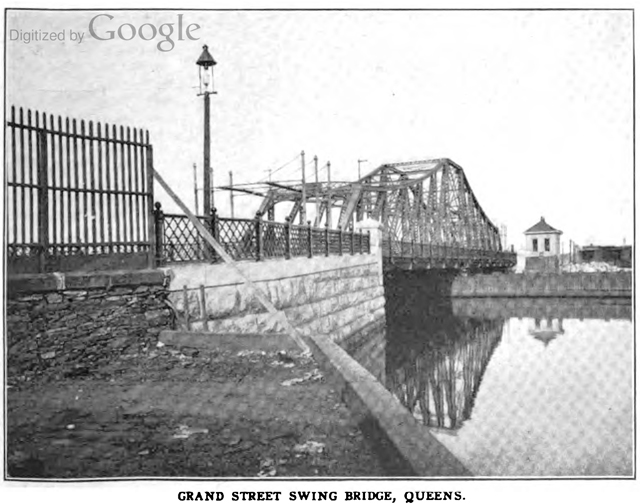
– photo from Engineering magazine, Volume 38, 1910- courtesy google books
While it does seem true that the Grand Street Bridge has changed little in the intervening century, the primary difference between then and now is that it doesn’t function as a swing bridge very often these days. The stalwart engineers and mechanics of the DOT do open it for maintenance periodically, but the City has petitioned the Coast Guard to abandon such actions due to lack of industrial need and expense of operation.
For a prior posting which will tell you literally EVERYTHING about the Grand Street Bridge and environs- an area I call DUGSBO- Down Under the Grand Street Bridge Onramp- click here
Also:

– photo by Mitch Waxman
An NCA event, which I for one am pretty stoked about:
April NCA meeting hosts Dr. Eric Sanderson
Thursday, April 26, 2012 at 6pm
Ridgewood Democratic Club, 6070 Putnam Avenue, Ridgewood, NY 11385
In addition to important updates from our members – in particular the Bioremedition Workgroup has been very busy! – we will be hosting a special presentation on the “Historical Ecology of Newtown Creek”.
Dr. Eric Sanderson, senior conservation ecologist at the Wildlife Conservation Society and author of “Mannahatta: A Natural History of New York City” (Abrams, 2009), will describe recent studies of the historical ecology of Newtown Creek, describing the original wetlands, creek channels, topography and vegetation of the area. He will show a series of 18th and 19th century maps of the watershed of the creek and discuss the process of synthesizing them into an integrated ecological picture that can be used to inform and inspire natural restoration and cultural appreciation of the Newtown Creek watershed. This work is part of the Welikia Project (welikia.org), an investigation into the historical ecology of the five boroughs of New York City and surrounding waters. The Welikia Project on Newtown Creek is funded by The NYCEF Newtown Creek Fund of the Hudson River Foundation.
And this Saturday,

Obscura Day 2012, Thirteen Steps around Dutch Kills
Saturday April 28th, 10 a.m.
Your humble narrator will be narrating humbly at this year’s Obscura Day event on April 28th, leading a walking tour of Dutch Kills. There are a few tickets left, so grab them while you can.
“Found less than one mile from the East River, Dutch Kills is home to four movable (and one fixed span) bridges, including one of only two retractible bridges remaining in New York City. Dutch Kills is considered to be the central artery of industrial Long Island City and is ringed with enormous factory buildings, titan rail yards — it’s where the industrial revolution actually happened. Bring your camera, as the tour will be revealing an incredible landscape along this section of the troubled Newtown Creek Watershed.”
For tickets and full details, click here :
obscuraday.com/events/thirteen-steps-dutch-kills-newtown-creek-exploration
time convulsed

– photo by Mitch Waxman
As mentioned in yesterday’s posting, I spend an atrocious amount of time studying century old publications and journals found on google books. These periodicals, both trade and municipal in nature, often discuss the origins of the Newtown Creek as it exists today. At the beginning of the 20th century, when the Creek was at its arguable worst (environmentally speaking), there was a popular sentiment that engineering could fix all of its problems.
Hindsight suggests that they just made things worse, of course, but there’s the human condition for you. Pictured above is the Greenpoint Avenue Bridge in modernity, while below is the 1910 version.
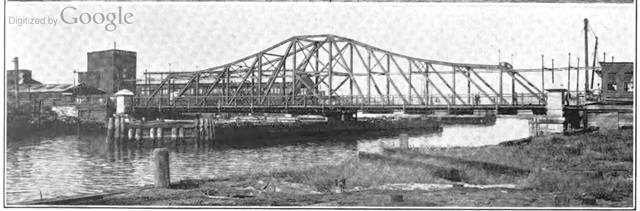
– photo from Engineering magazine, Volume 38, 1910- courtesy google books
This is the bridge that burned away in the 1919 Locust Hill Oil Refinery disaster, a swing bridge not unlike the relict Grand Street Bridge found further up the Creek. Whenever such “Now and then” shots come into my hands, especially images considered to be in the public domain- they will be eagerly shared at this- your Newtown Pentacle.
For more on the history of the Greenpoint Avenue Bridge and its environs, which I call DUGABO- Down Under the Greenpoint Avenue Bridge Onramp- click here
Also:
– photo by Mitch Waxman
An NCA event, which I for one am pretty stoked about:
April NCA meeting hosts Dr. Eric Sanderson
Thursday, April 26, 2012 at 6pm
Ridgewood Democratic Club, 6070 Putnam Avenue, Ridgewood, NY 11385
In addition to important updates from our members – in particular the Bioremedition Workgroup has been very busy! – we will be hosting a special presentation on the “Historical Ecology of Newtown Creek”.
Dr. Eric Sanderson, senior conservation ecologist at the Wildlife Conservation Society and author of “Mannahatta: A Natural History of New York City” (Abrams, 2009), will describe recent studies of the historical ecology of Newtown Creek, describing the original wetlands, creek channels, topography and vegetation of the area. He will show a series of 18th and 19th century maps of the watershed of the creek and discuss the process of synthesizing them into an integrated ecological picture that can be used to inform and inspire natural restoration and cultural appreciation of the Newtown Creek watershed. This work is part of the Welikia Project (welikia.org), an investigation into the historical ecology of the five boroughs of New York City and surrounding waters.
And this Saturday,
Obscura Day 2012, Thirteen Steps around Dutch Kills
Saturday April 28th, 10 a.m.
Your humble narrator will be narrating humbly at this year’s Obscura Day event on April 28th, leading a walking tour of Dutch Kills. There are a few tickets left, so grab them while you can.
“Found less than one mile from the East River, Dutch Kills is home to four movable (and one fixed span) bridges, including one of only two retractible bridges remaining in New York City. Dutch Kills is considered to be the central artery of industrial Long Island City and is ringed with enormous factory buildings, titan rail yards — it’s where the industrial revolution actually happened. Bring your camera, as the tour will be revealing an incredible landscape along this section of the troubled Newtown Creek Watershed.”
For tickets and full details, click here :
obscuraday.com/events/thirteen-steps-dutch-kills-newtown-creek-exploration


 The Newtown Pentacle