Archive for the ‘East River’ Category
partly delirious

– photo by Mitch Waxman
Recently spotted as it plied the estuarine expanses of the East River, the Vane Brothers Sassafras Tug. Your humble narrator was onboard an East River Ferry, heading from Manhattan to Greenpoint, and spotted the tug moving iconically along the strait.

– photo by Mitch Waxman
In the dim past of industrial supremacy, this was one of the busiest stretches of aqua firma in the world, and it is truly a condemnation upon our modern civilization that the passing of a tug and barge along its expanses is something remarkable. A blogger of a century ago would have been limited to monographs, of course, but such a creature would have found very little to say about such a thing. In modernity, it would be like commenting on the passing of a common truck.
———————————————————————————————
Upcoming Walking Tour- The Poison Cauldron, with Atlas Obscura


– photo by Mitch Waxman
Meetup at the corner of Kingsland and Norman Avenues in Greenpoint at 11 on Saturday, August 25th.
We will be exploring the petroleum and waste transfer districts of the Newtown Creek watershed in North Brooklyn. Heavily industrialized, the area we will be walking through is the heart of the Greenpoint Oil Spill and home to scores of waste transfer stations and other heavy industries. We will be heading for the thrice damned Kosciuszko Bridge, which is scheduled for a demolition and replacement project which will be starting in 2013. Photographers, in particular, will find this an interesting walk through a little known and quite obscure section of New York City.
Be prepared: We’ll be encountering broken pavement, sometimes heavy truck traffic, and experiencing a virtual urban desert as we move through the concrete devastations of North Brooklyn. Dress and pack appropriately for hiking, closed toe shoes are highly recommended- as are a hat or parasol to shield you from the sun.
Bathroom opportunities will be found only at the start of the walk, which will be around three hours long and cover approximately three miles of ground. Drivers, it would be wise to leave your cars in the vicinity of McGolrick Park in Greenpoint.
Click here for tickets, and as always- a limited number of walk ups will be welcomed- but for safety reasons we need to limit the group to a manageable size. Contact me at this email if you desire further details.
final destinations
This is tomorrow, as in Sunday the 22nd. Seriously- you can count the number of seats left with one hand. If you haven’t got your tickets yet, today is probably your last chance.
 |
 |
Many people know about the environmental issues facing Newtown Creek, but did you know that the Creek was once the busiest waterway in North America, carrying more industrial tonnage than the entire Mississippi River?
You’ll learn much more when Working Harbor Committee’s maritime historians and harbor experts
put it all in context during a Hidden Harbor Tours: Newtown Creek Exploration.
The heart of industrial New York, Newtown Creek was home port to hundreds of tugboats (one of which is the historic WO Decker). It was also an international destination for oceangoing ships and a vast intermodal shipping and manufacturing hub that employed hundreds of thousands of people. Forming the border of Brooklyn and Queens for nearly three miles, five great cities grew rich along the Newtown Creek’s bulkheads — Greenpoint, Willamsburg, Bushwick, Long Island City and Manhattan itself. The waterway is still a vital part of the harbor and the Working Harbor Committee (WHC) is proud to present this tour as part of the celebration of their tenth anniversary year.
Mitch Waxman, a member of WHC’s steering committee and the group’s official photographer, also serves with the Newtown Creek Alliance as its group Historian. In addition to working on WHC’s boat tours of the Creek, Mitch offers a regular lineup of popular walking tours, and presents a series of well-attended slideshows for political, governmental, antiquarian, historical and school groups. His website – newtownpentacle.com – chronicles his adventures along the Newtown Creek and in the greater Working Harbor.
He was recently profiled in the NY Times Metro section, check out the article here.
Upcoming tour: Hidden Harbor Tours: Newtown Creek Exploration.
On July 22nd, Mitch shares his unique point of view and deep understanding of the past, present and future conditions of the Newtown Creek as the narrator and expedition leader for this years Hidden Harbor Tours: Newtown Creek exploration.
Our NY Water Taxi leaves from South Street Seaport at 11 a.m. (sharp) on a three hour tour of the Newtown Creek. From the East River we’ll move into the Newtown Creek where we’ll explore explore vast amounts of maritime infrastructure, see many movable bridges and discover the very heart of the Hidden Harbor.
Limited seating available, get your tickets today.
 |
|||||||||||||||
|
|||||||||||||||


Newtown Creek Boat Tour

– photo by Mitch Waxman
This coming Sunday -the 22nd of July, the Working Harbor Committee is producing and offering a boat tour of the Newtown Creek to any interested parties. A special emphasis on the waterway’s storied history and maritime legacy will be made.
I’m going to be doing the history part, speaking in my capacity as the Newtown Creek Alliance Historian, and am tasked with highlighting the various points of interest encountered along the route. Anticipated to be some three hours in length, this boat tour will be delving some three miles inland, proceeding to the Metropolitan Avenue Bridge crossing English Kills in East Williamsburg, Brooklyn.

– photo by Mitch Waxman
The Maritime History of Newtown Creek is one largely forgotten in these decadent times, but even now an odd tugboat and barge might be spied making their way down the waterway on any given day. Property owners were considered to have been blessed by some of the finest industrial bulkheads in the world a mere century ago, yet many of the businesses based along the Creek today ignore this invaluable resource, allowing their waterfront property to decay and decline.
Nevertheless, a staggering amount of maritime traffic is still observed here, and towing companies such as Reinauer, K-Sea, DonJon, and Poling and Cutler are regular visitors.

– photo by Mitch Waxman
Vast operations will be witnessed by those onboard, many of which are involved in the scrap metal and recyclables trade. Responsible for an enormous amount of cross harbor shipping, companies such as SimsMetal are heavily reliant on the maritime trades for their economic success.
Not all that long ago, Newtown Creek carried a greater tonnage of cargo than the entire Mississippi River.

– photo by Mitch Waxman
An active and thriving industrial zone in the center of New York City, from the water one can truly grasp the sheer scale of Newtown Creek’s busy waterfront. Normally hidden by high fences and obscured by street facing structures, the intensity of the Newtown Creek is laid bare before the admiring gaze of first time visitor and veteran urban explorer alike.

– photo by Mitch Waxman
A tributary of the estuarine East River, Newtown Creek extends some 3.8 miles from its junction with the more familiar waterway, and provides demarcation for the currently undefended border of much of Brooklyn and Queens. Named to the Federal Superfund list, the Creek suffers from a history of environmental degradation and municipal neglect.
An era of great change is upon the Newtown Creek, and this trip will be one of your last chances to see it in its current form.

– photo by Mitch Waxman
We will see four moveable bridges, and this year will be your last chance to see the static Kosciuszko Bridge as the NYS DOT has indicated that construction on its replacement will begin as early as the Spring of 2013.

– photo by Mitch Waxman
Along it’s banks, great fortunes have risen.
Amongst others- Peter Cooper (BO Railroad, Canton Iron, and Cooper Union), Charles Pratt (Astral Oil, and Pratt University), and ultimately John D. Rockefeller (Standard Oil)– all grew richer than the dreams of avarice in this place. Alongside them, the darkest mills of the industrial revolution- rendering plants, yeast distilleries, bone blackers, and acid factories provided tens of thousands of jobs to the immigrant populations of Brooklyn and Queens. Today- National Grid, BP, Amoco, ExxonMobil, and a host of other multinational companies still maintain an enormous investment in this valuable industrial canal.
There are still a few, and I mean “few” tickets left for this trip- get yours while you can.
Upcoming tour: Hidden Harbor Tours: Newtown Creek Exploration.
On July 22nd, Mitch shares his unique point of view and deep understanding of the past, present and future conditions of the Newtown Creek as the narrator and expedition leader for this years Hidden Harbor Tours: Newtown Creek exploration.
Our NY Water Taxi leaves from South Street Seaport at 11 a.m. (sharp) on a three hour tour of the Newtown Creek. From the East River we’ll move into the Newtown Creek where we’ll explore explore vast amounts of maritime infrastructure, see many movable bridges and discover the very heart of the Hidden Harbor.
Limited seating available, get your tickets today.
Tickets $50, trip leaves Pier 17 at South Street Seaport at 11a.m. sharp.
We will be traveling in a comfortable NY Water Taxi vessel with indoor and outdoor seating. There will be refreshments and snacks available for purchase at the bar.
supposedly solid

– photo by Mitch Waxman
The DEP Pump House described in yesterday’s posting, which is located in Manhattan’s “Alphabet City” neighborhood, is found across the street from Con Ed’s East River Generating Station. Both facilities are, in turn, surrounded by vast residential complexes which long time New Yorkers might refer to as “The Projects“.
Governmental officials would prefer the term “affordable housing“, of course, or at the very least- “The Jacob Riis Houses”.
from wikipedia
The New York City steam system is a district heating system which takes steam produced by steam generating stations and carries it under the streets of Manhattan to heat, cool, or supply power to high rise buildings and businesses. Some New York businesses and facilities also use the steam for cleaning, climate control and disinfection.
The New York Steam Company began providing service in lower Manhattan in 1882. Today, Consolidated Edison operates the largest commercial steam system in the United States. The organization within Con Edison that is responsible for the system’s operation is known as Steam Operations, providing steam service to nearly 1,800 customers and serving more than 100,000 commercial and residential establishments in Manhattan from Battery Park to 96th Street uptown on the West side and 89th Street on the East side of Manhattan. Roughly 30 billion lbs (just under 13.64 megatons) of steam flow through the system every year.

– photo by Mitch Waxman
The subject of the post today has little to do with the aforementioned complex of buildings, they are mentioned strictly for contextual and geographic orientation of the Con Ed facility. My understanding is that this “cogeneration” facility is considered to be a desirable target to those ragged armies of third world sappers commonly referred to as “terrorists“, and several acquaintances and or friends have found themselves being interviewed by Police and Security personnel merely for having photographed the place.
from coned.com
In the grand tradition of the Jumbo dynamos, the six-story boilers installed at Fourteenth Street and East River were so large that a luncheon for nearly 100 people was served inside one of them before the renovated station went into operation in the late 1920s. During the opening day ceremony in 1926, Queen Marie of Rumania flipped the switch to start the 100,000 horsepower turbine generator.

– photo by Mitch Waxman
The view in the first two shots are from the East River, captured while onboard aquatic vessels, and the shot above is actually from the roof of the DEP Pump house.
The housing complex in the shot above is not true “public housing”, rather it is the Stuyvesant Town property. After the second World War, “urban renewal” projects such as the Riis Houses and Stuyvesant Town were seen as the answer to the endemic poverty found around and propagated by tenement slums. Funding and political impetus for large scale developments such as these- inspired by the ideations of a cryptofascist architect, LeCorbusier, and his disastrous “Tower in a park” conception- were made possible by both Federal and entrepreneurial sources.
Located on the east side of Lower Manhattan, the 43,000-sq.-ft. facility produces electricity and steam for homes and businesses throughout New York City. The project was completed May.
To repower the 360-MW power plant, the project team is performing all civil, structural, electrical and mechanical work, including the installation of major equipment, such as two GE Frame 7FA gas turbines, two Vogt-NEM, Inc. heat recovery steam generators and three Atlas Copco gas compressors. More than 100,000 lin. ft. of process pipe will be installed.
Construction of a new, onsite water treatment plant is also a part of the contract. The new treatment plant will consist of a 9,000 GMP reverse osmosis system that will produce pure water for steam generation. Electrical work includes the installation of 77,000 lin. ft. of conduit, 15,000 lin. ft. of cable tray, 665,000 lin. ft. of power and control cable and 30,000 electrical terminations.

– photo by Mitch Waxman
Historically, this area was known as the Gas House District, so named for an enormous number of multi story “high pressure” tanks and the hundreds of associated industrial buildings which serviced and supplied them. A network of pipes snaked out into Manhattan from the East River, supplying fuel to street lights, commercial customers, and even residences.
The adage “Don’t blow out the light” was displayed prominently in hotels and flop houses all over town during the 19th century, as newcomers to the City would often treat a gas light in the manner they would a candle- which would have disastrous, fatal, and often explosive results. The District followed the East River and extended from 14th to 27th streets.
The neighborhoods surrounding the Gas Light District was notorious for its violent crime.
from gsapp.org
Address: East 14th Street
Architect: Thomas E. Murray/Unknown
Date: 1926/1950s
The Consolidated Edison Company’s East River Generating Station dominates the eastern section of 14th Street, stretching from 13th and 17th Streets and between Avenue C and the East River. It was erected primarily in two phases, the first campaign completed in 1926 and the second in the 1950s. Because of its size and prominence, the East River Generating Station plays an important role in the history of the East River waterfront, as well as in the general evolution of power plant architecture in New York City. The widespread low-scale fabric of the Lower East Side, consisting mostly of tenement buildings, went generally unchanged for most of the nineteenth century and the early part of the twentieth century, while the rest of Manhattan was seeing the erection of skyscrapers and other tall buildings.
Driven by the increasing cost of power plant construction and the need to design “with an eye to the future,” the East River Generating Station of 1926 was designed to be less ostentatious than earlier stations that were typically of the Beaux-Arts Style, yet it was also less monolithic than contemporaries such as Hell Gate or Hudson Avenue Stations. The waterfront façade of this building was divided into three distinct bays in rectilinear form, a design scheme that allowed for easy expansion as need be. The building uses vertical fenestration and horizontal bands of limestone set within a field of dark red brick to give the façade a sense of visual excitement
eery pinnacle
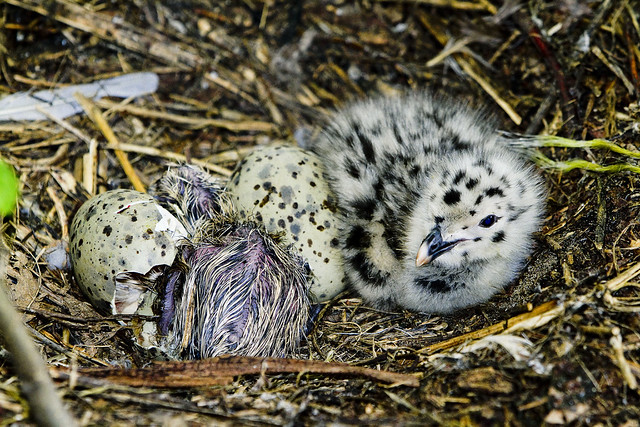
– photo by Mitch Waxman
Until you’ve had a flock of baby birds vomit on you, you haven’t really lived.
It seems that such regurgitation is just part of the daily grind here on South Brother island, an unassuming prominence found on the East River. Heavily wooded, the island is owned and managed by the Government(s) and it is usually “verboten” for primates to even visit.
from wikipedia
South Brother Island is one of a pair of small islands in the East River situated between the Bronx and Riker’s Island, New York City and is 7 acres (28,000 m2) in size. It is uninhabited. The other island, larger and better known, is North Brother Island. Until 1964, South Brother Island was part of Queens County, but it is now part of Bronx County. It had long been privately owned, but was purchased by the city in 2007. Together, the two Brother Islands, North and South, have a land area of 81,423 square meters, or 20.12 acres (81,400 m2).

– photo by Mitch Waxman
Your humble narrator managed to insert himself into a scientific survey of the breeding colony of Cormorants, Herons, and Egrets which thrive upon the riverine island. The island has been allowed to go feral, and is positively overrun by seabirds. Upon arriving there via a Zodiac boat, one of the fellows employed by the NRG (Natural Resources Group) of the NYC Parks Dept. asked me if I knew what poison ivy looked like.
Informing him that he should just assume my general ignorance about all things, he remarked- you’re standing in it.
from wikipedia
Toxicodendron radicans, better known as poison ivy (older synonyms are Rhus toxicodendron and Rhus radicans), is a poisonous North American plant that is well known for its production of urushiol, a clear liquid compound found within the sap of the plant that causes an itching, or sometimes painful rash in most people who touch it. The plant is not a true ivy (Hedera).
Poison ivy can be found growing in any of the following three forms:
- as a trailing vine that is 10–25 cm tall (4 to 10 inches)
- as a shrub up to 1.2 m tall (4 feet)
- as a climbing vine that grows on trees or some other support

– photo by Mitch Waxman
The party split into two groups, and the one I accompanied headed into the stand of trees which comprises the center of the island. Thick and overgrown, the darkness of the place was palpable, and a raucous chorus of bird calls was emanating from the canopy above. The mission was to count the number of nests installed (in this section by Cormorants) and whenever possible- to count the number of eggs and or hatchlings.
The other group was busy exploring Heron territory.
from wikipedia
The Black-crowned Night Heron (Nycticorax nycticorax), commonly abbreviated to just Night Heron in Eurasia, is a medium-sized heron found throughout a large part of the world, except in the coldest regions and Australasia (where replaced by the closely related Rufous Night Heron, with which it has hybridized in the area of contact).

– photo by Mitch Waxman
This was by no means an easy task, given the sort of terrain encountered.
Once- the Newtown Creek’s watershed would have resembled this scene, thought a humble narrator, when a half digested fragment of fish dropped out of the sky and bounced off my boonie hat. It was quickly explained to me that this was normal, expected, and part of their daily round. The floor of the place was a spongy mass of fallen branches, mulch, and guano.
An intense smell of ammonia forced me back to the beach a couple of times.
from wikipedia
Regurgitation is used by a number of species to feed their young. This is typically in circumstances where the young is at a fixed location and a parent must forage or hunt for food, especially under circumstances where the carriage of small prey would be subject to robbing by other predators or the whole prey is larger than can be carried to a den or nest. Some birds species also occasionally regurgitate pellets of indigestible matter such as bones and feathers. Penguins are known to regurgitate in order to feed their young ones.

– photo by Mitch Waxman
Shooting conditions were difficult, with dense foliage and few clearings. The humidity was nearly unbearable. The instructions I had received from the group leader indicated that I should dress in long sleeves, full length pants, and wear heavy boots.
Conditions on the island indeed demanded such cautions, but heat and humidity plus the aforementioned ensemble worn with a hat while carrying a camera bag and around six pounds of camera and lens made for an uncomfortable morning.
Karmic justice, I suppose, for all the complaining about being cold I subjected you to during the winter at this- your Newtown Pentacle.
this page at nysl.nysed.gov lists all the complaint departments in New York State
Complaint Departments
New York State government information and resources on Complaint Departments.
Consumer Information
WWW.NY.GOV – cick on “Complaints.
Attorney General’s Office
Complaints – Includes a section on “Complaints for Other Agencies” to help people contact the appropriate agency…

– photo by Mitch Waxman
It should be mentioned that I absolutely detest camping out, abhor hikes in the woods, and am- by definition- a City Boy. Nature wants to eat you, and will at the very first chance it gets. You might be disarmed by the coy attractions of these baby birds, but give them the chance and they’d rip you to shreds.
Then they’d vomit the bits back out onto the next guy who visits this island.
It did occur to me that this might be a safe haven in case of a zombie apocalypse, but the nearby North Brother Island would probably be a better choice. Seriously, I’m not just being paranoid, nature can be messed up, and given several recent headlines– might be time to start formulating a plan for upcoming Nights, Dawns, and Days.
from wikipedia
The bird family Phalacrocoracidae is represented by some 40 species of cormorants and shags. /ˈkɔrmərənt/ Several different classifications of the family have been proposed recently, and the number of genera is disputed.

– photo by Mitch Waxman
In the real world, of course, such fancies fall before the hard materialism of the empirical mindset, and this mission I was accompanying dwelt naught upon such extravagant thinking. They were doing the hard work of field science, collecting data and samples for later analysis. The South Brother Island was acquired by the Parks people in 2008 and the notion of dedicating the tiny island(s) as a refuge for seabirds is actually pretty darned cool.
from nycgovparks.org
In 2001, the City assigned Parks jurisdiction over the publicly-owned lands extending outward from the shores of South Brother Island. The island itself was owned by Hampton Scows, Inc. The recent acquisition of South Brother Island was directly negotiated and completed with approximately $2 million in funds allocated by Congressman Jose Serrano through NOAA’s Coastal and Estuarine Land Conservation Program.
The acquisition was executed by The Trust for Public Land on behalf of the recipients of the NOAA funding, The Wildlife Conservation Society and The Point Community Development Corporation. The Trust for Public Land then donated South Brother Island to Parks for public ownership, management, and natural resource protection.

– photo by Mitch Waxman
An interesting auditory effect was noticed, incidentally, which rendered the vocalizations of the avian multitudes into something akin to that which you would hear coming from a crowded lunchroom full of school kids. This blended with a syncopated call and response of what sounded like calisthenics PE over at Rikers Island, a short distance away.
Note- the island is strictly off limits (said status is zealously enforced by several of the different harbor officialdoms and gendarmes). I was the guest of a highly trained and dedicated crew who catechized me on the rules of the place and watched my every step to insure that no harm came to anything living here. It is illegal, in the extreme, to visit this place without prior approval from the authorities.
Despite my dripping sarcasm and good natured kvetching about the trip, the folks I was with are really fighting the good fight here, gathering data in difficult conditions in order to understand the breeding habits of endangered wildlife to foment the survival of said species in the harbor of New York.
check out this 2007 report from harborestuary.org, which contains data supplied by some of the folks on this trip, and is an earlier iteration of what they were up to just a few days ago.
Also:
June 16th, 2012- Newtown Creek Alliance Dutch Kills walk

– photo by Mitch Waxman
The Newtown Creek Alliance has asked that, in my official capacity as group historian, a tour be conducted on the 16th of June- a Saturday. This walk will follow the Dutch Kills tributary, and will include a couple of guest speakers from the Alliance itself, which will provide welcome relief for tour goers from listening to me rattle on about Michael Degnon, Patrick “Battle Ax” Gleason, and a bunch of bridges that no one has ever heard of.
for June 16th tickets, click here for the Newtown Creek Alliance ticketing page
June 23rd, 2012- Atlas Obscura Thirteen Steps around Dutch Kills walk

– photo by Mitch Waxman
Additionally- the “Obscura Day” Thirteen Steps around Dutch Kills tour proved that the efficacy and charms of the Newtown Creek’s least known tributary, with its myriad points of interest, could cause a large group to overlook my various inadequacies and failings. The folks at Atlas Obscura, which is a fantastic website worthy of your attentions (btw), have asked me to repeat the tour on the 23rd of June- also a Saturday.
for June 23rd tickets, click here for the Atlas Obscura ticketing page
June 30th, 2012- Working Harbor Committee Kill Van Kull walk

– photo by Mitch Waxman
My various interests out on the sixth borough, NY Harbor, have brought me into association with the Working Harbor Committee. A member of the group’s Steering Committee- I also serve as the “official” group photographer, am chairman and principal narrator of their annual Newtown Creek Boast Tour, and occasionally speak on the microphone during other tours (mainly the Brooklyn one). This year, the group has branched out into terrestrial explorations to compliment the intense and extant schedule of boat tours, and I’m going to be leading a Kill Van Kull walking tour that should be a lot of fun.
The Kill Van Kull, or tugboat alley as its known to we harbor rats, is a tidal strait that defines the border of Staten Island and New Jersey. A busy and highly industrialized waterfront, Working Harbor’s popular “Hidden Harbor – Newark Bay” boat tours provide water access to the Kill, but what is it like on the landward side?
Starting at the St. George Staten Island Ferry terminal, join WHC Steering Committee member Mitch Waxman for a walk up the Kill Van Kull via Staten Islands Richmond Terrace. You’ll encounter unrivaled views of the maritime traffic on the Kill itself, as well as the hidden past of the historic maritime communities which line it’s shores. Surprising and historic neighborhoods, an abandoned railway, and tales of prohibition era bootleggers await.
The tour will start at 11, sharp, and you must be on (at least) the 10:30 AM Staten Island Ferry to meet the group at St. George. Again, plan for transportation changes and unexpected weirdness to be revealed to you at MTA.info.
For June 30th tickets, click here for the Working Harbor Committee ticketing page


 The Newtown Pentacle