Archive for the ‘kosciuszko bridge’ Category
Project Firebox 26

– photo by Mitch Waxman
Hanging precipitously on Brooklyn’s Varick Avenue, in the shadow of the vast Kosciuszko Bridge, is found this emergency call box. Hedged and hidden by barbed undergrowth, neglected and forgotten by soporific politics, it nevertheless signals that a New Year has arrived in the Newtown Pentacle.
Welcome to 2012, lords and ladies, and don’t look back lest you become naught but a pillar of salt.
warnings and prophecies
2011’s Greatest Hits:

– photo by Mitch Waxman
In January of 2011, while walking along in knee deep snow, your humble narrator happened across this enigmatic and somehow familiar item sitting in a drift at the NYC S.E.M./Signals Street Light Yard of the DOT at 37th avenue near the Sunnyside and Astoria border. It looked familiar to me, but I didn’t recognize it for what it was until sharp eyed reader TJ Connick suggested that this might be the long missing Light Stanchion which once adorned the Queensboro Bridge’s Manhattan landing.
These two posts: “an odd impulse“, and “wisdom of crowds” discuss the discovery and identification in some detail.
Some good news about this iconic piece of Queens history will be forthcoming, but I’ve been asked to keep it quiet for the moment.

– photo by Mitch Waxman
In February of 2011, “Vapour Soaked” presented a startling concurrence of comparitive detail for the discerning viewer, when the shot above was presented in contrast with a 1920’s shot from The Newtown Creek industrial district of New York City By Merchants’ Association of New York. Industrial Bureau, 1921″, (courtesy Google Books).
Admittedly, not quite as earth shaking as January’s news, but cool nevertheless. I really like these “now and then” shots, expect more of the same to come your way in the future.

– photo by Mitch Waxman
In March of 2011, “first, Calvary” discussed the epic (for me) quest to find a proverbial “needle in a haystack” within First Calvary Cemetery- the grave of its very first interment, an Irish woman named Esther Ennis who died in 1848. I have spent an enormous amount of time searching for this spot, where Dagger John Hughes first consecrated the soil of Newtown.

– photo by Mitch Waxman
In April of 2011, the world lost one of its best people and my official “partner in crime”, Bernard Ente.
He was ill for awhile, but asked me to keep the severity of things quiet. He passed in the beginning of April, and one of the last requests he made of me (along with “taking care” of certain people) was to continue what he had started along the Newtown Creek and all around NY Harbor.
This was when I had to step forward, up my game, and attempt to fill a pair of gargantuan boots. Frankly, I’m not even half of who he was, but I’m trying. That’s when I officially stepped forward and began introducing myself as a representative of Newtown Creek Alliance, and joined the Working Harbor Committee– two organizations which Bernie was committed to. I’m still trying to wrap my head around his loss.

– photo by Mitch Waxman
In May of 2011, while attempting to come to terms with my new roles in both organizations, it was decided that a fitting tribute to our fallen comrade would be the continuance of his annual “Newtown Creek Cruises” and the date of May 21 was set for the event. An incredible learning experience, the success of the voyage would not have been possible without the tutelage of WHC’s John Doswell and Meg Black, NCA’s Katie Schmid, or especially the aid of “Our Lady of the Pentacle” and the Newtown Pentacle’s stalwart far eastern correspondent: Armstrong.
Funny moments from during this period included the question “Whom do you call to get a drawbridge in NYC to open for you?”.
During this time, I also became involved with Forgotten-NY’s Kevin Walsh and Greater Astoria Historical Society’s Richard Melnick and their ambitious schedule of historical tours.

– photo by Mitch Waxman
In June of 2011, the earliest Newtown Creek Chemical Factory which I’ve been able to find in the historical record, so far, was explored in the post “lined with sorrow“- describing “the Bushwick Chemical Works of M. Kalbfleisch & Sons”.
Additionally, my “Newtown Creek Magic Lantern Show” was presented to a sold out and standing room only crowd at the Greater Astoria Historical Society.
This was also the beginning of a period which has persisted all year- in which my efforts of behalf of the various organizations and political causes which I’m advocating for had reduced my output to a mere 15 or fewer postings a month.
All attempts are underway to remedy this situation in 2012, and apologies are offered.

– photo by Mitch Waxman
In July of 2011, another Newtown Creek boat tour was conducted, this time for the Metropolitan Water Alliance’s “City of Water Day”. The “Newtown Creek Magic Lantern Show” was also performed at the Admiral’s House for a packed room.
Additionally, my so called “Grand Walk” was presented in six postings. This was an attempt to follow a 19th century journey from the Bloody Sixth Ward, Manhattan’s notorious Five Points District, to Calvary Cemetery in Queens. Once, this would have been a straightforward endeavor involving minimal connections of Trolley and Ferry, but today one just has to walk. These were certainly not terribly popular posts, but are noteworthy for the hidden and occluded horde of forgotten New York history which they carry.
From the last of these posts, titled “suitable apparatus“- “As the redolent cargo of my camera card revealed- this “Grand Walk”, a panic induced marathon which carried your humble narrator across the East River from St. Patrick’s Old Cathedral in Manhattan into Williamsburg and up Grand Street to Maspeth and the baroque intrigues of the Newtown Creek– wound down into it’s final steps on Laurel Hill Blvd.”

– photo by Mitch Waxman
In August of 2011, “the dark moor” presented intriguing aerial views of the Newtown Creek Watershed, and “sinister exultation” shared the incredible sight of an Amtrak train on fire at the Hunters Point Avenue station in Long Island City. “revel and chaff” explored the aftermath of Hurricane Irene in LIC’s Zone A, and an extraordinary small boat journey around Dutch Kills was detailed in: “ponderous and forbidding“, “ethereal character“, “pillars and niches“, and “another aperture“.
This was an incredible month.

– photo by Mitch Waxman
In September of 2011, a posting called “uncommented masonry” offered this declaration:
” By 1915, there approximately 40,000 automotive trucks plying the streets of New York City.
What’s surprising is that 25% of them were electric.
Lords and ladies of Newtown, I present to you the last mortal remains of the General Electric Vehicle Company, 30-28 Starr Avenue, Long Island City– manufacturer of a substantial number of those electrical trucks.”
I’m particularly fond of this post, as this was a wholly forgotten moment of Newtown Creek and industrial history which I was able to reveal. Organically born, it was discovered in the course of other research, and I believed at the time that it was going to be the biggest story that I would present all year about Blissville.

– photo by Mitch Waxman
In October of 2011, a trio of Newtown Creek Tours (two public and one for educators) were accomplished. The public tours were full to capacity, as were the Open House New York tours I conducted on the 15th and 16th of that Month. Also, the Metropolitan Water Alliance invited me to photograph their “Parade of Boats” on October 11th, and I got the shot below of the FDNY Fireboat 343.

– photo by Mitch Waxman

– photo by Mitch Waxman
In November of 2011, a visit to Lovecraft Country in Brooklyn was described in “frightful pull“, and “vague stones and symbols” came pretty close to answering certain mysteries associated with the sky flung Miller Building found at the foot of the Greenpoint Avenue Bridge in Brooklyn.

– photo by Mitch Waxman
A December 2011 post titled “An Oil spill… in Queens” broke the news that petroleum products are seeping out of the bulkheads of Newtown Creek, this time along the Northern shoreline, which lies in the Queens neighborhood of Blissville.
Rest assured that your Newtown Pentacle is on top of the story of “the Blissville Oil Spill”, lords and ladies of Newtown, and will bring you breaking news as it develops in 2012.
crystal oblivion
– photo by Mitch Waxman
The other day I had the pleasure of some company on one of my little walks, Ms. Heather from NY-Shitty, and together we perambulated the hinterlands of Brooklyn- a no mans land between Greenpoint and East Williamsburg which has long been referred to as DUKBO in postings at this, your Newtown Pentacle.
This is a dusty, worn down, and fairly evocative place, crammed to the gills with industrial yards and century old mill buildings. A palpable evil lurks about the place, and the colour coats every surface. As a boy, when I asked my dad what was down there- he would turn pale, and demand promises that I never visit this area. This is the darkest of the hillside thickets found along the Newtown Creek, after all, legendary homeland of all that might go wrong under the American system of government.
Sorry Pop.
from the “Fellowship of the Ring” by Peter Jackson, et al.
Boromir: One does not simply walk into Mordor. Its black gates are guarded by more than just orcs. There is evil there that does not sleep, and the Great Eye is ever watchful. It is a barren wasteland, riddled with fire and ash and dust, the very air you breathe is a poisonous fume. Not with ten thousand men could you do this. It is folly.

– photo by Mitch Waxman
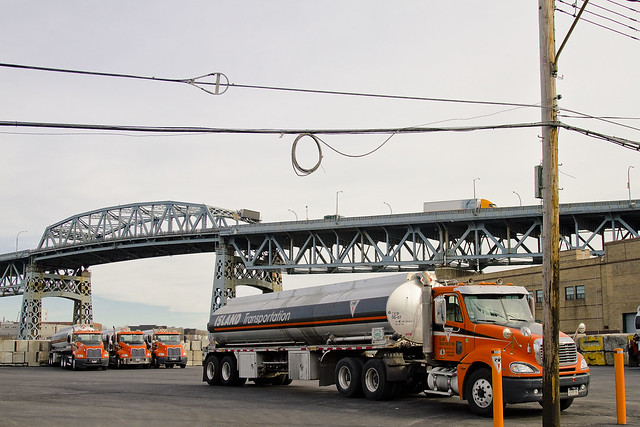
There was a pretty good reason that I was in the neighborhood, which will be discussed in later postings, but we soon found ourselves traipsing along beneath the rotting steel of the Kosciuszko Bridge. This is a fairly dangerous place, from a pedestrian point of view. Trucks rattle by at full throttle, sidewalks (when they exist) exhibit broken concrete and pooled water. Hideously barbed weeds sprout from the shattered roadbeds, and from every abyss something or someone stares back suspiciously.
There is nowhere to run to, in this abattoir of hope- your best hope is to attempt to fit in.
This clip from the same director’s “Return of the King” neatly encapsulates the sort of day Ms. Heather and I experienced:
w

– photo by Mitch Waxman
Mad stories have been told to me by those who labor in the area about what transpires in the fuligin hours around these parts, tales which I am duty bound not to repeat. Suffice to say that certain “ethnic fraternities” and other “ad hoc associations” maintain a certain presence in this locale, the members of which desire privacy and the cover of night to pursue their crafts. Said privacy is zealously guarded, as much of the City has been denied them by the efforts of an alliance of regional and national law enforcement.
Even during the daylight hours, the sure knowledge of their presence informs and constrains my movements and actions, but I’m from Brooklyn and know that what lurks around these parts both demand and deserves “Respect”.
As I’ve been told in the past by members of these groups- “Don’t ‘eff around back here”. Additionally, scholastic and mainstream critics have accused me of describing this area as “Mordor”, and that its not that bad.
from wikipedia
Three sides of Mordor were bounded by mountain ranges, arranged in a rough rectangle: Ered Lithui, translated as ‘Ash Mountains’ in the north, Ephel Dúath, translated as ‘Fence of Shadow’ in the west, and an unnamed (or was possibly still called Ephel Dúath) range in the south. In the northwest corner of Mordor, the deep valley of Udûn formed the region’s gate and guard house. That was the only entrance for large armies, and was where Sauron built the Black Gate of Mordor, and later where Gondor built the Towers of the Teeth. Behind the Black Gate, these towers watched over Mordor during the time of peace between the Last Alliance and Sauron’s return. In front of the Morannon lay the Dagorlad or the Battle Plain.
Within this mountainous region, Sauron’s main fortress Barad-dûr formed its tower, at the foothills of Ered Lithui. To southwest of Barad-dûr lay the arid plateau of Gorgoroth, forming the region’s keep, and Mount Doom its forge. To the east lay the plain of Lithlad.

photo courtesy wikipedia-
Mount Doom and Sauron’s tower of Barad-dûr in Mordor, as depicted in the Peter Jackson film

– photo by Mitch Waxman
Of course, that’s a ridiculous charge.
When have I ever suggested that there is some disembodied evil, a great eye, lurking at the top of a tower that looks down over some ash blasted wasteland which has a river of poison flowing through it?
Happy Birthday, Kosciuszko Bridge

– photo by Mitch Waxman
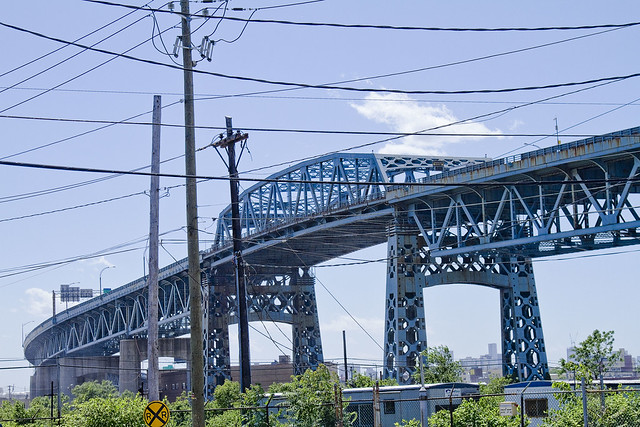
A virtual guarantee is offered that this is the only posting you will see today commemorating and wishing the Kosciuszko Bridge a happy 72nd birthday. Some 26,298 days ago, Robert Moses saw the first link in a crazy idea of his which would one day be called the “Brooklyn Queens Connecting Highway” open for business.

– photo by Mitch Waxman
The Meeker Avenue Bridge opened on August 23rd, 1939 (renamed in 1940 as The Kosciuszko Bridge) – some 631, 152 hours ago. It was promised to allow easy egress to the World’s Fair, and was a showpiece project for the Great Builder.

– photo by Mitch Waxman
From a Newtown Pentacle posting of December 8, 2010– in which the big K was described as thrice damned:
Damned Once- The Kosciuszko Bridge catches radio frequency emissions from several nearby commercial radio broadcast antennas. A lot of it.
Whatever knows fear burns at The Kosciuszko Bridge’s touch.
Damned Twice- The Kosciuszko Bridge is at extreme risk in the eventuality of a seismic event. The Brooklyn pier actually sits on the Creek bed, some 6 meters below grade, but the Queens side is anchored on piles driven into the mud. The hard soil around Queens Plaza will merely shake, but the land surrounding the Newtown Creek will liquify.
Damned Thrice- The Kosciuszko Bridge once had pedestrian walkways, but they were removed in 1961. Can you imagine what kind of photos would be possible on a pedestrian walkway 124 feet over the Newtown Creek?
– photo by Mitch Waxman
Like many things and people who are 72 years old, the Kosciuszko Bridge is not long for this world. Why not raise a glass to it tonight, and acknowledge its long service to the City?
Click here for a sentimental slideshow of the old girl from the last couple of years
suitable apparatus
– photo by Mitch Waxman
As the redolent cargo of my camera card revealed- this “Grand Walk”, a panic induced marathon which carried your humble narrator across the East River from St. Patrick’s Old Cathedral in Manhattan into Williamsburg and up Grand Street to Maspeth and the baroque intrigues of the Newtown Creek– wound down into it’s final steps on Laurel Hill Blvd.
Examining the images recorded on my camera, photos which I don’t remember taking, the ineluctable feeling that something was missing from the modern scene was inescapable.
from wikipedia
Nichols, along with his son Charles W. Nichols, helped organize the merger of 12 companies in 1899 to create General Chemical. Under his leadership, the company grew its asset base and increased its earnings threefold, making Nichols a force in America’s fledgling chemical industry. His vision of a bigger, better chemical company took off when he teamed up with investor Eugene Meyer in 1920. Nichols and Meyer combined five smaller chemical companies to create the Allied Chemical & Dye Corporation, which later became Allied Chemical Corp., and eventually became part of AlliedSignal, the forerunner of Honeywell’s specialty materials business. Both men have buildings named after them at Honeywell’s headquarters in Morristown, New Jersey. His original plant along the Newtown Creek in Queens is infamous for its legacy of pollution. Nichols is rumored to have once emptied vats of excess sulfuric acid into the creek rather than sell it cheaply to a businessman he had no respect for.

– photo by Mitch Waxman
Nichols Chemical, from which the legendary Phelps Dodge Laurel Hill plant would someday sprout, would have been found along the Newtown Creek nearby the thrice damned Kosciuszko Bridge – which is itself doomed and consigned to the stuff of future reminiscence. At it’s apex, this industrial site employed 17,500 people and squatted along some 36 square acres of the Creeklands.
The tallest chimneys in the United States (at the time) stabbed at the sky from here, painting the Newtown sky with poison effluvium whose pH content was sufficient to cause marble and granite to melt like ice cream left to the merciless gaze of the burning thermonuclear eye of god itself.

– photo by Mitch Waxman
The Kosciuszko Bridge is slated for demolition and replacement in a few short years of course, and this scene will irrevocably alter when a modern structure is put in place. The high flying bridge was built large to accommodate the sort of ocean going craft which were common in the 1930’s- cargo and passenger vessels with enormous smokestacks that would have been serviced and outfitted by other corporations just up the Creek.
Additionally, the war department held certain intentions and reserved the option to sequester battleships in Newtown Creek, with the intentions of protecting the vital industrial center from a safe inlet, were an invasion of North America attempted by hostile European adversaries via New York Harbor.
When a manufacturing establishment decides to increase its output fivefold; when it decides to tear down its present buildings and put up new ones; and when it owns valuable waterfront which is marketable at a high price, that concern considers carefully the question whether it will remain in its present location or move to some other. Now our friends above mentioned would doubtless at once aver that, if this concern was a New York concern and found itself in this situation, there could be but one answer—”To Jersey for us”— or to some other place near land’s end where land can be purchased for a song, where government regulations are unknown and where, in addition, the manufacturer would find himself surrounded by a great and aching void.
But all these prophesies are as wormwood and the pessimists are confounded. Over In the wilds of Queens there Is a place—look it up on the map—called Laurel Hill.
Laurel Hill is not a place of beauty. The undulating hills in them neighborhood are covered with cemeteries, rocks, and ugly houses and through the midst of it all (lows the far-famed Newtown Creek, covered at all times during the day and night with busy water craft. But Laurel Hill is one of the most important manufacturing districts in Greater New York and Newtown Creek is one of the foremost commercial arteries in or about NewYork City.

– photo by Mitch Waxman
One of the aphorisms which has emerged in my studies of Newtown Creek and the surrounding communities is this: “all roads lead to Calvary“.
Whether it be ancient ferry lines which fed the street car roads, or the occluded pathways of the aboriginal Mespaetche and Decadent Dutch, all the roads of western Queens and North Brooklyn point inevitably to this spot. Semi conscious during this “Grand Walk”, your humble narrator nevertheless found himself at the corner of Laurel Hill Blvd. and Review Avenue once again, standing before the great and sacred Polyandrion of the Roman Catholic church in New York City.
Perhaps the foremost industry at Laurel Hill is the Nichols Copper Company. To this factory each year come by boat and by rail thousands of tons of copper, some of it in the raw state— the ore—and much of it already in bars ready for the final refining. The copper is refined here and put into a variety of forms and shapes ready for the market. The raw material comes in from the Lake Superior region, from Mexico, and even from more distant South America. The finished product goes to manufacturers in all parts of the world. The annual value of this product is over $60,000,000, and there are between seventeen hundred and eighteen hundred men engaged in converting the raw copper into the refined product which has made this factory famous tne world over.
In this factory, located within Greater New York, there is three times as much copper refined as in any other factory in the United States.

– photo by Mitch Waxman
Here lies Tammany, the Dead Rabbits, and a good percentage of those colorful characters who populated the “Bloody Sixth Ward” of the Five Points in 19th century New York. Here lies the Newsboy Governor, the “Original Gangster“, and the rightful heirs to the throne of Ireland rest within the ground consecrated by the legendary prelate called “Dagger John” alongside the “Fighting 69th” and “the 21” and the “Abbot“. Here is the secretive cruciform shaped repository which contains the remains of thousands of priests and nuns, in a catacomb which lies some 50 feet below the Almirall Chapel.
Additionally, here might be found the grave of a man who died in 1718, lying with both his descendants and his african slaves in the only Protestant burial ground entirely contained by a Catholic cemetery in North America.
And from above, that thing in the Sapphire Megalith which neither thinks nor breathes but instead hungers, watches.
from Illustrated history of the borough of Queens, New York City, 1908, courtesy google books
The Alsop family was also among the early settlers. Richard Alsop, the first of the name to locate here, came at the request of his uncle, one Thomas Wandell, who was said to have left England because he had become involved in a quarrel with Oliver Cromwell, though this report is doubtful, for it is known that Wandell was living at Mespat Kills in 1648, or before Charles I was put to death. He had secured a considerable tract of land by patents and purchase which he left to his nephew, Richard Alsop. The family he founded became extinct in 1837 when the last of the name died without issue.


 The Newtown Pentacle