Archive for the ‘New York Harbor’ Category
ancient mariners
It’s National Chocolate Chip Day, in these United States.

– photo by Mitch Waxman
Eleven and a third (.35 actually) score years ago today, Alexander Hamilton and the Congress created what would become the United States Coast Guard. A humble narrator has never been one to omit offering a “happy birthday” salutation, and I don’t plan on starting now. I’ve probably had more contact with this branch of the military than any other over the years, and I can tell you – based on the sailors and officers I’ve met – the Coast Guard is staffed by some of the most dedicated and patriotic people I’ve ever met. Happy 227th Birthday!
from wikipedia
Created by Congress on 4 August 1790 at the request of Alexander Hamilton as the Revenue Marine, it is the oldest continuous seagoing service of the United States. As Secretary of the Treasury, Hamilton headed the Revenue Marine, whose original purpose was collecting customs duties in the nation’s seaports. By the 1860s, the service was known as the U.S. Revenue Cutter Service and the term Revenue Marine gradually fell into disuse.

– photo by Mitch Waxman
In New York Harbor, the USCG vessels you’re most likely to see are the “SAFE” Boats which provide security to ferry and pleasure craft, as well as patrolling some of the more extant industrial and cargo port areas. They also work closely with NYPD’s harbor patrol in assisting boaters in distress. Maritime security in the age of terror is no laughing matter.
The hull colors of Coast Guard vessels indicate their missions. On the “ship” side; Black hull- aids to navigation, White hull- maritime law enforcement and other safety-at-sea missions, Red hull- icebreaking. All vessels under 65 feet in length are classified as “boats” and operate near shore and inland waterways, and are usually painted “Coast Guard Orange.”
from uscg.mil
The Coast Guard is the principal Federal agency responsible for maritime safety, security, and environmental stewardship in U.S. ports and waterways. In this capacity, the Coast Guard protects and defends more than 100,000 miles of U.S. coastline and inland waterways, and safeguards an Exclusive Economic Zone (EEZ) encompassing 4.5 million square miles stretching from North of the Arctic Circle to South of the equator, from Puerto Rico to Guam, encompassing nine time zones – the largest EEZ in the world. As one of the five Armed Services of the United States, the Coast Guard is the only military branch within the Department of Homeland Security. In addition to its role as an Armed Service, the Coast Guard is a first responder and humanitarian service that provides aid to people in distress or impacted by natural and man-made disasters whether at sea or ashore. The Coast Guard is a member of the Intelligence Community, and is a law enforcement and regulatory agency with broad legal authorities associated with maritime transportation, hazardous materials shipping, bridge administration, oil spill response, pilotage, and vessel construction and operation.

– photo by Mitch Waxman
One of the national conversations which we should be having, incidentally, involves the age and condition of USCG’s fleet. Most of the defense budget ends up flowing towards the “head of the spear” services like Air Force and Navy, Army and Marines. There are serious structural issues in several of the USCG’s older vessels due to age and weathering, and we need to begin the funding fleet replacement for them so as to continue their mission.
The Seneca, pictured above, is a relatively new ship for the Coast Guard – even though it was launched in 1984.
Upcoming Tours and events
We’re cancelling Saturday the 5th’s Insalubrious Valley tour due to a forecast of scattered thunderstorms with lightning expected.
The Insalubrious Valley of the Newtown Creek Walking Tour, with Newtown Creek Alliance – Saturday August 5th, 11 a.m. – 1;30 p.m.
Century old movable bridges, the remains of a 19th century highway between Brooklyn and Queens, and explore two of the lesser known tributaries of the troubled Newtown Creek watershed. For the vulgarly curious, Conrad Wissell’s Dead Animal and Night Soil wharf will be seen and described, with NCA Historian Mitch Waxman – details here.
Brooklyn Waterfront Boat Tour, with Working Harbor Committee – Saturday August 12th, 6 p.m. – 8 p.m.
Explore the coastline of Brooklyn from Newtown Creek to Sunset Park, with NCA Historian Mitch Waxman, Andrew Gustafson of Turnstile Tours, and Gordon Cooper of Working Harbor Committee on the narrating about Brooklyn’s industrial past and rapidly changing present. – details here.
The Poison Cauldron of the Newtown Creek Walking Tour, with Newtown Creek Alliance – Sunday August 13th, 11 a.m. – 1:30 p.m.
Explore the hellish waste transfer and petroleum districts of North Brooklyn on this daring walk towards the doomed Kosciuszko Bridge, with NCA Historian Mitch Waxman – details here.
Two Newtown Creek Boat Tours, with Newtown Creek Alliance and Open House NY – Wednesday August 16th, 5 p.m. and 7 p.m.
The neighborhoods surrounding Newtown Creek are home to the densest collection of these garbage facilities anywhere in the city and collectively, the waste transfer stations around and along Newtown Creek handle almost 40% of the waste that moves through New York. Join Newtown Creek Alliance’s Mitch Waxman and Willis Elkins to learn about the ongoing efforts to address the environmental burden that this “clustering” has caused. – details here.
DUPBO Newtown Creek Walking Tour, with NYCH20 – Thursday August 24th, 7 p.m. – 9 p.m.
Explore Greenpoint and Hunters Point, with NCA Historian Mitch Waxman – details here.
“follow” me on Twitter- @newtownpentacle
eleventh hour
It remains National Creme Brulee Day, in these United States.

– photo by Mitch Waxman
We’re breaking with normal Newtown Pentacle tradition today, as there were multiple posts sent your way, devoted to the seismic events on Newtown Creek which saw the central truss of the Kosciuszcko Bridge first lowered and then carted away. This second post carries some proper shots of the lowering action. In this morning’s post, a time lapse video of the lowering of the Kosciuszcko Bridge’s central truss was offered. This afternoon’s carried everything else I shot.
Here’s the last one, showing the Kosciuszcko Bridge exiting the Newtown Creek yesterday afternoon.

– photo by Mitch Waxman
One arrived early to the Newtown Creek from “Point A” in Astoria, this time situating myself at the Newtown Creek Waste Water Treatment Plant Nature Walk. While I was waiting for the Kosciuszcko Bridge to show up, the usual maritime industrial show on the Creek was underway with a tug delivering a barge to SimsMetal. The tug cleared out, and few minutes later, the horns on the Greenpoint Avenue Bridge sounded…

– photo by Mitch Waxman
“Thar she blows” cried a humble narrator, as the truss slid into view.

– photo by Mitch Waxman
As mentioned in earlier postings, there were actually two barges with a steel superstructure carrying the thing.

– photo by Mitch Waxman
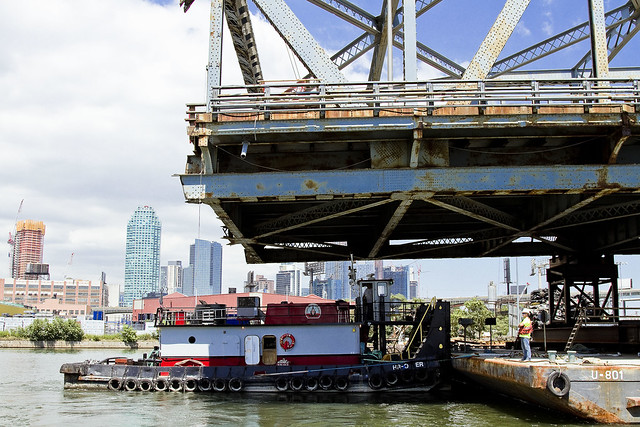
The sheer scale of all of this was staggering.
– photo by Mitch Waxman
One of the tugs, pictured above, was operating in reverse. There was a second tug on the other side of the truss, and a third accompanying them. The two directly towing the barges were of the “push boat” typology.

– photo by Mitch Waxman
Just as with the lowering procedure, a crowd of people had gathered to watch and photograph the operation.

– photo by Mitch Waxman
The barges with the Kosciuszcko Bridge truss headed west, and the Pulaski Bridge opened up to allow them egress.

– photo by Mitch Waxman
The third tug got involved when they were about to enter the draw of the Pulaski, maneuvering the assemblage into optimal position and centering it in the channel.

– photo by Mitch Waxman
So ended the seventy eight years that this structure has been on Newtown Creek.

– photo by Mitch Waxman
It was built as the New Meeker Avenue Bridge, and formally opened on August 23, 1939. A year later, in 1940, it was renamed Kosciuszcko Bridge to honor the large Polish community found in Maspeth and in Greenpoint. The barges carried the truss out onto the East River, and off to New Jersey where its steel would be harvested for recycling.
The end of an era for the Newtown Creek, and it all occurred on the 25th and 26th of July in 2017.
Documenting this project has been a long standing project of mine – this 2012 post tells you everything you could want to know about Robert Moses, Fiorella LaGuardia, and the origins of the 1939 model Kosciuszko Bridge. Just before construction started, I swept through both the Brooklyn and Queens sides of Newtown Creek in the area I call “DUKBO” – Down Under the Kosciuszko Bridge Onramp. Here’s a 2014 post, and another, showing what things used to look like on the Brooklyn side, and one dating back to 2010, and from 2012 discussing the Queens side – this. Construction started, and this 2014 post offers a look at things. There’s shots from the water of Newtown Creek, in this June 2015 post, and in this September 2015 post, which shows the bridge support towers rising. Additionally, this post from March of 2016 detailed the action on the Queens side. Most recently, here’s one from May of 2016, and one from June of the same year. Here’s one from August of 2016, the December 2016 one, one from March of 2017 which discusses the demolition of the 1939 bridge.
Most recently – a post showing what I saw during a pre opening walk through in early April of 2017, and the fanfare surrounding the opening of half of the new bridge in April of 2017, and a walk through of the Brooklyn side job site in June of 2017. Lastly, here’s some night shots from early July of 2017.
Upcoming Tours and events
The Insalubrious Valley of the Newtown Creek Walking Tour, with Newtown Creek Alliance – Saturday August 5th, 11 a.m. – 1;30 p.m.
Century old movable bridges, the remains of a 19th century highway between Brooklyn and Queens, and explore two of the lesser known tributaries of the troubled Newtown Creek watershed. For the vulgarly curious, Conrad Wissell’s Dead Animal and Night Soil wharf will be seen and described, with NCA Historian Mitch Waxman – details here.
Brooklyn Waterfront Boat Tour, with Working Harbor Committee – Saturday August 12th, 6 p.m. – 8 p.m.
Explore the coastline of Brooklyn from Newtown Creek to Sunset Park, with NCA Historian Mitch Waxman, Andrew Gustafson of Turnstile Tours, and Gordon Cooper of Working Harbor Committee on the narrating about Brooklyn’s industrial past and rapidly changing present. – details here.
The Poison Cauldron of the Newtown Creek Walking Tour, with Newtown Creek Alliance – Sunday August 13th, 11 a.m. – 1:30 p.m.
Explore the hellish waste transfer and petroleum districts of North Brooklyn on this daring walk towards the doomed Kosciuszko Bridge, with NCA Historian Mitch Waxman – details here.
Two Newtown Creek Boat Tours, with Newtown Creek Alliance and Open House NY – Wednesday August 16th, 5 p.m. and 7 p.m.
The neighborhoods surrounding Newtown Creek are home to the densest collection of these garbage facilities anywhere in the city and collectively, the waste transfer stations around and along Newtown Creek handle almost 40% of the waste that moves through New York. Join Newtown Creek Alliance’s Mitch Waxman and Willis Elkins to learn about the ongoing efforts to address the environmental burden that this “clustering” has caused. – details here.
“follow” me on Twitter- @newtownpentacle
unhallowed wizardry
It’s still National Creme Brulee Day, in these United States.

– photo by Mitch Waxman
We’re breaking with normal Newtown Pentacle tradition today, and there will be multiple posts coming your way, devoted to the seismic events on Newtown Creek which saw the central truss of the Kosciuszko Bridge first lowered and then carted away over the last couple of days. This second post carries some proper shots of the lowering action. In this morning’s post, a time lapse video of the lowering of the Kosciuszcko Bridge’s central truss was offered. What follows will be everything else I shot, basically all the stills.
There’s a third post that’ll be coming your way tonight, btw., so keep an eye on this – your Newtown Pentacle.

– photo by Mitch Waxman
One had arrived at the Meeker Avenue street end, aka Penny Bridge, by about ten in the morning. Not too much was happening, and word reached me that the lowering process – originally scheduled to begin at ten, would be delayed several hours due to an engineering issue which needed to be solved.

– photo by Mitch Waxman
There were several tugs buzzing about.

– photo by Mitch Waxman
Above, you can see the two flat top barges which were married together by a steel superstructure which would accept and support the bridge section.

– photo by Mitch Waxman
The truss itself was no longer supported, structurally speaking, by the approaches or towers which had cradled it for the last seventy eight years. Instead, it was the four “strand jacks” which were holding it up. Those yellow bits were the shoes on which the truss’s girders sat.

– photo by Mitch Waxman
FDNY and NYPD harbor units were on scene, with different units arriving and departing all day.

– photo by Mitch Waxman
The barges were continuously maneuvered, throughout the day.

– photo by Mitch Waxman
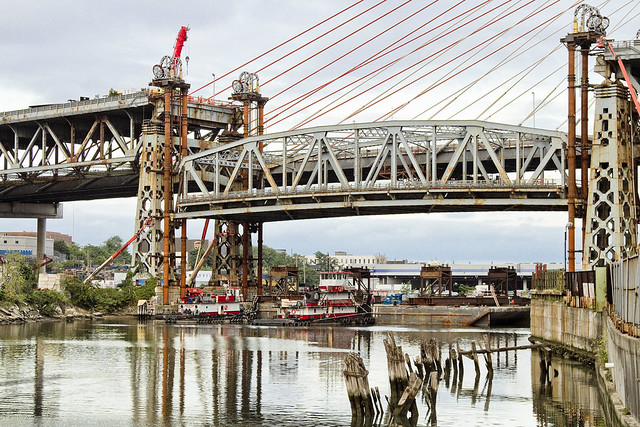
About two in the afternoon, the truss began to lower. It was moving so slowly, about twenty feet per hour I’m told, that to the eye it appeared entirely static.
– photo by Mitch Waxman
I was using two cameras, if you’re wondering. One was on a tripod, the other handheld.

– photo by Mitch Waxman
As the burning thermonuclear eye of God itself dipped behind Manhattan, and the Newtown Creek grew dark, the crews were still lowering the truss. The garish lights of the new bridge activated.

– photo by Mitch Waxman
There was quite a crowd gathered all around the Newtown Creek, and especially so at the Penny Bridge site where I was.

– photo by Mitch Waxman
By about 9:30 or so, the truss was almost resting on the barge.

– photo by Mitch Waxman
A groaning sound of buckling steel echoed out across the Creek as the weight of the truss was suddenly taken up by the superstructure on the barges.

– photo by Mitch Waxman
One spent about twelve hours at Penny Bridge, or the Meeker Avenue Street End, on the 25th of July in 2017. I would have to come back to Newtown Creek the next day, of course, to get shots of the thing leaving. That’s tonight’s post, however, as I’m still finishing up the shots for that one as you’re reading this.
Documenting this project has been a long standing project of mine – this 2012 post tells you everything you could want to know about Robert Moses, Fiorella LaGuardia, and the origins of the 1939 model Kosciuszko Bridge. Just before construction started, I swept through both the Brooklyn and Queens sides of Newtown Creek in the area I call “DUKBO” – Down Under the Kosciuszko Bridge Onramp. Here’s a 2014 post, and another, showing what things used to look like on the Brooklyn side, and one dating back to 2010, and from 2012 discussing the Queens side – this. Construction started, and this 2014 post offers a look at things. There’s shots from the water of Newtown Creek, in this June 2015 post, and in this September 2015 post, which shows the bridge support towers rising. Additionally, this post from March of 2016 detailed the action on the Queens side. Most recently, here’s one from May of 2016, and one from June of the same year. Here’s one from August of 2016, the December 2016 one, one from March of 2017 which discusses the demolition of the 1939 bridge.
Most recently – a post showing what I saw during a pre opening walk through in early April of 2017, and the fanfare surrounding the opening of half of the new bridge in April of 2017, and a walk through of the Brooklyn side job site in June of 2017. Lastly, here’s some night shots from early July of 2017.
Upcoming Tours and events
The Insalubrious Valley of the Newtown Creek Walking Tour, with Newtown Creek Alliance – Saturday August 5th, 11 a.m. – 1;30 p.m.
Century old movable bridges, the remains of a 19th century highway between Brooklyn and Queens, and explore two of the lesser known tributaries of the troubled Newtown Creek watershed. For the vulgarly curious, Conrad Wissell’s Dead Animal and Night Soil wharf will be seen and described, with NCA Historian Mitch Waxman – details here.
Brooklyn Waterfront Boat Tour, with Working Harbor Committee – Saturday August 12th, 6 p.m. – 8 p.m.
Explore the coastline of Brooklyn from Newtown Creek to Sunset Park, with NCA Historian Mitch Waxman, Andrew Gustafson of Turnstile Tours, and Gordon Cooper of Working Harbor Committee on the narrating about Brooklyn’s industrial past and rapidly changing present. – details here.
The Poison Cauldron of the Newtown Creek Walking Tour, with Newtown Creek Alliance – Sunday August 13th, 11 a.m. – 1:30 p.m.
Explore the hellish waste transfer and petroleum districts of North Brooklyn on this daring walk towards the doomed Kosciuszko Bridge, with NCA Historian Mitch Waxman – details here.
Two Newtown Creek Boat Tours, with Newtown Creek Alliance and Open House NY – Wednesday August 16th, 5 p.m. and 7 p.m.
The neighborhoods surrounding Newtown Creek are home to the densest collection of these garbage facilities anywhere in the city and collectively, the waste transfer stations around and along Newtown Creek handle almost 40% of the waste that moves through New York. Join Newtown Creek Alliance’s Mitch Waxman and Willis Elkins to learn about the ongoing efforts to address the environmental burden that this “clustering” has caused. – details here.
“follow” me on Twitter- @newtownpentacle
decisive steps
It’s National Hot Fudge Sundae Day, in these United States.
– photo by Mitch Waxman
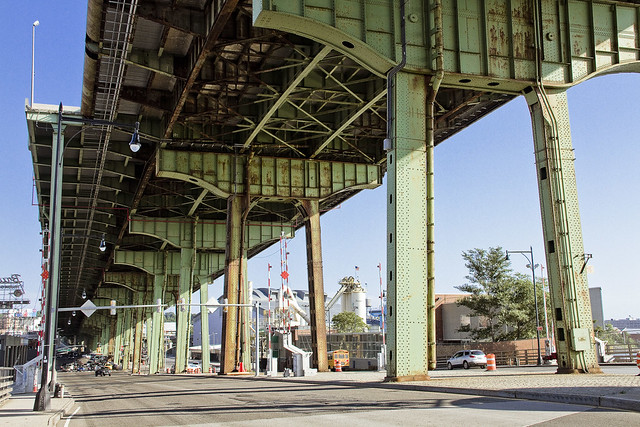
Despite the known presence of a tribe of Vampires lurking in the steel rafters of the Red Hook section’s Gowanus Expressway, the elevated span offers a welcoming respite from the radiate energies of the burning thermonuclear eye of God itself to a humble narrator as well as the revenants – and given the high temperature and humidity levels last week – one was willing to take his chances with the bloodsuckers in pursuance of a bit of shade. This corridor in South Brooklyn is hellacious to drive through, and is also a bit of an adventure whilst on foot.
It’s the “House of Moses” after all.
from wikipedia
Robert Moses (December 18, 1888 – July 29, 1981) was a public official who worked mainly in the New York metropolitan area. Known as the “master builder” of mid-20th century New York City, Long Island, Rockland County, and Westchester County, he is sometimes compared to Baron Haussmann of Second Empire Paris, and was one of the most polarizing figures in the history of urban development in the United States. His decisions favoring highways over public transit helped create the modern suburbs of Long Island and influenced a generation of engineers, architects, and urban planners who spread his philosophies across the nation despite not training in those professions. Moses would call himself a “coordinator” and was referred to in the media as a “master builder”.
– photo by Mitch Waxman
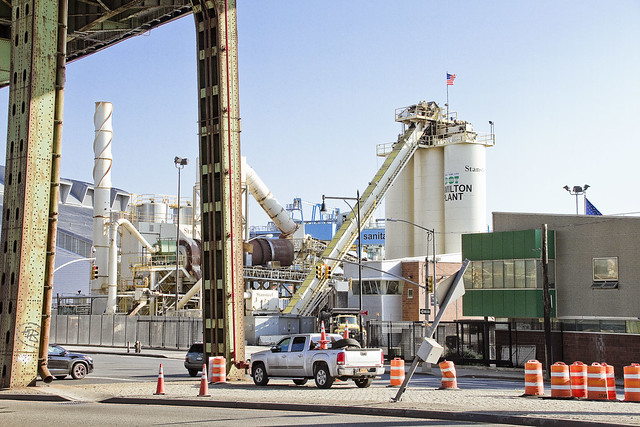
One’s plan was a simple one. Attendance at an event in Sunset Park was on the menu, and a convoluted trip using the subway from Point A in Queens’ Astoria to Point R in Brooklyn’s Red Hook was instituted. From Smith/9th street, I had a distance of about a mile to cover on foot, during which one encountered a series of challenging pedestrian obstacles which made me wish I had called a cab. My plan was to take Hamilton Avenue over to Third Avenue, whereupon I was headed over to 28th street in Sunset Park. Simple?
Btw, that’s NYC DOT’s Hamilton Plant pictured above, they do asphalt.
from wikipedia
Asphalt concrete (commonly called asphalt, blacktop, or pavement in North America, and tarmac or bitumen macadam in the United Kingdom and the Republic of Ireland) is a composite material commonly used to surface roads, parking lots, airports, as well as the core of embankment dams. It consists of mineral aggregate bound together with asphalt, laid in layers, and compacted. The process was refined and enhanced by Belgian inventor and U.S. immigrant Edward de Smedt.
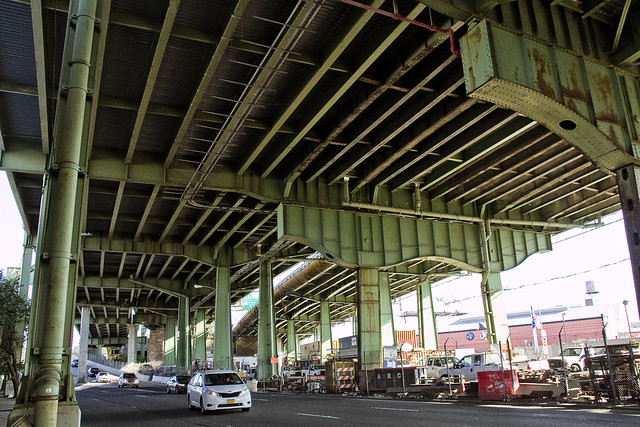
– photo by Mitch Waxman
Things got a little hairy for a scuttling narrator as the realization that there was no way to safely cross the street set in and that I was just going to have to “go with the flow” and follow whatever detours Robert Moses left behind for me. Realizing that you’re the only person moving along on foot along a busy road is a bit disconcerting. More so, the unseen eyes staring maliciously down at my gloriously blood swollen body were sensed rather than observed.
My understanding is that this tribe of Nosferatu are nowhere near as organized or aggressive as the ones found around Queens Plaza. Those are the ones who enact a nightly siege at the NY Blood Center facility in Vernon Blvd., but one remained vigilant nevertheless.
As quoted from a 2015 post at this – your Newtown Pentacle – “It is said that the vampires arrived with a grain shipment from Germany in the early 1900’s, quickly established themselves in the neighborhood, and never left.”
from wikipedia
During the 18th century, there was a frenzy of vampire sightings in Eastern Europe, with frequent stakings and grave diggings to identify and kill the potential revenants. Even government officials engaged in the hunting and staking of vampires. Despite being called the Age of Enlightenment, during which most folkloric legends were quelled, the belief in vampires increased dramatically, resulting in a mass hysteria throughout most of Europe. The panic began with an outbreak of alleged vampire attacks in East Prussia in 1721 and in the Habsburg Monarchy from 1725 to 1734, which spread to other localities.
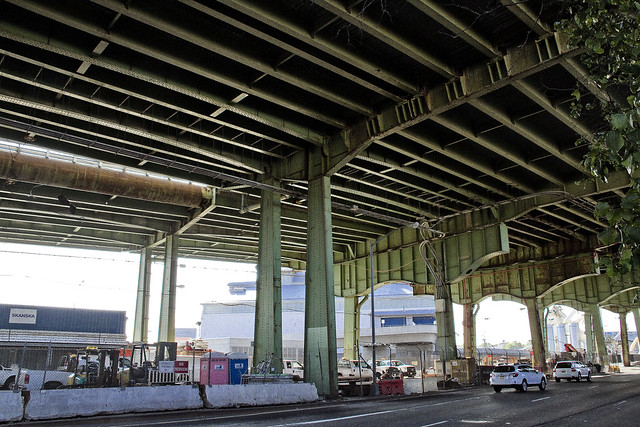
– photo by Mitch Waxman
The diversionary sidewalk path carried me away from Hamilton’s intersection with Third Avenue, and one was forced to vacate the BQE’s shadows – which sheltered both undead army and humble narrator alike from the sky born radiation. One found himself at the veritable angle between the three neighborhoods surrounding the Gowanus Canal, and proceeded along his way.
I kept a close eye on those steel rafters, however.
from wikipedia
Legends of vampires have existed for millennia; cultures such as the Mesopotamians, Hebrews, ancient Greeks, and Romans had tales of demonic entities and blood-drinking spirits which are considered precursors to modern vampires. Despite the occurrence of vampire-like creatures in these ancient civilizations, the folklore for the entity we know today as the vampire originates almost exclusively from early 18th-century Southeastern Europe, particularly Transylvania as verbal traditions of many ethnic groups of the region were recorded and published. In most cases, vampires are revenants of evil beings, suicide victims, or witches, but can also be created by a malevolent spirit possessing a corpse or by being bitten by a vampire itself. Belief in such legends became so rife that in some areas it caused mass hysteria and even public executions of people believed to be vampires.
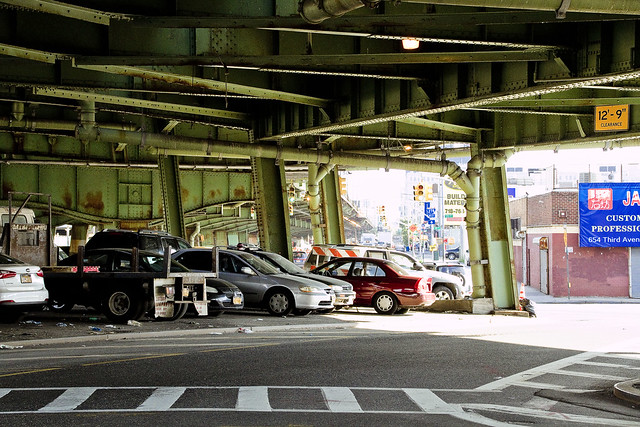
– photo by Mitch Waxman
Along my path, several gaunt and filthy humans appeared, asking me for things I might have – oddly specific amounts of currency or just random items that they noticed me carrying. Surely, these debased people were the “bled white” servitors of the vampiric powers, enjoying the brief sojourn of freedom which the daytime brings them. Shoving past them with a “harummpf” and a “good day to you madam,” one was nevertheless on a mission, which was arriving at my destination in Sunset Park on time and not quite a perspiring mess due to the uncomfortable atmospherics.
One had arrived at Third Avenue, finally.
from wikipedia
Clinical vampirism is named after the mythical vampire, and is a recognizable, although rare, clinical entity characterized by periodic compulsive blood-drinking, affinity with the dead and uncertain identity. It is hypothetically the expression of an inherited archaic myth, the act of taking blood being a ritual that gives temporary relief. From ancient times vampirists have given substance to belief in the existence of supernatural vampires. Four vampirists, including Haigh, the ‘acid-bath murderer’, are described. From childhood they cut themselves, drank their own, exogenous human or animal blood to relieve a craving, dreamed of blood-shed, associated with the dead, and had a changing identity. They were intelligent, with no family mental or social pathology. Some self-cutters are auto-vampirists; females are not likely to assault others for blood, but males are potentially dangerous. Vampirism may be a cause of unpredictable repeated assault and murder, and should be looked for in violent criminals who are self-mutilators. No specific treatment is known.
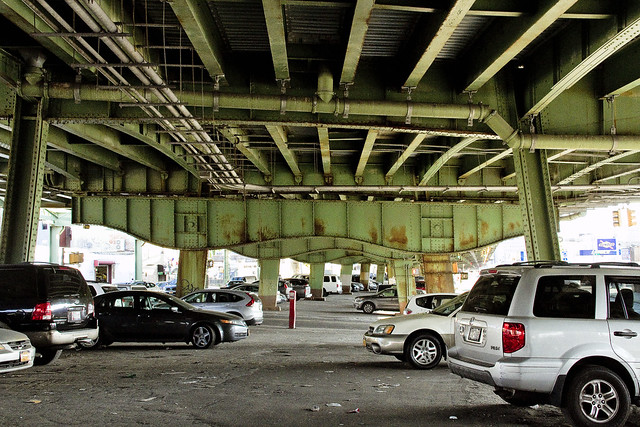
– photo by Mitch Waxman
I noticed that the steel rafters of the highway were no longer quite so high relative to my position, but were instead placed far closer to the ground. At this lower height, it would be a simple thing for some glass nailed claw connected to a pale limb by creaking ligaments to swing down and scratch at my skinvelope, causing my bodily juices to spill out and make for easy consumption. The local gendarmes don’t inquire too deeply into exsanguinated corpses around these parts, I’m told, chalking the complete lack of blood up to “extreme dehydration” on official NYPD paperwork.
Yeah… there’s definitely something thirsty hereabouts… I’ll tell you!
from wikipedia
The Oxford English Dictionary dates the first appearance of the English word vampire (as vampyre) in English from 1734, in a travelogue titled Travels of Three English Gentlemen published in The Harleian Miscellany in 1745. Vampires had already been discussed in French and German literature. After Austria gained control of northern Serbia and Oltenia with the Treaty of Passarowitz in 1718, officials noted the local practice of exhuming bodies and “killing vampires”. These reports, prepared between 1725 and 1732, received widespread publicity. The English term was derived (possibly via French vampyre) from the German Vampir, in turn derived in the early 18th century from the Serbian vampir (Cyrillic: вампир).
The Serbian form has parallels in virtually all Slavic languages: Bulgarian and Macedonian вампир (vampir), Bosnian: vampir, Croatian vampir, Czech and Slovak upír, Polish wąpierz, and (perhaps East Slavic-influenced) upiór, Ukrainian упир (upyr), Russian упырь (upyr’), Belarusian упыр (upyr), from Old East Slavic упирь (upir’) (many of these languages have also borrowed forms such as “vampir/wampir” subsequently from the West; these are distinct from the original local words for the creature). The exact etymology is unclear. Among the proposed proto-Slavic forms are *ǫpyrь and *ǫpirь.
Another less widespread theory is that the Slavic languages have borrowed the word from a Turkic term for “witch” (e.g., Tatar ubyr). Czech linguist Václav Machek proposes Slovak verb “vrepiť sa” (stick to, thrust into), or its hypothetical anagram “vperiť sa” (in Czech, the archaic verb “vpeřit” means “to thrust violently”) as an etymological background, and thus translates “upír” as “someone who thrusts, bites”. An early use of the Old Russian word is in the anti-pagan treatise “Word of Saint Grigoriy” (Russian Слово святого Григория), dated variously to the 11th–13th centuries, where pagan worship of upyri is reported.
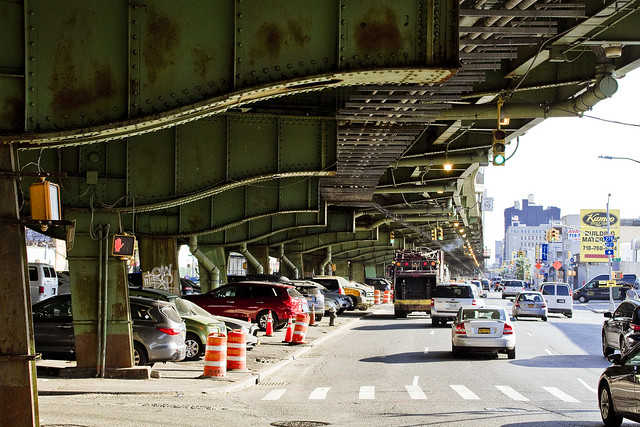
– photo by Mitch Waxman
One bolted across Third Avenue, seeking safety instead of avoiding the burning gaze of the Thermonuclear Eye of God itself. For one such as myself, it is merely uncomfortable to stand in the radiation of the almighty’s gaze, but for the Vampire folk it is an existential matter. It’s why their kind prefers cold climates with long winters, when’re they can enjoy the ecstasies of freedom and the hunt both unmolested and unrestrained, like the wolf.
I’m told that one of the local South Brooklyn Vampires has recently announced a run for the local City Council seat as an independent. There’s a lot of minor candidates who feel emboldened by Donald Trump’s surprise victory to try and gain elective office who figure that if Trump could do it, why not them too? Watch out Brad Lander.
from wikipedia
Opportunism is the conscious policy and practice of taking advantage of circumstances – with little regard for principles, or with what the consequences are for others. Opportunist actions are expedient actions guided primarily by self-interested motives. The term can be applied to individual humans and living organisms, groups, organizations, styles, behaviours, and trends.
Opportunism or “opportunistic behavior” is an important concept in such fields of study as biology, transaction cost economics, game theory, ethics, psychology, sociology and politics.
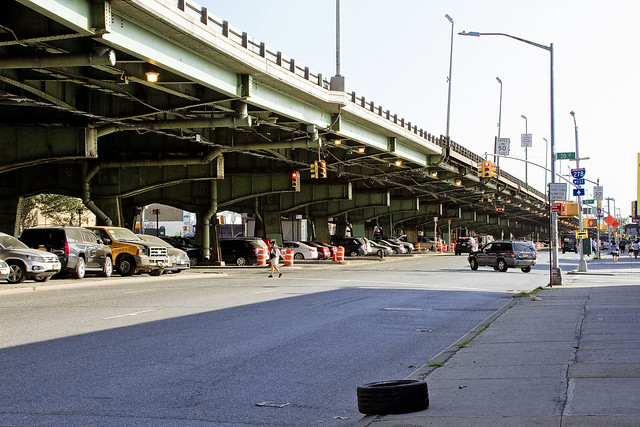
– photo by Mitch Waxman
Warehouse and fenceline shadows would now have to be my only shelter from the burning rays of the thermonuclear orb in the sky, and one proceeded south. Now all I had to worry about were those man things which have seemingly never been instructed in how to wear human clothing that are common in this area, the everpresent high speed and randomly directed truck traffic, and a growing crowd of disaffected and heavily tattooed young humans who were riding their bicycles clumsily on the sidewalk while texting on their iphones.
from wikipedia
The hipster subculture is stereotypically composed of youth who reside primarily in gentrifying neighborhoods. It is broadly associated with indie and alternative music, a varied non-mainstream fashion sensibility, vintage and thrift store-bought clothing, generally progressive political views, organic and artisanal foods, alternative lifestyles and snobbery. The subculture typically consists of mostly white young adults living in urban areas. It has been described as a “mutating, trans-Atlantic melting pot of styles, tastes and behavior”.
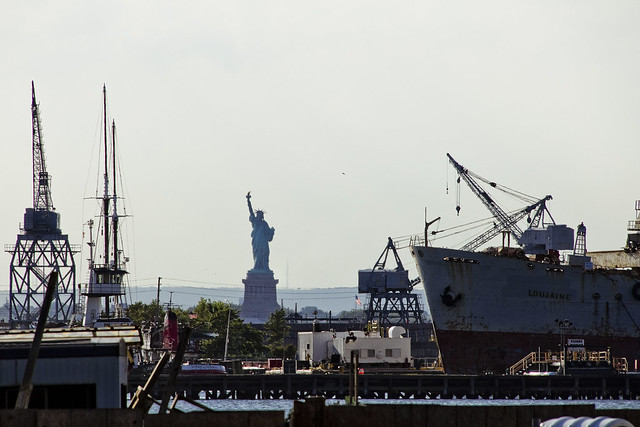
– photo by Mitch Waxman
Tomorrow, I’ll show you where I was going to in Sunset Park, and why I braved the horrors of the sweating concrete bunkers of the MTA, the pedestrian hating “House of Moses,” and the Vampiric hordes of hoary Red Hook itself.
That’s Gowanus Bay above, as seen from my eventual destination in Sunset Park, which was ultimately kind of a trashy experience – but more on that subject tomorrow – at this, your Newtown Pentacle.
from wikipedia
Sunset Park is a neighborhood in the southwestern part of the New York City borough of Brooklyn. It is bounded by Park Slope, Greenwood Heights and Green-Wood Cemetery to the north, Borough Park to the east, Bay Ridge to the south, and Upper New York Bay to the west. Because it was once close to the southern boundary of the City of Brooklyn, Sunset Park is considered to be part of South Brooklyn. However, until the 1960s, the northern part of Sunset Park was considered to be part of Gowanus, and the southern part was included in Bay Ridge. The neighborhood received its own name in that decade.
Upcoming Tours and events
The Insalubrious Valley of the Newtown Creek Walking Tour, with Newtown Creek Alliance – Saturday August 5th, 11 a.m. – 1;30 p.m.
Century old movable bridges, the remains of a 19th century highway between Brooklyn and Queens, and explore two of the lesser known tributaries of the troubled Newtown Creek watershed. For the vulgarly curious, Conrad Wissell’s Dead Animal and Night Soil wharf will be seen and described, with NCA Historian Mitch Waxman – details here.
Brooklyn Waterfront Boat Tour, with Working Harbor Committee – Saturday August 12th, 6 p.m. – 8 p.m.
Explore the coastline of Brooklyn from Newtown Creek to Sunset Park, with NCA Historian Mitch Waxman, Andrew Gustafson of Turnstile Tours, and Gordon Cooper of Working Harbor Committee on the narrating about Brooklyn’s industrial past and rapidly changing present. – details here.
The Poison Cauldron of the Newtown Creek Walking Tour, with Newtown Creek Alliance – Sunday August 13th, 11 a.m. – 1:30 p.m.
Explore the hellish waste transfer and petroleum districts of North Brooklyn on this daring walk towards the doomed Kosciuszko Bridge, with NCA Historian Mitch Waxman – details here.
Two Newtown Creek Boat Tours, with Newtown Creek Alliance and Open House NY – Wednesday August 16th, 5 p.m. and 7 p.m.
The neighborhoods surrounding Newtown Creek are home to the densest collection of these garbage facilities anywhere in the city and collectively, the waste transfer stations around and along Newtown Creek handle almost 40% of the waste that moves through New York. Join Newtown Creek Alliance’s Mitch Waxman and Willis Elkins to learn about the ongoing efforts to address the environmental burden that this “clustering” has caused. – details here.
“follow” me on Twitter- @newtownpentacle
secret assemblages
It’s National Mac & Cheese Day, in these United States.

– photo by Mitch Waxman
Well, I guess it’s kind of been “Creek Week” around these parts this last week, so let’s finish things up with a tugboat!
As mentioned in Monday’s post, one has been desirous of capturing a few last shot of the old Koscisuzcko Bridge before its deconstruction is engaged, just for the record… y’know? While setting up my gear for a night shoot, the Donjon Tug Brian Nicholas, which appeared in Wednesday’s post briefly, suddenly appeared. I hadn’t affixed the camera to the tripod yet, so I got busy with the clicking and the focusing.

– photo by Mitch Waxman
Brian Nicholas has been in many, many posts at this – your Newtown Pentacle – over the years. Just below is my favorite ever shot of this tug, from 2012.

– photo by Mitch Waxman
Some 75 feet long, with a gross tonnage of 104 GRT, the Brian Nicholas is owned by DonJon towing and powered by 2 850 HP engines. Brian Nicholas was built in 1966 and retrofitted in 2010 as a “green tug.”
from docs.google.com
This past June, Donjon completed the top-to-bottom refit and replacement of the main engines, generators, gears and related equipment of its tug Brian icholas. The refit was performed in house at Donjon’s Port Newark, New Jersey facility under the supervision of Donjon’s Gabe Yandoli and Robert Stickles. As a result of the refit, the Brian Nicholas is now a “green” tug, compliant with all applicable EPA and Tier 2 marine emissions regulations.
The rebuild included a repowering of the main propulsion with Cummins K38-M Marine engines, which were specifically developed by Cummins to meet EPA and Tier 2 marine emissions regulations. The new engines also meet the IMO, MARPOL and EU Stage 3A requirements. Similarly, the generators were upgraded to incorporate John Deere 4045TFM75 engines, also Tier 2 compliant. In addition to the replacement of the aforementioned engines, the project required virtually total replacement of exhaust lines and routing of new control lines and panels in the engine room and wheelhouse.

– photo by Mitch Waxman
Brian Nicholas was towing a barge of what looked like shredded metals and construction debris, which would mean that it’s coming from one of the waste transfer locations found along the English Kills tributary further east.
As I’ve said in the past – whether they’re pushing or pulling, tugs are always towing – that’s what the term is.

– photo by Mitch Waxman
Brian Nicholas was headed for the East River, and ultimately it would likely head over to New Jersey, where the recyclable metals on its barge could be packaged up, loade on a container ship, and be then sold on a global commodities market.
See you next week, with something completely different, at this – your Newtown Pentacle. Also, I’m doing a tour of Dutch Kills tomorrow – come with? I’ll show you something cool.
Upcoming Tours and events
13 Steps Around Dutch Kills Walking Tour, with Newtown Creek Alliance – July 15th, 10 a.m. – 1 p.m..
The “then and now” of Newtown Creek’s Dutch Kills tributary in LIC, once known as the “workshop of the United States.” with NCA Historian Mitch Waxman – details here.
The Poison Cauldron of the Newtown Creek Walking Tour, with Atlas Obscura – July 22nd, 11 a.m. – 2 p.m..
Explore the hellish waste transfer and petroleum districts of North Brooklyn on this daring walk towards the doomed Kosciuszko Bridge, with NCA Historian Mitch Waxman – details here.
“follow” me on Twitter- @newtownpentacle


 The Newtown Pentacle