Archive for the ‘Greenpoint Avenue Bridge’ Category
bland face

– photo by Mitch Waxman
A lot of this Newtown Creek thing involves going to meetings in Greenpoint- this monitoring committee or that alliance or just some gathering at which an unelected official or designated regulator will speak at. This consumes quite a bit of time, which is amplified in my case, as I walk to the place from Astoria. Not a long walk by any stretch, roughly 3 miles, but sometimes it feels as if I spend all my time walking to and from the Greenpoint Avenue Bridge.

– photo by Mitch Waxman
Long have I been intrigued by this little fix a flat building which sits at the cross roads of Greenpoint Avenue, Van Dam St., and Review avenue on the Queens side in Blissville. Run down, it seems to be held together with tape and tacks, but there has always been something about the structure which has caught my eye. “Something” seems significant about it, given its location. Despite efforts at finding that something, it has always remained an enigma. Until now, thanks to the NYC Municipal Archives LUNA website.

– photo by Mitch Waxman
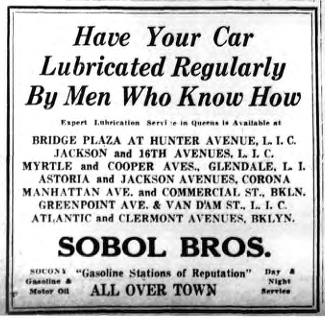
This shot, of the Sobol Brothers SOCONY station at the intersection of Greenpoint and Van Dam, is from August 20, 1930- roughly 82 years ago. SOCONY, of course, stands for Standard Oil Company of New York. Standard used to franchise out filling stations, in the same manner as its modern day incarnation ExxonMobil does. The name SOCONY indicates that the signage went up after 1911 when the Standard Trust was broken up, incidentally.
click here for the giant sharp version of the NYCMA image.
Also, at the ever reliable fultonhistory.com, I found this ad for the company, which seems to have had several locations in Queens.
Newtown Creek Boat Tour

– photo by Mitch Waxman
This coming Sunday -the 22nd of July, the Working Harbor Committee is producing and offering a boat tour of the Newtown Creek to any interested parties. A special emphasis on the waterway’s storied history and maritime legacy will be made.
I’m going to be doing the history part, speaking in my capacity as the Newtown Creek Alliance Historian, and am tasked with highlighting the various points of interest encountered along the route. Anticipated to be some three hours in length, this boat tour will be delving some three miles inland, proceeding to the Metropolitan Avenue Bridge crossing English Kills in East Williamsburg, Brooklyn.

– photo by Mitch Waxman
The Maritime History of Newtown Creek is one largely forgotten in these decadent times, but even now an odd tugboat and barge might be spied making their way down the waterway on any given day. Property owners were considered to have been blessed by some of the finest industrial bulkheads in the world a mere century ago, yet many of the businesses based along the Creek today ignore this invaluable resource, allowing their waterfront property to decay and decline.
Nevertheless, a staggering amount of maritime traffic is still observed here, and towing companies such as Reinauer, K-Sea, DonJon, and Poling and Cutler are regular visitors.

– photo by Mitch Waxman
Vast operations will be witnessed by those onboard, many of which are involved in the scrap metal and recyclables trade. Responsible for an enormous amount of cross harbor shipping, companies such as SimsMetal are heavily reliant on the maritime trades for their economic success.
Not all that long ago, Newtown Creek carried a greater tonnage of cargo than the entire Mississippi River.

– photo by Mitch Waxman
An active and thriving industrial zone in the center of New York City, from the water one can truly grasp the sheer scale of Newtown Creek’s busy waterfront. Normally hidden by high fences and obscured by street facing structures, the intensity of the Newtown Creek is laid bare before the admiring gaze of first time visitor and veteran urban explorer alike.

– photo by Mitch Waxman
A tributary of the estuarine East River, Newtown Creek extends some 3.8 miles from its junction with the more familiar waterway, and provides demarcation for the currently undefended border of much of Brooklyn and Queens. Named to the Federal Superfund list, the Creek suffers from a history of environmental degradation and municipal neglect.
An era of great change is upon the Newtown Creek, and this trip will be one of your last chances to see it in its current form.

– photo by Mitch Waxman
We will see four moveable bridges, and this year will be your last chance to see the static Kosciuszko Bridge as the NYS DOT has indicated that construction on its replacement will begin as early as the Spring of 2013.

– photo by Mitch Waxman
Along it’s banks, great fortunes have risen.
Amongst others- Peter Cooper (BO Railroad, Canton Iron, and Cooper Union), Charles Pratt (Astral Oil, and Pratt University), and ultimately John D. Rockefeller (Standard Oil)– all grew richer than the dreams of avarice in this place. Alongside them, the darkest mills of the industrial revolution- rendering plants, yeast distilleries, bone blackers, and acid factories provided tens of thousands of jobs to the immigrant populations of Brooklyn and Queens. Today- National Grid, BP, Amoco, ExxonMobil, and a host of other multinational companies still maintain an enormous investment in this valuable industrial canal.
There are still a few, and I mean “few” tickets left for this trip- get yours while you can.
Upcoming tour: Hidden Harbor Tours: Newtown Creek Exploration.
On July 22nd, Mitch shares his unique point of view and deep understanding of the past, present and future conditions of the Newtown Creek as the narrator and expedition leader for this years Hidden Harbor Tours: Newtown Creek exploration.
Our NY Water Taxi leaves from South Street Seaport at 11 a.m. (sharp) on a three hour tour of the Newtown Creek. From the East River we’ll move into the Newtown Creek where we’ll explore explore vast amounts of maritime infrastructure, see many movable bridges and discover the very heart of the Hidden Harbor.
Limited seating available, get your tickets today.
Tickets $50, trip leaves Pier 17 at South Street Seaport at 11a.m. sharp.
We will be traveling in a comfortable NY Water Taxi vessel with indoor and outdoor seating. There will be refreshments and snacks available for purchase at the bar.
clearing sky

– photo by Mitch Waxman
While scuttling across the Greenpoint Avenue Bridge recently, enroute to a Newtown Creek Alliance meeting featuring a presentation by the DEC’s head oil spill man -Randall Austin, this fellow was observed hard at work by one unused to such exertion. As a zoom lens was already affixed to my camera, I decided to see what might be captured, and realized that I knew almost nothing about the process of welding.
Of course, what I do know about is Newtown Creek.
from wikipedia
Welding is a fabrication or sculptural process that joins materials, usually metals or thermoplastics, by causing coalescence. This is often done by melting the workpieces and adding a filler material to form a pool of molten material (the weld pool) that cools to become a strong joint, with pressure sometimes used in conjunction with heat, or by itself, to produce the weld. This is in contrast with soldering and brazing, which involve melting a lower-melting-point material between the workpieces to form a bond between them, without melting the workpieces.

– photo by Mitch Waxman
On a basic level, I understand the process, but having never undertaken the task- am largely ignorant of its mores. Something I do know of welding, however, it that a welded tank is preferred to a riveted one for bulk storage of petroleum- which was once the industry “standard”.
Incontrovertibly, if one is at Newtown Creek, and the word “Standard” comes up- only one meaning can be gleaned.
from wikipedia
A rivet is a permanent mechanical fastener. Before being installed a rivet consists of a smooth cylindrical shaft with a head on one end. The end opposite the head is called the buck-tail. On installation the rivet is placed in a punched or drilled hole, and the tail is upset, or bucked (i.e., deformed), so that it expands to about 1.5 times the original shaft diameter, holding the rivet in place. To distinguish between the two ends of the rivet, the original head is called the factory head and the deformed end is called the shop head or buck-tail.

– photo by Mitch Waxman
The facility that this torch bearing fellow was at work in is either the Lukoil or Metro depots, but I’m never certain about the property lines in the petroleum district- and given the generally paranoid atmosphere loosed roughly upon society and caused by the ongoing Terror Wars- it’s probably best not to speculate too long about the subject of whose fence begins or ends and where the property lines are.
What’s more interesting about this spot along Newtown Creek, to me at least, is that this laborer was at work in a very special spot- historically speaking.
from wikipedia
Oil depots are usually situated close to oil refineries or in locations where marine tankers containing products can discharge their cargo. Some depots are attached to pipelines from which they draw their supplies and depots can also be fed by rail, by barge and by road tanker (sometimes known as “bridging”).
Most oil depots have road tankers operating from their grounds and these vehicles transport products to petrol stations or other users.
An oil depot is a comparatively unsophisticated facility in that (in most cases) there is no processing or other transformation on site. The products which reach the depot (from a refinery) are in their final form suitable for delivery to customers. In some cases additives may be injected into products in tanks, but there is usually no manufacturing plant on site. Modern depots comprise the same types of tankage, pipelines and gantries as those in the past and although there is a greater degree of automation on site, there have been few significant changes in depot operational activities over time.

– photo by Mitch Waxman
This was right across the street from an early (1840) Kerosene refinery- Sone and Fleming, which was later acquired by John D Rockefeller’s Standard Oil Trust and transformed into an oil refinery. This facility has been mentioned before, in connection with an armageddon like blaze which Greenpoint suffered through in 1919. Such disasters were fairly common occurrences in the early days of oil refining and storage depots, and often were caused or made worse by weaknesses in petroleum tanks that were defectively riveted.
Today, there are no refineries along the Creek, it’s all about distribution and temporary storage.
from nytimes.com
TWENTY ACRES OF OIL TANKS ABLAZE; BIG FACTORIES BURN; Flames Cross Newtown Creek from Standard Yards Storing 110,000,000 Gallons of Oil. LOSS RUNS TO MILLIONS Each Fresh Explosion Fills the Sky, as from a Volcano, with Flame and Smoke. 1,200 FIREMEN AT THE SCENE Blaze Spreads for Blocks–Two City Fireboats Catch Fire and Two of Crew Reported Missing. TWENTY ACRES OF OIL TANKS ABLAZE Burned in 1883. Crowd All But Engulfed.
also- check this photo at cah.utexas.edu out, it’s from 1919, showing the fire’s aftermath.

– photo by Mitch Waxman
Welded joins are an order of magnitude better than riveted ones in such structures. Owing to my ignorance of this industrial art, a quick check was made with a neighbor who was formerly a member of a steam fitting trade union. He instructs that a perfect weld should look like a series of quarters overlapping each other seamlessly, and that an x-ray spectrum radiological photograph can be inspected to confirm a firm and lasting fit- something which cannot be obtained with rivets.
See, you learn something new every day- here in heart of the Newtown Pentacle- along the loquacious and utterly provocative Newtown Creek..
from 1921’s Welding engineer, Volume 6, courtesy google books
____________________________________________________________________________
Click for details on Mitch Waxman’s
Upcoming boat tours of Newtown Creek
July 22nd, 2012 NEXT SUNDAY- There are Just a few tickets left, don’t miss out
Working Harbor Committee Newtown Creek Boat Tour

protecting shade

– photo by Mitch Waxman
Much to the chagrin of Our Lady of the Pentacle, an awful lot of time is devoted to “mah research”, and the recent largesse displayed by the NYC Municipal Records folks in allowing online access to their startling photographic collections has consumed an awful lot of my time.
Of particular interest to me, of course, are the historic shots of Newtown Creek and the surrounding communities at various moments in time. Today’s offering is a comparison of modern conditions with historic ones, which in the shots above and below- portray the venerable Grand Street Bridge in both eras from dissimilar but roughly analogous points of view.
My shot is closer to Queens, with the 1903 one below hugging the Bosserts lumber yard on the Brooklyn side.
Here’s the Grand Street bridge in 1903, when it was brand new courtesy NYC Dept. Of Records

Cool, huh?

– photo by Mitch Waxman
Metropolitan Avenue Bridge, formerly known as Masters Bridge, from English Kills looking west in modernity, and the precursor of the modern span being constructed in 1904 below (also looking west).
DUMABO in 1904, courtesy NYC Dept. Of Records

Also cool, no?

– photo by Mitch Waxman
Meeker Avenue Bridge is what it was called when it opened in 1939, and it was renamed as the Kosciuszko Bridge in 1940. My shot is from the middle of the Newtown Creek, while the historic view below is right next to the Phelps Dodge bulkheads on the Queens side.
Here’s the thing in 1939, courtesy NYC Dept. Of Records

– photo by Arthur J. Foley
____________________________________________________________________________
Click for details on Mitch Waxman’s
Upcoming walking and boat tours of Newtown Creek
July 8th, 2012- Atlas Obscura Walking Tour- The Insalubrious Valley
(note: there are just a few tickets left for this one)
for July 8th tickets, click here for the Atlas Obscura ticketing page
July 22nd, 2012- Working Harbor Committee Newtown Creek Boat Tour
virgin aether

– photo by Mitch Waxman
“It’s a meat grinder over there” is a phrase and analogous statement often used by modern pundits to describe a past or present war, firefight, or even a less than welcoming part of the Bronx.
Conjuring imagery of familiar butcher tools spewing out hamburger meat, the term means something else entirely to those versed in the lore of that infamous cataract known as the Newtown Creek.
To those who have stared too long at the blasted heaths of Blissville, “It’s a meat grinder over there” refers to a certain spot in DUGABO (Down Under the Greenpoint Avenue Bridge Onramp), the mention of which engenders the sudden display of wan and pale complexions upon the faces of long time area residents merely at the mention of its cursed and shunned name.
Van Iderstine.
from 1875’s “Report of the Department of Health of the City of Brooklyn, N.Y.“, courtesy google books
FAT RENDERING.
In this process animal fat, obtained from the slaughter-houses and butcher-shops, is exposed to sufficient heat to liquefy it The resulting tallow is removed to settling-vats, and finally [tacked in suitable casks to harden. Up to within the past lew years the methods in use were of the most primitive description, the fatty materia) being placed in open kettles and heat applied at the bottom. As during the heating of the mass very offensive odors are given off, consisting of sulphureted and phosphureted hydrogen and ammoniacal gases, repeated complaints were caused, and it became necessary to adopt some method of correcting the evil.
The most improved methods dispose of the noxious goses by combustion or condensation. The latter is the one adopted by the factories in this district, and consists of the following process. The fatty material is placed in a steam-tight tank (Lockwood & Everett’s), capable of holding about ten thousand pounds; the tank is double, being, in fact, a smaller tank within a larger. The fat is contained in the inner compartment, while the outer is used for holding the steam. On applying the steam heat, pressure is originated in the mass, and the offensive gases thereby forced through a condensing-pipe into Newtown creek below low-water mark. The tallow at a certain stage is passed by its proper pipe to a large open vat, from which it is dipped into casks. The residue, known as “scrap,” is subsequently removed through a trap in the bottom of the tank, and being pressed is sold for fertilizing purposes.
By this method all offense appears to be prevented, and the manufacture might be carried on without prejudice in a built-up portion of the city.
In this district there are three rendering factories of any importance, all situated on Newtown Creek, near Greenpoint avenue. The owners are F. A. Van Iderstine, S. Rosenbaeh and John Van Iderstine.

– photo by Mitch Waxman
Chicago’s Phillip Armour, whose industrial methodology was contemporaneously described as “using every part of the pig except the squeal”, set a standard for the industrial exploitation of animals. Inedible parts of farm or food livestock, spoiled meat or rancid chicken eggs, dead animals such as equines, canines, feral cats- even the collected blood from slaughterhouse killing floors was (and is) a valuable commodity.
Rendering companies receive this organic “raw material” from butcher shops, slaughterhouses, dog pounds, and veterinarians.
In the days of horse and Ox drawn carriages, thousands of dead pack animals found their way to the Van Iderstine mills, which seemed to specialize in larger mammals.
I haven’t been able to locate a primary source for this not locked up behind a paywall, yet, but they apparently handled Elephants.
from fire-police-ems.com
In the early days any animal which died on the streets of New York, such as horses that pulled wagons, circus animals, some as huge as elephants, that died when the circus came to town, were taken to the Van Iderstine Factory. There, they were put into a giant funnel set-up that had huge meat grinders at the bottom which ground up their bodies. These smaller more manageable pieces were brought to other buildings on the large factory premises where the fat was rendered to make soap and glue.
Van Iderstine trucks would also go to butchers all over the city to buy their waste fat and bones.

– photo by Mitch Waxman
Some detail will be presented and discussed in later postings of the subject, as the early Van Iderstine story is obscured behind distaste for their long presence in the community, and reviled on both sides of the Creek. An odd thing, considering they were a major employer and- in one corporate guise or another- the operation was in this spot for a little over a century. There’s a Green Asphalt company in the shot above, which is found in modernity at the extreme eastern side of the Van Iderstine property.
A fire in 1964, coupled with a rising tide of community activism, is said to have led to the company’s abandonment of the site and eventual move to Newark, New Jersey.
from wikipedia
The rendering industry is one of the oldest recycling industries, and made possible the development of a large food industry. The industry takes what would otherwise be waste materials and makes useful products such as fuels, soaps, rubber, plastics, etc. At the same time, rendering solves what would otherwise be a major disposal problem. As an example, the USA recycles more than 21 million metric tons annually of highly perishable and noxious organic matter. In 2004, the U.S. industry produced over 8 million metric tons of products, of which 1.6 million metric tons were exported.
Usually, materials used as raw materials in the rendering process are susceptible to spoilage. However, after rendering, the materials are much more resistant to spoiling. This is due to the application of heat either through cooking in the wet rendering process or the extraction of fluid in the dry rendering process. The fat obtained can be used as low-cost raw material in making grease, animal feed, soap, candles, biodiesel, and as a feed-stock for the chemical industry. Tallow, derived from beef waste, is an important raw material in the steel rolling industry providing the required lubrication when compressing steel sheets. The meat and the bones (which are in a dry, ground state) are converted to what is known as meat and bone meal. For many years meat and bone meal were fed to cattle. This practice is now prohibited in developed countries because it is believed to be the main route for the spread of bovine spongiform encephalopathy (mad-cow disease, BSE), which is also fatal to human beings. Meat and bone meal from cattle is, however, fed to non-ruminant animals and meat and bone meal from non-ruminant animals is fed to cattle in the United States. This may not prove to be a solution to the problem due to the resistant nature of the infectious agent of BSE, a misfolded protein (prion). Therefore, even if cattle is fed to non-ruminant animals and vice-versa, it will not prevent BSE from occurring. The underlying cause is that the prion survives within the system of the animal that has been fed with meat and bone meal from different animals including cattle. These animals are then eventually rendered and fed to cattle, which also results in the development of the disease.

– photo by Mitch Waxman
Effluents, miasma, all sorts of ugly “humours”, hung in the air around the Van Iderstine Mill. A complex of buildings, there would have been dozens of dark blue trucks waiting to tip their loads into the yard. Workers would have sorted fester from boil, fat from bone, and would have had to be quick with both saw and hook- along with possessing a startling ability to ignore a blasting and pestilential stink.
The LIRR tracks, of course, run right alongside the property and provided the factory with freight service. These tracks were also used by passenger trains heading east from Hunters Point.
One colorful description of experiencing Van Iderstine in a passenger train advanced that the writer’s first impression of the distant scene was that a series of smoky campfires had been lit at Van Iderstine, with long plumes of black smoke trailing into an evening sky.
When the train came nearer, he realized that the smoke was actually formed by billions of flies descending on the yard from the swampy wetlands found east of the spot, past Haberman and around Maspeth Creek.
from epa.gov
Volatile organic compounds (VOCs) are the primary air pollutants emitted from rendering operations. The major constituents that have been qualitatively identified as potential emissions include organic sulfides, disulfides, C-4 to C-7 aldehydes, trimethylamine, C-4 amines, quinoline, dimethyl pyrazine, other pyrazines, and C-3 to C-6 organic acids. In addition, lesser amounts of C-4 to C-7 alcohols, ketones, aliphatic hydrocarbons, and aromatic compounds are potentially emitted. No quantitative emission data were presented. Historically, the VOCs are considered an odor nuisance in residential areas in close proximity to rendering plants, and emission controls are directed toward odor elimination. The odor detection threshold for many of these compounds is low; some as low as 1 part per billion (ppb). Of the specific constituents listed, only quinoline is classified as a hazardous air pollutant (HAP). In addition to emissions from rendering operations, VOCs may be emitted from the boilers used to generate steam for the operation.

– photo by Mitch Waxman
Sensational hyperbole is what it seems to be.
Nearly every reference to Van Iderstine and the other renderers- or distilleries like Fleischman Yeast- involves a court case or ordinance condemning them. Rest assured that the horror stories, in particular the ones offered by the NY State Board of Health, are likely true. Reports from community members old enough to remember the operation are less than glowing. It’s just odd.
The Board of Health reports, then and now, are considered sworn testimony- but…
This was the golden age of Tammany Hall.
Entirely speculative, this, but: In the 1890’s, the Tammany boys were cooking up the consolidation of the City of Greater New York, and they very well might have needed a villain or two for their political narratives. I’m just getting started on this one, I’ll let you know what can be squirreled out on the subject.
After all- who can guess, all there is, that might be buried down there?
from 1894’s “Public Papers of Roswell P. Flower, Governor” courtesy google books
A continuous nuisance of a serious character is caused, (a) by Hildebrandt’s Works, located on Furman’s Island, just north of Wissel’s offal dock. This is a small wooden structure where blood and animal refuse matter are treated in an open kettle; (b) by the following rendering establishments: Preston’s Fertilizer and Rendering Works; Peter Van Iderstine, Jr.’s Fat Rendering Works; F. A. Van Iderstine’s Rendering Works; Fred. Heffners Fat Rendering Works.
These rendering establishments depend upon the water of the creek for water supply to furnish their condensers. The latter are used to condense the gases and vapors given off during the process of rendering. These gases and vapors, condensed and held in solution and in suspension in the water, are discharged into the creek with the discharge from said condensers. The creek water is utterly unfit for this purpose, and the creek itself is unfit to receive such discharge, which, under the conditions now existing thereat, is a source of nuisance that can only be abated by closing the rendering works named in this section, or by a radical change in the present method of disposing of the gases in question. The latter, under the circumstances, is not practicable.
____________________________________________________________________________
Click for details on Mitch Waxman’s
Upcoming walking and boat tours of Newtown Creek
July 8th, 2012- Atlas Obscura Walking Tour- The Insalubrious Valley
for July 8th tickets, click here for the Atlas Obscura ticketing page
July 22nd, 2012- Working Harbor Committee Newtown Creek Boat Tour


 The Newtown Pentacle