Archive for the ‘Queens’ Category
nature transmutes

– photo by Mitch Waxman
A humble narrator just can’t get enough of the Long Island Railroad yard in Long Island City.
Back in January of this year, while “wondering uneasily“, we established that the LIRR station in Long Island City accomplishes tasks which it would take some 30,000 horses to accomplish on a daily basis. Last year, in October- these very tracks were visited in “Deeply Hidden“.
Simply put, I’m kind of drawn to this spot.
from wikipedia
This station has 13 tracks, two concrete high-level island platforms, and one wooden high-level island platform. All platforms are two cars long and accessible from Borden Avenue just west of Fifth Street. The northernmost one, adjacent to tracks 2 and 3, is the only one used for passenger service. The other concrete platform adjacent to tracks 6 and 7 and the wooden one adjacent to tracks 8 and 9 are used for employees only. All tracks without platforms are used for train storage. The southernmost four tracks are powered by third rail while the remaining tracks are used only by diesel-powered trains.

– photo by Mitch Waxman
Once upon a time, street grade rail crossings were pretty common in Western Queens, but these days there are only a few that I know about. As always, never will I claim to be an expert on this subject, as there’s too many alphanumeric terms involved for me to remember. As mentioned in the past, mathematics isn’t my strong suit, and I’ve always been cursed by a sort of numbers based dyslexia. I’m all ‘effed up.
from wikipedia
The Long Island Rail Road owns an electric fleet of 836 M7 and 170 M3 electric multiple unit cars, and 134 C3 bilevel rail cars powered by 23 DE30AC diesel-electric locomotives and 22 DM30AC dual-mode locomotives.
In 1997 and 1998, the LIRR received 134 double-decker passenger cars from Kawasaki, including 23 cab control cars, and 46 General Motors Electro-Motive Division diesel-electric locomotives (23 diesel DE30ACs and 23 dual-mode DM30ACs) to pull them, allowing trains from non-electric territory to access Penn Station for the first time in many years, due to the prohibition on diesel operation in the East River Tunnels leading to Penn Station.

– photo by Mitch Waxman
Arithmetic challenged, in a Jewish family, this marks one as worse than an idiot. The stereotype which opines that Jews are possessed of a certain aptitude for mathematics is fairly accurate (or at least it generally is in my family), and black sheep status was assigned me as early as second grade when they rolled out long division. Consistently low scores on the math section of standardized testing always betrayed my inadequacies to scholastic authorities, and was a great cause of concern to my parents. Reports from teachers fed their dire suspicions that I would someday end up “a bum on da bowery” or “shovelin shit on da street”.
from wikipedia
The DE30AC and DM30AC locomotives replaced aging GP38s, Alco FA1/FA2s, F7As and F9As, and MP15AC and SW1001 locomotives, with GP38s used to push and pull diesel trains and other locomotives used to provide HEP for the trains. The bodies of the DE30AC and the DM30AC are similar; the difference is the ability of the DM30AC to use electric third rail while the diesel engine is off, enabling the locomotive to use the East River Tunnels into New York Penn Station. DM30ACs have third rail contact shoes, permitting direct service from non-electrified lines in eastern Long Island via the western electrified main lines all the way to Penn Station. A few such trains a day run on the Port Jefferson, Oyster Bay, and Montauk Branches. The engines’ naming scheme: DM = Dual Mode, DE = Diesel Engine, 30 = 3000 hp, AC = Alternating Current traction motors.

– photo by Mitch Waxman
I’m told that people suffering from several different cognitive disorders spend their time memorizing train schedules and details about the rail system, and that they find some solace in the purely numerical language which governs the subject. Me, I just wander around aimlessly, and get the giggles when I’m lucky enough to randomly come across a train passing so close by. My major malfunction is taking too many pictures of trains and boats, it would seem.
from 1877′s “Long Island and where to go!!: A descriptive work compiled for the Long R.R. Co.“, courtesy google books:
Long Island City is the concentrating point upon the East river, of all the main avenues of travel from the back districts of Long Island to the city of New York. The great arteries of travel leading from New York are Thomson avenue, macadamized, 100 feet wide, leading directly to Newtown, Jamaica and the middle and southern roads on Long Island, and Jackson avenue, also 100 feet wide, and leading directly to Flushing, Whitestone and the northerly roads.
Long Island City is also the concentrating point upon the East river, of the railway system of Long Island.
The railways, upon reaching the city, pass under the main avenues of travel and traffic, and not upon or across their surface.
extreme aspirations

– photo by Mitch Waxman
Obligation had carried me away from Astoria yesterday, and upon my return, I discovered this scene playing out. A police cruiser, taxi, and two other vehicles had been smashed. I checked with one of the officers on the scene, who told me that it seemed as if his compatriots who were in the wreck were going to be OK. I missed all the action, apparently.
Additional inquiries regarding the event were offered to the multitudes of neighbors milling about, and one of them volunteered to guest blog.

– photo by Mitch Waxman
The following text was received from today’s guest blogger- a member of our local gentry, a yenta, and itinerant area wag who wishes to be called Mr. Blogovich.
Blogovich is a respectably sturdy Croat of long neighborhood affiliation and good reputation, despite his bizarre and unconventional manner of dress. His comments and observations follow in italics:
“Pieced together from many perspectives:
The police car came into the intersection doing 80-100, sirens and lights going.
It clipped the dip in the street, back right tire probably popping and locking there.

– photo by Mitch Waxman
It went down about 200-300 feet, fishtailed to the right, its back right bumper slapping into the bumper of the white Nissan Sentra.
Impact and momentum pushed it to the left side of the street. It went about 30 feet to impact with a black SUV with cement bags in its back hatch.
This lifted the black SUV up a bit and piled it directly into a taxi cab that was parked in front of it, with a spray of cement powder flying everywhere.
Three very lucky people were standing about 6 feet from the place of initial impact. A foot worth of tilt to the left and the cop car would have plowed into them and taken them out.

– photo by Mr. Blogovich
Directly after the impact with the black SUV the back end of the cop car swerved to the left and impacted with the black iron fence next to XXXXX’s house.
It was at this point I booked down the street shirtless.
I got there in time to see the two cops staggering slightly out of the car. The airbags deployed. I shouted, “Are you guys okay?”
The driving officer immediately asked, “Did anyone see the little girl I swerved for?” or some such.
Why did he not ask, “Is the little girl alright?”

– photo by Mr. Blogovich
Oil was cascading out of the bottom. The car was still on. A bystander told the passenger cop to turn the motor off.
I offered them water if needed, asked them if they were ok. The driving officer said, ” I’ll be okay if I get a witness who saw the little girl.”
The response sirens were almost immediate. Not ten seconds after I arrived on the scene.
The response was IMMENSE.
- Conservative estimates:
- 8 cop cars, all told.
- 4 fire trucks.
- 4-5 ambulances. These are not counting the response vehicles that didn’t even turn down the street.

– photo by Mitch Waxman
The street became congested with the response team.
Cops pulled all tools and gear out of the car. The two cops service belts were stored away.
All the owners of each vehicle were interviewed.
Oddly, at least initially, the three main witnesses who could have nearly died, were not.”
Wow, says a humble narrator. Thanks to Mr. Blogovich for all the details, and use of his photos.
____________________________________________________________________________
Click for details on Mitch Waxman’s
Upcoming boat tours of Newtown Creek
July 22nd, 2012 NEXT SUNDAY- There are Just a few tickets left, don’t miss out
Working Harbor Committee Newtown Creek Boat Tour

Newtown Creek Boat Tour

– photo by Mitch Waxman
This coming Sunday -the 22nd of July, the Working Harbor Committee is producing and offering a boat tour of the Newtown Creek to any interested parties. A special emphasis on the waterway’s storied history and maritime legacy will be made.
I’m going to be doing the history part, speaking in my capacity as the Newtown Creek Alliance Historian, and am tasked with highlighting the various points of interest encountered along the route. Anticipated to be some three hours in length, this boat tour will be delving some three miles inland, proceeding to the Metropolitan Avenue Bridge crossing English Kills in East Williamsburg, Brooklyn.

– photo by Mitch Waxman
The Maritime History of Newtown Creek is one largely forgotten in these decadent times, but even now an odd tugboat and barge might be spied making their way down the waterway on any given day. Property owners were considered to have been blessed by some of the finest industrial bulkheads in the world a mere century ago, yet many of the businesses based along the Creek today ignore this invaluable resource, allowing their waterfront property to decay and decline.
Nevertheless, a staggering amount of maritime traffic is still observed here, and towing companies such as Reinauer, K-Sea, DonJon, and Poling and Cutler are regular visitors.

– photo by Mitch Waxman
Vast operations will be witnessed by those onboard, many of which are involved in the scrap metal and recyclables trade. Responsible for an enormous amount of cross harbor shipping, companies such as SimsMetal are heavily reliant on the maritime trades for their economic success.
Not all that long ago, Newtown Creek carried a greater tonnage of cargo than the entire Mississippi River.

– photo by Mitch Waxman
An active and thriving industrial zone in the center of New York City, from the water one can truly grasp the sheer scale of Newtown Creek’s busy waterfront. Normally hidden by high fences and obscured by street facing structures, the intensity of the Newtown Creek is laid bare before the admiring gaze of first time visitor and veteran urban explorer alike.

– photo by Mitch Waxman
A tributary of the estuarine East River, Newtown Creek extends some 3.8 miles from its junction with the more familiar waterway, and provides demarcation for the currently undefended border of much of Brooklyn and Queens. Named to the Federal Superfund list, the Creek suffers from a history of environmental degradation and municipal neglect.
An era of great change is upon the Newtown Creek, and this trip will be one of your last chances to see it in its current form.

– photo by Mitch Waxman
We will see four moveable bridges, and this year will be your last chance to see the static Kosciuszko Bridge as the NYS DOT has indicated that construction on its replacement will begin as early as the Spring of 2013.

– photo by Mitch Waxman
Along it’s banks, great fortunes have risen.
Amongst others- Peter Cooper (BO Railroad, Canton Iron, and Cooper Union), Charles Pratt (Astral Oil, and Pratt University), and ultimately John D. Rockefeller (Standard Oil)– all grew richer than the dreams of avarice in this place. Alongside them, the darkest mills of the industrial revolution- rendering plants, yeast distilleries, bone blackers, and acid factories provided tens of thousands of jobs to the immigrant populations of Brooklyn and Queens. Today- National Grid, BP, Amoco, ExxonMobil, and a host of other multinational companies still maintain an enormous investment in this valuable industrial canal.
There are still a few, and I mean “few” tickets left for this trip- get yours while you can.
Upcoming tour: Hidden Harbor Tours: Newtown Creek Exploration.
On July 22nd, Mitch shares his unique point of view and deep understanding of the past, present and future conditions of the Newtown Creek as the narrator and expedition leader for this years Hidden Harbor Tours: Newtown Creek exploration.
Our NY Water Taxi leaves from South Street Seaport at 11 a.m. (sharp) on a three hour tour of the Newtown Creek. From the East River we’ll move into the Newtown Creek where we’ll explore explore vast amounts of maritime infrastructure, see many movable bridges and discover the very heart of the Hidden Harbor.
Limited seating available, get your tickets today.
Tickets $50, trip leaves Pier 17 at South Street Seaport at 11a.m. sharp.
We will be traveling in a comfortable NY Water Taxi vessel with indoor and outdoor seating. There will be refreshments and snacks available for purchase at the bar.
Project Firebox 49

– photo by Mitch Waxman
Forgotten by all save I, this lonely node of a far flung network hangs forlornly in ancient Maspeth. Alongside a gargantuan parcel delivery yard, and not too far from either the Long Island Rail Road nor Maspeth Creek, it waits… and waits… should trouble pass it by.
ordered terraces
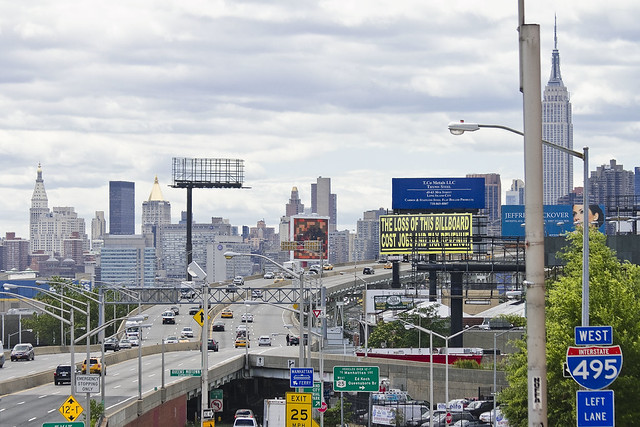
– photo by Mitch Waxman
The blasted heaths of Western Queens, which the art of engineering have conquered fully, must have once been quite lovely. What exists at the dawn of the second millennia, however, represent obeisance to the motor vehicle and “flow”. Gaze in horror upon the Queens Midtown Expressway section of the Long Island Expressway, a 1939 expression of the seeming ennui felt by Robert Moses for the ancient villages and communities of Long Island City.
Your humble narrator is often struck dumb and blind when doing so.
from wikipedia
Symptoms of acute stress reaction
The symptoms show great variation but typically include an initial state of “daze”, with some constriction of the field of consciousness and narrowing of attention, inability to comprehend stimuli, and disorientation.
This state may be quickly followed by either further withdrawal from the surrounding situation (to the extent of a dissociative stupor), or by agitation and overactivity, anxiety, impaired judgement, confusion, detachment, and depression. Autonomic signs of panic anxiety (tachycardia, sweating, flushing) are also commonly present.
The symptoms usually appear within minutes of the impact of the stressful stimulus or event, and disappear within 2–3 days (often within hours). Partial or complete amnesia for the episode may be present.

– photo by Mitch Waxman
At its apex over the Dutch Kills tributary of the languid Newtown Creek, which climbs to some one hundred and six feet over the water, the steel roadway begins a precipitous change in declination which carries vehicular traffic to the subaqueous Queens Midtown Tunnel and into Manhattan. The roadway was elevated to this altitude for no reason other than allow ocean going vessels egress to the turning basin of the Degnon Terminal at the head of Dutch Kills, and the blighting effect it had on Long Island City was quite unintentional. The industrial center became something to be ignored, driven over, forgotten, and quite irrelevant- seemingly by design.
If this is not the case, why are there no entrance or exit ramps between Greenpoint and Vernon Avenues?
from wikipedia
Depersonalization disorder (DPD) is a dissociative disorder (ICD-10 classifies the disorder as an anxiety disorder) in which the sufferer is affected by persistent or recurrent feelings of depersonalization and/or derealization. A diagnosis is made when the dissociation is persistent and interferes with the social and occupational functions necessary for everyday living. Diagnostic criteria include persistent or recurrent experiences of feeling detached from one’s mental processes or body. “Dissociation is defined as a disruption in the usually integrated functions of consciousness, memory, identity and perception, leading to a fragmentation of the coherence, unity and continuity of the sense of self.

– photo by Mitch Waxman
The complicated snare of vehicular access to Manhattan as it all compacts in Long Island City has often caused me to fall into a stupor when contemplated. Subway lines, railroads, passenger and freight vehicles- all form a tight fist gripping the heart of this formerly vital center. Storm water flows freely from exhausts onto local streets, causing temporary lagoons of sooty liquids to agglutinate about garbage choked sewers. Many of these sewers bear the screed “no dumping, drains into waterway” embossed directly on the iron grates.
Perhaps one is entangled in some waking nightmare, and all of what may be observed is merely some fevered ideation?
from wikipedia
Oneirophrenia is a hallucinatory, dream-like state caused by several conditions such as prolonged sleep deprivation, sensory deprivation, or drugs (such as ibogaine). From the Greek words “ὄνειρο” (oneiro, “dream”) and “φρενός” (phrenos, “mind”). It has some of the characteristics of simple schizophrenia, such as a confusional state and clouding of consciousness, but without presenting the dissociative symptoms which are typical of this disorder.
Persons affected by oneirophrenia have a feeling of dream-like unreality which, in its extreme form, may progress to delusions and hallucinations. Therefore, it is considered a schizophrenia-like acute form of psychosis which remits in about 60% of cases within a period of two years. It is estimated that 50% or more of schizophrenic patients present oneirophrenia at least once.
____________________________________________________________________________
Click for details on Mitch Waxman’s
Upcoming boat tours of Newtown Creek
July 22nd, 2012- Working Harbor Committee Newtown Creek Boat Tour


