Posts Tagged ‘Brooklyn’
hitherto denied
Happy 115th birthday, Grand Street Bridge.

– photo by Mitch Waxman
At a cost of $174,937, the newly constructed Grand Street Bridge – spanning the fantastic Newtown Creek – officially opened on this day in 1903 (although it had already been unofficially open to traffic since December of 1902). The Grand Street Bridge connects Maspeth in Queens with East Williamsburg/Bushwick in Brooklyn, and when it was built they had horse driven traffic in mind, as well as electric streetcars or trolleys. The City of Greater New York, with its familiar five boroughs and Manhattancentric political orientation was only a few years old at this point in time. Grand Street was part of a spate of bridge building that occurred in the years following municipal consolidation, both major and minor, which allowed the newly created Borough Presidents a chance to… ahem… share the wealth with their supporters.
The 1903 model, pictured above, is the third Grand Street Bridge. There were 1875 and 1890 models as well, but the historic record describes them as being shabbily constructed and “dilapidated.” The 1903 model has stood the test of time, although it did receive a bit of work and a fresh coat of paint during a rehabilitation project back in 1973.

– photo by Mitch Waxman
Grand Street is the demarcation line between the so called “East Branch” tributary and the main stem of Newtown Creek. The intersection with another tributary, English Kills, is nearby. That’s part of the East Branch, pictured above. As a note, when Grand Street crosses northwards into Queens, it becomes Grand Avenue.
My understanding is that the 1890 model Grand Street Bridge was operated by hand cranking winches. It’s also my understanding that the presence of a nearby wharfage in this area (called White’s Dock) narrowed the navigational channel significantly, and that it was pressure from various Brooklyn based merchants and manufacturing associations which drove the Federal War Department into condemning that iteration of the bridge – and Whites Dock- setting the stage for the construction of the current model and the shaping of the modern bulkheads surrounding it.

– photo by Mitch Waxman
End to end, Grand Street Bridge is nearly two hundred and twenty seven feet and one half inch in length. Horizontally it’s meant to be just over thirty two feet wide, with two lanes of vehicle traffic squeezing into a very tight nineteen feet and eight inch area. There are two sidewalks which are meant to be just under six feet wide, according to the NYC DOT, but that number sort of conflicts with my perception of them. Those tight lanes of traffic mean that anything bigger than a passenger car has to wait for traffic coming from the other side to cross over the bridge before they can do the same. This creates backups on both sides of the thing.
I think the sidewalks measurement must include the box girders visible in the shot above, which is actually from below.

– photo by Mitch Waxman
The Grand Street Bridge is a swing bridge, which means that the whole structure sits on a mechanical palette and can rearticulate itself ninety degrees to allow maritime traffic to pass to and fro. It’s a crying shame that there aren’t any customers in the East Branch who would require the presence of barge and tug, since the City is obligated to maintain the machinery here in functional order by the orders of the United States Coast Guard.
The DOT spends a bunch of money every year doing so, and the City has been petitioning the USCG to “delist” the East Branch for navigability, and to allow them to replace the 1903 Grand Street Bridge with something more appropriate for modern traffic needs – a static and far wider truss bridge – since at least 2002. The USCG remains adamant in its position, however, that all of Newtown Creek is a “SMIA” or Significant Maritime Infrastructure Area and all of its bridges must be maintained and be “moveable” on the waterway.
This brings up the questionable status of the MTA’s rail swing bridge “DB Cabin” on the Dutch Kills tributary of Newtown Creek, but that’s another story.

– photo by Mitch Waxman
The last time I checked the numbers, Grand Street Bridge carried just under ten thousand vehicle trips a day. That was in 2011, it should be mentioned, and supposedly only 7% of that traffic was defined by DOT as being “trucks.” As always, you need to learn how to speak “government” when reading things like that. They mean heavy tonnage trucks – garbage, semis, tankers – not box trucks, pickups, or delivery vans which everybody else would call “trucks.” A significant causality of traffic congestion in both Maspeth and East Williamsburg/Bushwick, the Grand Street Bridge is structurally far too narrow for modern day needs.
Modern needs include accomodating the traffic generated by the MTA’s gargantuan Grand Ave Bus Depot & Central Maintenance Facility, which is found on the Maspeth side of the bridge. The entire bus company unit serving Brooklyn crosses this bridge at least once a week for cleaning, inspection, and maintenance.

– photo by Mitch Waxman
One such as myself always has his ear to the ground, or is probing away at the elected or appointed lords of the local vicinity in hope of gleaning some knowledge of their secretive plans for us all. The general impression gathered is that were there money available right now to replace the Grand Street Bridge with a newer model, construction would begin forthwith.
I’ll be sorry to see the old girl go when they find the cash, as the Grand Street Bridge is one of my favorite bridges found along the lugubrious Newtown Creek. At any rate, Happy Birthday, old lady.
“follow” me on Twitter- @newtownpentacle
formula filled
My creek also puts on a show when I’ve been away from her too long.
– photo by Mitch Waxman
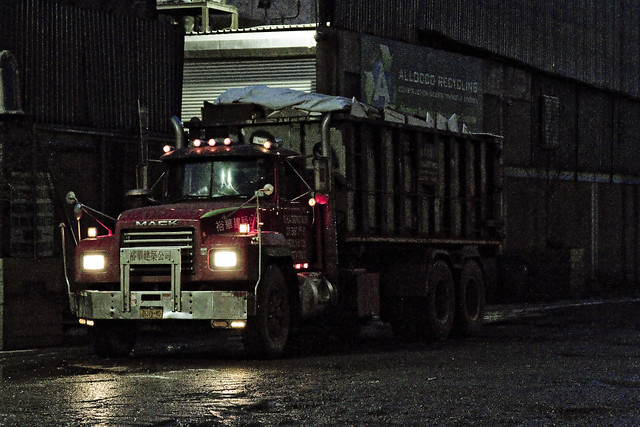
One of my practices, developed over the last decade or so, is to take a Newtown Creek break periodically and “allow my liver to return to a normal size.” I’m joking about the liver, but one does enjoy a bit of detox occasionally, and allowing the poisons I’ve accrued a chance to leach out. This is a luxury one enjoys, as he doesn’t live along Newtown Creek, others aren’t so lucky. Pictured above is roll on/ roll off garbage truck carrying a bin, spotted at a waste transfer station owned by a friend of mine which fairly straddles the border of Brooklyn and Queens.
– photo by Mitch Waxman
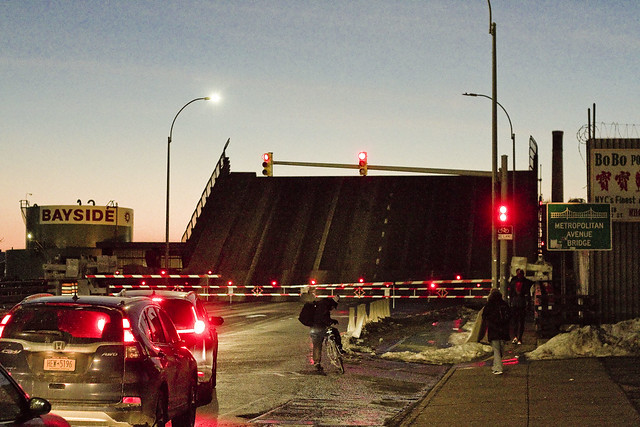
Marching along Metropolitan Avenue, one squealed with delight as the Metropolitan Avenue Bridge began to open. This used to be quite a frequent occurrence “back in the day.” These days there’s only one regular maritime customer back here on the English Kills tributary, which is Bayside Fuel.

– photo by Mitch Waxman
The timing of the bridge opening was bizarre, occurring at precisely the time of one of the heaviest traffic intervals in this section of North Brooklyn, about 6:30 p.m.

– photo by Mitch Waxman
That odd timing, however, allowed one to stand in the middle of Metropolitan Avenue without getting squished.

– photo by Mitch Waxman
I believe that the tug pictured above is the Mary H., which normally handles the Bayside duty, but it’s hard to say as I didn’t get any of its markings. I did manage to focus in on the captain in his wheelhouse, however, so “win.”
As a note, the Metropolitan Avenue Bridge spans the English Kills tributary of the larger Newtown Creek at a navigational mark 3.4 miles eastwards of the East River. Metropolitan Avenue was originally created as a private toll road about 1814, and was called the Williamsburgh and Jamaica Turnpike. The owners of the toll road, and the original bridge, were two brothers whose family name was Masters. That’s why you’ll occasionally see references to the road as the “Masters Turnpike” and the “Masters Bridge” in the historical record, if like me, you stay up until 4 in the morning reading old municipal journals and reports from the Chambers of Commerce of Brooklyn or Queens.

– photo by Mitch Waxman
My conceit is to call this area of Newtown Creek surrounding the Metropolitan Avenue Bridge “DUMABO.” That’s short for “Down Under the Metropolitan Avenue Bridge,” as I believe we need to be ahead of the real estate people on these sorts of things.
“follow” me on Twitter- @newtownpentacle
ignorantly spared
Back on the job.

– photo by Mitch Waxman
Since the recent extreme cold spell has broken, a humble narrator has found himself marching about again, and boy are my dogs barking. On Tuesday, a stroll over to Bushwick East Williamsburg was enacted and the farthest reaches of the Newtown Creek at English Kills were observed. As expected, the waterway was frozen over.

– photo by Mitch Waxman
Toxic ice. You don’t get to say that particular phrase that too often, but that’s what you’re looking at in the shot above. English Kills is the far eastern terminus of Newtown Creek, which branches off of the East River nearly 3.8 miles from the larger waterbody. These shots were gathered at about 3.7 miles back.

– photo by Mitch Waxman
That big sewer outfall at the end of the tributary is the 3.8 mile terminus mark, and the north/south street seen beyond the fencelines is Johnson Avenue. The surrounding neighborhood is gentrifying (dictionary definition of gentrifying), but on a fairly small scale as compared to points found to the west like LIC and Greenpoint.

– photo by Mitch Waxman
One decided to hang around the neighborhood for a bit and stretch my legs after the long interval of being trapped in the house by inclement clime, and visit a few of my favorite places. This shot is from the Scott Avenue footbridge, which spans the LIRR’s Bushwick Branch freight tracks, just as the burning thermonuclear eye of God itself was dipping behind New Jersey to the west.

– photo by Mitch Waxman
Heading over towards Metropolitan Avenue, and another of the dead end tributaries of Newtown Creek – the East Branch, one discovered that this section of the water was similarly locked in a decidedly polar state.

– photo by Mitch Waxman
The ice was decaying faster in both waterways where it touched the open sewer outfalls, no doubt due to the flow of melt water laden with road salt coming in from as far away as Canarsie. This untreated sewage is quite biologically active as well, and the metabolism of the microscopic entities contained in the water column likely helps to warm it up a bit.
“follow” me on Twitter- @newtownpentacle
trick atavism
Uh huh shattered, uh huh shattered.

– photo by Mitch Waxman
There’s a long list of things which are looked for when one is out wandering, and shattered glass is one of them. Don’t know why, but it’s something I’m attracted to shooting, as I like imperfection and meaningless destruction. Spotted the shatter pattern above on the window of a shop along Queens Blvd.

– photo by Mitch Waxman
The one above is from those walkways you’ll notice above the digester eggs of the sewer plant in Greenpoint. I was told that a “bird strike” caused the damage.

– photo by Mitch Waxman
Somewhere in industrial Maspeth, which is the epicenter for illegal dumping, these windows were abandoned on the sidewalk after being accidentally arranged in an esthetically pleasing pattern.

– photo by Mitch Waxman
That used to be a mirror, which was similarly ditched in industrial Maspeth.

– photo by Mitch Waxman
One of the reinforced glass windows – which used to be installed at the old Van Iderstine property in Blissville – was encountered along the bulkheads of Newtown Creek one day, and a humble narrator found himself transfixed.
“follow” me on Twitter- @newtownpentacle
peeling coats
It’s National Chocolate Candy Day, in these United States.

– photo by Mitch Waxman
It’s amazing, the way people can find a way to form up battle lines around just about anything these days. At the moment, I’m really enjoying the farcical arguments playing out in NYC regarding bicycling. How, on earth, anything as simple and wholesome as riding a bike has became so politicized is symptomatic of everything wrong with us as a society. A) Bikes aren’t the answer to everything transit, and B) Bikes aren’t the reason that were all going to hell in a handbasket. This one, it ain’t that complicated.
It vexes, you’ll have to understand.

– photo by Mitch Waxman
First, everybody in NYC orders in food periodically – Pizza, Chinese, whatever. Generally speaking, the person doing the delivery will likely arrive at your house on a two wheeled vehicle of some kind. Might be one of those newfangled electric jobs, or it could be a human powered bicycle. Could even be a velocipede, depending on whether or not you live in a hipster neighborhood. Let’s refer to the delivery people, the messengers and so on as “working bike riders.”
There’s a place which the politicians have been leading the vociferous and quite vocal “bicycle lobby” towards for several years now, by the way, and the working bicyclists are going to get there first.
Inevitably – there will be a municipal requirement for every bike and bike rider to be able to produce an operators permit, insurance, and display tags (license plates) – just like every other vehicle in NYC – when they interact with the NYPD. The politicians will eventually be setting up a fee based regulatory environment around bike riders soon enough, and it’s just a matter of time before they start hitting bicyclists with the sort of parking tickets and fines they do motorists to pay for the regulatory system.
Ten years at the most, in my opinion, before you need a drivers license to ride a bike in NYC. The Mayor is currently having the NYPD blitz the delivery riders with tickets as you read this, and a scheduled period of confiscation for the electric bikes is coming in the New Year. It’s already begun.

– photo by Mitch Waxman
Secondly, bikes are a pretty good choice to get around in fair weather, if you’re young and healthy enough to use one. Part of the argument which biking proponents miss is that for some of our neighbors, the only way to get around is by automobile. Your walking or stair climbing abilities may be compromised by any number of random medical factors, after all, and it’s not appropriate for many of us to show up at work slaked with sweat after a summertime commute.
You miss that sort of detail if you’re a member of the landed gentry who has decided to do a course of “public service” at City Hall, where the taxpayers maintain shower stalls for you to rinse off with before sitting down in front of your mahogany desk. Speaking of – I haven’t observed many of the City Hall people riding bikes to work, they use the train or drive City vehicles.
Practice what you preach, I always say, and as to that time I saw a former DOT Commisioner ask a limo driver to pull her bike out of the trunk a few blocks away from a press event (she wanted to be seen riding a bike to it) still ticks me off.

– photo by Mitch Waxman
Third – the anti bike people would point out the sort of dumbass behavior on display in the shot above as being emblematic of all bicycle enthusiasts. Bicycle proponents will describe stories of automobiles running roughshod throughout the City, purposely squishing and fracturing the populace. Both of these narratives have truth to them, but are overstated.
Why do we always jump to absolutes, and proclaim the impending arrival of the apocalypse over every little issue?
The “protected bike lanes” which the NYC DOT are pushing on us all are another one of those political terms, as they are not at all protected from other vehicles and still spit naked bike riders out into heavily travelled intersections. Given that bicyclists generally ignore traffic signals…

– photo by Mitch Waxman
These days, I’m a dedicated pedestrian, but I used to ride my bike all over the City just like any other Brooklyn kid. I was the worst kind of biker, incidentally, riding at speed both on and off the sidewalks and blowing through lights. Saying that, one was always fully in control of the thing, and never found myself in “trouble” with other moving objects on the road. That’s because, just as I do when I’m walking around, attention is paid to my surroundings. This is what is known as confirmation bias, incidentally. Just because you’ve done something risky once – or a hundred times – and gotten away with it, doesn’t mean your luck will continue.
You don’t want to be shooting selfies while riding along a busy street in LIC, as a note.

– photo by Mitch Waxman
If you are indeed hell bent on selfie shots, I’d point out the hundreds of so called “ghost bikes” which the Bicycling advocates have installed along our city streets, which are meant to memorialize those who have lost their lives in collisions with motor vehicles and chide the populace. The one above is on Rust Street in Maspeth nearby the Newtown Creek industrial zone, which is notorious for heavy trucking and is a poor choice to ride a bike through. It’s one of the few places in the City that I literally beg people to use the sidewalk when riding their bikes.
Thing is, a lot of these new bike lanes are actually accelerating the amount of interaction between human powered and motor vehicles – especially around the industrial areas. As a note, I’ve observed that a LOT of the lower pay scale laborers in these areas ride their bikes to work. Bosses drive, workers pedal, it would seem.

– photo by Mitch Waxman
In western Queens, the ghost bikes aren’t even safe on the sidewalk, nor is the signage admonishing vehicular operators to slow down or obey some of the rules of the road. This particular one sat alongside a “protected bike lane” sited on the LIE overpass at Greenpoint Avenue in Blissville. The turn lane for westbound traffic exiting the highway, as well as the turning lane for entering the east bound section, exists on this short block. It’s always a nightmare spot for traffic with 24/7 congestion, but despite this, the DOT decided to delete a traffic lane for bike usage. Bikes don’t actually use the lane, they wisely utilize the sidewalk instead, and there’s ghost bikes on both the north and south corners.
An anecdote: A few years ago, when a party of NY State environmental officials were queried as to why there weren’t any “No Fishing” signs along Newtown Creek, they said “well, you can’t fish there without a license, that would be illegal.” I asked them how the war on drugs was going, and reminded them that literally everything is legal in NYC if there aren’t any cops hanging around. The Albany people were aghast.
This sort of narrow bureaucratic thinking is precisely how we’ve found ourselves in the societal spot we’re in, arguing about everything in apocalyptic tone, because there aren’t gray areas anymore.

– photo by Mitch Waxman
I’d point to the very expensive solution DOT installed on the Pulaski Bridge as being what a protected bike lane should look like. Concrete barriers were set up to keep bikes, pedestrians, and trucks away from each other in distinct lanes. Thing is, just like every other half hearted process undertaken by officialdom, these “jersey barriers” end where the bridge ends in bothe LIC and Greenpoint, where turn lanes for vehicular traffic leaving the span cross right through the bike lanes and the helter skelter rules of NYC traffic begin. I guess this is the NYC way, however, lulling you into a false sense of security before dropping an air conditioner out of an eighth story window on you.
I’m also a fan of the experiments in Manhattan, along Broadway in the 30’s and 20’s, where the parking lane has been relocated to about 15-20 feet from the curb and the parked cars serve the purpose of protecting the bike lane. This particular plan has not been popular with drivers, however, who have lost a lane of travel and gained even more congestion at what has always been a traffic choke point between Herald Square and the Flatiron district.

– photo by Mitch Waxman
When I was a kid in Canarsie, one of the neighbors was an old sailor (part of the fishing fleet at Sheepshead Bay) named Joe who had one of the most well developed Brooklyn accents I’ve ever encountered. Now, my Dad’s mutterings often included “terlet,” “icewhole,” “boid,” and “glass a whatah,” but this old Irish guy named Joe next door was just magic. Joe would often opine “dat opinyeons ahrr likes iceholes, evrie botties gots one’s.” Personally, a humble narrator has little skin in this particular bicycle game, and as my old neighbor would have said – “koodint gives toose chits, one ways orz da uthher.”
Be like Old Joe, and share what ya got in the comments? What’s the way forward on this bike argument? Want to argue with other Newtown Pentacle readers? Click the comments link below and spout off.
“follow” me on Twitter- @newtownpentacle


 The Newtown Pentacle