Posts Tagged ‘Long Island City’
cunning mask

– photo by Mitch Waxman
Recently, a college student contacted me and asked if she might tag along on one of my walks around Newtown Creek. After enduring my usual admonishment toward the wearing of sandals, we met in Greenpoint and engaged In a generalized saunter around certain points of interest in what I refer to as “The Lower Creek,” specifically the area contained on both north and south banks between the Greenpoint Avenue and Pulaski Bridges. At the Newtown Creek Waste Water Treatment Plant Nature Walk in Greenpoint, we encountered the Captain Zeke tug.
Welcome back to Maritime Sunday at this, your Newtown Pentacle.

– photo by Mitch Waxman
Captain Zeke has been discussed before, in the posting “average specimens” from February of 2012. The barges Captain Zeke was handling seemed to be headed for the Allocco dock whose street address is on Kingsland Avenue in Greenpoint. That would indicate that these barges are for moving bulk materials such as rock, gravel, or even scrap metals. From my vantage, I could not see any cargo in the barges, and they were sitting quite high in the water so they were likely empty.

– photo by Mitch Waxman
After maneuvering their charge into place, the tug crew began moving around the boat, coiling rope and stowing away equipment. The tug reversed itself away form the barges and proceeded eastwards up the Creek to unknown destinations. In this case, the hearty Maritime Sunday shout out was offered in person, as the tug was less than 100 yards away from where my collegiate friend and I stood and the sailors onboard waved back.
As always, the thing in the Megalith watched on.
dark and furtive
“follow” me on Twitter at @newtownpentacle

– photo by Mitch Waxman
While inspecting the scene which stands extant in DUPBO, or Down Under the Pulaski Bridge Onramp, one cannot help but notice the regular appearance of the Long Island Railroad operating along those tracks which it has held tenancy over since 1870.
The singular thrumming and vibrations of the municipal railways engines often rouse me from the piles of trash and wind blown debris amongst which one such as myself dwelleth, commanding my attentions and demanding proximity.
from 1877′s “Long Island and where to go!!: A descriptive work compiled for the Long R.R. Co.“, courtesy google books:
Long Island City is the concentrating point upon the East river, of all the main avenues of travel from the back districts of Long Island to the city of New York. The great arteries of travel leading from New York are Thomson avenue, macadamized, 100 feet wide, leading directly to Newtown, Jamaica and the middle and southern roads on Long Island, and Jackson avenue, also 100 feet wide, and leading directly to Flushing, Whitestone and the northerly roads.
Long Island City is also the concentrating point upon the East river, of the railway system of Long Island.

– photo by Mitch Waxman
Diminished expectations notwithstanding, someday I would hope to actually ride upon one of these trains, transiting merrily from terminus to terminus and happily recording the largely pedestrian experience in photographs, anecdote, and the occasional video.
Of course, such pleasures must be denied to one such as myself, who is an onerous, undeserving, and decidedly feckless quisling renowned for publicly embarrassing himself with wild flights of fantasy and fantastic predictions of an uncomfortable and dire future.
from wikipedia
This station has 13 tracks, two concrete high-level island platforms, and one wooden high-level island platform. All platforms are two cars long and accessible from Borden Avenue just west of Fifth Street. The northernmost one, adjacent to tracks 2 and 3, is the only one used for passenger service. The other concrete platform adjacent to tracks 6 and 7 and the wooden one adjacent to tracks 8 and 9 are used for employees only. All tracks without platforms are used for train storage. The southernmost four tracks are powered by third rail while the remaining tracks are used only by diesel-powered trains.
– photo by Mitch Waxman
Feeling somehow exposed down in DUPBO, a dark corner of the Newtown Creek watershed occasionally occluded by the gaseous exhalations of high volume roads, vehicular tunnels, and hundreds of thousands of automotive engines, your humble narrator retreated to the increasingly well used and so called “51st Avenue bridge”.
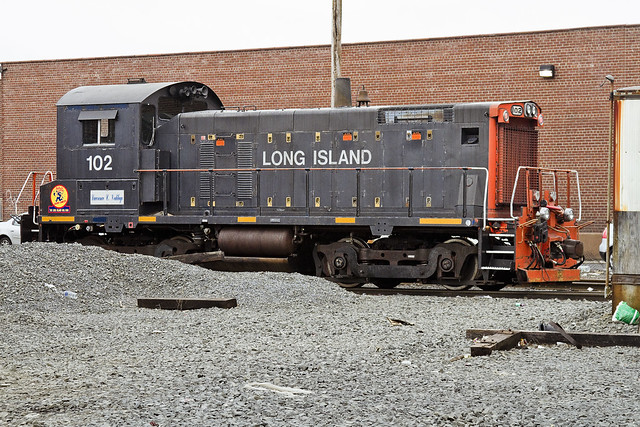
The elderly engine you see above, which is still at least ten years younger than me, is an EMD SW1001.
from wikipedia
The EMD SW1001 was a 1,000-horsepower (750 kW) diesel locomotive for industrial switching service built by General Motors’ Electro-Motive Division between September 1968 and June 1986. A total of 230 examples were constructed, mainly for North American railroads and industrial operations.
The SW1001 was developed because EMD’s SW1000 model had proved unpopular among industrial railroad customers, as the heights of its walkway and cab eaves were much greater than those of earlier EMD switcher models. The overall height was similar, but the SW1000’s roof was much flatter in curvature. Industrial railroads that only operated switchers often had facilities designed to the proportions of EMD’s earlier switchers.
– photo by Mitch Waxman
A decaying and increasingly decrepit truss bridge designed for pedestrians, the structure hurtles over the tracks and leads one under the steel of the fabled Long Island Expressway. Several years ago, I witnessed documents prepared by certain members of the government which proposed the utter destruction and subsequent replacement of this bridge. This report continued in dire tones- describing the bridge as standing, but unsound due to decaying concrete and rusted steel.
For a longer look at the bridge and environs, check out this post from February of 2010, “dimly lit and illimitable corridors.”
Personal observation has revealed that this is a VERY well traveled route between the industrial labor force of LIC and the nearby 7 train at 49th Avenue- or Hunters Point Avenue- depending on which century you’re describing. The 7, of course, offers connections to the east via Queens Plaza or a short journey into Manhattan via the Steinway Tunnel.
Forgotten-NY has been here too.
from wikipedia
The Steinway Tunnel carries the 7 trains of the New York City Subway under the East River between 42nd Street in Manhattan and 51st Avenue in Long Island City, Queens, in New York City. It was originally designed and built as an interurban trolley tunnel (hence the narrow loading gauge and height), with stations near the 7 ; trains’ current Hunters Point Avenue and Grand Central stations. It is named for William Steinway, who was a major promoter of its construction, although he died in 1896 before it was completed.

– photo by Mitch Waxman
This is officially “one of my spots,” by the way.
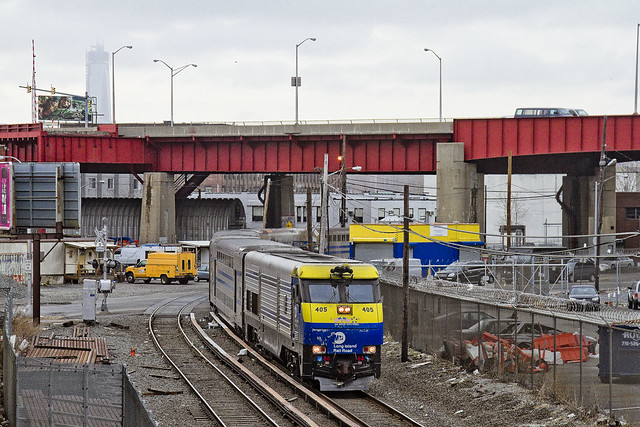
During the week, especially around rush hour, a series of trains roll through here, providing a good opportunity for photography enthusiasts to gain a less common angle on the familiar blue and yellow passenger service. The phrase “one of my spots,” by the way, refers to an area I visit often while looking for a perfect combination of sky and light and subject. A wealth of photos of this particular spot and situation adorns my photostream at flickr, but I still haven’t hit that moment here, which is another failure I can pin on to my sweater.
There’s magic on the 51st Avenue bridge, I just have to find the right place and time to photograph it, which will take nothing but persistence.
from wikipedia
The Long Island Rail Road owns an electric fleet of 836 M7 and 170 M3 electric multiple unit cars, and 134 C3 bilevel rail cars powered by 23 DE30AC diesel-electric locomotives and 22 DM30AC dual-mode locomotives.
In 1997 and 1998, the LIRR received 134 double-decker passenger cars from Kawasaki, including 23 cab control cars, and 46 General Motors Electro-Motive Division diesel-electric locomotives (23 diesel DE30ACs and 23 dual-mode DM30ACs) to pull them, allowing trains from non-electric territory to access Penn Station for the first time in many years, due to the prohibition on diesel operation in the East River Tunnels leading to Penn Station.
illusion brought
“follow” me on Twitter at @newtownpentacle

– photo by Mitch Waxman
Cloudy days and colorless nights are all that one such as myself can look forward to, and it is only within the wasted devastations of the Newtown Creek where memories of succor and happiness might be found.
In such a spot, and for several months in fact, these trailers of automotive tires have been sitting. Seemingly abandoned, one knows not the purpose of their corporeal presence at the Vernon Street End here in Long Island City, but given the long history of dumping in the area- one presumes their status as circumspect. It should be mentioned that the trailers have license plates and identifying marks, which is unusual for such scenarios.
from wikipedia
Tire stockpiles create a great health and safety risk. Tire fires can occur easily, burning for months, creating substantial pollution in the air and ground. Recycling helps to reduce the number of tires in storage. An additional health risk, tire piles provide harborage for vermin and a breeding ground for mosquitoes that may carry diseases. Illegal dumping of scrap tires pollutes ravines, woods, deserts, and empty lots; which has led many states to pass scrap tire regulations requiring proper management. Tire amnesty day events, in which community members can deposit a limited number of waste tires free of charge, can be funded by state scrap tire programs, helping decrease illegal dumping and improper storage of scrap tires.

– photo by Mitch Waxman
Four of these trailers have been here since at least late January. You can see them in the background of this shot from the 22nd day of 2013.
At various intervals, the doors of more than one of these trailers have hung open before me, and they are all full of tires. Mayhaps there is some legitimate and wholesome purpose for their presence, which is beyond my reckoning.
It’s not as if 4 seemingly abandoned trailers, parked in proximity to the Buckeye Pipeline and directly over the G train tunnel (and within throwing distance of a rail yard and the Midtown Tunnel) would be noticed or investigated by the same security and law enforcement personnel who will regularly inquire “what are you taking pictures of” of me from their squad cars. This is Queens.
What could happen?
from wikipedia
Security theater is the practice of investing in countermeasures intended to provide the feeling of improved security while doing little or nothing to actually achieve it. The term was coined by computer security specialist and writer Bruce Schneier for his book Beyond Fear, but has gained currency in security circles, particularly for describing airport security measures.

– photo by Mitch Waxman
For those of you used to the Brooklyn point of view, these are the slabs of cement that the boat people are tied off to on the Queens side of the Newtown Creek, around a block from the LIRR yard. Nothing to worry about, go back about your business.
I’m told that the group of boats nesting along the shore here has taken to calling itself the “Hunters Point Boat Sanctuary.”
This was once the home of the Newtown Creek Towing Company, incidentally, right alongside the Vernon Avenue Bridge.
1908 image from “Illustrated History of the Borough of Queens, New York City By Georg von Skal, Flushing Journal, Flushing, N.Y” – courtesy google books. That’s Brooklyn on the right, Queens to the left.

– photo by Mitch Waxman
The situation here continues to scare the hell out of me, but no one seems particularly concerned about it.

– photo by Mitch Waxman
To my admittedly age ravaged eyes, this doesn’t look so safe. The heavy concrete blocks which support the ad hoc moorings of these boats is clearly and inexorably being pulled toward the Creek. Never mind the fact that they are docking in the direct outfall of a combined sewer pipe.
from nyc.gov
Sometimes, during heavy rain and snow storms, combined sewers receive higher than normal flows. Treatment plants are unable to handle flows that are more than twice design capacity and when this occurs, a mix of excess stormwater and untreated wastewater discharges directly into the City’s waterways at certain outfalls. This is called a combined sewer overflow (CSO). We are concerned about CSOs because of their effect on water quality and recreational uses.

– photo by Mitch Waxman
Anyway, that’s the scene at the ragged border of Queens known as Newtown Creek and the Vernon Avenue Street End in the early spring of 2013.
It has been decided to do an occasional series of posts which are strictly “here’s what is there” in nature, simply to document the place as it begins a season of tremendous change. Hunters Point South has begun, and the Kosciuszko reconstruction will be starting up this fall, Greenpoint Landing is not far away either.
This is the penultimate year for the Newtown Creek’s 20th century incarnation, which will be utterly altered, upgraded, and updated in the next decade.
from nyc.gov
Newtown Creek is a 3.8-mile long tidal water body located in the City of New York, having five main tributaries (Dutch Creek, Whale Creek, Maspeth Creek, East Branch and English Kills) and is itself a tributary of the East River. The creek is a part of the New York – New Jersey Harbor Estuary that forms the north-south border between the New York City boroughs of Brooklyn and Queens.
The Newtown Creek area has a history of widespread industrial development dating back to the 1800s. In the mid-1800s, the area adjacent to Newtown Creek was one of the busiest hubs of industrial activity in New York City. More than 50 refineries were located along its banks, including oil refineries, petrochemical plants, fertilizer and glue factories, sawmills, and lumber and coal yards. Newtown Creek was brimming with commercial vessels. During World War II, the creek was one of the busiest ports in the nation. This historic development has resulted in changes in the nature of the Creek from a natural drainage condition to one that is largely governed by engineered and institutional systems.
humanless region
“follow” me on Twitter at @newtownpentacle

– photo by Mitch Waxman
As one might have observed in recent media reports, the Mayor of New York City and certain hand picked lieutenants and allies deployed the “golden shovels” and officially “broke ground” at the so called Hunters Point South project in Long Island City. Funny, as construction has been going on around here for a while, mainly on improving the archaic sewer and water system.

– photo by Mitch Waxman
On second street, there is a long ditch currently extant which reveals part of this work. Much of what is happening around here, I am led to believe, is closer to the East River. This assertion is easily proven if one is a customer of the East River Ferry, as the fence line one follows to the dock winds its way along the early phases of the construction site where this grandiose plumbing is being installed.

– photo by Mitch Waxman
Spongy, the soil at Hunters Point has seen a lot of industrial tenants come and go over the centuries. At the penultimate southern terminus of the street is the notorious Newtown Creek, to the west is the squamous East River- which was known as the River of Sound to ancient mariners. Interestingly enough- the ground water, or at least the bits of it which have percolated into this pit, is not dissimilar in color or appearance to the very end of the Newtown Creek’s distant tributary English Kills in Bushwick.

– photo by Mitch Waxman
Surprisingly, the “layer cake” normally observed in Long Island City street repairs was not visible. Like lower Manhattan and Downtown Brooklyn, the streets are several centuries deep, and one will often see several layers of different pavement technologies on display. If one is very lucky and the street is very old- a layer of compacted and oiled earth, capped by a white chalky substance surmounted by a layer or two of gravel which lies under Belgian Blocks then cement and tar and then concrete and asphalt might be observed.
I’ve got a shot or two from Queens Plaza in which this layer cake is obviously encountered, for instance.
groping again
“follow” me on Twitter at @newtownpentacle

– photo by Mitch Waxman
Perhaps one has become an internet troll.
I do spend an awful lot of time scuttling around beneath bridges and overhead trusses of all kinds, while wandering throughout the concrete devastations of the Newtown Pentacle. Then I find myself posting photos of them to the internet, which offers connection via correlation. As the scions of some mythical “old neighborhood” might proffer: “Dictionary definition, look here douchebag, trolls live under bridges. That means you a fucking troll. Fuck you, troll.”
That really is a quote, incidentally, from a Dungeons and Dragons comrade in Canarsie back during the 1980’s. Essential usage of the Brooklyn patois, at that time, always involved explaining your work when cursing someone out. It was a gentler age, when a young Joe Piscopo taught us all how to laugh again.

– photo by Mitch Waxman
Perhaps, one can be cast as a paparazzo for decaying infrastructure and artisan pollution instead. Imagine a humble narrator clad in scarf and motor scooter, zipping around town searching for remnants of the forgotten and occluded world of fat rendering and manufactured gas while always keeping a watchful eye on the once and future king of the Creeks, called Newtown.
Dynamic, this lifestyle of the paparazzi would, given the poor and mediocre existence currently endured, irrevocably brighten ones outlook.
Back in the “old neighborhood,” which was not all that old or really much of a neighborhood, it was opined as best to keep ones sights set low lest disappointment and regret rule ones mind in extreme old age. It was commonly decided that prudence demanded the acquisition of a government job with benefits and regular hours, receiving a pension after 25 years, and then moving away from “all the bullshit” to be the best course of action one could take.
There were a lot of cops, garbage men, firemen, and EMT’s in the old neighborhood. Nurses too.

– photo by Mitch Waxman
Unfortunately, it does seem that one has indeed become this much maligned creature of hideous modernity called an “Internet troll.” If you spot some scruffy bag of mostly water, all wrapped up in a filthy black raincoat and scuttling about while clumsily picking its path around and beneath a bridge, that very well might be me.
What else it might be, for my countenance is somewhat unbearable to behold by the unprepared and there are certain asymmetrical oddities in my gait and postures which defy impersonation, few can say. I will continue to post these captured photons on the internet, notwithstanding that they might be dispatches from Trollheim.


 The Newtown Pentacle