Posts Tagged ‘ny harbor’
enigmatic fragments

– photo by Mitch Waxman
This blog post is not about Osama Bin Laden or LeBron James, has little or nothing to say about Charlie Sheen or Hosni Mubarek, and it’s production has not been influenced in any way by fluctuations in the Producer Price Index or any other leading financial indicators. Additionally, it is not sponsored by the Pew Charitable Trust nor a grant from the Koch foundation.
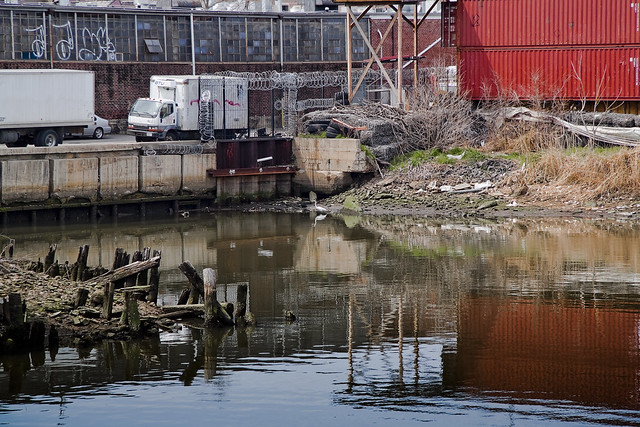
Instead, the focus of this post is about a silted over, non navigable, and relict tributary of the Newtown Creek found fairly close to the dead bang geographic center of New York City called Maspeth Creek.
It is apparently a good place to get rid of an unwanted automobile or two,

– photo by Mitch Waxman
Your humble narrator seems to end up here a lot, as until just recently, it was one of the few places in Queens where one might witness the terrible grandeur of the Newtown Creek up close and personal with a minimum of hassle from private security or curious inquiries from the local gendarme. A large lot, overgrown with thorny plants, all stained with that peculiar colour- which is like something out of space- allowed some access to the place. Alas, the owner of the febrile lot seems to have found some new usage for it, and the fences have gone up.

– photo by Mitch Waxman
One of the great problems associated with Newtown Creek, and an obstacle to the efforts being made by Newtown Creek Alliance and other groups to reveal the history and significance of the place to the vast new populations being installed in Greenpoint and Long Island City by certain Real Estate interests is the fact that the Creek is hidden in most places by anonymous warehouses and industrial sites not friendly to casual visitors. The point of view of the property owners is one of liability for injury, and they have entirely appropriate concerns. The Newtown Creek can be a dangerous place, with multi ton trucks and gargantuan machinery whizzing around on streets where few pedestrians or bicyclists are normally seen. Not far from this spot, your humble narrator found himself falling into a hole in the roadway (at the end of the winter) which was nearly a yard deep.
Those of you out there who wander the rail tracks, however, are being foolhardy. The threat to your very existence is manifest, and should you be prosecuted for trespass, mandatory sentencing applies.

– photo by Mitch Waxman
Other area bloggers and several urban explorers have taken me to task over the years for my admonitions reminding readers of this, your Newtown Pentacle, to remain cautious and alert of their surroundings when exploring the creek lands. There are forces here, sinister and hidden, which like the Creek just the way it is and don’t appreciate strangers with cameras wandering through their back yards. Additionally, the purely physical hazards of high speed traffic (the issue of trucks moving through Maspeth and other residential neighborhoods is a long standing and somewhat intractable issue, I would suggest a visit to the folks at COMET for more on the situation) and broken road surfaces must be factored in around these parts.
Recently, I almost got Kevin Walsh of forgotten-ny killed on Metropolitan Avenue- which goes to show that even those well versed in navigating these streets can end up in an emergency room after visiting the area. Kevin is fine by the way, his scalp is back in one piece, he just can’t say any word in which the second letter is a “c” for awhile- although his physicians swear this is only temporary.
Lastly, a safe way to experience the Newtown Creek:
It is critical for you to purchase tickets for the Newtown Creek Cruise soon. We’re filling up rapidly and seating is limited. Your humble narrator is acting as chairman for this journey, and spectacular guest speakers are enlisted to be onboard. Click here to order tickets.
From workingharbor.com
he May 21st, Newtown Creek Cruise:
Explore Newtown Creek by Boat
Saturday, 21 May, 2011
Pier 17, South Street Seaport.
Departs 10 am sharp
Returns 1 pm
Price: $60
Join us for a special water tour with expert narration from historical and environmental guest speakers.
There are limited tickets available on the MV American Princess for a very rare tour of Newtown Creek. Guest narrators will cover points of industrial and historical interest as well as environmental and conservation issues during your three-hour exploration. New York’s forgotten history will be revealed – as well as bright plans for the creeks future.
MV American Princess is a large, comfortable vessel with indoor and outdoor seating. Complimentary soft drinks and a tour brochure are included.
Cruise runs rain or shine
Queries? Contact Tour Chairman Mitch Waxman: waxmanstudio@gmail.com
Hosted by Hidden Harbor Tours ® in association with the Newtown Creek Alliance.
sweet forgetfulness

– photo by Mitch Waxman
While wandering about the Newtown Creek, it is easy to lose faith that wholesomeness exists anywhere, and one’s thoughts turn toward the apocalyptic. Floating sewage, volatile organic chemicals, and sometimes even oil envenomate the water. Languid waves lick at and nourish shorelines whose concretized holdings of mud and soil are deeply riven with heavy metals and certain ashy residues which hint at a faded industrial grandeur, and the very air you breath is a poisonous fume.
Yet, somehow, against every possible chance, nature endures in this place.

– photo by Mitch Waxman
One of the mythologies about the Newtown Creek is that it is some sort of dead zone, destroyed and irrevocably altered by man.
While some of this is true, Dutch Kills for instance used to run all the way to Queens Plaza (ever notice the smell down in the subway station? That’s Dutch Kills, which still follows it’s ancient course through brick lined subterranean sewers, and oozes through the masonry walls of the subway. I know the specific smell of Dutch Kills, and the odor in the station is definitely it) and Maspeth Creek flowed halfway to Flushing when the Dutch found it.
The thing is, while the bird in these shots is beautiful, most of the life found in the Newtown Creek is not as esthetically pleasing.
– photo by Mitch Waxman
Just the other day, a stalwart member of the Long Island City Boathouse described observing oyster colonies, obviously rendered unfit for consumption by the endemic pollution of the waterway, growing wild in English Kills. I’ve personally observed Eel fry as far back as Maspeth Creek, several higher species of the icthyan order, jellyfish. The radical LaGuardia Community College biologist Dr. Sarah Durand is in the process of collecting evidences of zooplankton and other invertebrate populations in the water column. There’s also a Heron which is known to reveal it’s wisdom, close to the Grand Street Bridge, to those wise enough to ask it the right questions.
Who can guess all there is, that might be hidden down there?
time stained

– photo by Mitch Waxman
Business carried me to… Staten Island… recently, and as always the charms of the place were lost upon my dross sensibilities. To one of my peculiar fascinations, the two most interesting things about the place are what’s floating around it on the Kill Van Kull, and the queer but persistent rumors that when Garibaldi hid from the Papists on Staten Island in the last century, he was in possession of certain Masonic treasures which did not make the return trip to Italy with him and that said antiquities might lie extant still somewhere on the Island.
It’s actually a lovely part of the City of Greater New York, of course, which I bear an unreasoning prejudice against… I’m all ‘effed up.
from wikipedia
The Kill Van Kull is a tidal strait between Staten Island, New York and Bayonne, New Jersey in the United States. Approximately 3 miles (4.8 km) long and 1,000 feet (305 m) wide, it connects Newark Bay with Upper New York Bay. The Robbins Reef Light marks the eastern end of the Kill, Bergen Point its western end. Spanned by the Bayonne Bridge, it is one of the most heavily travelled waterways in the Port of New York and New Jersey.

– photo by Mitch Waxman
The maritime culture of Staten Island, once a thriving and all encompassing economy, has been reduced but it still quite active. The looming question of the landmarked Bayonne Bridge, which is now considered to be an impediment to further expansion and modernization of the portages at Newark and Elizabeth continues. The latest plan I was privy to described a process which would scrub the current roadway and build a newer deck that would allow egress to the gargantuan class of ships called “Panamax” which will dominate the transoceanic shipping trade within a few years.
An inability to access the docks in New Jersey would result in Asian and European cargo being unloaded in another state and municipality, which would drive a stake directly into the heart of our local maritime industry, and chart out a declining future for the Port of New York.
from wikipedia
Seagoing tugboats are in three basic categories:
The standard seagoing tugboat with model bow that tows its “payload” on a hawser.
The “notch tug” which can be secured in a notch at the stern of a specially designed barge, effectively making the combination a ship. This configuration, however, is dangerous to use with a barge which is “in ballast” (no cargo) or in a head or following sea. Therefore, the “notch tugs” are usually built with a towing winch. With this configuration, the barge being pushed might approach the size of a small ship, the interaction of the water flow allows a higher speed with a minimal increase in power required or fuel consumption.
The “integral unit,” “integrated tug and barge,” or “ITB,” comprises specially designed vessels that lock together in such a rigid and strong method as to be certified as such by authorities (classification societies) such as the American Bureau of Shipping, Lloyd’s Register of Shipping, Indian Register of Shipping, Det Norske Veritas or several others. These units stay combined under virtually any sea conditions and the “tugs” usually have poor sea keeping designs for navigation without their “barges” attached. Vessels in this category are legally considered to be ships rather than tugboats and barges must be staffed accordingly. Such vessels must show navigation lights compliant with those required of ships rather than those required of tugboats and vessels under tow. Articulated tug and barge units also utilize mechanical means to connect to their barges. ATB’s generally utilize Intercon and Bludworth connection systems. Other available systems include Articouple, Hydraconn and Beacon Jak. ATB’s are generally staffed as a large tugboat, with between seven to nine crew members. The typical American ATB operating on the east coast, per custom, displays navigational lights of a towing vessel pushing ahead, as described in the ’72 COLREGS.

– photo by Mitch Waxman
Enthusiasts and colleagues always try to disabuse me of my dislike for the Island, and it’s rich history does tantalize. Vanderbilts, and Kreischers, and Willowbrook, and Snug Harbor are oft mentioned but the modern island- with it’s hideous modernist residences and consumerist population- causes me to shrink away and shun it’s charms. As mentioned, this is dictionary prejudice, and I’m not trying to start a fight with my counterparts in the antiquarian community of the Island.
Better that I stick to Richmond Terrace, with it’s spectacular maritime theatrics, than delve too deeply into the place lest I betray a mind closed to possibilities.
from nan.usace.army.mil
The Kill van Kull deepening project is part of the overall NY & NJ Harbor Deepening (50 feet) $1.6 billion project to deepen certain channels to 50 feet in order to allow the safe and economically efficient passage of the newest container ships serving the Port of NY & NJ. The first Corps contract was awarded in March 2005 for the Kill Van Kull Channel, S-KVK-2. Dredging for this contract started west of the Bayonne Bridge and worked east through the channel. Since the area along Bergen Point is made up of diabase rock, drilling and blasting was required.
May 21st

– photo by Mitch Waxman
The show must go on, as they say, yet your humble narrator is of heavy heart in announcing the Newtown Creek tour of May 21st, 2011- which is offered for your consideration by the Working Harbor Committee.
It is not the task of course, which tempers the normal ebullience experienced when an opportunity to share the wonders of the Newtown Creek with a group of enthusiasts from the comfort and safety of a modern vessel like the MV American Princess (which is outfitted with all the amenities one would expect to find during a harbor trip in a tourist Mecca such as New York City), crosses my path.
It is not that unnatural and uncontrollable timorousness which plagues me when I am asked to speak before “this group of pale enthusiasts” or “that gang of antiquarians”. Revealing and sharing the history of this amazing place is one the things I revel in, and brings me close to understanding what joy must be like.
from workingharbor.com
Visit Beautiful Newtown Creek Saturday, May 21, 2011
On MV American Princess, Boat departs from Pier 17, South Street Seaport, Manhattan NYC, 10am – 1pm
Souvenir Tour Brochure with historical information and vintage maps. Narration by experienced historical and environmental guest speakers. Complimentary soft drinks will be served. Come aboard for an intense Newtown Creek exploration! Our comfortable charter boat will travel the length of Newtown Creek. The tour will pause at many interesting locations for narration and discussion. Guest narrators will cover historical, environmental, and conservation issues. Large comfortable vessel with indoor & outdoor seating. Cruise runs rain or shine. Price: $60
To purchase tickets click here
or contact Tour Chairman Mitch Waxman: waxmanstudio(AT)gmail.com

– photo by Mitch Waxman
This is where the Industrial Revolution happened, and this trip will transverse and offer certain observations about the Newtown Creek’s present form and usage, and reveal a potentially bright future which this neglected ribbon of water- which provides the currently undefended border of Brooklyn and Queens- were it to be revitalized and renewed, might offer the future.
After boarding at South Street seaport, Working Harbor’s maritime experts will discuss the waterfront of Brooklyn as we pass beneath the Brooklyn Bridge and Manhattan Bridge, and finally passing under the Willamsburg Bridge. Our vessel will smoothly move past the neighborhoods of Dumbo, Williamsburg, and Greenpoint in Brooklyn, and offer spectacular views of Manhattan. This entire trip will be a photographer’s delight, incidentally, offering spectacular and unreal urban panoramas.

– photo by Mitch Waxman
At Long Island City, your humble narrator will presume to expose you to a short history of the Newtown Creek, and offer an identity to some of the enigmatic structures arrayed around the troubled industrial waterway.
Luckily for all concerned, there are other speakers who will relieve the crowd from my droning prattle, maritime experts and environmentalists included. Around Newtown Creek Alliance headquarters, there is some buzz amongst the staff about which one of the heavyweight orators will be onboard.
Soft drinks, one to a customer, will be complimentary as well.

– photo by Mitch Waxman
The American Princess will proceed past the titan Newtown Creek Waste Water Treatment Plant, the malign Dutch Kills, the cyclopean SimsMetal dock, the brutal symmetry of the Greenpoint Avenue Bridge, through the agglutinated heart of the Greenpoint Oil Spill, past the severed Penny Bridge at Meeker Avenue, and beyond the emerald devastations of Calvary Cemetery.
Then, we’re going to take a moment to remember our fallen friend… for just a moment.
I’m hesitant to mention this… as this is not what this trip is meant to be about, this is not a memorial event… but Bernie Ente is and will be so profoundly missed by many of us who will be conducting this tour, of which he is the originator and founder of… it would be in bad taste if a moment of silence to remember him, in this place which he expended so much of his attentions revealing and teaching and guiding about, were not offered. More on this in a later posting, but as the initial line says “the show must go on”, and that is exactly what Bernie would have us do.

– photo by Mitch Waxman
The course will continue, past the middle point of the Newtown Creek, and will plunge past the Maspeth Plank road, past the Phelps Dodge site and the Kosciusko Bridge. At the branching of the Newtown Creek which exists at the confluence of the East Branch and English Kills, we will witness the remains of the Maspeth Plank Road and approach the wicked end of the navigable section of the Newtown Creek itself and approach one the hydra like tributaries which spread languishing tendrils of rotting bulkheads and unused yet prime industrial waterfront locations all across Brooklyn and Queens.
This is not the world you know.

– photo by Mitch Waxman
Witness the startling elegance of the Grand Street Bridge, a century old swing bridge connecting Brooklyn and Queens, which signals the entrance to English Kills has been reached. Industrial heartland, this is a grossly contaminated section of the waterway which has- of course- been designated as a Federal Superfund site. Seeing the Newtown Creek in this state, this bizarre half life which is neither tick nor tock- industrial nor residential, is a fairly short term proposition.
Vast changes are coming which will literally alter the very landscape.

– photo by Mitch Waxman
The Kosciusko Bridge replacement, and the enormous new populations and residential conversion in progress and expected in Hunters Point South and Greenpoint, and the EPA conducting the initial stages of Superfund remediation (which will involve dredging and vast public works projects conducted by hundreds of contractors) will all be happening in roughly the same timeframe. Ten years from now, it will hard to recognize the place, and twenty more will render it a stranger to those who know it today.
In the English Kills, you will become transfixed by a waterfront frozen in some other century, and witness the extant vitality of those economies of heavy industry which build, and drain, and recycle, and dispose of. You don’t get Manhattan without a Newtown Creek, after all.

– photo by Mitch Waxman
We will proceed into the depths of English Kills near the Third Ward in East Williamsburg, Brooklyn. Our journey will cross the navigable sections of the Newtown Creek and begin it’s return journey to the Shining City of Manhattan and the South Street Seaport, leaving Greenpoint and Long Island City behind.
The plan for the return narration includes a full description and explanation of the Superfund situation by representatives of the Newtown Creek Alliance, and a return to Manhattan’s South Street Seaport. Personally, I’ll be at the bow during this part of the trip, as the photographic possibilities of moving languidly along the Creek with the sun behind us and illuminating both the creek lands and the Shining City as we smoothly speed across the East River beyond will be awe inspiring.
You haven’t experienced the Newtown Creek until you’ve sailed down it, and such a trip will disabuse you of viewing it with anything but wonder afterward. Simply, what is offered is a new perspective on the City of New York, one that less than 10% of New Yorkers have ever even heard of.

– photo by Mitch Waxman
Once again…
from workingharbor.com
Visit Beautiful Newtown Creek Saturday, May 21, 2011
On MV American Princess, Boat departs from Pier 17, South Street Seaport, Manhattan NYC, 10am – 1pm
Souvenir Tour Brochure with historical information and vintage maps. Narration by experienced historical and environmental guest speakers. Complimentary soft drinks will be served. Come aboard for an intense Newtown Creek exploration! Our comfortable charter boat will travel the length of Newtown Creek. The tour will pause at many interesting locations for narration and discussion. Guest narrators will cover historical, environmental, and conservation issues. Large comfortable vessel with indoor & outdoor seating. Cruise runs rain or shine. Price: $60
To purchase tickets click here
or contact Tour Chairman Mitch Waxman: waxmanstudio(AT)gmail.com
squat creatures

– photo by Mitch Waxman
An interesting conversation with someone who had just moved into the Long Island City area, whom I met at the after party for the recent Forgotten NY “2nd Saturday” Skillman avenue walking tour, involved the environmental and health consequences of living so close to Newtown Creek and the heavy infrastructure around LIC.
She was part of that group often referred to in a denigrating manner by area wags as “tower people”, and desperate to describe her new neighborhood as “not that bad”- she began making references to far off catastrophic environmental situations. Delicate turf for one such as myself, whose taciturn visage and brusque “matter of fact” mannerisms have never proven popular in polite circles- and extra hazardous as it involves Newtown Creek.
from wikipedia
Long Island City station was built on June 26, 1854, and was rebuilt seven times during the 19th Century. On December 18, 1902, both the two-story station building, and an office building owned by the LIRR burned down. The station was rebuilt on April 26, 1903, and was electrified on June 16, 1910.
Before the East River Tunnels were built, the Long Island City station served as the terminus for Manhattan-bound passengers from Long Island, who took ferries to the East Side of Manhattan. The passenger ferry service was abandoned on March 3, 1925, although freight was carried by car floats (see Gantry Plaza State Park) to and from Manhattan until the middle twentieth century.

– photo by Mitch Waxman
The specific structure she dwells in is a newly realized and daring escapade which sits directly next to the Midtown Tunnel and the Pulaski Bridge, and is only a few blocks from the Newtown Creek. On the next corner one may find one of the Belmont Tunnels which carries both 7 train and Long Island Railroad to Manhattan, and the LIRR main line tracks weave through the area as well. She described the experience of living in this new building as fantastic, but overhearing your humble narrator as he proselytizes and promotes awareness of the Newtown Creek, grew increasingly uneasy as she heard an alternate description of her new home.
This is not my intention, nor what I intend when discussing the Creek and it’s environs in public.
from newtownpentacle posting of June 10, 2009
In the late 1860′s, Newtown Township was being run, politically, by a group of country hicks from eastern Long Island who wouldn’t know a good deal if it bit them on the bottom. All the sweat and blood being shed in Hunter’s Point, and along Newtown Creek- servicing the exploding populations of the two cities (Brooklyn and especially Manhattan)- it was the East River’s taxes that were building elaborate courthouses and paving roadways (in Jamaica, Queens and other unimaginably eastward points)- but what were these “New Men of industry” getting back from Newtown Township?
Was it those baronial Dutch farmers from Elmhurst who built the ironclad Monitors that redefined naval warfare? Was it they who had set up the casino riverboats, and a Turtle Bay to Hunters point ferry service to bring in the rubes, when Manhattan outlawed card rooms and horse betting parlors? Did those cloud watchers and pig farmers build the greatest and most productive shipyards in the entire world on Newtown Creek, or was it men like Cord Meyer and Daniel Pratt? The entrepreneurial explosion of the industrial revolution, the future, was happening right now on the East River and especially on the Newtown Creek, notLong Island Sound or Jamaica Bay.
These farmers from Flushing were standing in the way of progress, and holding on to an agrarian way of life that the railroad was obviously going to destroy. Besides, all the farm goods on Long Island would still have to go through the docks in Hunters Point and Astoria on their way to Manhattan anyway. The shores of Newtown Creek were bulkheaded and straightened by Newtown Township in 1868 in an effort to boost navigability.
In 1870- the leading men of the communities of Astoria, Ravenswood, Blissville, Sunnyside, Dutch Kills, Bowery Bay, and Middleton combined their considerable political patronage and their vast fortunes together and formed Long Island City. The population of the new city didn’t quite number 10,000, but the great unwashed- like we modern multitudes- were just along for the ride.
All this was far more than the men who owned and operated the 800 pound gorilla, also known as the Long Island Rail Road, could have asked for.
Industrialists and gangsters all over the new city vied for position on the train tracks, waiting for the iron road to lead the world directly to their door.

– photo by Mitch Waxman
Here’s the thing… I can’t lie to the LIC Tower people about the history of the place and the leave behinds in the ground and water that are extant still, but by the same token, don’t want to breathe fire in their direction either. Attempts were made to explain her new role not as some mere resident of LIC, but as an actual stakeholder in it’s future. Careful shepherding by the actual community, rather than some external agency, is what LIC needs. Burying ones head in the sand works badly for Ostriches, and worse for primates.
She didn’t see it that way and insisted that things weren’t so bad around these parts, and that proximity to the admittedly excellent Sweetleaf Coffee shop trumped other concerns.
We laughed.
from ny1.com
Residents of a building in Long Island City, Queens say they are near their wits’ end over the noise from train engines that idle all day in a nearby yard, and want the MTA to put the brakes on it. Borough reporter Ruschell Boone filed the following report.
For some Long Island City residents, the sound of idling train engines plow through their day.
“I’m not here to observe it all day. I wouldn’t want to be here five days a week,” said resident Mark Goetz.
“It’s really horrible. I mean, like I wake up to this noise every morning,” said resident Lillian Marchena.
Marchena’s apartment is directly across the street from the Long Island Rail Road rail yard. She says residents have been complaining for years about the diesel engine trains that sit idling during the day.
“It’s actually gotten a little bit better from the beginning when I first moved in, but it’s still a big problem,” she said.
Over the last two years, the LIRR has turned off some of the engines during the day and placed some trains in other parts of the rail yard as part of a compromise, but some residents said the noise is starting to increase again.
“From 7:30 in the morning ’til 5:30 at night, Monday through Friday,” said Community Board 2 Chairman Joe Conley.
It is a harsh reality for new residents moving to the once-industrial area. The rail yard has been there for more than 100 years, but residents want the diesel engines turned off during the day.

– photo by Mitch Waxman
The Greenpoint side of the Newtown Creek is actually a hotbed of neighborhood activism, which is reflected by the abundance of grant money funding community projects there. Greenpoint of course, is a multi generational community, whose population is largely anchored in place and possessed of an “institutional memory” that remembers the sins of the past. The Queens side, not so much.
A not so funny joke I tell is: the borough motto should be “welcome to Queens, go fuck yourself“.
The reason it’s not funny is that it’s largely true, and something as simple as a blizzard or a blackout will concretize that rather quickly. It’s also why our neighborhoods are viewed as transient way stations on the way east by the elites of Manhattan, and it is something that needs to addressed, should we desire to see the “American Style” of government continue throughout the 21st century.
The trains and the Creek and the commuter traffic and the noise, you see, are not going to be leaving the scene anytime soon and frankly- compared to a hundred years ago, things are just grand.
from the 1898 “NEW AMERICAN SUPPLEMENT TO THE LATEST EDITION OF THE ENCYCLOPEDIAE BRITANNICA A” STANDARD WORK OF REFERENCE IN ART, LITERATURE, SCIENCE. HISTORY, GEOGRAPHY, COMMERCE, BIOGRAPHY, DISCOVERY AND INVENTION EDITED UNDER THE PERSONAL SUPERVISION OF DAY OTIS KELLOGG, D.D. -courtesy Google Books”
LONG ISLAND CITY, a city of New York, separated from Brooklyn by Newtown Creek, with Hunter’s Point as its southwestern portion. It is the terminus of the Long Island and the Flushing and North Side railroad. It has large oil-refineries, sulphuric-acid factories, and many other large and important manufacturing establishments.
Blissville, now incorporated within the city limits, on Newtown Creek, is the seat of large distilleries, and of factories for compressed yeast, fertilizers, etc.
Astoria, the northwestern portion of Long Island City, contains carpet and piano factories, and many good residences.
The part of the city called Ravenswood contains also many handsome residences, Long Island City has an extensive front along the East River, Newtown Creek and Long Island Sound, Newtown Creek being navigable at this point.
The city has water-works, gas and electriclight plants and street-railways. The public schools have an enrollment of over six thousand pupils. Both Jamaica and Long Island City claim to be the county capital, each having several county buildings. Population of the city 1890, 30,506.


 The Newtown Pentacle