Posts Tagged ‘ny harbor’
shadowed lips

– photo by Mitch Waxman
The fairly excellent Watercourses blog presents this post on Sunswick Creek, a waterbody which once existed here in Astoria, and still runs to the East River through manmade corridors deep below the modern streets. No, really. Watercourses has been down there and has photos! More importantly, the post also carries two maps from the 1870’s which show the early street plan of Astoria.
You’ll notice, on the 2nd one, a “Ridge St.” and a “Camelia St.”. The road running between them is Broadway, and at its intersection with Vernon Ave. the latter takes a wicked hook and becomes Sunswick Creek XXX (at this moment, it remains obfuscated to me whether this is a street or avenue or road, I think I can hear somebody at Greater Astoria Historic Society sighing right now).
This bit of geographic reckoning, of course, is simplified by saying- “Stevens Est.” = Costco, and that weird mouth of the creek is Socrates Sculpture Garden, and these photos were shot just beyond where that little dock shape is, between the “n” and second “s” in Sunswick. (I also wanted to send a shout out to Watercourses. Well Done!)
Whew!

– photo by Mitch Waxman
According to certain sources, two aboriginals named Shawestcont and Erramorhar (as witnessed by their cohorts Warchan and Kethcanaparan) sold much of what we know as Astoria (but which they called Sintsinck) to William Hallett (who was similarly accompanied by a company of witnesses and countrymen) on August 1, 1664- which is how the place got its name.
For a more complete view of highlights from Hallets Cove, and Sunswick Creek- check out this Newtown Pentacle post from February of 2010, and the “The Horrors of Hallet’s Cove“ from June of 2009.
The very fact that temperatures have risen once again to the point at which the atmosphere can sustain water in a liquid state, by the way, is a font of joy for your humble narrator- as walking the East River shoreline is once more possible for both man and duck. Which means that a winter’s worth of book research can finally be explored materially.
Whew!
I’ll be that weirdo in the dirty black raincoat you might spy scuttling along the waterfront…
vapour soaked
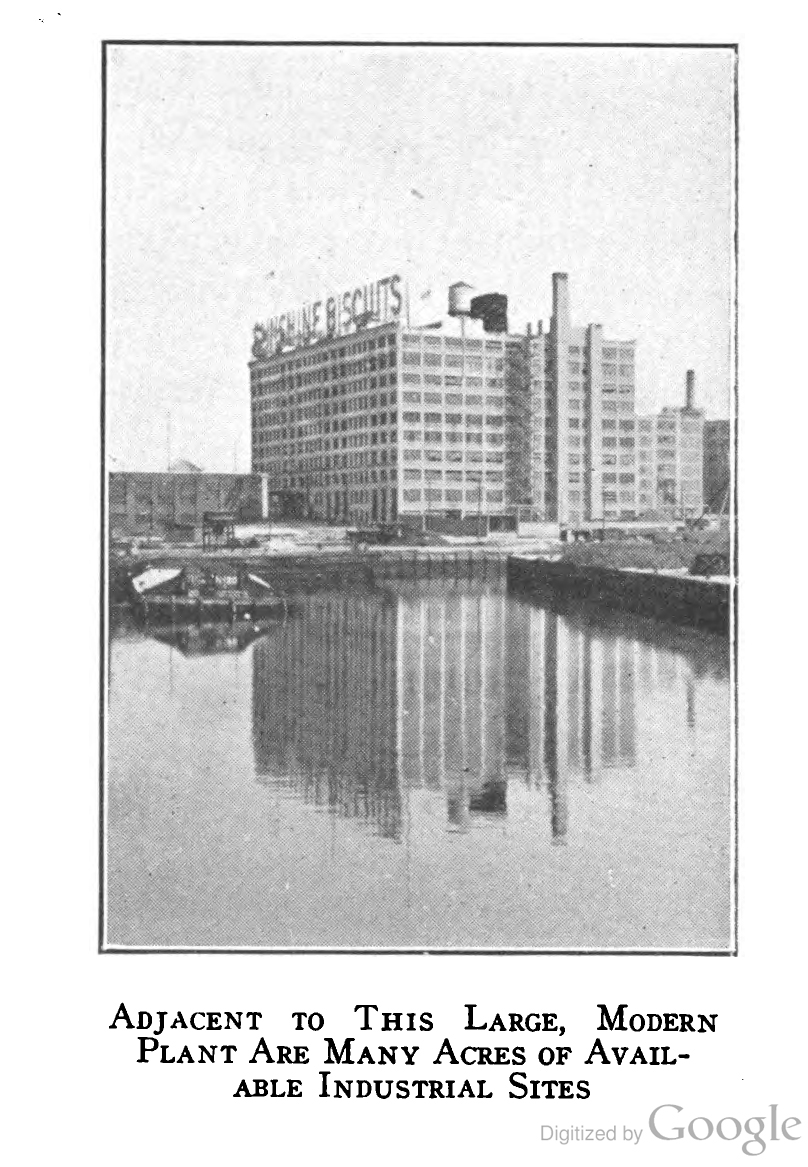
– photo from “The Newtown Creek industrial district of New York City By Merchants’ Association of New York. Industrial Bureau, 1921”, courtesy Google Books
My weird obsession with recreating very old photographs once again turns toward Dutch Kills, this time it’s looking to the end of the Degnon Terminal barge turning basin toward LaGuardia Community College’s building C- which was the former Sunshine Biscuits or Loose Wiles Bakery.
The shot above was captured in 1921 or thereabouts, and the ones below from 2011.

– photo by Mitch Waxman
An interesting parallell to this shot is the one presented at the end of the “Hunters Point Avenue Bridge Centennial, Dec. 11” posting from December 3rd in 2009, which presents the inverse viewpoint of today’s.
That shot was obtained from a 7th floor window of the building, on the wall with the red detailing, 3rd window from the left some four score and ten years or approximately 24,855 days later than the original and focused on the spot where these were shot.

– photo by Mitch Waxman
This is the uncropped version, showing Dutch Kills just around sunset, on February 17th, 2011 from the deck of the Hunters Point Avenue Bridge.
glassy flatness

– photo by Mitch Waxman
Odd and solitary even as a child, amongst my few friends in public school was a fellow named Brian. Despite the occasional beatings he would administer to me, which long experience has taught me to expect when interacting with others, he was an amiable kid. Brian was wont to propagate an urban legend which once permeated Brooklyn, a story which goes like this (phonetically spelled, as Brooklyn patois is critical to the telling):
“So, yooz knows about de Verryzanno Bridgde, rights? When deys wuz bilding its, and pourinz de cement- workers who fell intadee cements would just sinks rights down, and dheres nuttin that could get dones to saves ’em, so’s da bahdeez are still in da bridge. My grandfather’s brudda died dat way, my Uncle Mike…”
translation:
So, you know about the Verrazano Bridge, right? When they were building it, and pouring the cement- workers who fell into the cement would just sink in, and there was nothing that could be done to save them, so the bodies are still in the Bridge… As far as the Grandfather’s brother, versions of the story told by others involved every possible male acquaintance or familial description possible.
from nycroads.com
The foundations, which support the 264,000-ton weight of both the towers and the suspended deck, as well as a design live load of 16,000 tons on the deck, were dug 105 feet below the water on the Staten Island side, and 170 feet below the water on the Brooklyn side. Conventional foundation design called for sand islands that kept water, as well as provided working and storage space. However, because the currents were swift and the ground was unstable in the area, sand islands were not constructed. Instead, “cofferdams,” or vertically interlocking steel sheet pilings, were driven below the surface to protect the caissons. Above each 13-foot-high caisson base, muck and sand were dredged out of 66 vertical concrete shafts. When the caissons reached their predetermined depth, the shafts were filled with water, and caisson tops and bottoms were sealed with concrete. The two tower piers, which contain a combined 196,500 cubic yards of concrete, were completed in less than two years at a cost of $16.5 million.
Two anchorages were then constructed at either end of the Narrows. Each anchorage stands 130 feet high, 160 feet wide and 300 feet long. However, because of the differences below ground, the Brooklyn anchorage contains 207,000 cubic yards of concrete, while the Staten Island anchorage contains only 171,000 cubic yards of concrete. On their inshore ends, they support the two decks of bridge approaches. On their outshore ends, they carry four massive, roller-mounted saddles that support, and move with, the four cables as they change length, either because of temperature changes or because of load changes. The hand-polished concrete exteriors have diagonal patterns that continue the path of the suspension cables. Inside the anchorages, forces from the suspension are transferred at two points: the front of the anchorage (where the compacted cables bend around saddles that rest on inclined steel posts), and near the heel of the anchorage (where eyebars transfer force to inclined girders buried within the concrete). The anchorages cost $18 million to construct.

– photo by Mitch Waxman
This urban legend- and yes, it is– was once omnipresent in the land of Egg Creams and really good Pizza.
So much so that it actually made it to the movies, as you’ll observe in the clip from “Saturday Night Fever” presented below, courtesy of youtube. For a great first person description of the building of the bridge, and the remembered effects of building the Brooklyn pierage in Bay Ridge- check out the inestimable Forgotten-NY’s “Bridge in the Back Yard” posting from 2003 here.
I can tell you that the old guys in Canarsie and Flatbush who worked on the thing always “beamed” a little bit when driving down the Belt Parkway toward the City and seeing it rear up.
from youtube

– photo by Mitch Waxman
Officially, there were three deaths associated with the building of the Verrazano, and the bodies were all recovered. Brooklyn legends notwithstanding, that is actually an incredible number given the size and scope of the project.
But what else would you expect from the maestro, Othmar Amman, on his final project?
from wikipedia
The bridge is owned by New York City and operated by the Triborough Bridge and Tunnel Authority, an affiliate agency of the Metropolitan Transportation Authority. Interstate 278 passes over the bridge, connecting the Staten Island Expressway with the Gowanus Expressway and the Belt Parkway. The Verrazano, along with the other three major Staten Island bridges, created a new way for commuters and travelers to reach Brooklyn, Long Island, and Manhattan by car from New Jersey.
The bridge was the last great public works project in New York City overseen by Robert Moses, the New York State Parks Commissioner and head of the Triborough Bridge and Tunnel Authority, who had long desired the bridge as a means of completing the expressway system which was itself largely the result of his efforts. The bridge was also the last project designed by Chief Engineer Othmar Ammann, who had also designed most of the other major crossings of New York City, including the George Washington Bridge, the Bayonne Bridge, the Bronx Whitestone Bridge, the Robert F. Kennedy Bridge, and the Throgs Neck Bridge. The plans to build the bridge caused considerable controversy in the neighborhood of Bay Ridge, because many families had settled in homes in the area where the bridge now stands and were forced to relocate.
a ghastly plot
“Newtown Creek for the Vulgarly Curious” is a fully annotated 68 page, full-color journey from the mouth of Newtown Creek at the East River all the way back to the heart of darkness at English Kills, with photos and text by Mitch Waxman.
Check out the preview of the book at lulu.com, which is handling printing and order fulfillment, by clicking here.
Every book sold contributes directly to the material support and continuance of this, your Newtown Pentacle.
gentle manner

Combined Sewer Outfall BB-013, from the Pulaski Bridge – photo by Mitch Waxman
To begin- I warn you- this post will most likely “gross you out”.
In 1674, Boyle said: “I have often suspected, that there may be in the Air some yet more latent Qualities or Powers differing enough from all these, and principally due to the Substantial Parts or Ingredients, whereof it consists. For this is not as many imagine a simple and elementary body, but a confused aggregate of ‘effluviums’ from such differing bodies, that, though they all agree in constituting by their minuteness and various motions one great mass of fluid matter, yet perhaps there is scarce a more heterogeneous body in the world”.
When the pithy observation was recorded, “effluviums” were the central notion behind the miasmatic theory of disease.

CSO Outfall NC-077, Maspeth Creek, discharges 288.7M gallons per year into English Kills – photo by Mitch Waxman
The viewpoint of the learned classes in prior ages held that when certain noxious vapors produced by a mingling of soil with that standing water typically found about marsh, swamp, and sewer- then mixed with the cool night air- form so called miasmas (which is an ancient greek for pollution, I’m told).

CSO Outfall NC-077, Maspeth Creek, Tier 2 outfall – photo by Mitch Waxman
These miasmas- or “epidemic influences”- were believed to be the cause of Cholera and Typhus– and all the other plagues which would one day scythe through the crowded 18th and 19th century cities of the Industrial Revolution.
Vitruvius, in the 1st century BCE, said: “For when the morning breezes blow toward the town at sunrise, if they bring with them mist from marshes and, mingled with the mist, the poisonous breath of creatures of the marshes to be wafted into the bodies of the inhabitants, they will make the site unhealthy.”

CSO Outfall NC-077, Maspeth Creek, Ranked 25 out of over 400 in terms of volume – photo by Mitch Waxman
The air produced by, in, and around a sewer is typically an aerosol of whatever liquid solution might be floating through it. Hydroden sulfide, carbon dioxide, methane, ammonia and a host of other constituent compounds mingle and form what is generically known as “Sewer Gas”. Typically, this gas has the sulfurous smell commonly associated with rotten eggs. Otherwise lacking and poor, the average human’s sense of smell can discern this odor when its concentration in the surrounding air is minor- which speaks to an evolutionary quirk.
Obviously- our ancestors who could not detect this aerosol, or miasma, died off while while those who could detect them passed on these sensitivities on to future generations.

CSO Outfall BB-026, Dutch Kills – photo by Mitch Waxman
If you suffer from Obsessive Compulsive Disorder, this would probably be a good time to stop reading this post, incidentally. Things are about to get ugly.
As an example- When a toilet is flushed, and there is scientific evidence to back this, a plume of microscopic droplets- an aerosol– erupts from the water. These droplets carry microbes and virus particles, which then settle on surfaces around the commode facilitating the “surface to hand to mouth” vector of infection. Modern plumbing does its best to minimize this bioaerosol in the house, but routine antimicrobial maintenance with bleach and other chemicals is necessary to sterilize the potential infections which might otherwise occur.
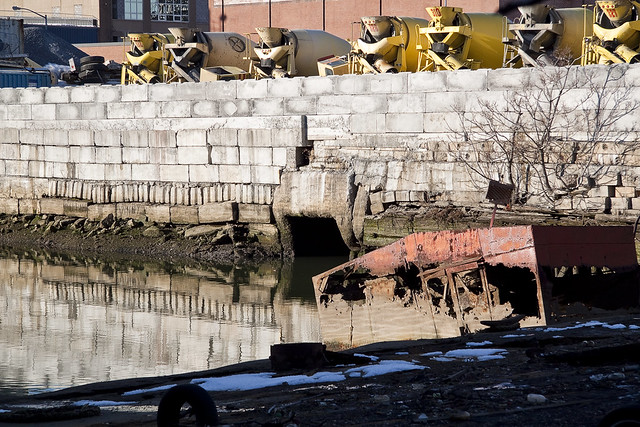
CSO Outfall BB-026, Dutch Kills – photo by Mitch Waxman
Of course, these cleaning chemicals- along with non neutralized microbes- end up in the wastewater flow, and make their way into the sewers… just like the petroleum products, volatile organic chemicals, and everything else that the human hive produces… where they swirl about beneath the streets and follow gravity to low lying areas. A properly designed system intercepts these waters, but in the case of a “CSO”, a lot of the poison makes it into the mud.

CSO Outfall BB-026, Dutch Kills – photo by Mitch Waxman
A classic example of a bacterium whose spread is defined by such aerosol dissemination is Legionella, but heavy metals and other contaminants may also find a pathway into the human body via such aerosols (let’s just call it vapor or fog). Additionally, fibers of toxic manmade substances- Asbestos for instance- are left behind during evaporation. Such deposits are then picked up on the wind, as are the dusty remains of the putrescent particulates which escape treatment by wastewater industries like the Newtown Creek Wastewater Treatment plant in Greenpoint or the Bowery Bay facility in Astoria.
During heavy rain events, some untreated sewage reaches the rivers, but a large percentage of it- the lion’s share- oozes out from the bulkheads of that assassination of joy called the Newtown Creek.

CSO Outfall NCB-632 – photo by Mitch Waxman
The Newtown Creek and its tributaries are indeed waterways, but no one ever discusses this plume of disease and contamination in the air. Fingers are pointed at certain chimneys and infamous underground lakes of petroleum and chemicals, heated discussions of when it might be safe to kayak or swim in the water are offered by interested parties, and odd admissions that there are some who actually fish in and consume the catch from these waters (which according to the EPA, are offering this catch for sale in area restaurants) both shock and titillate area wags- but what about the miasmas?

CSO Outfall NCB-632 – photo by Mitch Waxman
The sewer system of New York City is a composite beast, marrying together the municipal infrastructure of multiple communities into a single system. The cities of Brooklyn, Queens, and Manhattan (the historically agrarian and until modernity- lightly populated – Bronx has almost always been ruled over by Manhattan) each had their own standard, staring elevation, and set of regulations governing the sewers.
This NYTimes.com article from 2008 discusses recent attempts to consolidate and digitize the municipal record, and make sense out of the byzantine network of pipes which underlie the city.

CSO Outfall NCB-632 – photo by Mitch Waxman
Who can guess, all there is, that might be buried down there?
Who can speculate, all there is, which might be wafting out from these deep channels of filth and what strange aerosols are carried upon the gentle breeze- here in the Newtown Pentacle?


 The Newtown Pentacle