Posts Tagged ‘photowalk’
tones and accents

– photo by Mitch Waxman
Sauntering suspiciously through the hinterlands of Maspeth, along the malign fence lines of Rust Street, your humble narrator suddenly sensed a cacophony of ringing bells which occluded all reason. Assuming that one of my states was coming on, those hours of panic and terror brought on by a weakened constitution and the numerous afflictions which plague me, my first instinct was to monitor both pulse and temper.
Suddenly I realized that this ringing in my ears, now accompanied by a clattering and approaching ruckus, heralded the nearness of a train!
Note: Train folks, if you’ve got anything to say or link to regarding the actual model of locomotive, please use the comments link for this post. Every time a train photo is displayed here, I get at least a couple of emails telling me something cool about the locomotive. Please share, and leave a comment.
A
from wikipedia
Tinnitus can be perceived in one or both ears or in the head. It is usually described as a ringing noise, but in some patients, it takes the form of a high-pitched whining, electric buzzing, hissing, humming, tinging or whistling sound, or as ticking, clicking, roaring, “crickets” or “tree frogs” or “locusts (cicadas)”, tunes, songs, beeping, sizzling, sounds that slightly resemble human voices or even a pure steady tone like that heard during a hearing test. It has also been described as a “wooshing” sound, as of wind or waves. Tinnitus can be intermittent, or it can be continuous, in which case it can be the cause of great distress. In some individuals, the intensity can be changed by shoulder, head, tongue, jaw, or eye movements.

– photo by Mitch Waxman
This was once one of the busiest stretches of rail in New York, let alone the United States. The Long Island Railroad (in its various guises, incarnations, and corporate forebears) have maintained their “road” here since the 1860’s. A shame, these tracks are a shadow of their former self and it’s not all that frequently that one sees traffic along the route. Hurling myself across the busy truck route, your humble narrator quickly sprang onto that fence which vouchsafe the track from trespass and interference, and whipped out the camera and began clicking away.
from wikipedia
The LIRR chartered the New York and Jamaica Railroad on September 3, 1859, and a supplement to the LIRR’s charter passed March 12, 1860 authorized it to buy the NY&J and extend to Hunters Point. The LIRR carried through with the NY&J purchase on April 25, along with the purchase of a short piece of the Brooklyn and Jamaica at Jamaica, and the next day it cancelled its lease of the Brooklyn and Jamaica, but continued to operate over it. The Brooklyn Central and Jamaica Railroad, a consolidation of the B&J with the new Brooklyn Central Railroad, began operating from South Ferry over the top of the tunnel, along the B&J tracks to Flatbush Avenue, and south on the new Fifth Avenue Line in August 1860. The new line to Hunters Point was officially opened on May 9, 1861, with regular service starting May 10. A ferry connection (Hunter’s Point Ferry) was initially advertised to James Slip; connecting boats began running to East 34th Street Pier in October. he BC&J soon began operating horse cars over the old line from South Ferry, connecting with LIRR trains at Jamaica. The tunnel was closed off in December.
– photo by Mitch Waxman
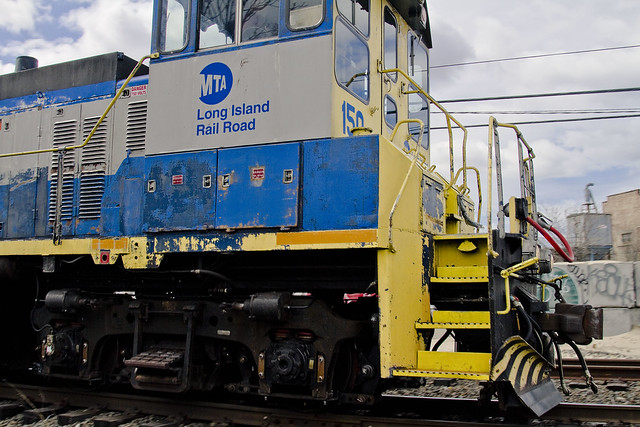
This double engine was hurtling along, which was somewhat remarkable. When I do see trains along this route, 9 times out of 10 they are NY & Atlantic freight trains which lumber along at a fairly tepid pace compared to this blue and gold comet which roared past me. Sadly, a diminished capacity for joy and low threshold for excitation allow one to consider the witnessing of this passing locomotive to be the high point of the day. Juvenile in character despite advanced years, it does not take much to impress one such as myself.
from wikipedia
Federal regulators limit the speed of trains with respect to the signaling method used. Passenger trains are limited to 59 mph and freight trains to 49 mph on track without block signal systems. (See dark territory.) Trains without “an automatic cab signal, automatic train stop or automatic train control system” may not exceed 79 mph. The order was issued in 1947 (effective 31 Dec 1951) by the Interstate Commerce Commission following a severe 1946 crash in Naperville, Illinois involving two Chicago, Burlington & Quincy Railroad trains. Following the 1987 Chase, Maryland train collision, freight trains operating in enhanced-speed corridors have been required to have locomotive speed limiters to forcibly slow trains rather than simply alerting the operator with in-cab signals. The signal panel in the Maryland crash had been partially disabled, with a muted whistle and a missing light bulb.

– photo by Mitch Waxman
Undoubtedly, as these tracks lead toward the Long Island City yard- which offers connections to both Manhattan and the gargantuan Sunnyside Yard- it is impossible to speculate on their final destination, but these engines were headed to somewhere in Long Island City.
for more on the twisting trackways of the Montauk Cutoff, check out this trainsarefun.com page

– photo by Mitch Waxman
On the Queens side of the Newtown Creek, a loathsome flood plain typified by concreted devastation and the relicts of the industrial revolution, the Long Island Railroad has long been the proverbial “800 pound gorilla” and as such- goes wherever it wants to go.
For visual orientation to more familiar locales, notice that dagger in the heart of Queens- the Sapphire Megalith- embedded in the innocent soil of Court Square in LIC, or the distant Freedom Tower under construction in lower Manhattan.
from wikipedia
“800 pound gorilla” is an American English expression for a person or organization so powerful that it can act without regard to the rights of others or the law. The phrase is rooted in a riddle:
“Where does an 800 lb. gorilla sleep?”
The answer:
“Anywhere it wants to.”
Also,

Obscura Day 2012, Thirteen Steps around Dutch Kills
April 28th, 10 a.m.
Your humble narrator will be narrating humbly at this year’s Obscura Day event on April 28th, leading a walking tour of Dutch Kills. The tour is already half booked up, and as I’m just announcing it, grab your tickets while you can.
“Found less than one mile from the East River, Dutch Kills is home to four movable (and one fixed span) bridges, including one of only two retractible bridges remaining in New York City. Dutch Kills is considered to be the central artery of industrial Long Island City and is ringed with enormous factory buildings, titan rail yards — it’s where the industrial revolution actually happened. Bring your camera, as the tour will be revealing an incredible landscape along this section of the troubled Newtown Creek Watershed.”
For tickets and full details, click here :
obscuraday.com/events/thirteen-steps-dutch-kills-newtown-creek-exploration
repeated lapses

– photo by Mitch Waxman
A new park is open in Queens Plaza, so your humble narrator decided to take a look. I’m probably going to be pilloried for this posting by members of the antiquarian community here in Queens, and excoriated by members of the Manhattan elites, as controversy has surrounded this construction- some of which I’ve been directly involved with. Saying that, read into this post whatever political prejudice or predilection you might, none is intended.
The “editorial policy” of this blog, a term which is often mocked by those offended by this or that posting, has always been “it’s not good, nor bad, it just is”.

– photo by Mitch Waxman
To begin with, the Mayor himself recently held a press event here, unveiling the name of the new park as “Dutch Kills Green”. Unfortunately, I was engaged with other things and was unable to cover the event, but luckily personnel from “Gothamist“, amongst others, were able to make it.

– photo by Mitch Waxman
The park itself is built along modernist principles, and offers certain laudable features. Stormwater remediation is built into the design, as are the use of native species. Queens Plaza has historically not been a friendly place for pedestrians, and the new park offers a chance to sit down, which is a rare thing.

– photo by Mitch Waxman
Environmental noise from elevated subway and never ending vehicular traffic is endemic, of course, and the clouds of automotive exhaust can be overwhelming. Saying that, such conditions are endemic in Western Queens and one of the great complaints offered by area wags is the lack of open space available to the public.

– photo by Mitch Waxman
The detailing in the park is curious, and designed to appear quite “urban”.
One is reminded of set pieces from the science fiction movie “Planet of the Apes” by the consciously rough hewn patina of the place. There are several little touches to the place that confirm careful thought went into its design and implementation. Observation of the spot over recent weeks has revealed that it has already found devotees in groups of teenage students and local office workers.

– photo by Mitch Waxman
It is an absolutely brilliant spot for photographing trains and the operations of the MTA at Queens Plaza, which has long fascinated a humble narrator, and offers a nearly 240 degree visual sweep of the enterprise for inspection and contemplation.
Additionally, as the place is a bit above grade, new angles of view are possible.

– photo by Mitch Waxman
Were it not for the damned noise, this could be a really interesting place to hang out, and I’ve already decided to use this as a meeting point for some future walking tour. It makes for a ready landmark in a neighborhood unfamiliar to most except as a transit hub.

– photo by Mitch Waxman
The Long Island City Millstones are back as well, although due to a lack of signage indicating their historical meaning or context, they appear to be just another accoutrement. One would hope that if the municipality is not forthcoming with such signage, local civic groups or historical societies might be able to fill in the gaps. Such signage might be forthcoming, but I haven’t heard anything about it.

– photo by Mitch Waxman
The mill stones are artifacts of colonial Queens, and were centrally figured in the controversy mentioned at the beginning of this post. Their presence distinguishes Dutch Kills Green, a welcome addition to the concrete devastations of Western Queens.
Also,
Obscura Day 2012, Thirteen Steps around Dutch Kills
April 28th, 10 a.m.
Your humble narrator will be narrating humbly at this year’s Obscura Day event on April 28th, leading a walking tour of Dutch Kills. The tour is already half booked up, and as I’m just announcing it, grab your tickets while you can.
“Found less than one mile from the East River, Dutch Kills is home to four movable (and one fixed span) bridges, including one of only two retractible bridges remaining in New York City. Dutch Kills is considered to be the central artery of industrial Long Island City and is ringed with enormous factory buildings, titan rail yards — it’s where the industrial revolution actually happened. Bring your camera, as the tour will be revealing an incredible landscape along this section of the troubled Newtown Creek Watershed.”
For tickets and full details, click here :
obscuraday.com/events/thirteen-steps-dutch-kills-newtown-creek-exploration
yellow rays

– photo by Mitch Waxman
Recorded recently in the neighborhood of Dutch Kills, not the waterway but the neighborhood which the waterway once flowed into. It’s confusing, as the waterway is often cited or mentioned in these postings and is “way over there” from the perspective of the neighborhood- which is found between Ravenswood, the East River, and Astoria. Large hotels are on the rise in the area, and there’s a whole lot of construction underway. For street artists, this is a bit of a playground.

– photo by Mitch Waxman
Personally, this is my kind of stuff. Garish in color and whimsical, not like the dark sarcasm and obviate ideations often observed in Brooklyn. Moreover, where one would expect to find elaborate renderings of “tags”, figurative cartooning trumps.

– photo by Mitch Waxman
A fairly even temper hangs about the brow of a humble narrator today, and this splash of color is much appreciated by this withering shadow.
primitive ruins
– photo by Mitch Waxman
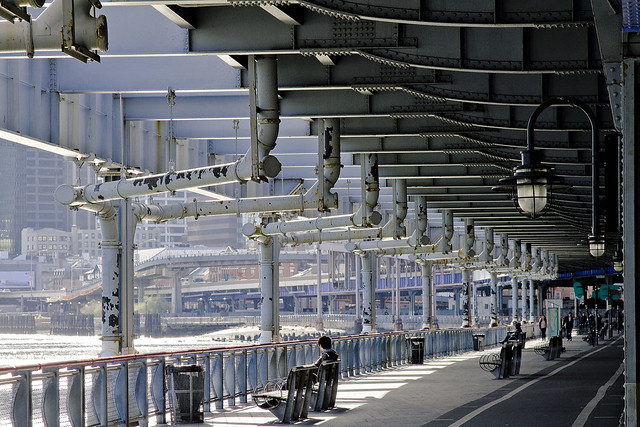
Recent business brought me to Manhattan, and an opportunity to walk along the East River while moving downtown presented itself. A spectacular promenade has recently emerged along the coast of the Shining City, much of which is unfortunately cement. Shiny and new, the sections above Corlears Hook made me a little nervous, as if one had wandered into an architect’s drawing populated by spandex wearing fitness models riding bicycles and running determinedly. Downtown, between East River Bridge Two and One (Manhattan and Brooklyn) this waterfront parkland was just grungy and old enough to feel lived in, by ordinary folk.

– photo by Mitch Waxman
It is difficult to complain about these open air trottoirs, which allow the citizenry a chance to gaze at the splendors of the harbor, especially given what these areas were like a mere 20-30 years ago. Trash strewn and off limits, New York had left its waterfront to rot away. The great shame of it all, and this is where the kvetching and Monday morning quarterbacking comes in, is that the infrastructure of docks and wharfs which literally made New York great is gone- never to return. Once something becomes a park, it is virtually impossible for it to return to other usage. No ship will be arriving here ever again.

– photo by Mitch Waxman
It’s the way of things, of course, and long ago was it decided that maritime interests were unimportant to Manhattan. So few are the docks on the island nowadays that it is scantly possible to find a berth. Word has it that the various waterfront vision plans include the usage of “temporary” or “floating” docks at some point in the future, but the days when a ship could unexpectedly arrive in the City- laden with some mysterious cargo from the south seas- seem to be over.
strange corridors

– photo by Mitch Waxman
Staying current on the story of Newtown Creek involves attending a lot of meetings. Some are private, most public. Often, they came rapid fire and it feels as if every other evening is consumed. One of the many community groups which hold such gatherings is the Newtown Creek Monitoring Committee. I’m a guest at this particular gathering, and as such an attempt is made to remain silent and observe the proceedings.
The group engages in a dialogue with representatives of the NYC DEP, who are offered input from community representatives regarding issues that might arise from the presence of the Newtown Creek Waste Water Treatment Plant.
One of these issues, as you would imagine, is the spread of odors emanating from the vast facility.

– photo by Mitch Waxman
The DEP contract with a company, called “Odor Science and Engineering”, who specialize in the detection and discovery as well as elimination of point sources for malodorous gases. Luckily, an inspection of the plant by the company was scheduled for the following week and Christine Holowacz (DEP community liaison) arranged for a few of us to accompany the effort.
Pictured above is Kate Zidar (Newtown Creek Alliance Executive Director) and Laura Hoffman (Newtown Creek Monitoring Committee), who with myself, showed up bright and early to be fitted with hard hats and vests.

– photo by Mitch Waxman
We were introduced to Dr. Ned Ostojic Ph.D and P.E., Odor Science & Engineering’s Vice President & Director of Engineering.
A tall and dignified fellow, Dr. Ostojic spoke with a barely detectable yet pleasant European accent and was extremely hospitable to us as he described his function at the plant. An engineer, he was tasked with not only finding the sources of odor but describing practical solutions to eliminate them.

– photo by Mitch Waxman
Dr. Ostojic produced a device whose purpose was to combat a human perception bias called environmental adaptation. To describe it simply, the human mind filters out environmental stimuli to create a sense of “normalcy”. If you live on a noisy street, your brain filters out most of that noise and you become inured to the environmental background level. The brain functions in the same way with smell, something I know to be accurate. When I encounter the smell of the Newtown Creek, or of any sewer plant, no reaction is displayed while others openly gag.
My brain has become adapted to Newtown Creek.

– photo by Mitch Waxman
He asked us not to make fun of the devices name, which was a “Nasal Ranger”.
It allows calibrated measurement of smell based on a concentrating chamber which lies behind an aperture dial. The dial allows ever smaller samples to be inhaled into the device, which can then be graded on a subjective and numerical scale. Good science, don’t forget, is all about measurement and objective recording. The Nasal Ranger removes personal interpretation from data records, as its operators are trained according to an empirical standard.

– photo by Mitch Waxman
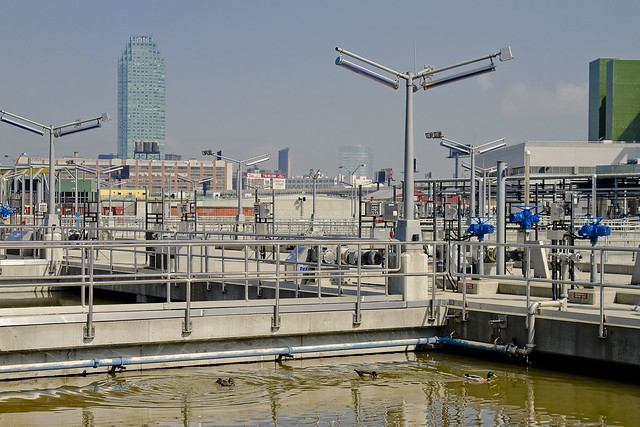
We three accompanied Dr. Ostojic on his walk through of the plant, and his duty this day was the inspection of the settling tanks which allow sewer borne debris to drop out, or be be skimmed from, the wastewater flow before it enters those famous digester eggs which distinguish this plant and betray its location on the skyline of New York City.

– photo by Mitch Waxman
Several times has your humble narrator been allowed to enter and record the grounds of this facility, found along the Newtown Creek, but this side of things has always been off limits because of extreme danger.
One of the curious facts related to me that day was that , were one of us to slip and fall into the highly aerated water and sewage in the tanks surrounding us, the liquid would not display much buoyancy. Because of all the dissolved gas in the liquid, neither would it slow your fall much and you would plummet- as if through air- some two stories to a hard cement floor.
In no uncertain terms, I was told, you would die. This was confirmed by one of my union buddies, who works at another plant in the DEP system.

– photo by Mitch Waxman
This is somewhere around midway through the sewage treatment process, after the larger bits of solute and debris carried in the flow have been removed. When the raw flow hits the plant, it carries wood and boxes and all sorts of garbage and debris with it. This gross matter is removed mechanically at another part of the plant. Next up is grit, which can be sand, soil, or just plain old coffee grounds. The rate of speed at which the wastewater races through the system makes even such innocuous contaminants hazardous to the works, and is removed by more specialized machines housed in separate “grit buildings”.

– photo by Mitch Waxman
Of course, nothing is perfect, and the job of these settling tanks is to skim off any floatable material which has evaded prior filtration. Fats, oils, and a surprising number of cigarette butts, tampon applicators, condoms, and other floatable material is seen at the collection side of the tanks. As they are open to the air, this is one of the spots which Dr. Ostojic regularly inspects and pays a great deal of attention to. He was constantly checking his readings and observations against the prevailing winds.

– photo by Mitch Waxman
Dr. Ostojic wasn’t alone for the inspection and was working with the fellow pictured above, who introduced himself as Gary Grumley. Mr. Grumley was working with a different detection device than Dr. Ostojic, a hydrogen sulfide detector.
Hydrogen sulfide, of course, is a colorless gas which is infamous for the fecund smell of decay commonly referred to as “rotten eggs”. Such emissions are responsible for a lot of community complaints, and are unfortunately part of the complex chemistry which accompanies the disposition of sewage.

– photo by Mitch Waxman
The device itself seemed sturdy, and Mr. Grumley arranged it neatly for photographing. He had begun work several hours prior to our arrival and began transmitting his findings and observations to Dr. Ostojic.

– photo by Mitch Waxman
A graphic map of the plant with its multitude of buildings, service areas, and zones was on Dr. Ostojic’s clipboard.
A running tally of various areas where an unexpected or intense odor was encountered had been kept, and each occurrence was registered with a numerical value or rating. We didn’t encounter anything truly horrible btw.
– photo by Mitch Waxman
An example was offered later in the day by the DEP’s Superintendent of the Plant, Jim Pynn, of Dr. Ostojic’s contributions.
It seems that a problem had developed around the hatches leading to an underground tank, cylindrical in shape, which had been located in a rectangular shaped shaft. An onerous odor was regularly emerging from the shaft, and Dr. Ostojic was called in. He determined that as wind passed over it, a venturi was forming in the space between the cylinder and the right angled walls which suctioned the tainted air from it’s enclosure and into the open air.
Dr. Ostojic’s simple solution, adding chevrons to the sides of the tank which would abort the formation of a vortex, saved the plant a costly redesign of the affected area. The smell stayed where it was meant to, as well.

– photo by Mitch Waxman
Dr. Ostojic was gracious and quite patient with us. A loving nickname for him, which is offered with wide smiles and a wink by those who work at the plant, is “Ned the Nose”.
Usually, when one is invited to attend a meeting at an industrial site in Greenpoint, Brooklyn- with someone named Ned the Nose- the encounter seldom turns out to be as pleasant as this was.

– photo by Mitch Waxman
Newtown Pentacle, we go these places so you don’t have to.
ALSO:
Your humble narrator will be narrating humbly at this year’s Obscura Day event on April 28th, leading a walking tour of Dutch Kills. The tour is already a third booked up, and as I’m just announcing it, grab your tickets while you can.
“Found less than one mile from the East River, Dutch Kills is home to four movable (and one fixed span) bridges, including one of only two retractible bridges remaining in New York City. Dutch Kills is considered to be the central artery of industrial Long Island City and is ringed with enormous factory buildings, titan rail yards — it’s where the industrial revolution actually happened. Bring your camera, as the tour will be revealing an incredible landscape along this section of the troubled Newtown Creek Watershed.”
For tickets and full details, click here :
obscuraday.com/events/thirteen-steps-dutch-kills-newtown-creek-exploration


