Archive for 2012
obscure world

– photo by Mitch Waxman
As described in prior postings, 58th road and Maspeth Avenue were once connected by a plank road which last crossed the Newtown Creek in 1875 and which was established as early as the 1830’s. What’s important about this is that the street grid in this spot hasn’t appreciably changed since the late 19th century, and it’s one of the few places around the creek where maps require little or no “interpretation”. That’s the Maspeth Avenue side pictured above.
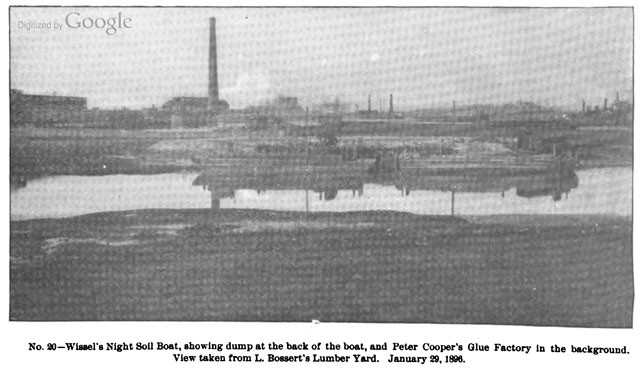
– photo from 1896’s Report By Brooklyn (New York, N.Y.). Dept. of Health, Brooklyn (New York, N.Y.). Health Board, courtesy google books
One of those little nuggets which has fascinated me since beginning to learn about the Creek has been references to “Conrad Wissel’s Dead Animal Wharf” or alternately “night soil dock”. Imagine my surprise when I found a photo of the place from 1896 the other night. In the far left corner of the frame, you can just make out the Maspeth Avenue Plank Road. Wo!
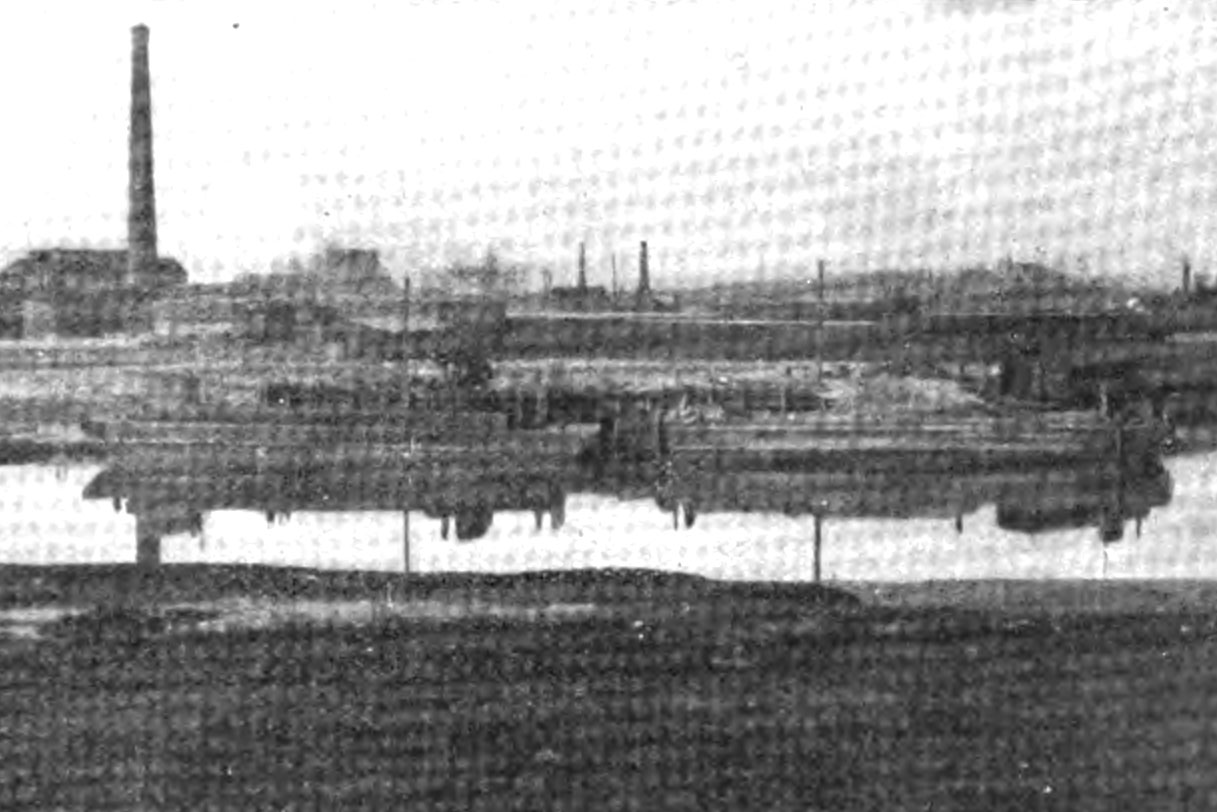
– photo from 1896’s Report By Brooklyn (New York, N.Y.). Dept. of Health, Brooklyn (New York, N.Y.). Health Board, courtesy google books
A little photoshopping has been applied here, improving contrast and attempting to remove some of the moire in google books’s scan of the original.
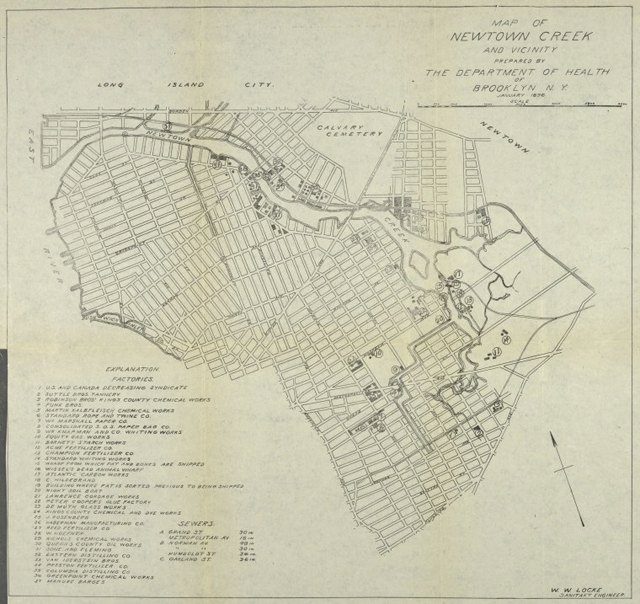
– map from 1896’s Report By Brooklyn (New York, N.Y.). Dept. of Health, Brooklyn (New York, N.Y.). Health Board, courtesy digitalgallery.nypl.org
The NY Public Library hosts the image above, which is the map that was included in the volume that the photo originates in. Click the image to access a zoom able version, whose key lists the Wissel’s dock as number 16.
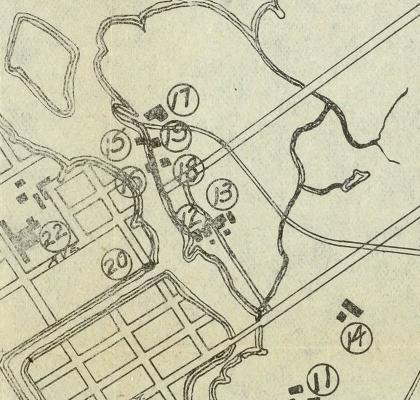
– map from 1896’s Report By Brooklyn (New York, N.Y.). Dept. of Health, Brooklyn (New York, N.Y.). Health Board, courtesy digitalgallery.nypl.org
In this detail from the map, number 16 is clearly just west of the Maspeth Avenue Street end. That’s one mystery solved.

– photo by Mitch Waxman
Here’s another view in modern times, the Wissel property would be just starting on the right side of the frame. The shot is from the Queens side, of course, as is the original- and captured at approximately where the “18” is on the detail of the map. The 1896 photographer would have standing around 500 feet to the right of this vantage point.
The Smelling Committee

– photo by Mitch Waxman
As long time readers will recall, in the fall of 2010, the Newtown Creek Alliance and the Working Harbor Committee received a grant from the NYCEF fund of the Hudson River Foundation to conduct 4 boat tours of Newtown Creek. The plan was to do two ticketed tours for the public (the tickets were available at a steeply discounted rate), one for educators, and one for “the elected’s” of the watershed. The first three went off without a hitch, but the fourth was postponed due to the tragic helicopter crash on the East River which occurred just as we were about to board the boat.
Last Friday, the 4th of May, we accomplished the fourth tour with a modern day “Smelling Committee” onboard.
from “Annual Report of the Department of Health of the City of Brooklyn for the year 1895”, courtesy google books
Whereas, Complaint has been made to the Governor of the State of New York during the year 1894 by the citizens and residents of the Town of Newtown and the City of Brooklyn, relating to the existence of public nuisances on or near Newtown Creek, jeopardizing the health and comfort of the people in the vicinity thereof, and the Hon. Roswell P. Flower, Governor of the State of New York, did thereupon, on the 2d day of August, 1894, pursuant to Chapter 661, of the Laws of 1893, require, order and direct the State Board of Health to examine into the alleged nuiscances, and to report the result thereof…

– photo by Mitch Waxman
Important to the mission was attendance of officials from both sides of the Creek. The “center of gravity” for the advocacy of the Newtown Creek has historically been in Greenpoint, but that doesn’t mean that the folks on the Queens side haven’t been paying attention. Pictured above are Michael Gianaris and Jimmy Van Bramer, and both were anxious to visit this hidden part of their districts.

– photo by Mitch Waxman
As luck would have it, we passed by one of the many workboats which have been operating along the Newtown Creek of late. These workboats, hailing from Millers Launch on Staten Island, are carrying contractors and employees of the Federal Environmental Protection Agency who are collecting samples of the so called “black mayonnaise” sediments for laboratory analysis.

– photo by Mitch Waxman
You cannot fix something unless you understand it, and the EPA has scheduled an exhaustive “scoping period” during which a series of such tests will be performed. Since January, I have personally witnessed dozens of such operations- ranging from towing a sonar buoy up and down the waterway to establish a subsurface topographical map, to the group onboard this vessel who seemed to operating a hand operated dredge to bring materials up into the light.
Notice that the folks directly handling the sediments are wearing protective garments.

– photo by Mitch Waxman
A Newtown Creek Alliance member, Phillip Musegaas of Riverkeeper fame came along to inform about and describe the legal and policy issues surrounding the Greenpoint Oil Spill, Superfund, or any of the myriad points of law which surround the Newtown Creek. That’s Phillip on the right.
I should mention that Council Member Stephen Levin of Greenpoint was onboard as well, but was forced to stay in the cabin and deal with urgent business in his district via phone.

– photo by Mitch Waxman
A decision which I’ve been keeping to is to not bring “civilians” all the way back to English Kills on these boat tours, but this “Smelling Committee” was no mere interested group and accordingly we entered into the heart of darkness- God’s Gift to Pain itself. This is as bad as it gets along the Newtown Creek, a stinking and fetid miasma poisoned with sewage and urban runoff surrounded by waste transfer stations.
In the distance is one of the largest CSO’s in the entire city, and the Montrose Avenue Rail Bridge of the LIRR’s Bushwick Branch.

– photo by Mitch Waxman
Not just elected officials were onboard, of course, representatives of a veritable alphabet soup of three lettered agencies were also invited. Additionally, local leaders- such as Tom Bornemann from the Ridgewood Democratic Club (pictured above, in sunglasses) accompanied the tour. The microphone was passed amongst us, with Kate Zidar (NCA’s executive director), Michael Heimbinder (NCA’s chair), Laura Hoffman (Newtown Creek Monitoring Committee), Phillip Musegaas (Riverkeeper), Penny Lee (City Planning), and myself narrating at various legs of the trip.

– photo by Mitch Waxman
Pictured above are Assemblyman Joe Lentol of Greenpoint, Council Member Jimmy Van Bramer of Queens, Working Harbor Development Director Meg Black, Council Member Diana Reyna of Brooklyn, a gentleman who I’m embarrassed to say I can’t identify, and State Senator Michael Gianaris.

– photo by Mitch Waxman
The Smelling Committee of 2012 encountered a Newtown Creek swollen by days of rain, replete with oil slicks and “floatables” contamination. The term floatables is used to describe everything from stray bits of lumber and tree limbs to cast off plastic bottles and wind blown trash carried in the water, by the way. The trip was 2 hours in length, and accomplished onboard a NY Water Taxi vessel. It left from Pier 17 in Manahattan at four in the afternoon and returned at six, proceeding some three and one half miles into the Newtown Creek and required the opening of the Metropolitan Avenue Bridge.

– photo by Mitch Waxman
Along the way, sites of legal or popular interest were pointed out- including the future of the Arch Street Yard, the Hunters Point South development, SimsMetal, the Newtown Creek Waste Water Treatment Plant, the Greenpoint petroleum district, the Blissville Oil spill, the Greenpoint Oil Spill, the Phelps Dodge site, the Kosciuszko Bridge, the CSO issue, the role of Newtown Creek as a mass employer, the maritime potential of the Creek and its potential for eliminating a significant amount of trucking activity, its myriad waste transfer stations, and the plans which EPA have for the place.

– photo by Mitch Waxman
Crass observers in the antiquarian community and political operatives in both boroughs will sneer at efforts such as this, the aim of which was to create a common sense of purpose and to identify issues regarding the Creek for both the Queens and Brooklyn political establishments. Ridgewood and Bushwick, Maspeth and Greenpoint, Williamsburg and Long Island City- all parts of the Newtown Creek watershed have more in common with each other than they do with neighboring districts in either borough. They are blessed with one of the finest industrial waterfronts in the world, but cursed by its past. What the Newtown Creek will look like in fifty years time is beginning to be discussed, and it was time for this “congress of the creek” to be convened.
So much of what the people in high office know of this place is influenced by dire reportage and dry testimony, and it can be easy to overlook the past, present, and future of this maritime superhighway if you haven’t experienced it first hand.
Especially from the water.

– photo by Mitch Waxman
Several times have I witnessed the effect that this place has on first time visitors, a transformation of expression and demeanor overtakes them.
Hardened New Yorkers all, the Newtown Creek nevertheless explodes all expectations and an expression of wonderment forms upon their faces. They come to see toxic waste dumps and oil spills, but instead find Herons, Egrets, and Cormorants nesting in the broken cement of abandoned industrial bulkheads. They witness the miles wide vistas and wide open view of the City of New York from its very navel, and are thunderstruck that such a place exists- this “Insalubrious Valley” of the Newtown Creek watershed.
Every time I start to narrate on one of these tours, my first utterance is always “this is not the world you know…”.
I’m happy to say that due to the Working Harbor Committee, Newtown Creek Alliance, and the NYCEF Fund of the Hudson River Foundation- the Smelling Committee of 2012 knows this corner of the world a little bit better.
What will come of it?
Others will have to answer that, for your humble narrator must remain without and is cursed to merely observe such matters. Always, an outsider.
perpetually ajar

– photo by Mitch Waxman
Recent serendipity found your humble narrator onboard a vessel plying the languid waters of the Newtown Creek. This particular adventure was part of a larger and laudable effort which will be the subject of a posting later in the week, but urgent demands and unavoidable deadlines preclude discussion of the outing at this point. Instead, one is anxious to share the scenic wonders and hidden landscape of this water body that defines the currently undefended border of Brooklyn and Queens.
Captured in the heart of DUMABO (Down Under the Metropolitan Avenue Bridge), the shot above depicts the far off and omnipresent Sapphire Megalith rising over industrial Brooklyn and framed by the Metropolitan Avenue Bridge while opening at English Kill.

– photo by Mitch Waxman
The self same Megalith again provides geographic context for the scene, and the thrice damned Kosciuszko Bridge and Calvary Cemetery occupy the foreground.
To the right is the Phelps Dodge site, and to the left is found the lurking fear and that rampant darkness which lurks on the Brooklyn side of DUKBO (Down Under the Kosciuszko Bridge Onramp).

– photo by Mitch Waxman
In the shot above, gaze in wonder at the skyline of the Shining City itself, as framed by the titan National Grid tanks and the myriad works of infrastructure arrayed across the Brooklyn flood plain. Inextricably linked, the heavy industries and energy installations along the Newtown Creek allow the Shining City to maintain the facade of assumptions which Manhattanites prefer to believe about this place where aspirant and realist metaphors clash.
More, on why exactly I was on this boat, will be forthcoming. Apologies for brevity and obfuscation.
hideous meaning

– photo by Mitch Waxman
Startling, recent transmissions and recitations from a weird and alien country called Albany brought word that the Governor of New York State has arranged to accelerate the Kosciuszko Bridge project. Complicated planning, difficult execution, and extreme expense hang gruesomely around this project- originally scheduled to commence in 2014, and now expected to begin in 2013.
from nydailynews.com
Construction on a new bridge is now expected to begin in spring 2013 — a year ahead of schedule, thanks to $460 million made available for the job by Gov. Cuomo’s New York Work initiative.
The 73-year-old bridge, which carries the Brooklyn-Queens Expressway over the Newtown Creek, qualified for the money in part because it is on the state’s “deficient bridge” list.
The initial phase of construction will build an eastbound lane next to the existing bridge, according to the state Department of Transportation, the agency overseeing the project. The 1.1-mile bridge is expected to be done in 2017 and will cost about $800 million.
When completed, two new spans with a total of nine vehicle lanes and paths for pedestrians and bikes will replace the original structure.
It’s the single biggest project made possible through the New York Works program, an initiative to create jobs while repairing the state’s infrastructure.

– photo by Mitch Waxman
The 1939 workhorse, erected at the whim of Robert Moses, will no longer soar above that mirrored ribbon of risible metaphor known as the Newtown Creek in just a few years, as scheduled work is meant to conclude in 2017. Area wags shrug and sigh at this, wearily offering that such projects often extend well past their scheduled and budgetary goals, and that the Creek itself will present a series of unexpected problems to be solved.
from dot.ny.gov
Following seven years of alternatives analysis, environmental studies and extensive partnering with community groups and stakeholders, the Federal Highway Administration (FHWA) approved the New York State Department of Transportation’s (NYSDOT) selection of Alternative BR-5 for a new Kosciuszko Bridge in its March 9, 2009 Record of Decision and granted authorization to proceed with Final Design. The Project Team has been working to complete key initial phases of the Final Design which would lay the groundwork to develop and complete the detailed design of the new bridge structure.

– photo by Mitch Waxman
Extensive documentation exists at the State DOT website, with coruscating revelations about both the current structure and anticipations of obstacles and opportunities which will be encountered during pursuit of the new structure. Your humble narrator, threatened by such rapid change, remains nevertheless excited about the idea of a pedestrian walkway overlooking not just the Creek itself- but Calvary Cemetery. Architectural drawings of the future DUKBO (Down Under the Kosciuszko Bridge Onramp) show an intriguing and modernist setting.
from dot.ny.gov
Under all Build Alternatives, excavation of soil would be performed to a depth of about 4.5 m (15 ft), and the walls of the excavation would be braced. Contaminated soil and groundwater would be collected and disposed of. The new foundations would be pile supported, and either large diameter drilled piles or concrete filled driven pipe piles would be used. Drilled pile construction would generate less noise and vibration than driven piles, but may be difficult to install if boulders are encountered. Additionally, there is widespread soil contamination in the area, and contaminated soil and water extracted while drilling would need to be collected, treated and disposed of properly. This construction impact study assumed the use of driven piles.
After pile installation is complete, formwork for the pile cap would be installed, rebar installed, and concrete placed. Pier construction would follow, working from ground level up in approximately 2.5 m (8 ft) segments. Formwork would be installed, rebar installed and concrete placed. After the concrete has cured sufficiently, the forms would be stripped and the sequence would be repeated until the pier was complete.

– photo by Mitch Waxman
A frequent commenter at Newtown Pentacle, “George the atheist”, asked me a while back for clarification and or documentation of my assertion that the reason for the truss bridge’s enormous height over the Creek was to allow egress to ocean going vessels with high stacks (smokestacks). During the course of some general research on Newtown Creek in the first half of the 20th century, this 1951 photo popped up at the NYS Digital collections site which illustrates just such a scene.
from wikipedia
The Kosciuszko Bridge is a truss bridge that spans Newtown Creek between the New York City boroughs of Brooklyn and Queens, connecting Greenpoint, Brooklyn and Maspeth, Queens. It is a part of Interstate 278, which is also locally known as the Brooklyn-Queens Expressway. The bridge opened in 1939, replacing the Penny Bridge from Meeker Avenue in Brooklyn to Review Avenue and Laurel Hill Boulevard, and is the only bridge over Newtown Creek that is not a drawbridge. It was named in honor of Tadeusz Kościuszko, a Polish volunteer who was a General in the American Revolutionary War. Two of the bridge towers are surmounted with eagles, one is the Polish eagle, and the other the American eagle.
uncouth clouds
Note: This “Maritime Sunday” is a repost of “Stronger than Fear” from September 12, 2010

– photo by Mitch Waxman
What would Superman do?
This governing logic which demands that one draw a line and say “No more” compels some to step forward and personally form a barrier between law and chaos. To leave behind the mundane, don a colorful uniform, and fight for truth, justice, and the American way.
Such men and women that display this sort of behavior may often found in the employ of the NYPD, and one elite unit of that inestimable organ of the municipality is the redoutable NY Harbor Patrol.
Witness 2 generations of their patrol vessels, plying the estuarine tides of the River of Sound– commonly known as the East River to modernity.
from safeboats.com
The Defender class comes standard with full cabin to protect the crew from weather and an independent forced air diesel heater, both of which provide the crew with the maximum amount of comfort and minimal fatigue. The Defender has the direct benefit of years of evolutionary USCG Non Standard boat history to maximize its operational availability. Just one sea trial will prove that the Defender Class is unmatched in performance, work ability, fit, finish and quality.

– photo by Mitch Waxman
What would Batman do?
The job of these amphibian officers is to protect and patrol the harbor of New York, assist maritime travelers experiencing mechanical or existential trouble, and to enforce a strict security cordon around the archipelago. In the age of the terror war, the strategic patrol of waterfront infrastructure and detection of multi national sapper units (called terrorists) has been added to their list of duties.
This is the NYPD unit that once was originally formed out of a bunch of beat cops in 1857 who, with a rowboat, were tasked with busting up a gang of river pirates called the Swamp Angels that operated out of an open sewer on Cherry Street in Manhattan. Today, Harbor unit is an elite and coveted posting.
An already impossible patrol area coupled with decades old technology and an expanded mission has demanded a few upgrades to equipment, and the acquisition of some “wonderful toys”.
from wikipedia
Commanding Officer of Harbor Unit – Deputy Inspector David Driscoll
On March 15, 1858, five members of the New York City Police Department rowed out into New York Harbor to combat piracy aboard merchant ships lying at anchor. The NYPD Harbor Unit has existed ever since, protecting life and property. With hundreds of miles of inland waterways to cover, the unit operates 27 boats from three bases.
For underwater work, the department used to contract with private diving companies when weapons or other evidence had to be recovered from the bottom of New York’s many rivers and waterways. In the early 1970s, however, the Harbor Unit formed a specialized scuba team that today numbers around 30 officers. Unlike many police dive units, whose members dive only part-time, NYPD divers are assigned to the unit full-time. (The exception are some scuba-trained officers in regular patrol units who are detailed to the team temporarily during the busy summer months.) In addition to the normal duties of evidence recovery, the Scuba Team’s mission has expanded since 9/11 to include a counter-terrorism role. For air-sea rescue work, the Harbor Unit keeps two divers assigned to the Aviation Unit 24 hours a day, seven days per week, all year round. These divers will work with their counterparts in the FDNY, who arrive at incidents by fireboat or rescue company.

- image from wikipedia

– photo by Mitch Waxman
What would Iron Man do?
I admit it, these safeboats that seem to be multiplying all across the harbor are amongst my favorite subjects to focus in on when they pass. Each one of the “services” has a configuration specific to its mission, a suit of armor tailor made for the tasks at hand…

– the Coast Guard ones have big honking machine guns…

– FDNY a water cannon…

– even the National Parks Dept. Police have their own version

– collect them all!
from homepage.mac.com/josephcocozza/poddiver
New York also is one of the world’s busiest seaports. Manhattan itself is an island. Moreover, the five boroughs are surrounded by water. According to NYPD Lieutenant John Harkins; “ New York City has 184 miles of coastline on the Atlantic Ocean, and we have over 546 square miles of inland waterways…. (and) the city is a major hub of international ship borne commerce.”
The policing of New York’s waterways are provided by the men and women of the NYPD Harbor Unit. The Harbor Unit is on the cutting edge of marine law enforcement. From its 3 bases and 27 boats, the Harbor Unit provides the City of New York with a marine force that is equipped to handle all water borne security, public safety and rescue concerns. This includes: enforcement of maritime laws, missing persons in the water, evidence recovery, air-sea rescues,, narcotics interdiction, anti-terrorism and security for United Nations. To accomplish this mission, the NYPD Harbor Unit works closely with state and federal law enforcement.

– photo by Mitch Waxman
What would Lex Luthor do?
There’s just something I love about the way that these small vessels crash over the water, a latent desire to see it really open up and go top speed. These defender class boats remind me of old science fiction shows from the 70′s, of a colonial viper or earth starfighter.
These boats were built in accordance with a governing military hardware design philosophy called “the weapons platform”. It doesn’t matter what configurations an individual user might install, the chassis is always standard, and one need install or replace only sensors or weapons at one’s own discretion. The United States Navy “Carrier fleet” concept is the ultimate application of this notion.
I often wonder what these boats may be electronically talking to as they patrol, whether they be wireless cameras or some of the more… esoteric gear which is rumored to be at work in the harbor. Police methods are ingenious, and varied.
from nypost.com
From “invisible” helicopters and mini-submarines to radiation-detecting knapsacks, the NYPD is employing a new generation of high-tech tools to combat terrorism and fight crime.
Officers are getting equipped with space-age gadgets like handheld bomb detectors, being trained in futuristic flight simulators, and traveling in gadget-filled, crime-solving vans. And more gizmos are being tested every day.
The NYPD’s Scuba Team is evaluating devices that allow divers to see underwater sonar images on LCD screens attached to their masks instead of blindly searching murky rivers.

– photo by Mitch Waxman
What would Spider Man do?
Great responsibility accompanies great power, and these police officers- roughly 150- are entrusted with the patrol of nearly 200 miles of coastline and 576 square miles of navigable water. On a warm summer evening such as the one enjoyed when these photos were shot, this seems to be the best posting in the entire NYPD, but remember, they’re out there in blizzards and thunderstorms.
from nytimes.com
The officers are likely to remain officers, they said, since few harbor unit members make detective.
”You’d basically have to save the mayor’s son from drowning,” Officer Parkin said, looking up toward Gracie Mansion and Carl Schurz Park, with the Franklin D. Roosevelt Drive running under its promenade.
They made a U-turn and headed back south, toward the Battery, where a Staten Island ferry boat passed, large and empty and brightly lighted.
”Rush-hour ferries,” Officer Whelan said, ”big targets.”
On the Hudson River they passed air vents to the Holland Tunnel, a tall brick structure at the end of Pier 34. A blip on the radar screen off the starboard bow turned out to be a sightseeing boat. Through the squad’s night-vision binoculars, dark undersides of piers were lighted up in Day-Glo green.

– photo by Mitch Waxman
What would the Punisher do?
The smaller and older of the vessels is a 25 foot fiberglass Parker, which (in its civilian configuration at least)is a 200 HP fishing boat converted over to police duty. Cop hull, cop screws, cop seats, cop bilge pump…sorry, the Blues Brothers are intruding again.
These craft offer a lightweight and shallow draft capability, and the silhouette they offer is reminiscent of older generations of vessels that once fished the coastlines of the north eastern United States in great multitudes. This makes a lot of sense, procuring equipment from the mass market for use by the gendarme, although the manner in which the Parker crashes the waves when at speed must be a great source of discomfort to those onboard.
But, if crime is a disease, NYPD is the cure.
from 1893, at nytimes.com
NEW BOAT FOR HARBOR POLICE; THE PATROL BUILT FOR SPEED AND EFFECTIVE WORK. To be Launched Near Baltimore To-morrow — As Handsomely furnished as a Private Yacht — Fitted for Fire and Wrecking Purposes as Well as Police Duty — Over 143 Feet Long and Constructed of Steel — Her Estimated Speed Sixteen Miles an Hour — Provided with a Powerful Searchlight.
check out these historic shots of Patrol at policeny.com

- photo from policeny.com
and here’s a link to a movie of Patrol capturing some pirates in 1903

– photo by Mitch Waxman
What would Captain America do?
also from nytimes.com, in 1889
THE HARBOR POLICE FORCE.; HISTORY OF AN ADMIRABLE ORGANIZATION. HOW THE RIVER THIEVES HAVE BEEN HELD IN SUBJECTION FOR MORE THAN TWENTY YEARS–THE PATROL.
The degenerate successor of the picturesque pirate of history and romance is the modern “water rat” or river pirate. The operations of thieves of this kind in the waters around New-York led to the establishment in 1857 of the present police patrol of New-York Harbor.
also from policeny.com
Sec. 157 When a boat shall bring prisoners ashore, it shall be the duty of one or more of the crew, to transfer them to the patrolmen on land, who shall convey the prisoners to the nearest station house.
Sec. 158 In addition to the ordinary baton of a patrolmen, each member of the harbor police shall be armed, while on duty, with a revolving pistol and a cutlass.
Sec. 159 Each boat, while on duty, shall be continually moving, unless engaged in watching some suspected place or vessel.

– photo by Mitch Waxman
Another specie of NYPD Patrol boat, a retired one which I’ve had the privileged of having actually boarded, is Launch 5, aka the Patrolman Walburger.


 The Newtown Pentacle