Archive for the ‘newtown creek’ Category
hitherto denied
Happy 115th birthday, Grand Street Bridge.

– photo by Mitch Waxman
At a cost of $174,937, the newly constructed Grand Street Bridge – spanning the fantastic Newtown Creek – officially opened on this day in 1903 (although it had already been unofficially open to traffic since December of 1902). The Grand Street Bridge connects Maspeth in Queens with East Williamsburg/Bushwick in Brooklyn, and when it was built they had horse driven traffic in mind, as well as electric streetcars or trolleys. The City of Greater New York, with its familiar five boroughs and Manhattancentric political orientation was only a few years old at this point in time. Grand Street was part of a spate of bridge building that occurred in the years following municipal consolidation, both major and minor, which allowed the newly created Borough Presidents a chance to… ahem… share the wealth with their supporters.
The 1903 model, pictured above, is the third Grand Street Bridge. There were 1875 and 1890 models as well, but the historic record describes them as being shabbily constructed and “dilapidated.” The 1903 model has stood the test of time, although it did receive a bit of work and a fresh coat of paint during a rehabilitation project back in 1973.

– photo by Mitch Waxman
Grand Street is the demarcation line between the so called “East Branch” tributary and the main stem of Newtown Creek. The intersection with another tributary, English Kills, is nearby. That’s part of the East Branch, pictured above. As a note, when Grand Street crosses northwards into Queens, it becomes Grand Avenue.
My understanding is that the 1890 model Grand Street Bridge was operated by hand cranking winches. It’s also my understanding that the presence of a nearby wharfage in this area (called White’s Dock) narrowed the navigational channel significantly, and that it was pressure from various Brooklyn based merchants and manufacturing associations which drove the Federal War Department into condemning that iteration of the bridge – and Whites Dock- setting the stage for the construction of the current model and the shaping of the modern bulkheads surrounding it.

– photo by Mitch Waxman
End to end, Grand Street Bridge is nearly two hundred and twenty seven feet and one half inch in length. Horizontally it’s meant to be just over thirty two feet wide, with two lanes of vehicle traffic squeezing into a very tight nineteen feet and eight inch area. There are two sidewalks which are meant to be just under six feet wide, according to the NYC DOT, but that number sort of conflicts with my perception of them. Those tight lanes of traffic mean that anything bigger than a passenger car has to wait for traffic coming from the other side to cross over the bridge before they can do the same. This creates backups on both sides of the thing.
I think the sidewalks measurement must include the box girders visible in the shot above, which is actually from below.

– photo by Mitch Waxman
The Grand Street Bridge is a swing bridge, which means that the whole structure sits on a mechanical palette and can rearticulate itself ninety degrees to allow maritime traffic to pass to and fro. It’s a crying shame that there aren’t any customers in the East Branch who would require the presence of barge and tug, since the City is obligated to maintain the machinery here in functional order by the orders of the United States Coast Guard.
The DOT spends a bunch of money every year doing so, and the City has been petitioning the USCG to “delist” the East Branch for navigability, and to allow them to replace the 1903 Grand Street Bridge with something more appropriate for modern traffic needs – a static and far wider truss bridge – since at least 2002. The USCG remains adamant in its position, however, that all of Newtown Creek is a “SMIA” or Significant Maritime Infrastructure Area and all of its bridges must be maintained and be “moveable” on the waterway.
This brings up the questionable status of the MTA’s rail swing bridge “DB Cabin” on the Dutch Kills tributary of Newtown Creek, but that’s another story.

– photo by Mitch Waxman
The last time I checked the numbers, Grand Street Bridge carried just under ten thousand vehicle trips a day. That was in 2011, it should be mentioned, and supposedly only 7% of that traffic was defined by DOT as being “trucks.” As always, you need to learn how to speak “government” when reading things like that. They mean heavy tonnage trucks – garbage, semis, tankers – not box trucks, pickups, or delivery vans which everybody else would call “trucks.” A significant causality of traffic congestion in both Maspeth and East Williamsburg/Bushwick, the Grand Street Bridge is structurally far too narrow for modern day needs.
Modern needs include accomodating the traffic generated by the MTA’s gargantuan Grand Ave Bus Depot & Central Maintenance Facility, which is found on the Maspeth side of the bridge. The entire bus company unit serving Brooklyn crosses this bridge at least once a week for cleaning, inspection, and maintenance.

– photo by Mitch Waxman
One such as myself always has his ear to the ground, or is probing away at the elected or appointed lords of the local vicinity in hope of gleaning some knowledge of their secretive plans for us all. The general impression gathered is that were there money available right now to replace the Grand Street Bridge with a newer model, construction would begin forthwith.
I’ll be sorry to see the old girl go when they find the cash, as the Grand Street Bridge is one of my favorite bridges found along the lugubrious Newtown Creek. At any rate, Happy Birthday, old lady.
“follow” me on Twitter- @newtownpentacle
small village
Literally in a dark place, me.

– photo by Mitch Waxman
As mentioned in yesterday’s post, over the weekend one was trekking through Industrial Maspeth. After catching up with a couple of old friends in Ridgewood later in the day, one began scuttling back to Astoria well after the burning thermonuclear eye of God itself had disappeared behind New Jersey. There’s only one efficient way to get “here” from “there” on foot, but luckily the walk is figuratively and literally all downhill from Ridgewood. My path carried me back into the hoary shadows of Industrial Maspeth, my happy place.
By the way, if you want to do something daring and scary – try to cross the intersection of Metropolitan and Flushing Avenues at night… brrr…

– photo by Mitch Waxman
One always feels vulnerable in this place, even when the burning thermonuclear eye of God itself still hangs wanly in the sky. There’s always someone – or something – watching as I scuttle by. Paranoid wonderings pollute the thoughts of one such as myself in these times. Delusional visions of getting grabbed and dragged, shuttled off to some storage vault or basement room and left to expire by some nefarious character, abound in the area between the ears and behind the eyes. There’s also sharp pieces of metal protruding from the pavement in random spots which you need to watch out for, as well as some of the watery eyed derelicts who establish temporary camps at the edges of habitability.
Who can guess, all there is, that might be hidden around here?

– photo by Mitch Waxman
Eerie and deserted by its diurnal army of laborers, industrial Maspeth nevertheless still serves as a thoroughfare for vehicular traffic preparing to exchange the streets of Queens for those of North Brooklyn, but in this lawless no man’s land of nighted warehouses they seldom offer anything other than a reluctant acknowledgement to traffic law. They eschew lane ordinances, roll through stop signs at speed, and can be observed laughing hysterically while blowing through traffic signals and ignoring intersectional regulations while traveling at cyclonic velocities.
The very air you breathe is a poisonous fume, which wouldn’t be forgotten.

– photo by Mitch Waxman
There are homes hereabouts, wholesome structures populated by those both stout and stubborn, and families whose multigenerational presence at the edges of Industrial Maspeth defy the impressions gathered by one such as myself. With the filthy black raincoat flapping about behind me, the arrangement of my sweatshirt hood and raised coat collar combinine with a usually shaved pate, and one lends no other impression to a casual viewer than that of a corpulent and aged vulture hybrid scuttling by in the dark. Essentially, who am I to cast the first stone? I’m some weirdo who likes wandering around in the dark with a camera while imagining that monsters, and witches, and a serial killer are chasing after me.
The reason that I love this area so much is its distinct lack of reflective surfaces, wherein true horror is revealed.
“follow” me on Twitter- @newtownpentacle
trips for
Twirling, ever twirling, that’s me.
– photo by Mitch Waxman
The venerable Grand Street Bridge is pictured above, as seen from the northern fork of the East Branch tributary of Newtown Creek. The East Branch doesn’t seem like much of a tributary today, terminating as it does in a supermarket parking lot (for the north fork) and at an open sewer on Metropolitan Avenue (the southern fork). Once upon a time…
As a note, one of my colleagues recently informed me that a high ranking DEP official complained to him about our common use of the term “open sewer,” and opined that modern day wastewater engineers feel that the term demeans their trade and is offensive. One point eight billion gallons of untreated sewage being released annually into Newtown Creek offends me, let alone the totality of NYC’s entire wastewater output in the harbor. Engineer that.

– photo by Mitch Waxman
Trekking through industrial Maspeth for the first time in a few weeks, obvious indications that the Queens Cobbler has been busy in the first month of 2018 were apparent. For those of you new to the story, a theorized serial killer is active in the neighborhoods surrounding Newtown Creek who leaves beyond trophies of their kills on area streets. The trophy is always a single shoe, seemingly cast aside in the tidal surges of garbage and litter which abound in these parts.
Western Queens is full of dark secrets. The vampires of Queens Plaza, the thing unearthed beneath Burger Jorissen’s grist mill during the construction of the Sunnsyide Yards… Curly Joe knew the score.

– photo by Mitch Waxman
On the particular day these shots were captured, industrial Maspeth was busy defrosting itself. The sidewalks became slippery again as formerly gelatinous petroleum products that are regularly spilled hereabouts regained their liquid state, due to the higher atmospheric temperatures, and that odd combination of smells which the area is known for began to nebulously recombine forming a mephitic olfactory profile. The smell of fine marijuanas, roasting on open fires, was omnipresent as well, but it was late afternoon on a Saturday. If a man works hard, there’s nothing wrong with a bit of stress relief after the work day has ended, right?
It ain’t Jack Frost nipping at your nose in Industrial Maspeth, its hydrogen sulfide.

– photo by Mitch Waxman
Moving inexorably south east, a humble narrator again encountered the calling card of the Queens Cobbler, displayed pretty as you please on those concretized devastations which form the flood plane for all the existential horror found in these parts. One does not allow himself to forget the rumors handed down to me by the Slavic centenarians of Maspeth, which hint at certain events in the early 1950’s that drew the attention and a deployment of certain United States Marine Corps specialized units.
As the story goes, something colossal rose from the Newtown Creek after nightfall, an abominable and mutated reptilian thing said to be capable of swallowing a horse in one gulp. Federal authorities conspired with the office of the Queens Borough President (Maurice A. FitzGerald) to keep things quiet until the Marines arrived, saying that there had been a gas leak and an explosion which required a temporary evacuation of residents and laborers. That’s how the BP explained away the artillery fire, saying it was just a gas leak. Hang around in the bars of Maspeth, or at the Clinton Diner, and you might hear a different telling of what went down at the United Enameling and Stamping Co. property on that summer night in 1950. Some that you’d ask, and certainly every Government official, will deny such an event ever happened.
Who can guess, all there is, that might be buried in the mud and sediments of the Newtown Creek?

– photo by Mitch Waxman
Of course, the biggest hazard to the mammalian way of life along the Newtown Creek in Industrial Maspeth isn’t actually the possible presence of a serial killer who leaves single shoes in his wake, rumors of a giant mutated turtle called Creeky, the probable witch cult who cast off numerous artifacts in area cemeteries, or the endemic environmental pollution and ongoing release of billions of gallons of untreated sewage into the waterway every time it rains. It’s the trucks.
Pictured above is a fairly indestructible safety cone, whose purpose is the visual indication of “no go” areas for drivers, smashed flat and torn asunder by truck tires.

– photo by Mitch Waxman
Later that same day… over in Ridgewood.
“follow” me on Twitter- @newtownpentacle
cannot give
Another set of shots from the Newtown Creek frozone.

– photo by Mitch Waxman
Last week I showed you what it looks like when Brooklyn’s English Kills freezes over, today it’s the polar paradise which Dutch Kills in LIC became after that recent spell of super cold weather that’s in focus. Both waterways are tributaries of the fabulous Newtown Creek, and the “kills” bit is Old Dutch for “creek.” The English and Dutch parts of the names are meant to indicate where the various ethnicities of European settlers sited themselves.

– photo by Mitch Waxman
Dutch Kills, as we know it today, is a canalized post industrial waterway surrounded by stout factory and warehouse structures and crossed by multiple bridges, with the current shape of things dating back to the creation of the surrounding Degnon Terminal in the late nineteen-teens. It attained its modern characteristics by 1921, and the last big addition to Dutch Kills was the installation of the Midtown Tunnel and Long Island Expressway way back in 1940.
That’s the LIE, or at least the Queens Midtown Expressway section of the it, pictured above. Close to 90,000 vehicle trips a day pass over the water here, yet most people you meet say they have never heard of the Newtown Creek.

– photo by Mitch Waxman
Like English Kills in Bushwick, Dutch Kills here in LIC was contained nearly completely by a layer of plate ice when I visited it last Wednesday. The ice was already “rotting” as the air temperatures returned to seasonal norms, and the weak tidal action witnessed in Dutch Kills was breaking it into distinct floes.

– photo by Mitch Waxman
Just like English Kills, certain areas which have been observed as being highly biologically active due to the presence of sewage sediment mounds during warmer climes were fully melted and flowing. The status of those unknown things which slither and slide and slop about in the bottom sediments during these unfrozen times remains a mystery.
There are some things you really do not want to know, after all.

– photo by Mitch Waxman
Over on the Borden Avenue Bridge, just to the south of the vantage point in the previous shots – which is offered by the Hunters Point Avenue Bridge – the rot of the ice was a bit more pronounced. An analogous appearance vaguely reminiscent of an otherwise wholesome slice of Swiss Cheese came to mind.

– photo by Mitch Waxman
The structure pictured in the first shot of today’s post, as well as in the last one presented above, is called a “dolphin.” It’s rooted deeply in the substrata of Dutch Kills and constructed of creosoted lumber piles. The purpose of these things is to protect the movable bridges they adjoin from an allision, accidental contact with passing maritime traffic. If both the boat and bridge were moving it be a collision, allision is if a moving object strikes a stationary one.
For me, they provide essential design elements and focal points for the framing of photos at a frozen superfund site, hidden at the very center of New York City.
“follow” me on Twitter- @newtownpentacle
formula filled
My creek also puts on a show when I’ve been away from her too long.
– photo by Mitch Waxman
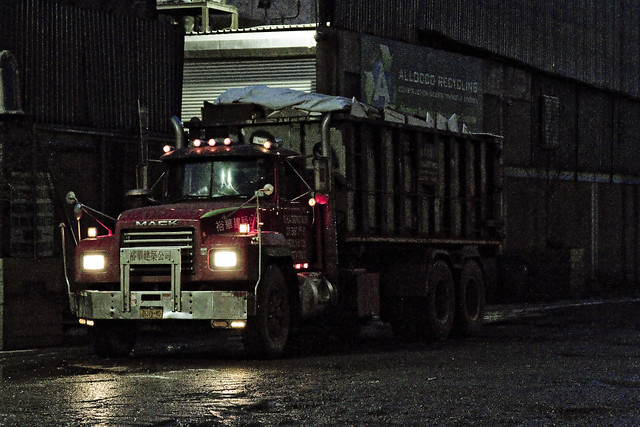
One of my practices, developed over the last decade or so, is to take a Newtown Creek break periodically and “allow my liver to return to a normal size.” I’m joking about the liver, but one does enjoy a bit of detox occasionally, and allowing the poisons I’ve accrued a chance to leach out. This is a luxury one enjoys, as he doesn’t live along Newtown Creek, others aren’t so lucky. Pictured above is roll on/ roll off garbage truck carrying a bin, spotted at a waste transfer station owned by a friend of mine which fairly straddles the border of Brooklyn and Queens.
– photo by Mitch Waxman
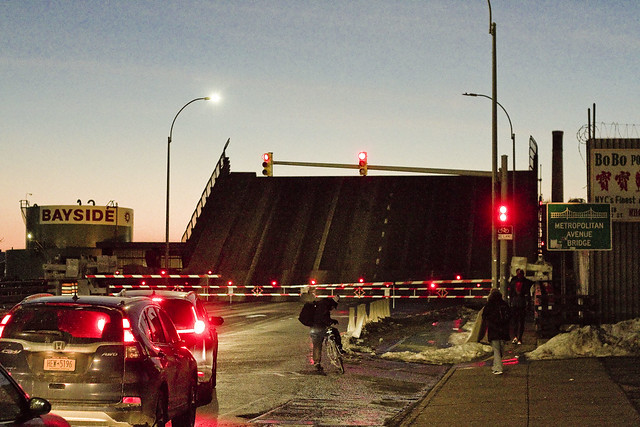
Marching along Metropolitan Avenue, one squealed with delight as the Metropolitan Avenue Bridge began to open. This used to be quite a frequent occurrence “back in the day.” These days there’s only one regular maritime customer back here on the English Kills tributary, which is Bayside Fuel.

– photo by Mitch Waxman
The timing of the bridge opening was bizarre, occurring at precisely the time of one of the heaviest traffic intervals in this section of North Brooklyn, about 6:30 p.m.

– photo by Mitch Waxman
That odd timing, however, allowed one to stand in the middle of Metropolitan Avenue without getting squished.

– photo by Mitch Waxman
I believe that the tug pictured above is the Mary H., which normally handles the Bayside duty, but it’s hard to say as I didn’t get any of its markings. I did manage to focus in on the captain in his wheelhouse, however, so “win.”
As a note, the Metropolitan Avenue Bridge spans the English Kills tributary of the larger Newtown Creek at a navigational mark 3.4 miles eastwards of the East River. Metropolitan Avenue was originally created as a private toll road about 1814, and was called the Williamsburgh and Jamaica Turnpike. The owners of the toll road, and the original bridge, were two brothers whose family name was Masters. That’s why you’ll occasionally see references to the road as the “Masters Turnpike” and the “Masters Bridge” in the historical record, if like me, you stay up until 4 in the morning reading old municipal journals and reports from the Chambers of Commerce of Brooklyn or Queens.

– photo by Mitch Waxman
My conceit is to call this area of Newtown Creek surrounding the Metropolitan Avenue Bridge “DUMABO.” That’s short for “Down Under the Metropolitan Avenue Bridge,” as I believe we need to be ahead of the real estate people on these sorts of things.
“follow” me on Twitter- @newtownpentacle


