Posts Tagged ‘ny harbor’
unlighted river

– photo by Mitch Waxman
Another DonJon tug is in the spotlight today, this time it’s the Paul Andrew. It’s pictured above at Port Elizabeth Newark, moving a barge past one of the gargantuan cargo docks which distinguish the place.
from wikipedia
The Port of New York was really eleven ports in one. It boasted a developed shoreline of over 650 miles (1,050 km) comprising the waterfronts of Manhattan, Brooklyn, Queens, the Bronx, and Staten Island as well as the New Jersey shoreline from Perth Amboy to Elizabeth, Bayonne, Newark, Jersey City, Hoboken and Weehawken. The Port of New York included some 1,800 docks, piers, and wharves of every conceivable size, condition, and state of repair. Some 750 were classified as “active” and 200 were able to berth 425 ocean-going vessels simultaneously in addition to the 600 able to anchor in the harbor. These docks and piers gave access to 1,100 warehouses containing some 41,000,000 square feet (3,800,000 m2) of inclosed storage space.
The SS Normandie arriving in New York Harbor on maiden voyage escorted by several tugboats.
In addition, the Port of New York had thirty-nine active shipyards, not including the huge New York Naval Shipyard on the Brooklyn side of the East River. These facilities included nine big ship repair yards, thirty-six large dry-docks, twenty-five small shipyards, thirty-three locomotive and gantry cranes of fifty ton lift capacity or greater, five floating derricks, and more than one hundred tractor cranes. Over 575 tugboats worked the Port of New York.

– photo by Mitch Waxman
These shots were acquired while onboard one of the many Working Harbor Committee tours of industrial Newark Bay and environs in September of 2011, which explains the glorious lighting.
Autumn is one of the times of the year in New York City during which the angle of the sun creates a golden orange “theatrical lighting” effect.
from wikipedia
The port consists of a complex of approximately 240 miles (386 km) of shipping channels as well as anchorages and port facilities. Most vessels require pilotage and larger vessels require tugboat assistance for the sharper channel turns. The natural depth of the harbor is about 17 feet (5 m), but it had been deepened over the years, to about 24 feet (7 m) controlling depth in 1880.[12] By 1891 the Main Ship Channel was minimally 30 feet (9 m). In 1914 Ambrose Channel became the main entrance to the Harbor, at 40 feet (12 m) deep and 2,000 feet (600 m) wide. During World War II the main channel was dredged to 45 feet (14 m) depth to accommodate larger ships up to Panamax size. Currently the Corps of Engineers is contracting out deepening to 50 feet (15 m), to accommodate Post-Panamax container vessels, which can pass through the Suez Canal. This has been a source of environmental concern along channels connecting the container facilities in Port Newark to the Atlantic. PCBs and other pollutants lay in a blanket just underneath the soil. In June 2009 it was announced that 200,000 cubic yards of dredged PCBs would be “cleaned” and stored en masse at the site of the former Yankee Stadium, as well as at the Brooklyn Bridge Park. In many areas the sandy bottom has been excavated down to rock and now requires blasting. Dredging equipment then picks up the rock and disposes of it. At one point in 2005 there were 70 pieces of dredging equipment working to deepen channels, the largest fleet of dredging equipment anywhere in the world.

– photo by Mitch Waxman
Writing this in the depth of frozen January, your humble narrator literally aches for the shirt sleeve warmth and long hours of sunlight offered during other seasons. The “photographer’s way” of course is to adapt, improvise, and “get it”, of course- but I truly pine for warmer (and brighter) times right now.
Built in 1968, by Breaux’s Bay Craft of Loreauville, Louisiana as the tug Miss Holly.
The tug was later acquired by DonJon Marine of Hillside, New Jersey where she was renamed as the Paul Andrew.
She is a twin screw tug powered by two Cummins KTA 19-M3 main engines with two Twin Disc MG 516 reduction gears at a ratio of 6:1 turning two 19(ft) 304 stainless steel 5 1/2 diameter 62(in) by 46(in) propellers for a rated 1,200 horsepower. Her electrical service is provided by two 30 kw generators driven by DD 3-71 engines 120-208 Triple Phase.

– photo by Mitch Waxman
The shot of the Paul Andrew above is from a Working Harbor trip even earlier in the year, August as a matter of fact. As a note, it is hitched up to a different sort of barge, and is tied up in a “on the hip” configuration.
Man, I can’t wait for the thaw.
from donjon.com
DIMENSIONS
Length Overall: 68 ft./ 20.73 m
Length Design Load Waterline: 63.6 ft./ 19.39 m
Beam Molded Amidships: 23.0 ft./ 7.01 m
Depth Molded to Main Deck: 9.0 ft./ 2.74 m
Tonnage (Gross): 99 GRT
Tonnage (Net): 67 NRT
CONSTRUCTION
All Steel
PROPULSION & STEERING
Main Engines: (2) Cummins KTA 19-M3 1,200 bhp
Propellers: (2) 19 ft. 304 Stainless Steel, 5½ diameter, 62 inch x 46 inch
Gears: Twin Disc MG 516, 6:1 Ratio
Rudders: (2) Spade
Steering Stations: Pilothouse, Upper Wheelhouse, Aft
PERFORMANCE
Speed (Free Route): 10 knots
Speed (Cruising): 8 knots
Bollard Pull:12 tons
Fuel Use/Range (Towing): 41 gph / 17 days
Fuel Use/Range (Cruising): 25 gph / 28 days
many candles

– photo by Mitch Waxman
Another one of NY Harbor’s towing companies whose craft are a delight to behold is DonJon Marine.
They operate a fleet of sky blue tugs whose capabilities range from canal and river tugs all the way up to a gargantuan oceanic tug which is called Atlantic Salvor.
Today, the focus is on DonJon’s Cheyenne, which is one of their smaller tugs. That’s her, moving past Wards Island and passing beneath the Hells Gate Bridge.
from donjon.com
Founded in 1964 by Mr. J. Arnold Witte, Donjon’s President and Chief Executive Officer, Donjon Marine’s principal business activities were marine salvage, marine transportation, and related services. Today Donjon Marine is a true provider of multifaceted marine services. Donjon’s controlled expansion into related businesses such as dredging, ferrous and non-ferrous recycling and heavy lift services are a natural progression, paralleling our record of solid technical and cost-effective performance.
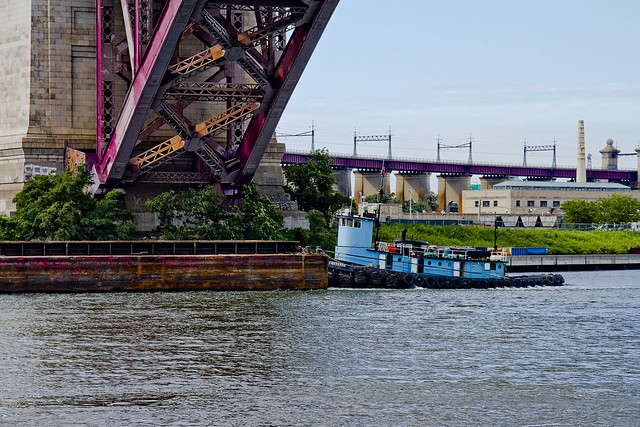
– photo by Mitch Waxman
Cheyenne is older than I am, yet manages to get to work every day, unlike me.
DonJon serves as one of the integral components of New York Harbor’s system for moving recyclable commodities from curb to customer, and can often be spotted moving barges of metallic waste between DSNY collection points.
I first became aware of the company’s role in the process after spotting them at the SimsMetal Newtown Creek docks a few years ago.
Built in 1965, by Ira S. Bushey and Sons of Brooklyn, New York (hull #628) as the tug Glenwood for Red Star Towing.
In 1970, she was acquired by Spentonbush Towing where she was renamed as the Cheyenne
The tug was later acquired by Amerada Hess where she retained her name.
She was then acquired by Empire Harbor Marine where the tug retained her name. The company would later be renamed as Port Albany Ventures.
In 2009, Port Albany Ventures was acquired by the DonJon Marine Company of Hillside, New Jersey.

– photo by Mitch Waxman
A dirty and necessary industry, recycling is nothing like you would imagine it to be. University professors, environmentalists, and politicians present an image of something akin to Santa’s Elves in crisp white uniforms working in an antiseptic factory isolated from population centers. The reality is that it is performed by oil streaked and smoke belching heavy machinery, consumes far more fuel than you would imagine, and that it is quite a dangerous occupation (also, the concentration and processing of these metals carries dark implications for groundwater and air quality in the localities which it takes place in).
Green jobs of the future indeed.
from wikipedia
The scrap industry contributed $65 billion in 2006 and is one of the few contributing positively to the U.S. balance of trade, exporting $15.7 billion in scrap commodities in 2006. This imbalance of trade has resulted in rising scrap prices during 2007 and 2008 within the United States. Scrap recycling also helps reduce greenhouse gas emissions and conserves energy and natural resources. For example, scrap recycling diverts 145,000,000 short tons (129,464,286 long tons; 131,541,787 t) of materials away from landfills. Recycled scrap is a raw material feedstock for 2 out of 3 pounds of steel made in the U.S., for 60% of the metals and alloys produced in the U.S., for more than 50% of the U.S. paper industry’s needs, and for 33% of U.S. aluminum. Recycled scrap helps keep air and water cleaner by removing potentially hazardous materials and keeping them out of landfills.

– photo by Mitch Waxman
Not meaning to sound negative on this otherwise essential service, it’s just that as certain highly placed municipal employees have advised me in the past- “Be careful which laws you ask for, as some things may come only at too great a cost”.
If it costs ten gallons of fuel to recycle and reuse something which it would have cost five gallons of fuel to pull out of the ground… what are we actually saving?
from wikipedia
The tugboat is one symbol of New York. Along with its more famous icons of Lady Liberty, the Empire State Building, and the Brooklyn Bridge, the sturdy little tugs, once all steam powered, working quietly in the harbor became a sight in the city.
The first hull was the paddler tug Rufus W. King of 1828.
New York Harbor at the confluence of the East River, Hudson River, and Atlantic Ocean is among the world’s largest natural harbors and was chosen in the 17th century as the site of New Amsterdam for its potential as a port. The completion of the Erie Canal in 1825 to the upper Hudson River ensured that New York would be the center of trade for the Eastern Seaboard, and as a result, the city boomed. At the port’s peak in the period of 1900-1950, ships moved millions of tons of freight, immigrants, millionaires, and GI service men serving in wars.
Sheparding the traffic around the harbor were hundreds of tugs–over 700 steam tugs worked the harbor in 1929. Firms such as McAllister, and Moran Tugs came into the business. Cornelius Vanderbilt started his empire with a sailboat and went on to greatness with the New York Central Railroad, incidentally owning many tugs.
dense curtain

– photo by Mitch Waxman
The 1.3 billion gallon a day flow of New York City’s sewage really should be defined as a third major river.
That’s 1,300,000,000 gallons a day or 474,500,000,000 gallons of night soil a year.
1.3 billion is approximately the population of China.
Pictured above is the DEP Sludge Vessel M/V Newtown Creek. A veteran, she was was laid down by the Wiley Manufacturing Co. in 1967. Just under 324 foot long, M/V Newtown Creek can carry 102,000 cubic feet of cargo and weighs in at 2,557 gross tons.
from nywea.org
The largest vessels, M/V Newtown Creek and M/V North River, are semiautomated motor vessels with more than twice the capacity of the original sludge vessels. The crew size was reduced to eight in 1980 and reduced again in 1987 to the current size of six. In 1987, MPRSA was amended, and ocean dumping was moved from the 12-mi site to a 106-mi site. As a result, the operation of the M/V was changed to in-harbor work transporting sludge to four newly constructed New York City ocean-going barges for disposal to the 106-mi site.
In 1991, to comply with the Ocean Dumping Ban Act (ODBA), the M/V Newtown Creek, North River and Owls Head began transporting sludge from plants without dewatering facilities or other means of conveyance to plants with dewatering facilities for processing. Since barges were no longer needed, three were retired, and one, the Udalls Cove, was kept as part of the fleet for emergencies.

– photo by Mitch Waxman
Forty-four and change years is a long time to be working any job, especially one with the city.
M/V Newtown Creek was cruising along the East River one winter’s afternoon, just before sunset, and your humble narrator was similarly crossing the water- only I was upon the Queensboro Bridge’s pedestrian walkway, en route to the Shining City.
from nyc.gov
Presently, NYC-DEP Marine Section uses these three sludge vessels for the transportation of liquid sludge from wastewater treatment plants without dewatering capabilities.

– photo by Mitch Waxman
The DEP people actually refer to these ships as “Honey Boats”, by the way, or at least some of the ones that I’ve interacted with have.
It’s gallows humor, the refined and thickened sludge that these vessels carry does not have the appearance and seeming viscosity of honey, rather it is said to be darkly colored and resemble pea soup.
from wikipedia
The New York City Department of Environmental Protection (NYCDEP) manages the city’s water supply, providing more than 1.1 billion US gallons (4,200,000 m3) of water each day to more than 9 million residents throughout New York State through a complex network of nineteen reservoirs, three controlled lakes and 6,200 miles (10,000 km) of water pipes, tunnels and aqueducts. The DEP is also responsible for managing the city’s combined sewer system, which carries both storm water runoff and sanitary waste, and fourteen wastewater treatment plants located throughout the city. The DEP carries out federal Clean Water Act rules and regulations, handles hazardous materials emergencies and toxic site remediation, oversees asbestos monitoring and removal, enforces the city’s air and noise codes, bills and collects on city water and sewer accounts, and manages citywide water conservation programs.
Emily Lloyd was the commissioner of the Department of Environmental Protection until resigning in 2008. On November 30, 2009, New York City Mayor Michael Bloomberg appointed Caswell F. Holloway to be the new commissioner of NYCDEP. Following Holloway’s appointment as the new NYC Deputy Mayor for Operations, Mayor Bloomberg appointed Carter H. Strickland, Jr. to be the new commissioner of NYCDEP on August 17, 2011.
warnings and prophecies
2011’s Greatest Hits:

– photo by Mitch Waxman
In January of 2011, while walking along in knee deep snow, your humble narrator happened across this enigmatic and somehow familiar item sitting in a drift at the NYC S.E.M./Signals Street Light Yard of the DOT at 37th avenue near the Sunnyside and Astoria border. It looked familiar to me, but I didn’t recognize it for what it was until sharp eyed reader TJ Connick suggested that this might be the long missing Light Stanchion which once adorned the Queensboro Bridge’s Manhattan landing.
These two posts: “an odd impulse“, and “wisdom of crowds” discuss the discovery and identification in some detail.
Some good news about this iconic piece of Queens history will be forthcoming, but I’ve been asked to keep it quiet for the moment.

– photo by Mitch Waxman
In February of 2011, “Vapour Soaked” presented a startling concurrence of comparitive detail for the discerning viewer, when the shot above was presented in contrast with a 1920’s shot from The Newtown Creek industrial district of New York City By Merchants’ Association of New York. Industrial Bureau, 1921″, (courtesy Google Books).
Admittedly, not quite as earth shaking as January’s news, but cool nevertheless. I really like these “now and then” shots, expect more of the same to come your way in the future.

– photo by Mitch Waxman
In March of 2011, “first, Calvary” discussed the epic (for me) quest to find a proverbial “needle in a haystack” within First Calvary Cemetery- the grave of its very first interment, an Irish woman named Esther Ennis who died in 1848. I have spent an enormous amount of time searching for this spot, where Dagger John Hughes first consecrated the soil of Newtown.

– photo by Mitch Waxman
In April of 2011, the world lost one of its best people and my official “partner in crime”, Bernard Ente.
He was ill for awhile, but asked me to keep the severity of things quiet. He passed in the beginning of April, and one of the last requests he made of me (along with “taking care” of certain people) was to continue what he had started along the Newtown Creek and all around NY Harbor.
This was when I had to step forward, up my game, and attempt to fill a pair of gargantuan boots. Frankly, I’m not even half of who he was, but I’m trying. That’s when I officially stepped forward and began introducing myself as a representative of Newtown Creek Alliance, and joined the Working Harbor Committee– two organizations which Bernie was committed to. I’m still trying to wrap my head around his loss.

– photo by Mitch Waxman
In May of 2011, while attempting to come to terms with my new roles in both organizations, it was decided that a fitting tribute to our fallen comrade would be the continuance of his annual “Newtown Creek Cruises” and the date of May 21 was set for the event. An incredible learning experience, the success of the voyage would not have been possible without the tutelage of WHC’s John Doswell and Meg Black, NCA’s Katie Schmid, or especially the aid of “Our Lady of the Pentacle” and the Newtown Pentacle’s stalwart far eastern correspondent: Armstrong.
Funny moments from during this period included the question “Whom do you call to get a drawbridge in NYC to open for you?”.
During this time, I also became involved with Forgotten-NY’s Kevin Walsh and Greater Astoria Historical Society’s Richard Melnick and their ambitious schedule of historical tours.

– photo by Mitch Waxman
In June of 2011, the earliest Newtown Creek Chemical Factory which I’ve been able to find in the historical record, so far, was explored in the post “lined with sorrow“- describing “the Bushwick Chemical Works of M. Kalbfleisch & Sons”.
Additionally, my “Newtown Creek Magic Lantern Show” was presented to a sold out and standing room only crowd at the Greater Astoria Historical Society.
This was also the beginning of a period which has persisted all year- in which my efforts of behalf of the various organizations and political causes which I’m advocating for had reduced my output to a mere 15 or fewer postings a month.
All attempts are underway to remedy this situation in 2012, and apologies are offered.

– photo by Mitch Waxman
In July of 2011, another Newtown Creek boat tour was conducted, this time for the Metropolitan Water Alliance’s “City of Water Day”. The “Newtown Creek Magic Lantern Show” was also performed at the Admiral’s House for a packed room.
Additionally, my so called “Grand Walk” was presented in six postings. This was an attempt to follow a 19th century journey from the Bloody Sixth Ward, Manhattan’s notorious Five Points District, to Calvary Cemetery in Queens. Once, this would have been a straightforward endeavor involving minimal connections of Trolley and Ferry, but today one just has to walk. These were certainly not terribly popular posts, but are noteworthy for the hidden and occluded horde of forgotten New York history which they carry.
From the last of these posts, titled “suitable apparatus“- “As the redolent cargo of my camera card revealed- this “Grand Walk”, a panic induced marathon which carried your humble narrator across the East River from St. Patrick’s Old Cathedral in Manhattan into Williamsburg and up Grand Street to Maspeth and the baroque intrigues of the Newtown Creek– wound down into it’s final steps on Laurel Hill Blvd.”

– photo by Mitch Waxman
In August of 2011, “the dark moor” presented intriguing aerial views of the Newtown Creek Watershed, and “sinister exultation” shared the incredible sight of an Amtrak train on fire at the Hunters Point Avenue station in Long Island City. “revel and chaff” explored the aftermath of Hurricane Irene in LIC’s Zone A, and an extraordinary small boat journey around Dutch Kills was detailed in: “ponderous and forbidding“, “ethereal character“, “pillars and niches“, and “another aperture“.
This was an incredible month.

– photo by Mitch Waxman
In September of 2011, a posting called “uncommented masonry” offered this declaration:
” By 1915, there approximately 40,000 automotive trucks plying the streets of New York City.
What’s surprising is that 25% of them were electric.
Lords and ladies of Newtown, I present to you the last mortal remains of the General Electric Vehicle Company, 30-28 Starr Avenue, Long Island City– manufacturer of a substantial number of those electrical trucks.”
I’m particularly fond of this post, as this was a wholly forgotten moment of Newtown Creek and industrial history which I was able to reveal. Organically born, it was discovered in the course of other research, and I believed at the time that it was going to be the biggest story that I would present all year about Blissville.

– photo by Mitch Waxman
In October of 2011, a trio of Newtown Creek Tours (two public and one for educators) were accomplished. The public tours were full to capacity, as were the Open House New York tours I conducted on the 15th and 16th of that Month. Also, the Metropolitan Water Alliance invited me to photograph their “Parade of Boats” on October 11th, and I got the shot below of the FDNY Fireboat 343.

– photo by Mitch Waxman

– photo by Mitch Waxman
In November of 2011, a visit to Lovecraft Country in Brooklyn was described in “frightful pull“, and “vague stones and symbols” came pretty close to answering certain mysteries associated with the sky flung Miller Building found at the foot of the Greenpoint Avenue Bridge in Brooklyn.

– photo by Mitch Waxman
A December 2011 post titled “An Oil spill… in Queens” broke the news that petroleum products are seeping out of the bulkheads of Newtown Creek, this time along the Northern shoreline, which lies in the Queens neighborhood of Blissville.
Rest assured that your Newtown Pentacle is on top of the story of “the Blissville Oil Spill”, lords and ladies of Newtown, and will bring you breaking news as it develops in 2012.
crooked boughs

– photo by Mitch Waxman
This Tug, the Gramma Lee T. Moran, was mentioned in a Newtown Pentacle posting of November 26- “loose and displaced“. As it’s one of my favorite tugs in New York Harbor to shoot, I felt a little bad that the starring role in that posting had gone to a cargo ship- and that Gramma Lee T. Moran had to share the second banana position with another Moran Tug- the estimable Marion Moran.
Can’t tell you why I like the esthetics of this ship so much, nor can I say why exactly it always reminds me of the Millennium Falcon (from the Star Wars movies) as it slides along the Kill Van Kull.
from wikipedia
The Kill Van Kull is a tidal strait approximately 3 miles (4.8 km) long and 1,000 feet (305 m) wide separating Staten Island and Bayonne, New Jersey, USA. The name kill comes from the Middle Dutch word kille, meaning “riverbed” or “water channel.”
Kill Van Kull connects Newark Bay with Upper New York Bay. The Robbins Reef Light marks the eastern end. Historically it has been one of the most important channels for the commerce of the region, providing a passage for marine traffic between Manhattan and the industrial towns of New Jersey. Since the final third of the 20th century, it has provided the principal access for ocean-going container ships to Port Newark-Elizabeth Marine Terminal, the busiest port facility in the eastern United States and the principal marine terminal for New York Harbor.

– photo by Mitch Waxman
These two shots are from just a few months ago, captured in the fall of 2011. It’s always odd seeing a tugboat operating without a barge, or tending a larger vessel which can be hundreds of times larger than itself. The majesty of these ships, and their crews, come alive when they are tasked with bearing such sisyphean burdens.
Can you imagine what it must be like guiding a fuel tanker into the narrow Kill Van Kull or down the East River? It must take nerves of steel to muster the confidence needed to Captain such tasks.
from tugboatenthusiastsociety.org
Tugs are “displacement” hull vessels, the hull is designed so water flows around it, there is no consideration for having the vessel “plane”. Because of this the hull form is limited to a maximum speed when running “free” that is about 1.5 times the square root of the waterline length. As the tug approaches this speed when running “free” it is perched between the bow wave and the stern wave. Since the hull cannot plane, application of additional power when approaching maximum hull speed only results in a larger bow wave, with the tug “squatting” further into the trough.

– photo by Mitch Waxman
The shot above, and the one below are from earlier in 2011- April to be exact.
Moran is a well established company which operates tugs all over North America. A century and a half old, the company’s fleet can be found on the USA’s Pacific and Atlantic coasts and within the Great Lakes, both along the west coast of- and in the Gulf of- Mexico, and within the inland waters of the eastern United States. They’ve been known to operate periodically as far away as the Caribbean Sea and South American waters.
from morantug.com
The LEE T. MORAN is an expression of brute power and utility that belies the refinements of technical engineering below her waterline. There, twin ports are cut into the steel hull to make room for the tug’s Z-drive units. On the floor of the shop they look like the lower units of giant outboard engines. Made by Ulstein, a subsidiary of Rolls-Royce, the Z-drive functions much like an outboard. Imagine two outboards extending straight down through the hull, each having the ability to rotate 360 degrees. That makes even a heavy, 92-foot tug with a 450-ton displacement very maneuverable. “It can turn on a dime,” says Doughty. “The hull bottom is slightly flatter to adjust to the two drive units. By turning each drive out 90 degrees, the captain can go from full-ahead (14 knots) to a dead stop in no time.”

– photo by Mitch Waxman
Perhaps it’s the low slung aspect of the wheelhouse, or the gentle curves observed in its hull… I can’t say, but there is just something pleasing about the design of this boat. A big toot goes out from this, your Newtown Pentacle, to one of my favorite citizens of the NY Harbor- the Gramma Lee T. Moran.
Moran Towing began operations in 1860 when founder Michael Moran opened a towing brokerage, Moran Towing and Transportation Company, in New York Harbor. In 1863, the company was transformed from a brokerage into an owner-operator of tugboats when it purchased a one-half interest in the tugboat Ida Miller for $2,700. Over time Moran acquires a fleet of tugboats. It was Michael Moran who painted the first white “M” on a Moran tugboat stack, in 1880.


 The Newtown Pentacle