Archive for the ‘Hells Gate’ Category
weedy walls
Note- This is a reblog of a Newtown Pentacle posting from June 5, 2010 titled: from Hells Gate, loosed upon the world

– photo by Mitch Waxman
The Friday of memorial day weekend, your humble narrator stumbled into the wilds of Astoria, headed for Astoria Park. Astoria Park is at the western end of Queens, and adjoins the East River, hosting parts of both the mighty Triboro Bridge and the sublime exemplar of bridge engineering called Hellgate. Named for the section of the East River it crosses, Hellgate was my intended destination and subject, and I was hoping for some visually interesting rail traffic to be crossing the great bridge. Frustrated by a gray and humid day, the Acela and other Amtrak traffic was observed, as well as a curious CSX double engine. Then…
from nycgovparks.org
Astoria Park, on the west shore of Queens, extends from south of the Triborough Bridge to north of the Hell Gate Bridge. With a panoramic view of the skyscrapers of midtown Manhattan in the south to the Hell Gate channel in the north, the scenery presents the diverse landscape of New York City. The Hell Gate channel, formed by faults deep underground, contains some of the deepest water in New York Harbor. Its treacherous reefs bear picturesque names such as “Hen and Chickens,” “Pot Rock,” “Bread & Cheese,” and “Bald Headed Billy.”
Throughout the centuries the stunning natural beauty of this location has attracted visitors and settlers. Before the arrival of European colonists, a trail passed by the site, and an Indian village flourished at Pot Cove. Local inhabitants grew maize on the shores, fished in Hell Gate, and drew water from Linden Brook, a small stream that still flows under Astoria Park South. In the mid-1600s the Dutch parceled out this land to various owners, including William Hallet whose grant embraced hundreds of acres. During the American Revolution, several British and Hessian regiments were stationed in the area. On November 25, 1780 the frigate Hussar and its five-million-dollar cargo sank to the bottom of Hell Gate, where despite some removal of cannons, the treasure still remains.

– photo by Mitch Waxman
I’ve become pretty familiar with NY Harbor in the last year, and can identify some of the common types of ships that cross its waters. Every now and then, however, a mysterious craft- an unidentified floating object or UFO if you will- crosses in front of me. Proceeding south, this catamaran (actually a trimaran) was nearly devoid of markings- which is remarkable in itself- and moving at a tremendous clip. Its “colorway” and hull shape instantly said “military” to me, but I could not recognize its specie.
from wikipedia
The first trimarans were built by indigenous Polynesians almost 4,000 years ago, and much of the current terminology is inherited from them. Multihull sailboats (catamarans and trimarans) gained favor during the 1960s and 1970s. Modern recreational trimarans are rooted in the same homebuilt tradition as other multihulls but there are also a number of production models on the market. A number of trimarans in the 19–36-foot lengths (5.8–11 m) have been designed over the last 30 years to be accommodated on a road trailer. These include the original Farrier – Corsair folding trimarans – and original John Westell swing-wing folding trimaran (using the same folding system later adopted also on Quorning Dragonfly) and like trimarans. Many sailboat designers have also designed demountable trimarans that are able to be trailered (like the SeaCart 30 by Oceanlake Marine).
The trimaran design is also becoming more widespread as a passenger ferry. In 2005 the 127-metre trimaran (417 ft) Benchijigua Express was delivered by Austal to Spanish ferry operator Fred. Olsen, S.A. for service in the Canary Islands. Capable of carrying 1,280 passengers and 340 cars, or equivalents, at speeds up to 40 knots, this boat was the longest aluminum ship in the world at the time of delivery. The trimaran concept has also been considered for modern warships. The RV Triton was commissioned by British defence contractor QinetiQ in 2000. In October 2005, the United States Navy commissioned for evaluation the construction of a General Dynamics Littoral Combat Ship (LCS) trimaran designed and built by Austal.

– photo by Mitch Waxman
Evocative, as on one hand it resembled a radar dodging stealth aircraft for the odd angles and aerodynamic shape, on the other it suggested a modern combat tank with its armor designed to deflect rather than defeat ballistic weapons.
The ship, nevertheless, was kicking up a huge wake and was shooting water behind it- some 10-20 feet high- as it rocketed down the East River.
from wikipedia
The littoral zone refers to that part of a sea, lake or river that is close to the shore. In coastal environments the littoral zone extends from the high water mark, which is rarely inundated, to shoreline areas that are permanently submerged. It always includes this intertidal zone and is often used to mean the same as the intertidal zone. However, the meaning of “littoral zone” can extend well beyond the intertidal zone.
There is no single definition. What is regarded as the full extent of the littoral zone, and the way the littoral zone is divided into subregions, varies in different contexts (lakes and rivers have their own definitions). The use of the term also varies from one part of the world to another, and between different disciplines. For example, military commanders speak of the littoral in ways that are quite different from marine biologists.
The adjacency of water gives a number of distinctive characteristics to littoral regions. The erosive power of water results in particular types of landforms, such as sand dunes, and estuaries. The natural movement of the littoral along the coast is called the littoral drift. Biologically, the ready availability of water enables a greater variety of plant and animal life, and the additional local humidity due to evaporation usually creates a microclimate supporting unique types of organisms.
The word “littoral” is used both as a noun and an adjective. It derives from the Latin noun litus, litoris, meaning “shore”. (The doubled ‘t’ is a late medieval innovation and the word is sometimes seen in the more classical-looking spelling ‘litoral’.)

– photo by Mitch Waxman
The “colorway” and camouflage of the craft suggested that the futurists of Britain still have modern adherents, long after the last of the “dazzle ships” were launched.
For those of you not in the know, the Dazzle Ships were an experiment in “breaking up the shape” of large combat vessels against the horizon, an attempt to reduce the visual profile of capital ships and reduce the ability of submariners to target vital areas of said ships. Dazzle works best at distance, which is what modern naval combat is all about.
from wikipedia
At first glance Dazzle seems unlikely camouflage, drawing attention to the ship rather than hiding it, but this technique was developed after the Allied Navies were unable to develop effective means to disguise ships in all weather.
Dazzle did not conceal the ship but made it difficult for the enemy to estimate its type, size, speed and heading. The idea was to disrupt the visual rangefinders used for naval artillery. Its purpose was confusion rather than concealment. An observer would find it difficult to know exactly whether the stern or the bow is in view; and it would be equally difficult to estimate whether the observed vessel is moving towards or away from the observer’s position.
Rangefinders were based on the co-incidence principle with an optical mechanism, operated by a human to compute the range. The operator adjusted the mechanism until two half-images of the target lined up in a complete picture. Dazzle was intended to make that hard because clashing patterns looked abnormal even when the two halves were aligned. This became more important when submarine periscopes included similar rangefinders. As an additional feature, the dazzle pattern usually included a false bow wave to make estimation of the ship’s speed difficult.

– photo by Mitch Waxman
As mentioned, my computer was down for the holiday weekend, but Our Lady of the Pentacle allowed me to use her laptop and I managed to get a few of these images out to that clandestine and anonymous network of maritime enthusiasts and quasi governmental experts who advise, comment, or offer corrections to your Newtown Pentacle. Credit for identifying this craft goes out to them, and I wish that they would allow me to sing praise publicly, but certain conflicts of interest or oaths of secrecy demand that they must always be referred to as “anonymous sources”. In this case, the ultimate sources will be referred to as Daidalos and Icaros (hey, it is Astoria Park).
from wikipedia
It is in images, not in texts that Daedalus is seen with wings; many Greek myths appear to have been invented to make sense of known but inexplicable images. The most familiar literary telling explaining Daedalus’ wings is a late one, that of Ovid: in his Metamorphoses (VIII:183-235) Daedalus was shut up in a tower to prevent his knowledge of his Labyrinth from spreading to the public. He could not leave Crete by sea, as the king kept strict watch on all vessels, permitting none to sail without being carefully searched. Since Minos controlled the land and sea routes, Daedalus set to work to fabricate wings for himself and his young son Icarus. He tied feathers together, from smallest to largest so as to form an increasing surface. The larger ones he secured with thread and the smaller with wax, and gave the whole a gentle curvature like the wings of a bird. When the work was done, the artist, waving his wings, found himself buoyed upward and hung suspended, poising himself on the beaten air. He next equipped his son in the same manner, and taught him how to fly. When both were prepared for flight, Daedalus warned Icarus not to fly too high, because the heat of the sun would melt the wax, nor too low, because the sea foam would soak the feathers.

– photo by Mitch Waxman
Daidalos was actually stumped when the photos arrived, and neither of us could make any sense of the only marking- a string of tiny numbers on the hull- of this unidentified floating object. High flying, Icaros received the shots from the latter, and contacted high ranking members of a certain governmental entity. This entity-let’s just say that they have lots of boats and planes, and boats that are airports, and boats that carry nuclear missiles and stay underwater for months at a time, and a lot of the people who work for it wear white dress uniforms– claimed the ship as theirs!
from wikipedia
From the time of its inception, the military played a decisive role in the history of the United States. A sense of national unity and identity was forged out of the victorious Barbary Wars, as well as the War of 1812. Even so, the Founders were suspicious of a permanent military force and not until the outbreak of World War II did a large standing army become officially established.
The National Security Act of 1947, adopted following World War II and during the onset of the Cold War, created the modern U.S. military framework; the Act merged previously Cabinet-level Department of War and the Department of the Navy into the National Military Establishment (renamed the Department of Defense in 1949), headed by the Secretary of Defense; and created the Department of the Air Force and National Security Council.
The U.S. military is one of the largest militaries in terms of number of personnel. It draws its manpower from a large pool of volunteers; although conscription has been used in the past in various times of both war and peace, it has not been used since 1972. As of 2010, the United States spends about $692 billion annually to fund its military forces, constituting approximately 43 percent of world military expenditures. The U.S. armed forces as a whole possess large quantities of advanced and powerful equipment, which gives them significant capabilities in both defense and power projection.

– photo by Mitch Waxman
What you have just seen, lords and ladies, shooting down the East River at high speed was described as a (JHSV) Joint High Speed Vessel.
A JHSV can comfortably carry 300 fully armed MARINES, or up to 600 in a pinch. Alternatively, it can move multiple main battle tanks- the astounding M1 Abrams. Just so you understand, 600 is near the low end of Battalion strength, and 600 U.S. Marines could probably claim a beachhead in Hell itself if they were asked to. It also has a landing pad for a helicoptor.
This ship is huge… but a helicoptor pad?
from navy.mil
Description
The JHSV program is procuring high-speed transport vessels for the Army and the Navy. These vessels will be used for fast intra-theater transportation of troops, military vehicles and equipment. The JHSV program merges the previous Army Theater Support Vessel (TSV) and the Navy High Speed Connector (HSC), taking advantage of the inherent commonality between the two programs.
JHSV will be capable of transporting 600 short tons 1,200 nautical miles at an average speed of 35 knots. The ships will be capable of operating in shallow-draft ports and waterways, interfacing with roll-on/roll-off discharge facilities, and on/off-loading a combat-loaded Abrams Main Battle Tank (M1A2). Other joint requirements include an aviation flight deck to support day and night air vehicle launch and recovery operations.
JHSV is a commercial-design, non-combatant transport vessel, and does not require the development of any new technology. JHSV is being built to American Bureau of Shipping (ABS) High Speed Naval Craft Guide. Systems onboard will be based on commercial ABS steel vessel rules. As such, it does not require the survivability and ability to sustain damage like the LCS. It has no combat system capability and no ability to support or use LCS mission modules. It will leverage non-developmental or commercial technology that is modified to suit military applications. Select military features include Aviation; Command, Control, Communications, Computers, and (Military) Intelligence; and Firefighting for the Mission Bay. NVR does not apply to any part of JHSV.
As a non-combatant sealift ship, the Navy variant of JHSV will be crewed by civilian mariners, either employed by or under contract to the Navy’s Military Sealift Command. U.S. Army vessels will be crewed by Army craft masters. Both versions will require a crew of approximately 22-40 people, but will have airline style seating for more than 300 embarked forces and fixed berthing for approximately 100 more.
- Primary Function: The JHSV Program will provide high speed, shallow draft transportation capability to support the intra-theater maneuver of personnel, supplies and equipment for the U. S. Navy, Marine Corps, and Army.
- Builder: Austal USA
- Propulsion: Water Jet
- Length: 103 Meters (338 feet)
- Beam: 28.5 meters (93.5 feet)
- Displacement: 600 short tons
- Draft: < 15 feet (4.57 meters)
- Speed: 35-40 knots
- Range: 1,200 nautical miles
- Crew: 22-40 civilian mariners/U.S. Army craft masters
- Homeport: No homeport – construction has yet to begin.
However… This is not a JHSV!!!
This here is the M80 Stiletto.

– photo by Mitch Waxman
Check out this video at youtube which explains the Stiletto’s potential in great detail, and supplies 3D animation for operational scenarios.
With the formal roll-out of the 88-foot Stiletto stealth ship and its cutting-edge “M-Hull” wave-damping design, that legacy takes another step forward. The Stiletto is part of Project WolfPac, which aims to test new concepts of shallow-water and riverine warfare organized around swarms of smaller, affordable ships linked by communications. The Stiletto can slip into shallow waters, launching inflatable boats and even UAVs while serving as a communications hub via its “electronic keel.” Best of all, the M-Hull significantly reduces the pounding its occupants take from waves – poundings that often result in back injuries that cut careers short, or leave sailors with lingering disabilities in later life.
and from wikipedia
The 88-foot (27 m) long vessel has a notable hull design, an M-shaped hull that provides a stable yet fast platform for mounting electronic surveillance equipment or weapons, or for conducting special operations. The hull design does not require foils or lifting devices to achieve a smooth ride at high speeds in rough conditions. Its shallow draft means the M80 Stiletto can operate in littoral and riverine environments and potentially allows for beach landings.
The M80 Stiletto is equipped with four Caterpillar, Inc. C32 1232 kW (1652 HP) engines yielding a top speed in excess of 50 knots (90 km/h) and a range of 500 nautical miles (900 km) when fully loaded. It can be outfitted with jet drives for shallow water operations and beaching.
It has a topside flight deck for launching and retrieving UAVs and a rear ramp that can launch and recover an 11-meter rigid-hull inflatable boat (RIB) or Autonomous Underwater Vehicle (AUV).
It weighs 45 tons unloaded, light enough that it can be hoisted onto a cargo ship, while still able to carry up to 20 tons of cargo in the 1,996 square feet (200 m2) of usable interior space. The ship is 88.6 feet (27.0 m) in length, with a width of 40 feet (12 m) and a height of 18.5 feet (5.6 m), yet has a draft of only 2.5 feet (0.8 m).
The M80 Stiletto is the largest U.S. naval vessel built using carbon-fiber composite and epoxy building techniques, which yields a very light but strong hull. The prototype M80 Stiletto is expected to be in use in less than one year. Ships are expected to cost between $6 and $10 million
vast enclosure

– photo by Mitch Waxman
When you cut things down to the bone, and ask yourself the question “Who was the New Yorker that most profoundly changed the City?” it always comes back to one fellow. Ray Kelly or Mike Bloomberg would vie for the crown in modernity, in the long view of history Alexander Hamilton, DeWitt Clinton, Boss Tweed, or the Roebling clan have major claims on the title. Robert Moses would tell you that it was himself, and arguably, so would Osama Bin Laden.
In the opinion of a humble narrator, the crown belongs to one man- a Swedish immigrant named Othmar Ammann, and today is his birthday.
from wikipedia
Othmar Hermann Ammann (March 26, 1879 – September 22, 1965) was a American structural engineer whose designs include the George Washington Bridge, Verrazano-Narrows Bridge, and Bayonne Bridge.

– photo by Mitch Waxman
Brooklyn Bridge has the fame, Williamsburg Bridge the infamy, Manhattan Bridge is overlooked. The bridges of Othmar Ammann, however, are the ones which shaped the modern megalopolis and allowed the expansion and diaspora of New York’s laborers from the tenement neighborhoods of the five boroughs to the suburban satellites of modernity. The vast populations of Long Island and New Jersey and Westchester who commute into the city on a daily basis would have never achieved their current size, were Ammann removed from the story.
As a side note, and just to toot my own horn for a moment, the shot above was published last year in the New York Times- check it out here
Also from wikipedia
Othmar Ammann designed more than half of the eleven bridges that connect New York City to the rest of the United States. His talent and ingenuity helped him create the two longest suspension bridges of his time. Ammann was known for being able to create bridges that were light and inexpensive, yet they were still simple and beautiful. He was able to do this by using the deflection theory. He believed that the weight per foot of the span and the cables would provide enough stiffness so that the bridge would not need any stiffening trusses. This made him popular during the depression era when being able to reduce the cost was crucial. Famous bridges by Ammann include:
- George Washington Bridge (opened October 24, 1931)
- Bayonne Bridge (opened November 15, 1931)
- Triborough Bridge (opened July 11, 1936)
- Bronx-Whitestone Bridge (opened April 29, 1939)
- Walt Whitman Bridge (opened May 16, 1957)
- Throgs Neck Bridge (opened January 11, 1961)
- Verrazano Narrows Bridge (opened November 21, 1964)

– photo by Mitch Waxman
Othmar Ammann was a bit of an artist, his bridges achieving a rare thing for engineering projects, which is the elevation of a functional structure to the sublime. A prevailing theory in fine art and graphic design which emerged in the 20th century is “less is more”, and Ammann’s spans are manifestations of this concept in steel and cement.
from smithsonian.com
By the early 1960s, when the George Washington’s lower deck was added (as specified in the original plans), Ammann had all but eclipsed his mentor. Ammann’s other 1931 creation, the Bayonne Bridge connecting Staten Island and New Jersey, was until 1977 the world’s largest steel arch bridge — more than 600 feet longer than the previous record holder, Lindenthal’s Hell Gate Bridge.
Months before his death in 1965, Ammann gazed through a telescope from his 32nd-floor Manhattan apartment. In his viewfinder was a brand-new sight some 12 miles away: his Verrazano-Narrows suspension bridge. As if in tribute to the engineering prowess that made Ammann’s George Washington Bridge great, this equally slender, graceful span would not be surpassed in length for another 17 years.

– photo by Mitch Waxman
Eclipsed by the vain and power seeking during his sunset years, Ammann is one of the forgotten few who crafted the connections between the individual components of the archipelago islands of New York Harbor. Mighty Triborough or the graceful arch of the Bayonne Bridge speak to his sense of esthetic, and indicate that he was in touch with some higher imperative than merely moving automobiles from one place to another.
from nytimes.com
His works soar above the water, spanning the city’s rivers and connecting New York to the rest of the country. But who has heard of Othmar H. Ammann?
Donald Trump hadn’t, at least not back in 1964 when he was a high school student and his father took him to the dedication ceremony for the Verrazano-Narrows Bridge. ”It was a sad experience,” Mr. Trump recalled. ”For years, various politicians had fought the bridge. Now that it was built, I watched as these same people all got up and took credit for it, congratulating themselves and introducing one another. The only one not introduced was the man who made the bridge, Othmar Ammann.
middle stature

– photo by Mitch Waxman
It’s Maritime Sunday once again at this, your Newtown Pentacle, and today the focus is on Thornton Towing’s 1600 HP and 1958 vintage “Thornton Bros.” tugboat. Call sign WDD6171, Thornton Bros. is some 25m x 8m in size and has been clocked going as fast as 8 knots.
from wikipedia
Merchant and naval vessels are assigned call signs by their national licensing authorities. In the case of states such as Liberia or Panama, which are flags of convenience for ship registration, call signs for larger vessels consist of the national prefix plus three letters (for example, 3LXY, and sometimes followed by a number, i.e. 3Lxy2). United States merchant vessels are given call signs beginning with the letters “W” or “K” while US naval ships are assigned callsigns beginning with “N”. Originally both ships and broadcast stations were given call signs in this series consisting of three or four letters, but as demand for both marine radio and broadcast call signs grew, gradually American-flagged vessels were given longer call signs with mixed letters and numbers.

– photo by Mitch Waxman
From what I’ve been able to determine, the actual Thornton Brothers are local boys, although I’ve never met them. The tug Thornton Bros., however, seems to spend a lot of time transporting bulk metals around the harbor. These are the same sort of barges which one often observes at SimsMetal at Newtown Creek, so one might presume that they are part of the “recycling industrial complex”.
from marinesteel.com
Thornton Towing & Transportation is owned by Gerard and Richard Thornton, and Ed Carr; all of whom have spent their entire professional careers working on and around the waters of New York Harbor.

– photo by Mitch Waxman
Originally launched as the John E. Matton, the tug has had a long career and undergone more than one change of ownership. As is maritime custom, each owner has leased the boat with a unique sobriquet, which is detailed by the always reliable folks at tugboatinformation.com in the link below.
Built in 1958, by Matton Shipyard of Cohoes, New York (hull #325) as the John E. Matton.
The Morania Oil Tanker corporation chartered the vessel and eventually purchased her, where she was renamed as the Morania No. 12 .
When Morania phased out their canal fleet and the Morania No. 12 was acquired by Reinauer Transportation of Staten Island, New York where she was renamed as the Cissi Reinauer .

– photo by Mitch Waxman
John Matton was a shipbuilder upstate, located in Cohoes NY. A largely forgotten industrial center, Cohoes was also a center of brick manufacturing and to this day- one can discern thousands of red bricks scattered along the Hudson River shoreline.
The tale begins in 1899. An enterprising boat builder by the name of John E. Matton opened a boat building and repair facility along the enlarged, mule-drawn Champlain Canal about three miles north of the Waterford side-cut. At the time, the ill-fated “$9 million improvement” of New York’s canals was on life support but still limping along against the backdrop of corruption and scandal in Albany. John E. Matton had no reason to expect that he would not be able to work out of his present location for years and years to come.
Just four years later, however, after Theodore Roosevelt had appointed a new commission to chart a future for New York’s canals, the Barge Canal Act was passed by the State Legislature and approved by New York voters. What would this mean for John E. Matton? That his facility would be utterly useless in a matter of years when the new Barge Canal was completed.
warnings and prophecies
2011’s Greatest Hits:

– photo by Mitch Waxman
In January of 2011, while walking along in knee deep snow, your humble narrator happened across this enigmatic and somehow familiar item sitting in a drift at the NYC S.E.M./Signals Street Light Yard of the DOT at 37th avenue near the Sunnyside and Astoria border. It looked familiar to me, but I didn’t recognize it for what it was until sharp eyed reader TJ Connick suggested that this might be the long missing Light Stanchion which once adorned the Queensboro Bridge’s Manhattan landing.
These two posts: “an odd impulse“, and “wisdom of crowds” discuss the discovery and identification in some detail.
Some good news about this iconic piece of Queens history will be forthcoming, but I’ve been asked to keep it quiet for the moment.

– photo by Mitch Waxman
In February of 2011, “Vapour Soaked” presented a startling concurrence of comparitive detail for the discerning viewer, when the shot above was presented in contrast with a 1920’s shot from The Newtown Creek industrial district of New York City By Merchants’ Association of New York. Industrial Bureau, 1921″, (courtesy Google Books).
Admittedly, not quite as earth shaking as January’s news, but cool nevertheless. I really like these “now and then” shots, expect more of the same to come your way in the future.

– photo by Mitch Waxman
In March of 2011, “first, Calvary” discussed the epic (for me) quest to find a proverbial “needle in a haystack” within First Calvary Cemetery- the grave of its very first interment, an Irish woman named Esther Ennis who died in 1848. I have spent an enormous amount of time searching for this spot, where Dagger John Hughes first consecrated the soil of Newtown.

– photo by Mitch Waxman
In April of 2011, the world lost one of its best people and my official “partner in crime”, Bernard Ente.
He was ill for awhile, but asked me to keep the severity of things quiet. He passed in the beginning of April, and one of the last requests he made of me (along with “taking care” of certain people) was to continue what he had started along the Newtown Creek and all around NY Harbor.
This was when I had to step forward, up my game, and attempt to fill a pair of gargantuan boots. Frankly, I’m not even half of who he was, but I’m trying. That’s when I officially stepped forward and began introducing myself as a representative of Newtown Creek Alliance, and joined the Working Harbor Committee– two organizations which Bernie was committed to. I’m still trying to wrap my head around his loss.

– photo by Mitch Waxman
In May of 2011, while attempting to come to terms with my new roles in both organizations, it was decided that a fitting tribute to our fallen comrade would be the continuance of his annual “Newtown Creek Cruises” and the date of May 21 was set for the event. An incredible learning experience, the success of the voyage would not have been possible without the tutelage of WHC’s John Doswell and Meg Black, NCA’s Katie Schmid, or especially the aid of “Our Lady of the Pentacle” and the Newtown Pentacle’s stalwart far eastern correspondent: Armstrong.
Funny moments from during this period included the question “Whom do you call to get a drawbridge in NYC to open for you?”.
During this time, I also became involved with Forgotten-NY’s Kevin Walsh and Greater Astoria Historical Society’s Richard Melnick and their ambitious schedule of historical tours.

– photo by Mitch Waxman
In June of 2011, the earliest Newtown Creek Chemical Factory which I’ve been able to find in the historical record, so far, was explored in the post “lined with sorrow“- describing “the Bushwick Chemical Works of M. Kalbfleisch & Sons”.
Additionally, my “Newtown Creek Magic Lantern Show” was presented to a sold out and standing room only crowd at the Greater Astoria Historical Society.
This was also the beginning of a period which has persisted all year- in which my efforts of behalf of the various organizations and political causes which I’m advocating for had reduced my output to a mere 15 or fewer postings a month.
All attempts are underway to remedy this situation in 2012, and apologies are offered.

– photo by Mitch Waxman
In July of 2011, another Newtown Creek boat tour was conducted, this time for the Metropolitan Water Alliance’s “City of Water Day”. The “Newtown Creek Magic Lantern Show” was also performed at the Admiral’s House for a packed room.
Additionally, my so called “Grand Walk” was presented in six postings. This was an attempt to follow a 19th century journey from the Bloody Sixth Ward, Manhattan’s notorious Five Points District, to Calvary Cemetery in Queens. Once, this would have been a straightforward endeavor involving minimal connections of Trolley and Ferry, but today one just has to walk. These were certainly not terribly popular posts, but are noteworthy for the hidden and occluded horde of forgotten New York history which they carry.
From the last of these posts, titled “suitable apparatus“- “As the redolent cargo of my camera card revealed- this “Grand Walk”, a panic induced marathon which carried your humble narrator across the East River from St. Patrick’s Old Cathedral in Manhattan into Williamsburg and up Grand Street to Maspeth and the baroque intrigues of the Newtown Creek– wound down into it’s final steps on Laurel Hill Blvd.”

– photo by Mitch Waxman
In August of 2011, “the dark moor” presented intriguing aerial views of the Newtown Creek Watershed, and “sinister exultation” shared the incredible sight of an Amtrak train on fire at the Hunters Point Avenue station in Long Island City. “revel and chaff” explored the aftermath of Hurricane Irene in LIC’s Zone A, and an extraordinary small boat journey around Dutch Kills was detailed in: “ponderous and forbidding“, “ethereal character“, “pillars and niches“, and “another aperture“.
This was an incredible month.

– photo by Mitch Waxman
In September of 2011, a posting called “uncommented masonry” offered this declaration:
” By 1915, there approximately 40,000 automotive trucks plying the streets of New York City.
What’s surprising is that 25% of them were electric.
Lords and ladies of Newtown, I present to you the last mortal remains of the General Electric Vehicle Company, 30-28 Starr Avenue, Long Island City– manufacturer of a substantial number of those electrical trucks.”
I’m particularly fond of this post, as this was a wholly forgotten moment of Newtown Creek and industrial history which I was able to reveal. Organically born, it was discovered in the course of other research, and I believed at the time that it was going to be the biggest story that I would present all year about Blissville.

– photo by Mitch Waxman
In October of 2011, a trio of Newtown Creek Tours (two public and one for educators) were accomplished. The public tours were full to capacity, as were the Open House New York tours I conducted on the 15th and 16th of that Month. Also, the Metropolitan Water Alliance invited me to photograph their “Parade of Boats” on October 11th, and I got the shot below of the FDNY Fireboat 343.

– photo by Mitch Waxman

– photo by Mitch Waxman
In November of 2011, a visit to Lovecraft Country in Brooklyn was described in “frightful pull“, and “vague stones and symbols” came pretty close to answering certain mysteries associated with the sky flung Miller Building found at the foot of the Greenpoint Avenue Bridge in Brooklyn.

– photo by Mitch Waxman
A December 2011 post titled “An Oil spill… in Queens” broke the news that petroleum products are seeping out of the bulkheads of Newtown Creek, this time along the Northern shoreline, which lies in the Queens neighborhood of Blissville.
Rest assured that your Newtown Pentacle is on top of the story of “the Blissville Oil Spill”, lords and ladies of Newtown, and will bring you breaking news as it develops in 2012.
feeble horns
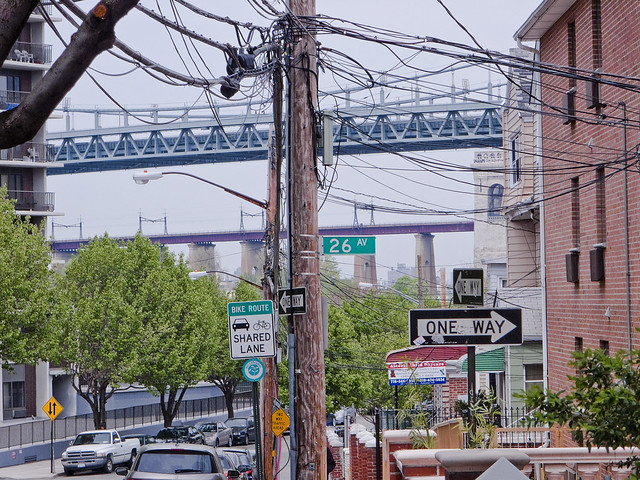
Hell Gate and Triborough bridges from Old Astoria – photo by Mitch Waxman
Loathsome memories of recent setbacks- and also of certain rebuffs- plague your humble narrator during these gloomy and sunless days, and always only solace can offer nepenthe. Thus, during a recent stroll by the pacific maelstrom of Hell Gate, nestled between two steel structures whose unearthly vibrations and omnipresent vocalizations form the aural environment- this series of shots were captured.

curiously scattered bones on sidewalk in Astoria – photo by Mitch Waxman
Vengeance and malice, indeed all of the seven deadly transgressions, populate the infernal dream world which has plagued me since childhood. Of late, a vivid character has typified these somnambulist hallucinations, and at least once during the night I’ll awaken in cold sweat grasping at the void of a curtain draped chamber. Surely, these negative humors are manifestations of another failing displayed by your humble narrator and least of all men, the inability to not bear grudges well beyond all sensible intervals.

sinister seeming bird at Hells Gate – photo by Mitch Waxman
Having grown up in a lonely and isolated existence, in dusty rooms of sculptured green carpeting and vinyl covered couches with odd knick knacks that betrayed basic tenets of adherence to the Hebrew faith, family members carried a charge of eastern European distrust for outsiders. Don’t trust anyone, my mother used to tell me while still in the cradle. As such, your humble narrator has grown into a hostile and suspicious man, contemptuous of authority even when such authority is necessary to govern over and control chaos and anarchy.

Amtrak at Hellegat Hell Gate Bridge – photo by Mitch Waxman
Often I stand on a point of principle, in a combative and tenacious- and vastly unpopular- stand over small matters such as allowing a police officer the right to inspect my belongings on demand. Of course I realize the age we are living in is fraught with the consequences of living in a global military empire the likes of which even the Romans or Turks would gasp and genuflect at, and that to most “standard of living” trumps “individual rights” but the constables have to follow the rules too. That’s what our modern Metropolis operates on, and as the saying in Brooklyn used to go “if I gots to stands in lines, youse gotta stands in da line”.

Psychiatric Hospitals at Hell Gate – photo by Mitch Waxman
Often, I fear that someday my darker impulses will take control of me, and I’ll spin off and become some comic book villain like parody of myself, the defeated antihero of a cosmic parable. Perhaps I will be remembered as a cautionary tale, your humble narrative of the man who looked under too many rocks. The Rumpelstiltskin of Newtown Creek, or perhaps just some old man in a shack who talks only to a collection of bottles?

Wards Island from Hell Gate – photo by Mitch Waxman
Preoccupations with such bizarre concerns has led me to believe in and visualize conspiracy lurking behind every corner. The attentions of certain malign elements, teenage adherents to some form of the Hip Hop cult, have been noted milling about around headquarters of late. Additionally, strange vehicles not usually parked in the neighborhood have been observed, adorned with mysterious antennae and blacked out windows- even on the windshield, which is unusual in itself due to municipal regulation.
Such bizarre notions, undoubtedly the product of lonely studies and a massive workload, were what led me to seek the solace of Astoria Park. I had hoped (futilely as turns out) to photograph passing Tugboats, but instead grew focused on certain uluations which seemed to be emerging from the impossibly distant Psychiatric hospitals at Wards Island…

The President of the United States on Marine 1 over Hell Gate – photo by Mitch Waxman
And that’s when the President of the United States flew by in Marine One on his way to the World Trade Center site to commemorate the death of his arch enemy.
In short, I’m all ‘effed up, and this post hits six points out of seven of the ICD-10 for paranoid personality type.
And the Newtown Pentacle is back in session.


 The Newtown Pentacle