Archive for the ‘Dutch Kills’ Category
looming up
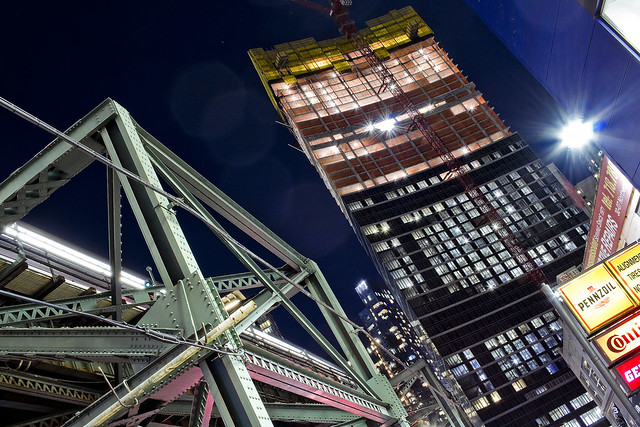
Continuing a night time stroll down Jackson Avenue.
– photo by Mitch Waxman
For generations have the children of Queens cried out in anguish and despair that they were denied their birthright – a chance to live in a small to medium sized but quite expensive apartment in or near Queens Plaza. Luckily, the powers that be over in Manhattan heard the children’s pleas and have answered their prayers. The under construction structure pictured above will be capped off by an “infinity pool,” which should answer another group’s longings – specifically the statistically relevant number of people who have always wanted to swim in a pool high above Queens Plaza. It’s a magical place, after all.
I get nostalgic for the porn shops and hookers, personally. They really dressed the place up, back in the day.
– photo by Mitch Waxman
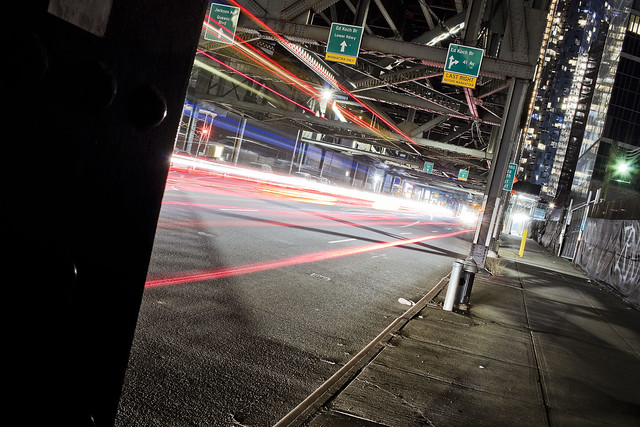
The stretch of Jackson Avenue lying betwixt Queens Plaza and 31st street is just horrible. You’ve got security fences and fortress walls on one side of the street, and long featureless construction fences on the other. A dizzying amount of automotive traffic occupies the center, and above there’s the tormenting sound of steel subway wheels grinding against the elevated rails. Jackson Avenue is too dark, and too bright, all at the same time. Everything is a confusion. It’s terrifying crossing the street, as every intersection is rumbling with traffic waiting to spring forth. Also, there’s vampires hiding up there in the steel.
God almighty, how I love places like this.

– photo by Mitch Waxman
Dormitory style living awaits just a few blocks away, where all of that traffic – both automotive and locomotive – is coincidentally heading towards. Queens Plaza is where an automotive choke point turn off of Jackson Avenue carries you towards the onramps of the Queensboro Bridge. It’s also where the Flushing line subway conjoins with the Astoria service, so you’ve got that extra bit of steel rail sound to contemplate. I could not hear anything playing on the headphones jammed in my ears while shooting these photos, which indicates just how loud Queens Plaza actually is.
There’s lots and lots of new construction here, so the kids of Queens can finally live the dream. There’s that.
“follow” me on Twitter- @newtownpentacle
Buy a book!
“In the Shadows at Newtown Creek,” an 88 page softcover 8.5×11 magazine format photo book by Mitch Waxman, is now on sale at blurb.com for $30.
correlated causeways
Eleven bridges, one creek.

– photo by Mitch Waxman
Pulaski Bridge is the first span you encounter, when you’ve left the East River and embarked on a journey down the fabulous Newtown Creek. A double bascule drawbridge, and electrically powered, the Pulaski Bridge connects 11th street in Long Island City with McGuinness Blvd. to the south in Brooklyn’s Greenpoint. Built in 1954, the Pulaski Bridge is owned and operated by the New York City Department of Transportation or “NYC DOT.” The Pulaski Bridge carries five lanes of traffic, plus a dedicated bicycle lane and a separate pedestrian pathway. It overflies the Queens Midtown Tunnel and Long Island Expressway, as well as active railroad tracks found on Borden Avenue.

– photo by Mitch Waxman
DB Cabin acts as a gatekeeper to the Dutch Kills tributary of Newtown Creek. It’s a railroad swing bridge owned by the Long Island Railroad, and connects two rail yards – the Wheelspur Yard (to the west, or left in the shot above) and the Blissville Yard – across the water. Both rail yards and the bridge itself are part of the LIRR’s Lower Montauk tracks. DB Cabin dates back to the 1890’s and is in a terrible state of repair. The swing bridge’s motors are nonfunctional, which isolates the Dutch Kills tributary from maritime traffic, and from the rest of the Newtown Creek.

– photo by Mitch Waxman
Cabin M is just to the north of DB Cabin on Dutch Kills, and the single bascule drawbridge connects the Montauk Cutoff with the Blissville Yard mentioned above. The Montauk Cutoff is an elevated track which used to provide a connection between the LIRR’s Main Line tracks at the nearby Sunnyside Yards with the Lower Montauk tracks along the north (or Queens side) shoreline of Newtown Creek. The 2020 Capital Plan just released by the Long Island Railroad’s owner – The MTA – includes funding to demolish Cabin M.

– photo by Mitch Waxman
Borden Avenue Bridge is owned by the NYC DOT, and is one of just two retractile bridges in NYC (the other being the Carroll Street Bridge over the Gowanus Canal). Built in 1908 to replace an earlier wooden drawbridge (1868) at the intersection of Borden Avenue and Dutch Kills, Borden Avenue Bridge received extensive upgrades and structural repairs in 2010 and 2011, and had its electronic components destroyed by flooding during Hurricane Sandy. Another round of repairs and upgrades began in 2019, which included asbestos abatement work.

– photo by Mitch Waxman
The Long Island Expressway is 71 miles long, and is operationally managed in three sections. The Queens Midtown Expressway is how it’s owners, the New York State Department of Transportation, refer to the section found between the Queens Midtown Tunnel and Greenpoint Avenue in Long Island City. This section is elevated, rising to 106 feet above the waters of Dutch Kills. The LIE truss pictured above handles some 87.7 thousand daily vehicle trips, or 32 million annually, to and from Manhattan,
– photo by Mitch Waxman
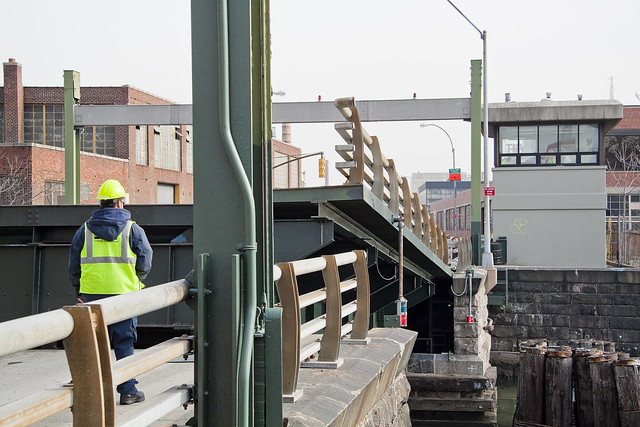
Hunters Point Avenue Bridge is due north west of Borden Avenue Bridge and the LIE truss. It’s a single bascule drawbridge, owned by the NYC DOT. Replacing an earlier wooden draw bridge that was opened and closed by a donkey walking on a wheel, the Hunters Point Avenue Bridge was built in 1910. Back then, it was a double bascule bridge, but a rebuild in the 1980’s simplified the mechanism to a single bascule. The masonry of the bridge is original to the 1910 design.

– photo by Mitch Waxman
The Greenpoint Avenue Bridge is found some 1.37 miles from Newtown Creek’s intersection with the East River, and roughly a half mile from the mouth of Dutch Kills. It’s a double bascule bridge, built in 1987, and owned and operated by the NYC DOT. There have been many Greenpoint Avenue Bridges, dating back to the first one built by Greenpoint’s town father Neziah Bliss back in 1850, but that one was called the “Blissville Bridge.” The Greenpoint Avenue Bridge is a traffic machine, carrying 28.3 thousand vehicle trips a day, or about ten million a year. Most of that traffic takes the form of heavy trucking.

– photo by Mitch Waxman
The brand new Kosciuszko Bridge(s) replaced a 1939 vintage truss bridge that carried the Brooklyn Queens Expressway over Newtown Creek and are found some 2.1 miles from the East River. The NYS DOT is busy putting the finishing touches on the new cable stay bridge’s construction. In addition to the… ahem… high speed traffic lanes of the BQE, there is also a pedestrian and bicycle pathway found on the new Kosciuszko Bridge which connects 43rd street in Queens’s Sunnyside section with Meeker Avenue in Brooklyn’s Greenpoint.

– photo by Mitch Waxman
The Grand Street Bridge is a swing bridge connecting Maspeth’s Grand Avenue in Queens with East Williamsburg/Bushwick’s Grand Street in Brooklyn. 3.1 miles back from the East River, in a section of Newtown Creek once called “White’s Dock,” the NYC DOT have recently announced plans to replace this 1909 beauty – which is actually the third bridge to occupy this spot. Damage from Hurricane Sandy, and the narrow roadways with height restrictions that the bridge offers, have pretty much sealed its fate. It will be missed.
This is where the main spur of Newtown Creek ends, as a note. Directly east is a truncated tributary called the East Branch, and another tributary called English Kills makes a hard turn to the south just before you encounter Grand Street Bridge.

– photo by Mitch Waxman
Metropolitan Avenue Bridge is a double bascule drawbridge that crosses the English Kills tributary of Newtown Creek, and is owned by the NYC DOT. Metropolitan Avenue was originally built as a private toll road in 1813, and the first bridge here was a part of the “Williamsburg and Jamaica Turnpike.” The current Metropolitan Avenue Bridge was built in 1931, although it has received significant alterations in 1976, 1992, 2006, and again in 2015. The 2015 alterations?
You guessed it, Hurricane Sandy strikes again.

– photo by Mitch Waxman
Montrose Avenue Rail Bridge is the final crossing found over the waters of Newtown Creek and its tributaries. Some 3.7 miles back from the East River, it’s the property of the Long Island Railroad and used for freight service on their Bushwick Branch tracks. A truss bridge, or trestle if you must, my understanding of things are that whereas the trackway and parts of the rail bridge date back to approximately 1924… there has been quite a lot of work done on the thing which I have not been able to fully document so rather than fill in blanks with assumptions – I’m just going to say that I don’t know everything… yet.
It’s an active track, it should be mentioned.
“follow” me on Twitter- @newtownpentacle
Buy a book!
“In the Shadows at Newtown Creek,” an 88 page softcover 8.5×11 magazine format photo book by Mitch Waxman, is now on sale at blurb.com for $30.
pressure laminated
Great lengths are needed for solitude.

– photo by Mitch Waxman
The thing about NYC is that you’re never actually alone. There’s always someone else within a couple hundred of feet of you, even if you don’t know they’re there. Driving by, lurking in a drain, nesting on a sofa, or standing naked on some rooftop – this place is positively infested with humans and it’s virtually impossible to find a spot where you’re truly alone. I’ve always opined that what this City really needs is a good plague. Given recent experience with the healthcare system here in the Borough of Queens, this plague’s Ground Zero will likely be the corner of Crescent Street and 31st avenue here in Astoria.
I would flee to one of my bolt holes around Newtown Creek in the event of a pandemic breaking out, where I will wait out the first phases of you all going zombie, or road warrior, or whatever dystopian endgame you find yourself in during the “die off.”

– photo by Mitch Waxman
My goal will be to make it to a certain spot where water based transportation can be easily gained, and then sail westwards across the East River and Hudson and subsequently south towards the Kill Van Kull and then Arthur Kill. From there, I’ll tack my way down the coast of New Jersey. Net fishing and rainwater collection will have to be done, but my goal would be to achieve continental landfall in Southern New Jersey and then head west along the Pennsylvania Turnpike towards Pittsburgh. From there, I’ll improvise, but will be heading in a generally southwest direction seeking more temperate climes.
Wherever I end up stopping my journey, I’m going to set up an end times cult with me and Our Lady of the Pentacle as the cult leaders. That way, as I grow older, I’ll have acolytes lined up to wipe my butt and do laundry or shopping. Once the cult grows in size and strength, we will return to a depopulated NYC, and set up the faith at the now abandoned New St. Patrick’s Cathedral. I’ll move back into my old apartment in Astoria, but nobody else will be allowed to live in Queens, by my holy edict. The Bronx will be returned to farmland. The border with Brooklyn will be fortified.

– photo by Mitch Waxman
I’m ready to throw down the fiery gospel anytime. I’ve spent a lot of time studying the oratory techniques of Reverend Creflo Dollar, Andrew Cuomo, and others. Devotions will involve fun stuff that we all enjoy, which will be a major lure for the small post apocalypse crowd. None of that Walking Dead stuff will happen, I promise. The Esoteric Order of Waxman will be egalitarian, welcoming to all, and won’t insist on the ritual mutilation of infant genitalia for either sex. Also, there’ll be some kind of pie.
Now, that’s what I would call a progressive end time cult, lords and ladies. Thing is, even during the apocalypse you really can’t be alone. There’ll be all sort of monsters out there roaming around, and the only one who will be able to keep you safe from the giant armored dragonflies and lion headed horses will be an old man in a filthy black raincoat, or so the legend will opine.
“follow” me on Twitter- @newtownpentacle
TONIGHT, come to the library!
In the Shadows at Newtown Creek – The Roosevelt Island Historic Society has invited me to present a slideshow and talk about my beloved Newtown Creek at the New York Public Library on Roosevelt Island, on November 14th, 6 p.m. Free event!
Click here for more information.!
Buy a book!
“In the Shadows at Newtown Creek,” an 88 page softcover 8.5×11 magazine format photo book by Mitch Waxman, is now on sale at blurb.com for $30.
chipped flagstones
May showers bring June flowers?

– photo by Mitch Waxman
Bother. Last week, the closest I got to photographing any part of Newtown Creek – due to the daily thunderstorms – was the sort of view you see above, which is to say that I was looking at it through the closed window of a car. I had a relatively light schedule last week, but as opined – god hates me – so any chance I had to find time to go out shooting was abrogated by meteorological instability. I’m not sure of the exact numbers, but an unimaginable amount of liquid cascaded down over the City of Greater New York.
NYC possesses what’s known as a “combined sewer system” wherein sanitary sewers (toilet water and other lovely effluents) and storm sewers (street runoff and so on) feed into the same pipe. During dry weather this isn’t an issue, as the NYC DEP’s 14 sewer plants can usually handle the flow. During rain events, a quarter inch of rain, city wide, can add a billion gallons of water into the mix. The DEP is then obliged to release the untreated sewage overflow into area waterways, a practice they’re working hard on avoiding, via “CSO’s” or Combined Sewer Outfalls.

– photo by Mitch Waxman
There’s four hundred of these “CSO’s” operated by DEP in NY Harbor, and there’s even more of them on the New Jersey side of the Hudson. As you move into other counties in Upstate New York and on Long Island, even more release points are found. Last time I checked, there were twenty two CSO points found along the bulkheads of Newtown Creek. Pictured above is Dutch Kills, a tributary of Newtown Creek in Long Island City, from last Sunday afternoon shortly before yet another thunderstorm rolled through. The water was a chocolate/coffee brown color this time around, and there were literal tons of floatables – a term used for the garbage and street litter which has been hydraulically swept into the sewer system – moving around on the surface of Dutch Kills in the wind.
To the west, another thunderstorm was building, and the wind was picking up.

– photo by Mitch Waxman
“Give a hoot, don’t pollute” is what Woodsy the Owl used to advise every school kid in the 1970’s, alongside Smokey the Bear reminding us not to start forest fires. Societal priorities shifted towards smoking cessation, avoiding teenager pregnancies, and HIV prevention more recently. We stopped “promoting shame” regarding littering in the 1990’s, as I recall. The City of New York’s streets are dirtier with clutter and unswept garbage than at other point in my lifetime except for the late 1970’s and early 1980’s budget crisis era when cuts to municipal spending reduced the ranks of DSNY personnel. Don’t read that wrong, incidentally, the DSNY is doing its job quite well. The problem is “us.” There’s several generations of native born and immigrant Americans alike who don’t see any particular reason not to just toss their garbage in the street.
I’m pricing out one of those “Game of Thrones” style shame bells. I plan to walk around Queens ringing the thing and proclaiming “SHAME” whenever I see someone toss a plastic bottle at the curb. I know where it’s going to end up, after all. Check out that plastic bag life raft for other plastics floating in the water of Dutch Kills above. Yuck, ya buncha slobs.
Upcoming Tours and Events
June 15th – Exploring the East River,
From General Slocum Disaster to Abandoned Islands – with NY Adventure Club.
June 15th is one of those days in NYC history. In 1904, more than a thousand people boarded a boat in lower Manhattan, heading for a church picnic on Long Island — only 321 of them would return. This is the story of the General Slocum disaster, and how New York Harbor, the ferry industry, and a community were forever altered.
Join New York Adventure Club for a two-part aquatic adventure as we explore the General Slocum disaster, and historic sights and stories along the East River, all by NYC Ferry.
Tickets and more details here.
“follow” me on Twitter- @newtownpentacle
Buy a book!
“In the Shadows at Newtown Creek,” an 88 page softcover 8.5×11 magazine format photo book by Mitch Waxman, is now on sale at blurb.com for $30.
who wouldst
Happy Memorial Day, y’all.

– photo by Mitch Waxman
Spotted these stout iron doors and old timey giant padlock here in Astoria one recent evening on my way home from a thing. The thing in question was a Community Board meeting revolving around noise and “quality of life” complaints leveled against a couple of bars on my side of the neighborhood so although I’m not officially a member of that particular committee I showed up to see what’s what and learn how that particular process works. Turns out that like everything else governmental, it’s fairly pedantic and there’s a well worn procedural pathway from “A” to “B.”
Another well worn pathway, one that I scuttle along, is where I encountered this lock and iron door combo, which seemed newly installed.

– photo by Mitch Waxman
Another night, another meeting, this time in Greenpoint for some Newtown Creek business. My path home found me dragging the carcass down Norman Avenue, where this grocery store’s outdoor shelving caught my eye.
The meeting in question offered an analysis of all the sites along the Queens side of the Newtown Creek (and a few in Brooklyn) that are currently under the administration of the NYS DEC. Luckily, my calendar for the coming week is fairly open for serendipity and doing things that I actually want to do. What that means is that the weather will likely be unpredictable, since God hates me.

– photo by Mitch Waxman
Yet another occasion which I was obliged to attend recently found one marching through the still industrial side of Long Island City, and along the bulkheads of the Dutch Kills tributary of the fabulous Newtown Creek – where this shot was recorded.
Back tomorrow with more things I’ve seen in places I’ve gone.
“follow” me on Twitter- @newtownpentacle
Buy a book!
“In the Shadows at Newtown Creek,” an 88 page softcover 8.5×11 magazine format photo book by Mitch Waxman, is now on sale at blurb.com for $30.


 The Newtown Pentacle