Archive for the ‘Maspeth’ Category
proper turns
– photo by Mitch Waxman
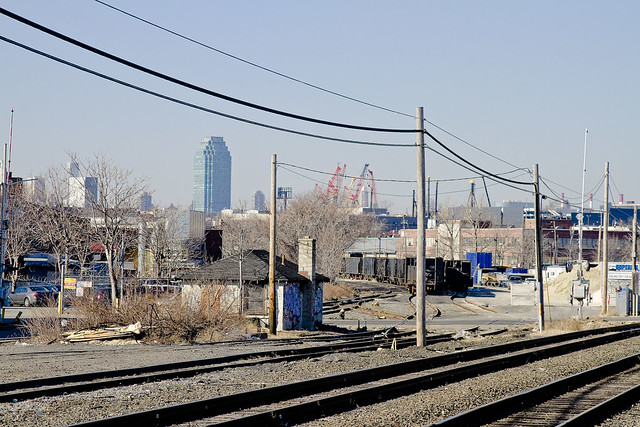
Once upon a time, this wasn’t the proverbial “wrong side of the tracks”, rather this was the center of town. 18th century residents would ask “what on earth could have happened to Maspeth Creek” were they able, and “where is the Town Dock which DeWitt Clinton himself used- where is it”?
What happened?

– photo by Mitch Waxman
19th Century residents and passerby would inquire what disaster occurred, that Haberman’s and Nichols Chemical and all of Berlin and Blissville have disappeared and been forgotten? What has happened to the great factories, the mills, and the hustle and bustle? Where have all the railroads gone, can one paltry freight line actually be charged with servicing all of Newtown Creek?

– photo by Mitch Waxman
For your humble narrator, a good place to ponder this sort of question has always been the Clinton Diner.
This little oasis has hosted a full group from a bus tour I helped conduct, acts a central meeting point for all sorts of Newtown Creek functions, and has provided a much needed cup of coffee and clean rest room to a half frozen yet quite humble narrator on more than one occasion.
It’s also sitting pretty much on a shoreline that Maspeth Creek once flowed past.

– photo by Mitch Waxman
Accordingly, a “Happy Valentine’s” day shout out to the Clinton Diner is offered today.
It would be meaningless to offer you shots of its interior as it has been featured more than once in the cinema. Witness below the trademark dolly shot of Martin Scorcese in Goodfellas… The window booth that DeNiro and Liotta are sitting in is the one with the “Go Giants” signage in the shot above.
And a happy valentine’s day greeting is offered to you as well, lords and ladies… or a giddy Lupercalia.
The Clinton Diner is found at 5626 Maspeth Ave., Maspeth, NY 11378-2248 (718) 894-3475
traitorous somnolence

– photo by Mitch Waxman
On one of the lonely transmigrations which your humble narrator famously engages in, actually vast pedestrian journeys across the concrete desolations of Western Queens, the walk up 58th street- the former Betts Avenue of colonial era Newtown- might be the loneliest of all. Rimmed by polyandrions of gargantuan acreage, this street hosts no sidewalk to speak of and one must pick ones way in the manner of some roadside mendicant. It is a valley whose cliffs are the masonry walls and iron gates of cemeteries.
This neighborhood is neither Woodside nor Maspeth, it is the angle found between them.
A personal preference is marked for the Eastern side of the street, which follows the stout iron of Mt. Zion’s fences.

– photo by Mitch Waxman
The former home of the so called Maspeth Gypsies, a tribe of Romani whose expulsion by Police in the early 20th century is spoken of in hushed whispers by the Centenarians of ancient Maspeth, Mt. Zion is a cemetery set aside for adherents of the Hebrew faith. It is located across the street from the vastness of 3rd Calvary, a Catholic cemetery. Mt. Zion seems crowded, due to the Hebraic tradition of installing a single occupant in a grave, unlike the Roman Catholic institution across the street.
Its residents, at least in this section of the cemetery, are long gone- most of the stones speak to their passing away in a time period long before even rumors of a Second World War became extant in the community.

– photo by Mitch Waxman
Peeking through the rotting iron of the fences while trudging along the other day, your humble narrator noticed this small offering hidden away between the cast iron palisade and the first row of graves (or last, were you within the parcel).
Similarities to other instances of peasant magick at St. Michael’s Cemetery in Astoria which have been detailed in prior Newtown Pentacle postings should be remarked upon.

– photo by Mitch Waxman
Probably “Afro-Cuban” in origin, the possible etymology of this odd tableau is betrayed by the presence of the Cigar. Tobacco plays a large ritual role in the so called syncretic faiths of Latin and Caribbean religions, and the manufactured item is often used as an offering to the Orisha or Loa- as a symbol of sacrificial wealth or as an embodiment of the virility or power of the magick worker.
Of course, sometimes a cigar is just a cigar, as the oft quoted (and incorrectly attributed) Freudian saying goes.

– photo by Mitch Waxman
The aluminum pan leaning against the monument contained a burnt offering of some kind, which appeared to be a textile wrapped around something occluded from view, and mingled with a piece of thin wood or perhaps the shell of a coconut which has been cut into some sort of odd shape.

– photo by Mitch Waxman
A closer shot of the arrangement. It would appear that some sort of accelerant was used to accomplish the combustion, something that would have burned off quickly like liquor. The fabric seems charred or singed more than immolated, as if the flames were extinguished quickly.
Of course, your humble narrator is no fire inspector nor arson investigation expert (or an authority on afro-cuban syncretic religious practices for that matter), so these callow observations should be considered mere speculation.

– photo by Mitch Waxman
This is not the first time which arcane leave behinds have been personally observed along this wall, which you’ll notice is constructed out of tombstones. A photo has been run here of a hand carved mortar and pestle which contained an odd ashy substance. The image dates back several years which implies that acolytes and devotees of whatever these forces which are being invoked here, in the heart of the Cemetery Belt, have been at work for a very long time.
One wonders, and more than wonders- could the so called Maspeth Gypsies tell us a thing or two about these legend haunted lowlands found at this angle between Woodside and Maspeth?
Magic Lantern Show in Ridgewood

Your humble narrator will be narrating humbly on Friday, February 24th at 7:30 P.M. for the “Ridgewood Democratic Club, 60-70 Putnam Avenue, Ridgewood, NY 11385” as the “Newtown Creek Magic Lantern Show” is presented to their esteemed group. The club hosts a public meeting, with guests and neighbors welcome, and say that refreshments will be served.
The “Magic Lantern Show” is actually a slideshow, packed with informative text and graphics, wherein we approach and explore the entire Newtown Creek. Every tributary, bridge, and significant spot are examined and illustrated with photography. This virtual tour will be augmented by personal observation and recollection by yours truly, with a question and answer period following.
For those of you who might have seen it last year, the presentation has been streamlined, augmented with new views, and updated with some of the emerging stories about Newtown Creek which have been exclusively reported on at this- your Newtown Pentacle.
For more information, please contact me here.
audient void

– photo by Mitch Waxman
Much is made of the various pollution vectors which we lucky few are exposed to daily, here in the Newtown Pentacle. The air is heavy with ash and soot, hopelessly mingled with sewer effluent and automotive exhaust, and smells a little “odd”. The water is ruined, as is the soil itself, and there’s that whole “Creek thing”. What I’ve been thinking about a lot lately, however, is something a bit less tangible.
It’s the noise.
from wikipedia
Noise pollution is excessive, displeasing human, animal or machine-created environmental noise that disrupts the activity or balance of human or animal life. The word noise comes from the Latin word nauseas, meaning seasickness.
The source of most outdoor noise worldwide is mainly construction and transportation systems, including motor vehicle noise, aircraft noise and rail noise. Poor urban planning may give rise to noise pollution, since side-by-side industrial and residential buildings can result in noise pollution in the residential area.

– photo by Mitch Waxman
These photos are from the heart of industrial Maspeth- a bleak moonscape of rail siding, oil streaked truck routes, and a maelstrom of construction and demolition- and illustrate prime and obvious offenders. Their usage is a bit disingenuous, because the kind of aural pollution which I’m wondering about is the “hum”.
Not some paranoid’s imagined perception of radio waves, that’s a Taos thing– but simply the aggregate melody of millions of engines, electrical transformers, air conditioners, tires on pavement, etc.
from wikipedia
Environmental noise regulations usually specify a maximum outdoor noise level of 60 to 65 dB(A), while occupational safety organizations recommend that the maximum exposure to noise is 40 hours per week at 85 to 90 dB(A). For every additional 3 dB(A), the maximum exposure time is reduced by a factor 2, e.g. 20 hours per week at 88 dB(A). Sometimes, a factor of two per additional 5 dB(A) is used. However, these occupational regulations are acknowledged by the health literature as inadequate to protect against hearing loss and other health effects.
With regard to indoor noise pollution in residences, the U.S. EPA has not set any restrictions on limits to the level of noise. Rather, it has provided a list of recommended levels in its Model Community Noise Control Ordinance, which was published in 1975. For instance, the recommended noise level for indoor residences is less than or equal to 45 dB. Noise pollution control in residences is not funded by the federal government in part because of the disagreements in establishing causal links between sounds and health risks, since the effect of noise is often psychological and also because it leaves no singular tangible trace of damage on the human body. For instance, hearing loss could be attributed to a variety of factors including age, rather than solely due to excessive exposure to noise. However, a state or local government is able to regulate indoor residential noise, such as when excessive noise from within a home causes disturbances to nearby residences.

– photo by Mitch Waxman
A noticeable silence hung heavily around Astoria this past holiday weekend, and much to the delight of second story men, two thirds of the neighborhood disappeared for holiday excursions. For around two days, it was actually fairly quiet. It was January 2nd, at least, before the honking and constant vibrato of traffic resumed it’s omnipresence.
One wonders what the effect is, biologically, of living in such a saturation of sound.
One also wonders what sounds- what music of the spheres- may lie just beyond the dross auditory senses of men…
from wikipedia
The human auditory system is sensitive to frequencies from about 20 Hz to a maximum of around 20,000 Hz, although the upper hearing limit decreases with age. Within this range, the human ear is most sensitive between 2 and 5 kHz, largely due to the resonance of the ear canal and the transfer function of the ossicles of the middle ear.
Equal-loudness contours were first measured by Fletcher and Munson using headphones (1933). In their study, listeners were presented with pure tones at various frequencies and over 10 dB increments in stimulus intensity. For each frequency and intensity, the listener was also presented with a reference tone at 1000 Hz. The reference tone was adjusted until it was perceived to be of the same loudness as the test tone. Loudness, being a psychological quantity, is difficult to measure, so Fletcher and Munson averaged their results over many test subjects to derive reasonable averages. The lowest equal-loudness contour represents the quietest audible tone and is also known as the absolute threshold of hearing.
The highest contour is the threshold of pain.
warnings and prophecies
2011’s Greatest Hits:

– photo by Mitch Waxman
In January of 2011, while walking along in knee deep snow, your humble narrator happened across this enigmatic and somehow familiar item sitting in a drift at the NYC S.E.M./Signals Street Light Yard of the DOT at 37th avenue near the Sunnyside and Astoria border. It looked familiar to me, but I didn’t recognize it for what it was until sharp eyed reader TJ Connick suggested that this might be the long missing Light Stanchion which once adorned the Queensboro Bridge’s Manhattan landing.
These two posts: “an odd impulse“, and “wisdom of crowds” discuss the discovery and identification in some detail.
Some good news about this iconic piece of Queens history will be forthcoming, but I’ve been asked to keep it quiet for the moment.

– photo by Mitch Waxman
In February of 2011, “Vapour Soaked” presented a startling concurrence of comparitive detail for the discerning viewer, when the shot above was presented in contrast with a 1920’s shot from The Newtown Creek industrial district of New York City By Merchants’ Association of New York. Industrial Bureau, 1921″, (courtesy Google Books).
Admittedly, not quite as earth shaking as January’s news, but cool nevertheless. I really like these “now and then” shots, expect more of the same to come your way in the future.

– photo by Mitch Waxman
In March of 2011, “first, Calvary” discussed the epic (for me) quest to find a proverbial “needle in a haystack” within First Calvary Cemetery- the grave of its very first interment, an Irish woman named Esther Ennis who died in 1848. I have spent an enormous amount of time searching for this spot, where Dagger John Hughes first consecrated the soil of Newtown.

– photo by Mitch Waxman
In April of 2011, the world lost one of its best people and my official “partner in crime”, Bernard Ente.
He was ill for awhile, but asked me to keep the severity of things quiet. He passed in the beginning of April, and one of the last requests he made of me (along with “taking care” of certain people) was to continue what he had started along the Newtown Creek and all around NY Harbor.
This was when I had to step forward, up my game, and attempt to fill a pair of gargantuan boots. Frankly, I’m not even half of who he was, but I’m trying. That’s when I officially stepped forward and began introducing myself as a representative of Newtown Creek Alliance, and joined the Working Harbor Committee– two organizations which Bernie was committed to. I’m still trying to wrap my head around his loss.

– photo by Mitch Waxman
In May of 2011, while attempting to come to terms with my new roles in both organizations, it was decided that a fitting tribute to our fallen comrade would be the continuance of his annual “Newtown Creek Cruises” and the date of May 21 was set for the event. An incredible learning experience, the success of the voyage would not have been possible without the tutelage of WHC’s John Doswell and Meg Black, NCA’s Katie Schmid, or especially the aid of “Our Lady of the Pentacle” and the Newtown Pentacle’s stalwart far eastern correspondent: Armstrong.
Funny moments from during this period included the question “Whom do you call to get a drawbridge in NYC to open for you?”.
During this time, I also became involved with Forgotten-NY’s Kevin Walsh and Greater Astoria Historical Society’s Richard Melnick and their ambitious schedule of historical tours.

– photo by Mitch Waxman
In June of 2011, the earliest Newtown Creek Chemical Factory which I’ve been able to find in the historical record, so far, was explored in the post “lined with sorrow“- describing “the Bushwick Chemical Works of M. Kalbfleisch & Sons”.
Additionally, my “Newtown Creek Magic Lantern Show” was presented to a sold out and standing room only crowd at the Greater Astoria Historical Society.
This was also the beginning of a period which has persisted all year- in which my efforts of behalf of the various organizations and political causes which I’m advocating for had reduced my output to a mere 15 or fewer postings a month.
All attempts are underway to remedy this situation in 2012, and apologies are offered.

– photo by Mitch Waxman
In July of 2011, another Newtown Creek boat tour was conducted, this time for the Metropolitan Water Alliance’s “City of Water Day”. The “Newtown Creek Magic Lantern Show” was also performed at the Admiral’s House for a packed room.
Additionally, my so called “Grand Walk” was presented in six postings. This was an attempt to follow a 19th century journey from the Bloody Sixth Ward, Manhattan’s notorious Five Points District, to Calvary Cemetery in Queens. Once, this would have been a straightforward endeavor involving minimal connections of Trolley and Ferry, but today one just has to walk. These were certainly not terribly popular posts, but are noteworthy for the hidden and occluded horde of forgotten New York history which they carry.
From the last of these posts, titled “suitable apparatus“- “As the redolent cargo of my camera card revealed- this “Grand Walk”, a panic induced marathon which carried your humble narrator across the East River from St. Patrick’s Old Cathedral in Manhattan into Williamsburg and up Grand Street to Maspeth and the baroque intrigues of the Newtown Creek– wound down into it’s final steps on Laurel Hill Blvd.”

– photo by Mitch Waxman
In August of 2011, “the dark moor” presented intriguing aerial views of the Newtown Creek Watershed, and “sinister exultation” shared the incredible sight of an Amtrak train on fire at the Hunters Point Avenue station in Long Island City. “revel and chaff” explored the aftermath of Hurricane Irene in LIC’s Zone A, and an extraordinary small boat journey around Dutch Kills was detailed in: “ponderous and forbidding“, “ethereal character“, “pillars and niches“, and “another aperture“.
This was an incredible month.

– photo by Mitch Waxman
In September of 2011, a posting called “uncommented masonry” offered this declaration:
” By 1915, there approximately 40,000 automotive trucks plying the streets of New York City.
What’s surprising is that 25% of them were electric.
Lords and ladies of Newtown, I present to you the last mortal remains of the General Electric Vehicle Company, 30-28 Starr Avenue, Long Island City– manufacturer of a substantial number of those electrical trucks.”
I’m particularly fond of this post, as this was a wholly forgotten moment of Newtown Creek and industrial history which I was able to reveal. Organically born, it was discovered in the course of other research, and I believed at the time that it was going to be the biggest story that I would present all year about Blissville.

– photo by Mitch Waxman
In October of 2011, a trio of Newtown Creek Tours (two public and one for educators) were accomplished. The public tours were full to capacity, as were the Open House New York tours I conducted on the 15th and 16th of that Month. Also, the Metropolitan Water Alliance invited me to photograph their “Parade of Boats” on October 11th, and I got the shot below of the FDNY Fireboat 343.

– photo by Mitch Waxman

– photo by Mitch Waxman
In November of 2011, a visit to Lovecraft Country in Brooklyn was described in “frightful pull“, and “vague stones and symbols” came pretty close to answering certain mysteries associated with the sky flung Miller Building found at the foot of the Greenpoint Avenue Bridge in Brooklyn.

– photo by Mitch Waxman
A December 2011 post titled “An Oil spill… in Queens” broke the news that petroleum products are seeping out of the bulkheads of Newtown Creek, this time along the Northern shoreline, which lies in the Queens neighborhood of Blissville.
Rest assured that your Newtown Pentacle is on top of the story of “the Blissville Oil Spill”, lords and ladies of Newtown, and will bring you breaking news as it develops in 2012.


 The Newtown Pentacle